
You've found the UTV you want, checked the monthly payment, and started imagining where you'll ride it. Then the dealer reviews your credit and the conversation changes. A low score, past late payments, limited credit history, or a recent bankruptcy can make approval feel uncertain, especially when the first offer carries a rate that makes the vehicle far more expensive than expected.
UTV financing for bad credit isn't automatically a yes-or-no decision. Lenders are pricing risk. They're asking how likely you are to repay, how much of the vehicle's value they'll finance, whether your income supports the payment, and what protection they have if the loan defaults. A weaker credit profile usually means a higher price for that risk, but another part of the deal, such as a larger down payment, stronger documentation, a co-signer, or a different lender, can change the result.
This guide walks through that process in practical terms. You'll learn how lenders interpret credit tiers, where borrowers with challenged credit can look, how rates and loan terms affect the total cost, and which application details can improve your position before you apply. You'll also see why the lowest monthly payment isn't always the most affordable offer.
The goal isn't to encourage you to borrow at any cost. It's to help you compare financing and decide whether the payment fits your budget. A lender's approval may solve the immediate purchase problem, but the right structure should also leave room for insurance, maintenance, registration, fuel or charging, and the rest of your household obligations.
Table of Contents
- Introduction: Why Bad Credit Does Not Have to Stop Your UTV Purchase
- How UTV Financing Works When Your Credit Is Low
- Where to Find UTV Financing With Bad Credit
- What Rates Terms and Total Costs to Expect With Poor Credit
- How to Strengthen Your Application Before You Apply
- Dealer Strategies Co Signers and Secured Options That Improve Approval
- Your Next Steps to Secure UTV Financing With Bad Credit
Introduction: Why Bad Credit Does Not Have to Stop Your UTV Purchase
You arrive at the finance desk with a low score and one immediate concern: “Will anyone approve me?” Approval matters, but UTV financing works more like risk pricing than a simple yes-or-no gate. The lender weighs how much risk the application presents, then prices or structures the loan around that risk.
That gives you several levers. A larger down payment reduces the amount borrowed and the lender's exposure. A shorter term can reduce total interest, although it usually raises the monthly payment. A lender that works with challenged credit may consider limited history or an earlier bankruptcy differently from a prime lender. Stable income, complete records, a co-signer, or the UTV's value can also affect the decision.
A current program lists a minimum FICO score of 550, accepts buyers with little to no credit history, and offers prequalification without a credit impact, according to the lender's UTV financing program. That threshold is not a promise of approval. It shows that some lenders assess the full application instead of treating a lower score as an automatic stop.
The practical mindset: A low score changes the loan's price and structure. It does not always end the purchase.
Cost still deserves careful attention. Promotional APRs may be as low as 0% to 4.99% for borrowers with FICO scores of 750 or higher, while applicants below 620 may face 18% or more, or denial, depending on the lender and application. Approval at the lower end may call for a 10% minimum down payment, ideally 20%. Treat those published bands as comparison points, not a quote for your UTV.
Before applying, review your credit reports, set a payment limit, and gather income records. Compare prequalification offers when available, then choose a lender type and loan structure that leave room for insurance, maintenance, registration, fuel or charging, and household bills.
How UTV Financing Works When Your Credit Is Low
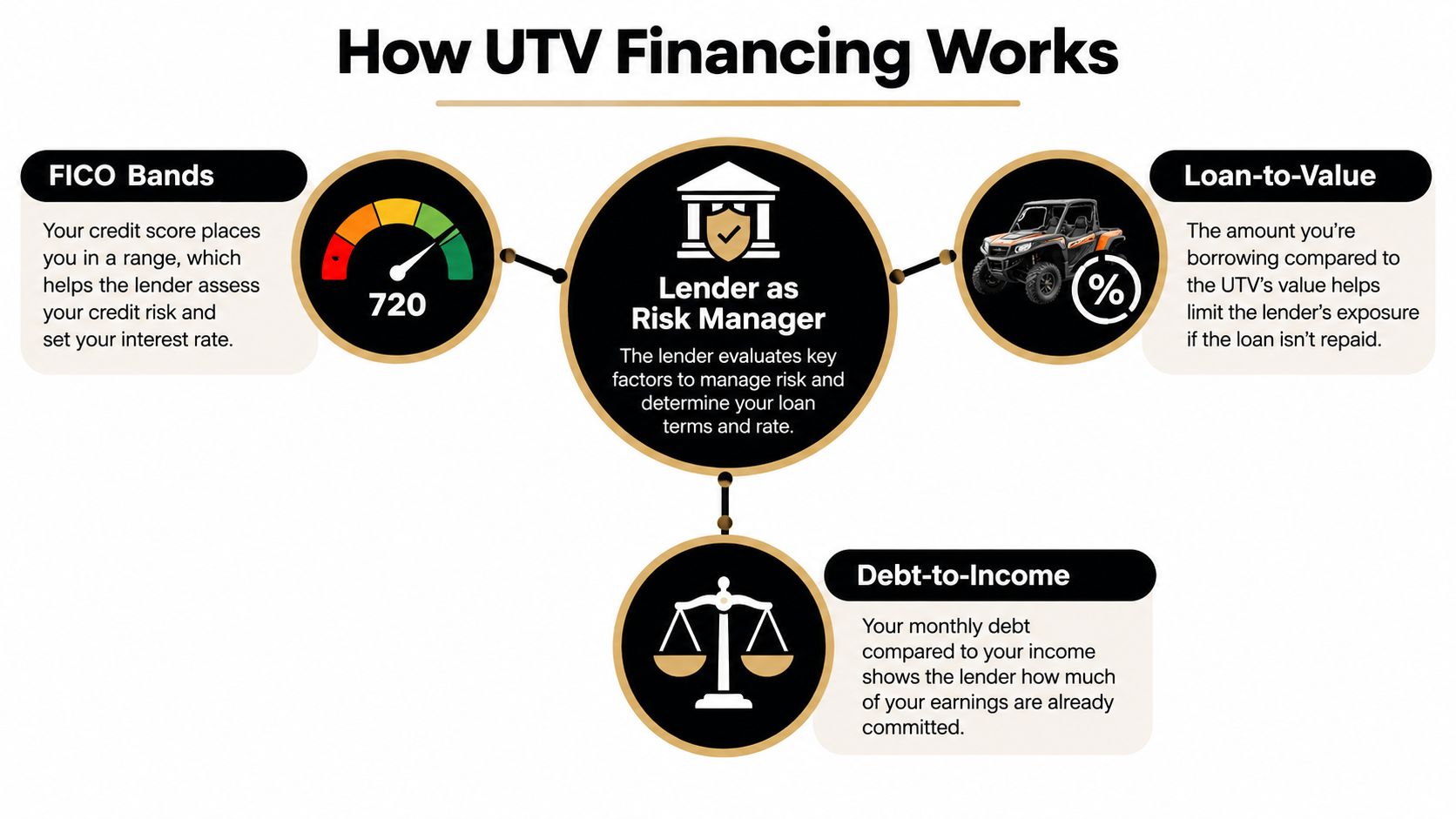
A lender does not treat your credit score as a complete financial biography. It is one signal in a broader risk assessment. The lender also reviews your payment history, current income, existing debts, down payment, and the UTV's value to judge whether the requested loan fits your finances.
Think of the lender as a risk manager. Your credit history helps estimate repayment risk. Your income shows whether the payment is manageable. Your loan-to-value ratio, or LTV, compares the loan with the UTV's value. Your debt-to-income ratio, or DTI, shows how much of your gross income already goes toward debt. The UTV itself provides collateral the lender may recover if you stop paying.
Approval thresholds and pricing thresholds
These terms describe different decisions.
An approval threshold is the point at which a lender may consider your application. A pricing threshold is the point at which it may offer more favorable terms. A borrower can qualify below a lender's preferred score while receiving a higher rate, a larger down payment requirement, more documentation requests, or a smaller loan amount.
A practical historical marker in UTV and broader powersports lending is about 620 FICO, which is commonly treated as a minimum threshold. Below that level, borrowers are often placed in subprime pricing or declined. Other programs may consider applicants around 550 FICO, including some buyers with no established credit history or a prior bankruptcy. Better terms may begin closer to 660 or higher. These markers help you decide where to apply, but they do not show whether the final payment will fit your budget.
Why the vehicle matters
A UTV is usually evaluated as a powersports or recreational vehicle loan rather than an ordinary household purchase. The lender reviews the model, age, condition, marketability, requested loan amount, and collateral value. A newer vehicle with an established resale market may be easier to approve than an unusual used unit with uncertain value.
The loan structure changes the risk calculation too. A larger down payment reduces the amount financed and lowers the LTV, which can improve approval odds and reduce total interest. A longer term may lower the monthly payment, but interest has more time to accumulate. The lender type also matters, because a specialty powersports lender may assess the collateral differently from a general consumer lender.
Existing obligations remain part of the decision. Rent, an auto loan, credit cards, and other debts can leave less room for a UTV payment, even if your score meets the minimum. If a current vehicle payment is creating pressure, reviewing options such as how to get rid of a car payment can clarify your monthly obligations before you add another loan.
Where to Find UTV Financing With Bad Credit
The lender type can matter as much as the score. A dealership may submit an application to several funding sources, while a bank or credit union may apply a narrower policy. Specialty lenders often understand powersports collateral better than a general consumer lender, but that flexibility can come with higher pricing.
| Lender Type | Best For | Approval Flexibility | Watch Out For |
|---|---|---|---|
| Captive dealer financing | Buyers purchasing an eligible new model | May offer promotional programs for stronger profiles | Promotional offers may exclude challenged credit |
| Specialty powersports lender | Buyers with lower scores, thin files, or prior credit problems | Often more familiar with UTV collateral and nonprime applications | Higher APR, larger down payment, and more documentation |
| Credit union | Members with established relationships and stable income | May review the full relationship rather than relying only on a score | Membership rules, stricter underwriting, or limited UTV programs |
| Online subprime marketplace | Applicants who want to compare several possible lenders | Can connect a broader range of credit profiles | Read privacy terms, fees, and whether the inquiry is soft or hard |
| Buy-here-pay-here style seller | Buyers declined by conventional lenders | May focus more on income and immediate repayment ability | Cost, vehicle selection, contract terms, and repossession risk require close review |
Match the lender to the problem
A thin file isn't the same as a history of missed payments. A prior bankruptcy isn't the same as unstable income. Tell the lender which issue needs context and provide documents that address it.
For limited credit history, start with a lender that explicitly considers first-time or thin-file borrowers. For nontraditional income, prepare bank statements, tax records, contracts, or other acceptable proof before applying. For a past bankruptcy, ask whether the lender has a seasoning requirement and whether the discharge or repayment status changes eligibility.
If negative information is inaccurate, review your reports before seeking a loan. A resource such as the Superior Credit Repair LVNV guide can help you understand how certain collection accounts and creditor records may affect a credit file. It isn't a substitute for checking the reports yourself, and you shouldn't dispute accurate information because it hurts your score.
Vehicle choice also affects the application. If you're comparing electric side-by-sides, review the differences in electric side-by-side UTVs before requesting financing. A clear purchase target helps you avoid applying for a loan amount that changes later.
Apply selectively. Start with a lender or marketplace that offers soft-pull prequalification, then move to a formal application only after reviewing the estimated terms.
What Rates Terms and Total Costs to Expect With Poor Credit
Approval alone does not make a UTV loan affordable. A lender may approve the purchase while the interest rate, term, and fees create a much higher total cost than the monthly payment suggests. Treat bad-credit financing as risk pricing: each part of the application can shift the lender's decision and the amount you repay.
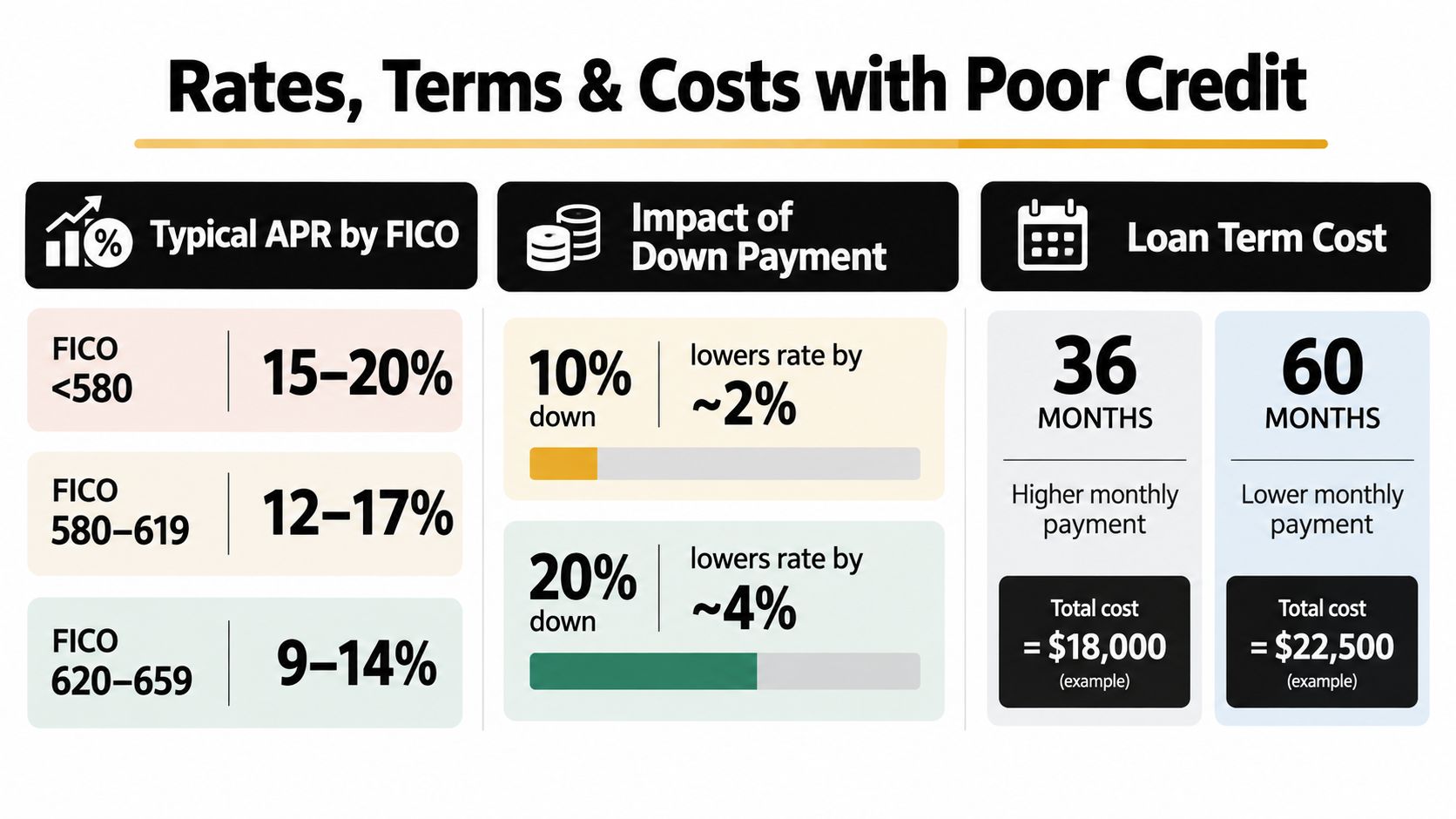
Published UTV financing bands show how sharply pricing can change across credit tiers. The cited 2026 guide lists 750 and above at 0% to 4.99%, 700 to 749 at 4.99% to 7.99%, 650 to 699 at 7.99% to 12.99%, 620 to 649 at 12.99% to 17.99%, and below 620 at 18% or more or possible denial. You can review those ranges in the published powersports financing guide. These bands are reference points, not promises. Income, existing debt, vehicle value, loan term, and down payment can move an offer higher or lower.
Why down payment changes the calculation
A down payment lowers the amount financed and the loan-to-value ratio. The lender starts with more equity protecting the loan, which may improve approval odds or reduce the amount at risk. Challenged-credit applicants may need 10% to 20% down, with 20% preferred in some circumstances, according to the Consumer Financial Protection Bureau subprime auto lending data point.
Use the down payment as a trade-off, not a score to chase. More cash upfront can reduce interest and strengthen the application, but emptying your emergency fund leaves less for taxes, registration, insurance, equipment, maintenance, and unexpected repairs.
Term length changes total interest
A longer term spreads repayment across more months, lowering the required payment. The trade-off is additional time for interest to accumulate and a greater chance that depreciation leaves you owing more than the UTV is worth.
Some recreational-vehicle programs advertise terms reaching 144 to 180 months. A credit-union rate sheet referenced in earlier financing information shows strong-credit powersports pricing starting as low as 6.24% APR. That rate does not describe a bad-credit offer, and a long term does not make a high rate inexpensive.
Request these details in writing:
- APR: The annual borrowing rate, including applicable finance costs.
- Amount financed: The balance after your down payment and included products.
- Total of payments: The full amount repaid across the term.
- Prepayment terms: Whether early payoff carries a penalty or reduces future interest.
For electric side-by-side buyers, electric vehicle financing options offer another comparison point. Review the actual contract, because the vehicle category alone does not determine the rate.
How to Strengthen Your Application Before You Apply
If a lender sees missed payments, the application is not automatically over. The lender is pricing uncertainty. Your job is to provide clearer evidence of repayment ability and choose terms that keep that risk manageable.
Prepare the facts before submitting
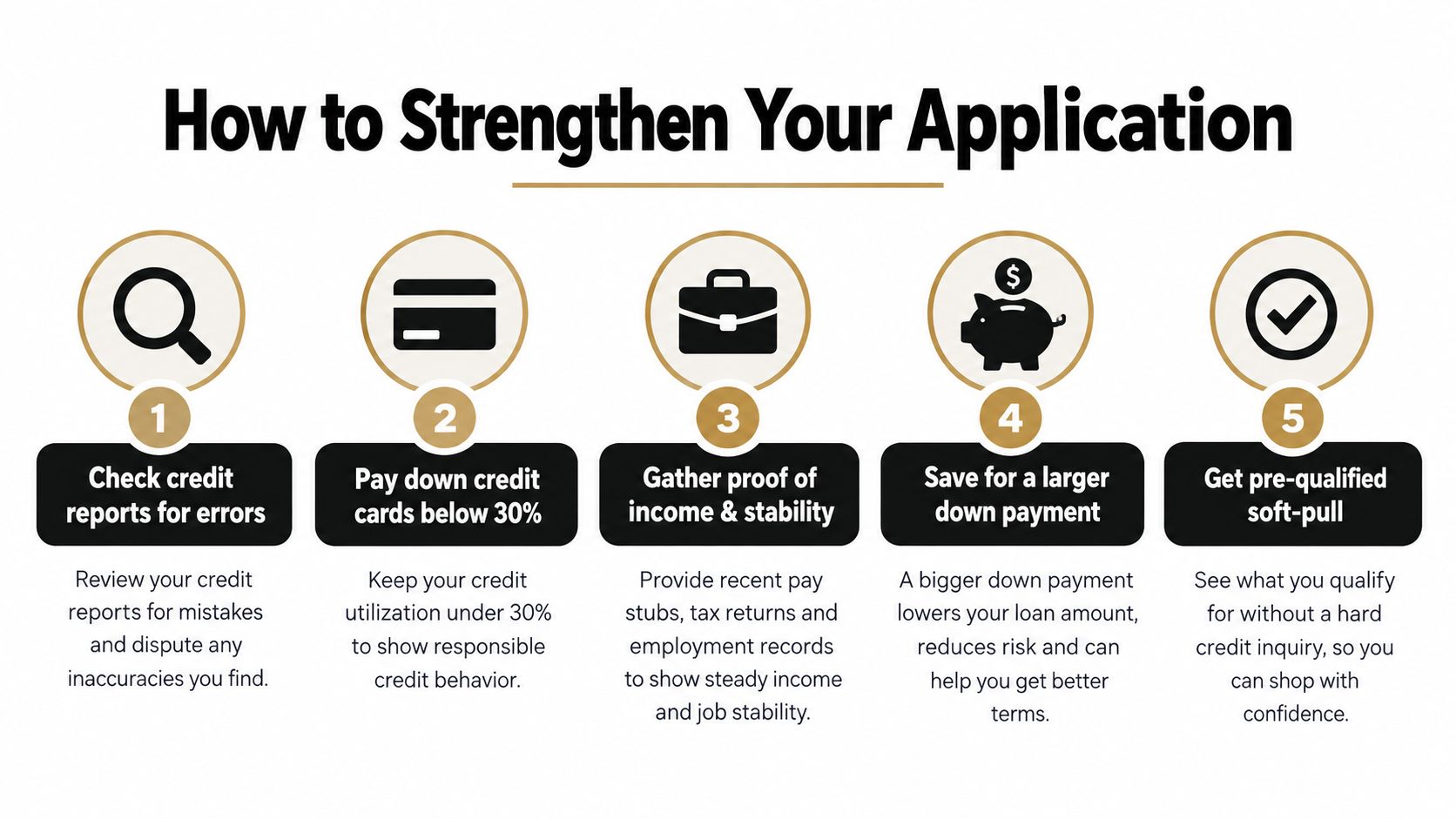
Pull your credit reports and check for accounts that are not yours, incorrect balances, duplicate collections, or inaccurate payment records. Dispute genuine errors, while leaving accurate negative information unchanged. Then total your monthly debt payments and compare them with gross monthly income.
Gather pay stubs, bank statements, tax returns, benefit letters, or other records that match how you earn money. Self-employed applicants should bring consistent documentation instead of relying on a verbal estimate.
Use this order:
- Review credit reports. Mark errors, outdated information, and accounts that need a short explanation.
- Reduce revolving balances where possible. Lower balances can improve the current picture and reduce required monthly payments.
- Document income stability. Organize recent records showing where repayment money comes from.
- Set a realistic cash target. Lenders may expect a meaningful down payment from applicants with challenged credit, but the amount depends on the lender, vehicle, income, and overall file. More cash upfront can lower the balance and improve approval odds, while using every available dollar can leave too little for insurance, registration, maintenance, or repairs.
- Use soft-pull prequalification. Confirm that the inquiry will not affect your credit before providing sensitive information.
Make the application easy to explain
A recent job change, bankruptcy, medical collection, or variable income does not become less important when omitted. Explain the issue briefly, factually, and with organized documentation. A clear explanation helps the lender distinguish a past problem from your current repayment plan.
Choose the loan structure deliberately. A smaller UTV or larger down payment lowers the amount financed. A shorter term usually reduces total interest but raises the required payment. A longer term may make the payment easier to carry while increasing the total cost. Approval is only useful if the payment fits your budget.
For electric side-by-side buyers, electric vehicle financing options provide another comparison point. Review the actual contract, because the vehicle category alone does not determine the rate.
Dealer Strategies Co Signers and Secured Options That Improve Approval
A dealer finance manager can be useful when the dealership works with several lenders, but you still need to control the structure. Ask which lender made the offer, whether the quoted rate is final, what fees are included, and whether optional products have been added to the amount financed.
A co-signer can strengthen an application when that person has stable income and stronger credit. The co-signer isn't a reference. They're generally accepting responsibility for repayment if you don't pay, so both parties should understand the effect of missed payments, late notices, and the outstanding balance.

Choose the structure, not just the approval
A secured loan uses the UTV or another eligible asset as collateral. That security can reduce the lender's exposure, but it also gives the lender repossession rights if the contract falls into default. Don't pledge a valuable asset without understanding exactly what happens after a missed payment.
A larger down payment works in a similar risk-reduction direction without placing another household asset at stake. The best choice depends on the cash you have, the asset being pledged, the APR, and the payment you can sustain.
Ask for a side-by-side comparison: Same vehicle, same fees, different down payment and term. The difference in total repayment often matters more than a small change in the advertised monthly payment.
Watch for yo-yo financing, where a dealer allows delivery before financing is fully settled and later asks you to accept different terms. Ask whether approval is final before signing or taking the UTV. Also inspect optional service contracts, protection products, accessories, and documentation fees. Products you didn't request can increase the amount financed and may be especially costly when the APR is already high.
When comparing offers, write down the sale price, cash down, amount financed, APR, term, payment, total of payments, fees, and prepayment rules. If the dealer won't provide a clear breakdown, pause the transaction.
Your Next Steps to Secure UTV Financing With Bad Credit
Approval is a pricing decision you can influence, not a simple yes-or-no gate. Before visiting a dealer, set a maximum payment that still leaves room for fuel, insurance, maintenance, storage, and unexpected repairs. Then choose a vehicle price and down payment that fit that limit. A larger down payment can lower the amount financed and may improve approval odds, while a longer term can reduce the monthly bill but increase total interest.
Bring a practical document packet: government-issued identification, proof of residence, recent income records, employment or benefit information, and details of current debts. Self-employed applicants should also prepare the income documents their lender requests. Having these papers ready can prevent a promising application from stalling over missing verification.
Ask the dealer for a written comparison using the same UTV and fees. Record the sale price, cash down, amount financed, APR, term, monthly payment, total of payments, and any prepayment rules. Compare lender types by total cost, not by the payment alone. A short term may cost more each month but less overall. A longer term may be easier to carry while leaving you paying interest for longer.
Use any expected incentive only after confirming its eligibility and timing. If an electric model fits your work, charging access, and budget, review the electric UTV tax credit information before treating a potential credit as available cash.
Use one decision rule: if the payment leaves no dependable margin after ownership costs, the UTV is too expensive, even if a lender approves it.
Solana EV offers electric UTVs and street-legal golf carts, with retail financing subject to credit approval and dealer availability. Visit Solana EV to review the lineup, find a nearby dealer, and compare an electric option before applying.