
A resort manager sees the same problem every afternoon. Guests need to move from lodging to dining, recreation, and event spaces, but the distances are too long to walk and too short to justify a full-size vehicle. A campus director faces a similar choice, while a gated-community manager wants quiet local transportation without putting another car on every driveway.
That's where transportation golf carts fit. Modern electric carts now serve resorts, campuses, planned communities, industrial sites, and private properties, not just golf courses. The category's expansion reflects stronger demand for low-speed mobility, improved vehicle technology, and a regulatory pathway that can make some carts suitable for public-road use. For operators and serious buyers, the question isn't whether a cart looks attractive. It's whether the vehicle's classification, equipment, operating environment, service support, and lifetime cost match the job.
Table of Contents
- Why Golf Carts Now Carry Real Transportation Responsibilities
- Understanding Vehicle Classifications and Their Legal Distinctions
- Legal Requirements and Safety Standards for Street-Legal Operation
- Where Transportation Golf Carts Make the Most Impact
- Key Features and Specifications to Evaluate Before Buying
- Total Cost of Ownership and Long-Term Maintenance Planning
- How to Choose a Dealer and Financing Path That Fits Your Needs
- Making Your Decision with Confidence
Why Golf Carts Now Carry Real Transportation Responsibilities
A resort guest leaves the lodge for a restaurant across the property. A campus employee travels between buildings, while residents in a gated community need short local trips. These routes are too long to walk comfortably but often inefficient for a full-size vehicle. That operating gap has turned transportation golf carts into working mobility equipment.
Market forecasts point to continued expansion in resorts, campuses, gated communities, industrial sites, and private properties. The estimates vary, but the direction is consistent. Mordor Intelligence's golf cart market analysis provides context for that growth.
Electric drivetrains suit repeated short trips. They operate without noise and produce no tailpipe emissions at the point of use, which helps when pedestrians, guests, residents, and staff share the same routes. Resorts can assign carts to guest shuttles and maintenance. Universities can use them for internal transportation. Communities can support local travel without adding a full-size car to every trip.
The route determines the vehicle requirement. A cart carrying guests between buildings on private property faces a different compliance and equipment profile from an LSV operating on public roads. Surface conditions, passenger loads, weather, charging access, and traffic exposure all affect the choice.
Federal regulation expanded the category's potential by creating a low-speed vehicle classification. In jurisdictions that adopt the relevant rules, qualifying vehicles may have a path to street-legal operation. That classification influences procurement, insurance, operator training, road access, and fleet planning.
For property managers and serious buyers, a transportation golf cart is a mobility asset rather than an accessory. Evaluate braking performance, operating limits, charging routines, service coverage, and total ownership cost before comparing colors or trim. Buyers reviewing resort transportation services should also assess whether the dealer can support inspections, repairs, parts availability, and fleet changes as routes evolve. The purchase decision connects vehicle capability with local law and the realities of daily operations.
Understanding Vehicle Classifications and Their Legal Distinctions
A resort operator may call every small electric shuttle a “golf cart,” while a campus planner or gated-community manager may need a vehicle recognized for public-road use. Similar body shapes do not create identical legal obligations. Classification determines where the vehicle may operate, what documentation it needs, and which compliance duties fall on the owner.
A conventional golf cart typically travels at 20 mph or less. An LSV is generally designed to travel more than 20 mph but not more than 25 mph. Under the federal framework established in a 1997 Federal Register notice, an LSV is a four-wheeled motor vehicle whose attainable speed in one mile does not exceed 25 mph. Federal guidance also describes a gross vehicle weight rating below 3,000 pounds. Buyers can review what a low-speed vehicle is for the category's basic definition.
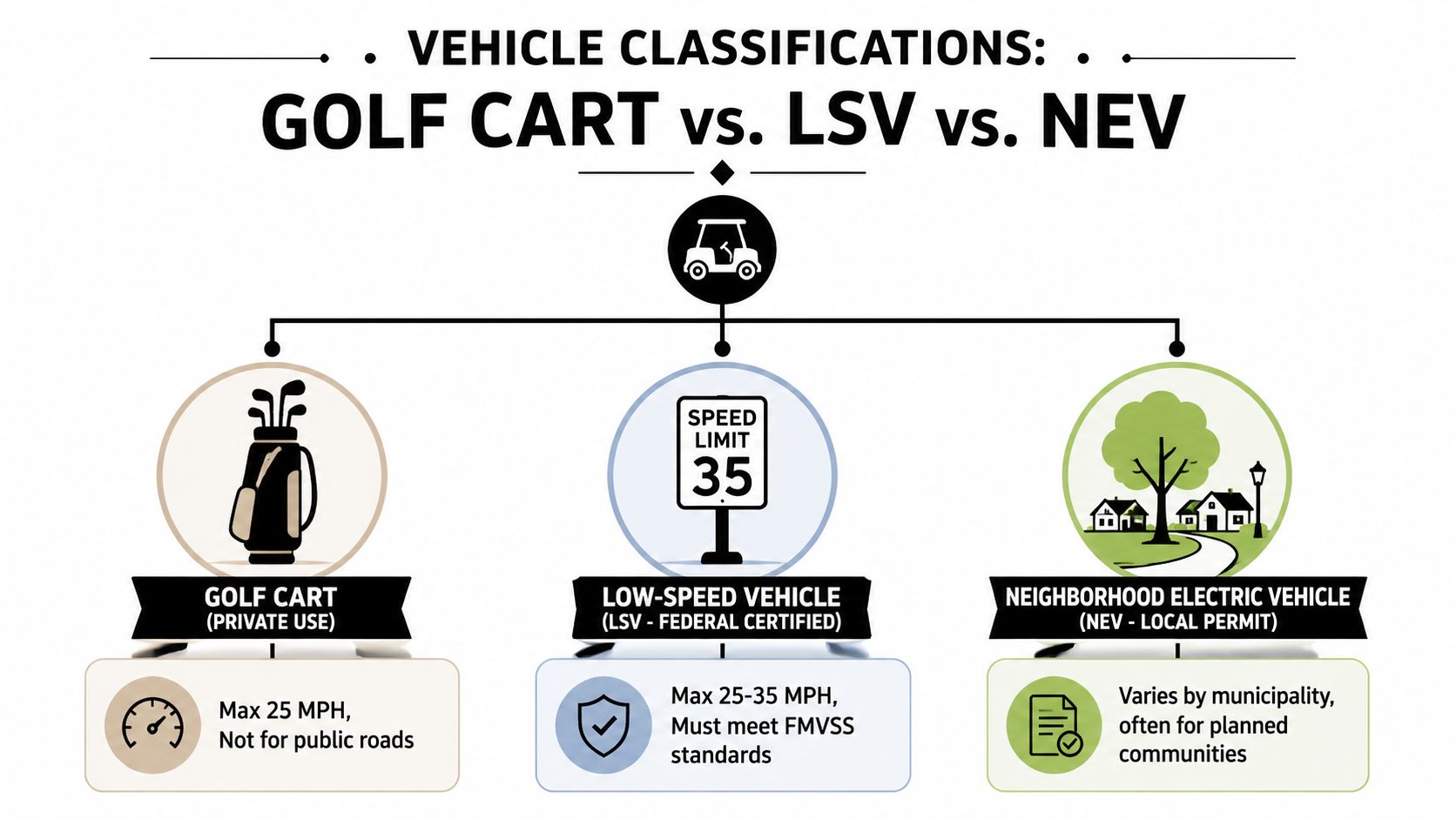
The terms buyers need to separate
LSV matters most when a fleet may use public roads. The vehicle must satisfy applicable federal safety requirements, while state registration and local road-access rules determine where it can operate.
NEV, or neighborhood electric vehicle, is often used as a commercial synonym for LSV. State statutes and municipal programs may define it differently, however. Treat the dealer's label as a starting point, then inspect the certification and registration documents.
Street legal describes a vehicle's permitted use in a specific jurisdiction. It is not a universal equipment package. A cart allowed on a designated community road may still be prohibited on a nearby public route.
For each buyer profile, the decision sequence is the same: classify the vehicle, confirm the governing jurisdiction, then match the route and operating role to that classification. A lighting kit, windshield, or higher speed setting does not automatically convert a conventional cart into an LSV. A dealer should be able to show which category the vehicle was built and certified to meet.
Legal Requirements and Safety Standards for Street-Legal Operation
A resort manager may receive a vehicle that appears road-ready, yet registration can fail because its classification or paperwork is wrong. Street legality begins with documentation. Ask the dealer which category applies, whether the vehicle was manufactured and certified for it, and which documents support registration.
The federal LSV framework covers a four-wheeled vehicle with an attainable speed that does not exceed 25 mph, as established in the 1997 Federal Register notice. State and municipal authorities may add requirements for registration, insurance, licensing, road access, and equipment. Confirm the current rules with the relevant motor-vehicle agency and local authority.
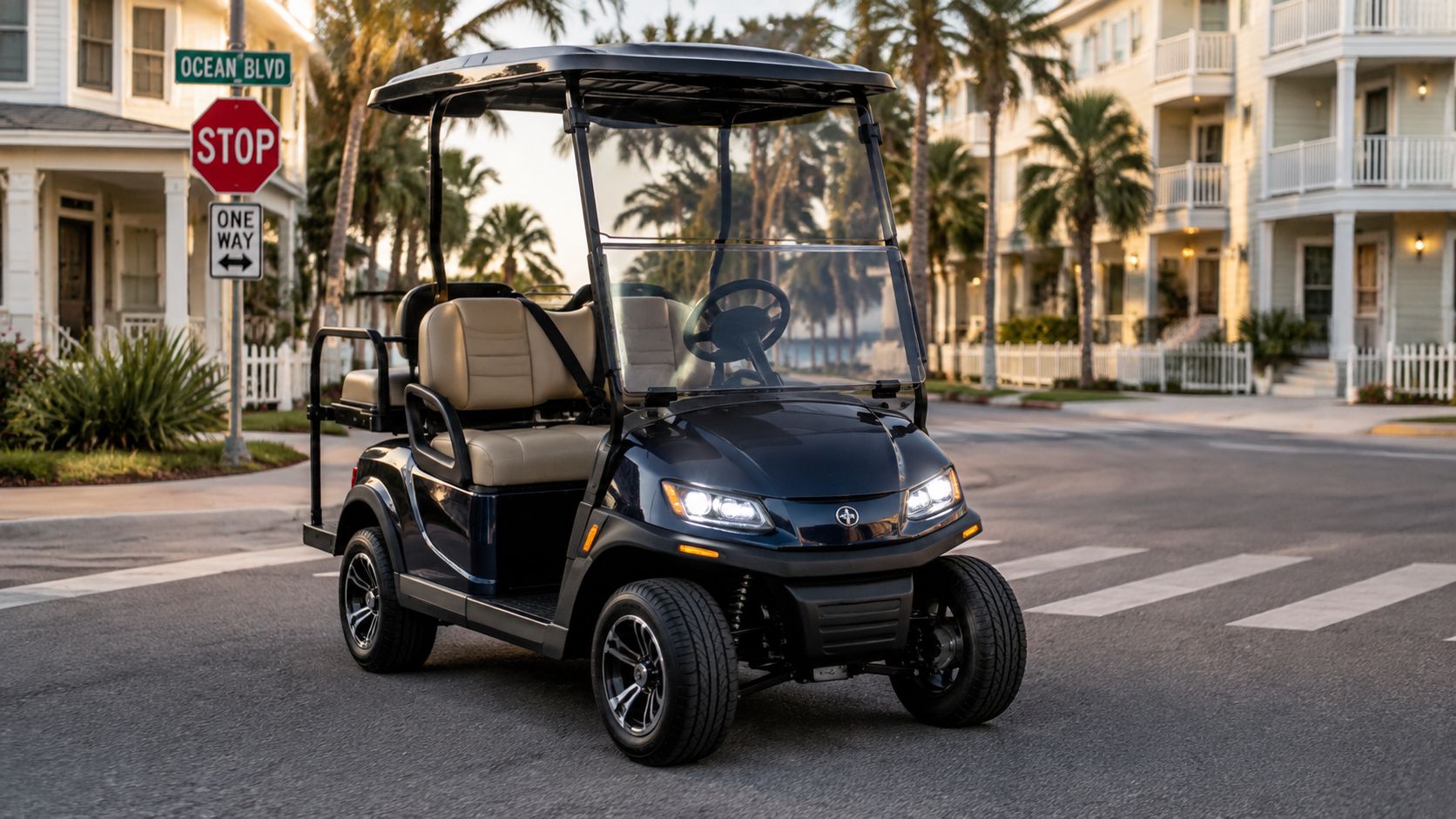
A practical compliance sequence
Confirm the classification. Determine whether the vehicle is a conventional golf cart, an LSV, or another locally defined category. Request certification records instead of relying on the phrase “street legal.”
Review required equipment. LSV equipment commonly includes seat belts, headlights, brake lights, turn signals, mirrors, a windshield, and a vehicle identification number. Requirements vary, so match the vehicle's equipment to the governing rules before purchase. A street-legal golf cart requirements guide can help organize that review.
Map the intended roads. Registered LSV access may differ from golf-cart access on locally designated roads, and neither permission applies everywhere. A route that works for a gated-community manager may not work for a campus fleet crossing a public street. Review this state-by-state comparison of golf-cart road access, then obtain a final determination from the relevant jurisdiction.
Check safety design. Braking affects stability, especially on slopes. Peer-reviewed research found that rear-wheel-only braking can create downhill rollover risk and reported allowable stopping distances of roughly 8 to 15 meters, or 28 to 50 feet, from top speeds of 15 to 20 mph. The braking research is summarized in this peer-reviewed source.
Insurance changes when a vehicle enters a registered-road environment. Before delivery, compare golf cart insurance options and confirm coverage for the classification, drivers, passengers, and planned routes. Resort operators, campus planners, and community managers should also assign responsibility for inspections and compliance records, so dealer support remains part of the purchase decision rather than an afterthought.
Where Transportation Golf Carts Make the Most Impact
A resort shuttle, campus service vehicle, and gated-community cart may look similar, yet each serves a different transportation problem. A peer-reviewed 2024 study identified golf-cart transportation as a distinct behavior with recognizable user groups. That distinction matters because adoption depends on the setting, trip purpose, and expectations of the people using the vehicle. The study is available through ScienceDirect.
Resorts and hospitality properties
Resorts generally need passenger capacity, weather protection, durable seating, easy-clean surfaces, and dependable daily availability. A guest shuttle may need enclosed storage and comfortable entry, while a maintenance cart may need room for supplies. Operators should map routes, luggage handling, charging locations, and staff oversight before selecting a configuration. The right cart works like a small fleet asset, not just a guest amenity.
Campuses and institutional sites
Universities, hospitals, and corporate campuses combine pedestrian-heavy corridors with repeated internal trips. Vehicle selection should account for visibility, controlled speed, step-in access, and the needs of staff, visitors, or light equipment. A vehicle that stays on private campus roads may not require public-road equipment, but its operating plan still needs clear separation between pedestrian areas and vehicle routes.
Gated communities and planned neighborhoods
Residents often prioritize quiet operation, weather protection, comfortable seating, and simple charging. Managers must distinguish community rules from public-road requirements. Internal permission does not automatically extend to nearby public streets, where a vehicle may need to meet LSV requirements and follow the jurisdiction's registration rules.
Industrial and property operations
Warehouses, factories, event venues, and large properties use carts to move people, tools, and light materials across controlled sites. Utility beds, towing capability, payload capacity, turning space, and service access usually matter more than entertainment features. Property managers should match the vehicle to the work cycle, route surface, and recovery plan when a unit is unavailable.
Outdoor recreation and private land
Off-road users need a different balance of capabilities. Ground clearance, tire selection, chassis durability, traction, and towing capacity can matter more than public-road equipment. Confirm where the vehicle may operate, because a recreational setup is not a substitute for a certified road vehicle.
Recent market research projects continued growth in the global and U.S. golf-cart markets. These projections are not guarantees, but they support a practical conclusion: transportation use now extends beyond the fairway. Resort operators, campus planners, and community managers should therefore compare route demands, legal classification, utilization, and support costs together rather than choosing by vehicle appearance alone.
Key Features and Specifications to Evaluate Before Buying
A serious buyer should convert the operating brief into a specification sheet before visiting dealers. Record the route, passenger load, cargo requirements, surface conditions, charging plan, and legal environment. This prevents a long feature list from replacing the more important question: can the vehicle perform its assigned work safely and consistently?
Transportation golf cart specification comparison
| Specification | Standard Golf Cart | Street-Legal LSV | Premium Utility Vehicle |
|---|---|---|---|
| Range | Match to private-site routes and charging access | Match to public-road and site routes | Match to mixed passenger, cargo, and off-road duties |
| Top speed | Typically capped at 20 mph or less | More than 20 mph and not more than 25 mph under the federal LSV framework | Depends on configuration and legal classification |
| Seating capacity | Usually selected for local passenger movement | Select according to registered vehicle configuration and restraint needs | Available in passenger and utility layouts |
| Chassis material | Evaluate corrosion resistance and repairability | Confirm structural quality and certification documentation | Prioritize durability, payload support, and terrain suitability |
| Battery chemistry | Compare charging behavior, service needs, and replacement planning | Consider daily utilization and charging infrastructure | Match chemistry and capacity to heavier duty cycles |
| Payload capacity | Suitable for passengers and light items | Confirm payload after required equipment is installed | Essential for tools, cargo, and towing requirements |
| Technology features | Useful when comfort and convenience matter | Ensure features don't distract from compliance and visibility | Consider connectivity, controls, lighting, and fleet usability |
Range should cover the longest normal duty cycle, rather than relying on a brochure estimate alone. Passenger weight, hills, temperature, tire choice, and cargo can reduce practical performance. A resort shuttle, campus vehicle, and gated-community cart may therefore require different range margins even when their routes appear similar.
Chassis construction affects durability, corrosion resistance, ride behavior, and serviceability. An aluminum platform may appeal to buyers seeking a durable structure without unnecessary weight. Ask the dealer how the chassis is engineered, repaired, and supported over its working life.
Battery chemistry requires a lifecycle discussion. Confirm charging equipment, storage procedures, diagnostics, warranty terms, replacement availability, and technician training. The battery affects uptime and future maintenance, so compare the service plan with the purchase specification rather than treating it as a separate concern.
Payload and layout should follow the duty cycle. Campus planners may need passenger capacity and clear visibility, resort operators may prioritize comfortable boarding and repeated shuttle runs, while gated-community managers may value compact dimensions and simple charging. Confirm remaining payload after seats, safety equipment, accessories, and other required equipment are installed.
Technology can improve daily usability when it matches the staff and route. Apple CarPlay and Android Auto may suit a resort or community vehicle used for navigation and communication. A utility operator may instead prioritize lighting, cargo access, and controls that different employees can learn quickly. Any technology package should support safe operation, not distract from visibility, training, or compliance.
Ask for a written comparison of configuration, certification documents, warranty coverage, parts availability, and dealer response times. That information connects vehicle features to legal responsibilities and total ownership cost, which is more useful than choosing by appearance or a single headline specification.
Total Cost of Ownership and Long-Term Maintenance Planning
A transportation golf cart that runs reliably on a resort route may cost less over time than a cheaper vehicle that sits idle awaiting parts. The purchase price is only one budget line. Property managers should account for energy, scheduled service, tires, brakes, battery replacement, insurance, registration, charging installation, software support, and parts logistics. Compare the cost of keeping each vehicle available for its assigned work.
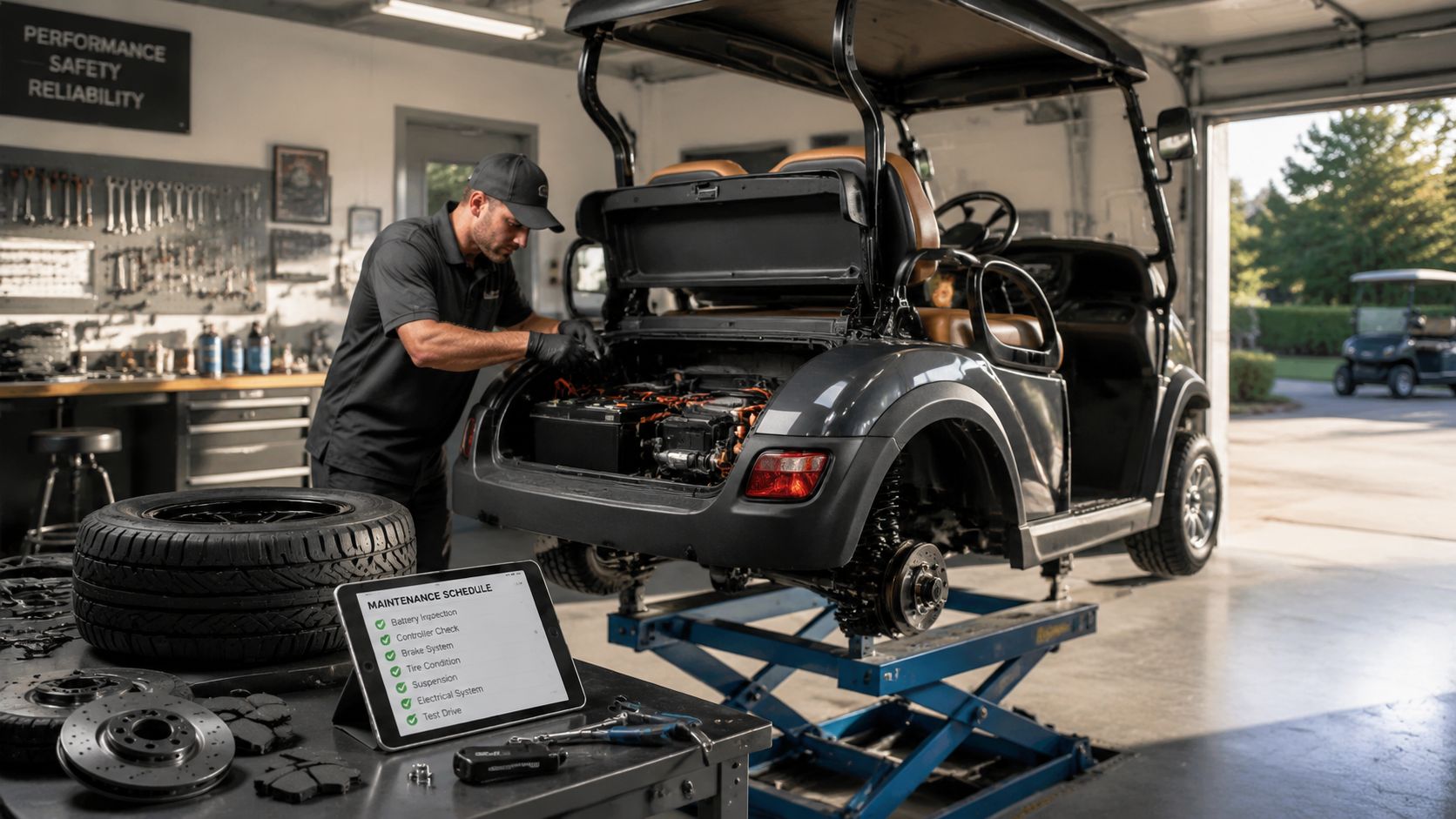
Build the ownership model around usage
A low-use gated-community cart needs a different maintenance plan from a resort shuttle operating throughout the day. Campus planners should also account for route length, passenger loads, terrain, and seasonal demand. If exact utilization is unavailable, estimate the duty cycle qualitatively and ask the dealer to convert those assumptions into service intervals.
Track these categories separately:
- Energy and charging: Include electricity, charger installation, electrical work, and site changes required to support several vehicles.
- Wear items: Tires, brake components, suspension parts, wipers, and lighting may require earlier attention on rough surfaces or under heavy use.
- Battery planning: Request replacement guidance, warranty coverage, storage requirements, diagnostics, technician training, and parts availability. The battery affects uptime and future maintenance, so include it in the ownership plan from the beginning.
- Compliance and insurance: Registration, applicable inspections, insurance, and driver policies belong in the operating budget.
- Downtime: A low repair invoice does not represent good value if a missing part keeps a vehicle out of service during peak demand.
Safety choices also shape lifetime cost. Evaluate braking, tires, load, terrain, and operator training together, because a vehicle configured for one route may be poorly suited to another. Ask whether the proposed specification supports controlled operation on the property's slopes, surfaces, and passenger loads.
A premium vehicle may carry a higher initial price while reducing service disruption through clearer documentation, stronger warranty coverage, and better parts support. That outcome is not automatic. Before signing, request warranty exclusions, service intervals, response procedures, common replacement-part costs, and the dealer's process for handling recurring faults.
Use the following maintenance demonstration to form dealer questions. It does not replace the manufacturer's service documentation.
How to Choose a Dealer and Financing Path That Fits Your Needs
The dealer relationship often determines whether a fleet remains productive after delivery. Price matters, but it shouldn't outrank parts availability, technician capability, warranty handling, training, and response time.
A resort operator should ask who handles urgent repairs during busy periods. A campus planner should ask whether the dealer can train several departments and document routine inspections. A gated-community manager should confirm who supports residents after purchase and whether replacement parts remain available through the expected ownership period.
Questions that reveal dealer quality
- Service coverage: Who performs warranty work, and where are repairs completed?
- Parts access: Can the dealer identify common wear parts and their ordering process?
- Training: Does onboarding cover charging, safe operation, inspections, and basic troubleshooting?
- Territory and support: For a prospective dealer, are territories protected, and what marketing and technical resources are included?
- Documentation: Will you receive certification, manuals, service schedules, and registration support?
Financing should be assessed by its effect on total acquisition cost and cash flow. Fleet buyers may consider dealer floor-plan financing for inventory, while retail buyers may need vehicle-level financing. Promotional terms can reduce near-term cash pressure, but always review eligibility, fees, deferred costs, and the total repayment obligation rather than focusing only on the advertised rate.
Solana EV presents a partner model that includes protected territories, onboarding and marketing resources, a 24/7 parts portal, technical assistance, dealer floor-plan financing through Dealer Direct, and retail financing options that include 0% APR for up to 60 months. Those are specific support and financing features to verify against current terms, territory availability, and your business plan.
Making Your Decision with Confidence
The right transportation golf cart sits at the intersection of legal compliance, operational fit, and total cost of ownership. Remove any one of those pillars and the purchase becomes fragile. A vehicle can have the right seating but the wrong road classification, or the right legal equipment but insufficient braking, range, cargo capacity, or service support for the property.
Use a final decision checkpoint before placing an order:
- Route: Are the intended roads private, locally designated, or public? Have you verified access with the relevant authority?
- Vehicle class: Is the cart a conventional golf cart, an LSV, or another locally defined vehicle?
- Workload: How many passengers, what cargo, what terrain, and what weather conditions will the vehicle face?
- Safety: Do the braking system, restraints, visibility equipment, tires, and operator procedures match the environment?
- Ownership plan: Have you budgeted energy, charging infrastructure, service, tires, brakes, batteries, insurance, registration, and downtime?
- Dealer support: Can the dealer supply parts, training, warranty service, technical help, and clear documentation?
Resort operators should prioritize uptime and passenger experience. Campus planners should emphasize pedestrian safety, repeatability, and fleet coordination. Gated-community managers should focus on local rules, resident usability, charging, and insurance. Outdoor users should weigh terrain capability and durability before road-focused equipment.
You don't need the most heavily equipped vehicle. You need a documented match between the vehicle and the work it must perform. Visit the manufacturer, dealer, and local regulatory resources with a written route and operating brief, then compare proposals on lifecycle value rather than purchase price alone.
Solana EV offers electric golf carts and related mobility models for neighborhood, resort, campus, recreational, and utility applications, with options such as the XA 4P, XA 6P, F, and G. Visit Solana EV to review current vehicles, locate an authorized dealer, or explore partnership information for your transportation needs.