
What makes one electric golf cart feel lively on a hill while another with the same sticker speed feels tired, even though both look nearly identical on the lot?
That question matters more than the brochure usually admits. Electric golf cart performance is not one number, it's a balance of speed, acceleration, hill climbing, range under load, and ride feel, and those traits often move in opposite directions.
A cart tuned for 12–15 mph stock course use, as summarized in independent market and technical sources, behaves very differently from a street-legal low-speed vehicle tuned closer to 20–25 mph for neighborhood and campus travel, as noted in the same benchmark set from Caddie Wheel's speed overview. That gap affects trip time, traffic fit, and how hard the drivetrain works every time a passenger climbs in or the route tilts upward.
Table of Contents
- What Electric Golf Cart Performance Really Means
- The Core Building Blocks of Electric Golf Cart Performance
- Voltage Systems and Battery Choices Compared
- How Terrain, Heat, and Load Change Real-World Performance
- How to Measure and Test Performance Yourself
- Upgrades That Deliver Real Results
- Matching Performance to Your Use Case
- Performance Checklist and Common Buyer Questions
What Electric Golf Cart Performance Really Means
A resort manager can spot the problem fast. Two carts leave the same charging bay, both advertised at the same speed, but one pulls passengers up a mild slope without drama while the other slows and sounds strained. The sticker told them almost nothing about usable performance.
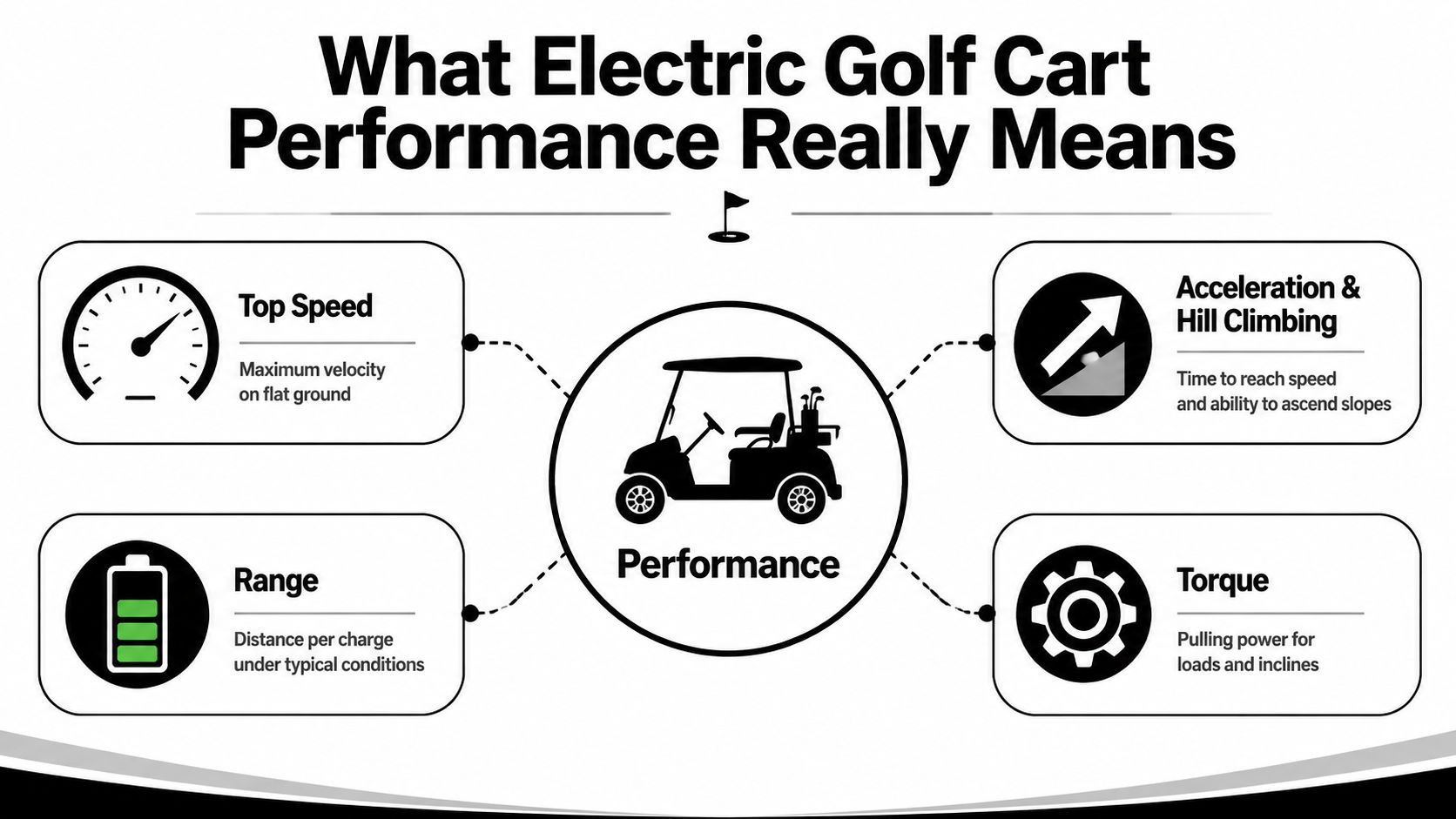
The four things buyers really feel
Top speed gets the most attention because it's easy to ask and easy to compare. But in daily use, acceleration and hill climbing often matter more, especially on properties with stop-start routes, passenger loads, or repeated grade changes.
Range under load is the next piece. A cart that can finish the route on a flat test drive may not hold up once the battery drops, the cart gets heavier, or the path turns hilly. Ride feel matters too, because a cart that bucks, drags, or surges never feels “fast” even if the speedometer says otherwise.
Why the same sticker speed can feel different
The mechanical and electrical setup underneath the body decides how the cart behaves. A lower-speed course cart and a street-legal LSV are built with different expectations, and the regulatory ceiling often shapes that difference. In many markets, the street-legal target sits around 20–25 mph, while factory golf carts often live in the 12–20 mph range depending on voltage, controller settings, payload, and terrain, as summarized by this speed benchmark.
Practical rule: If a cart only feels good on flat ground with one person aboard, it's not really a strong-performance cart for fleet work.
The right question isn't “how fast does it go?” It's “how fast does it go, with my people, on my route, after half a charge?”
The Core Building Blocks of Electric Golf Cart Performance
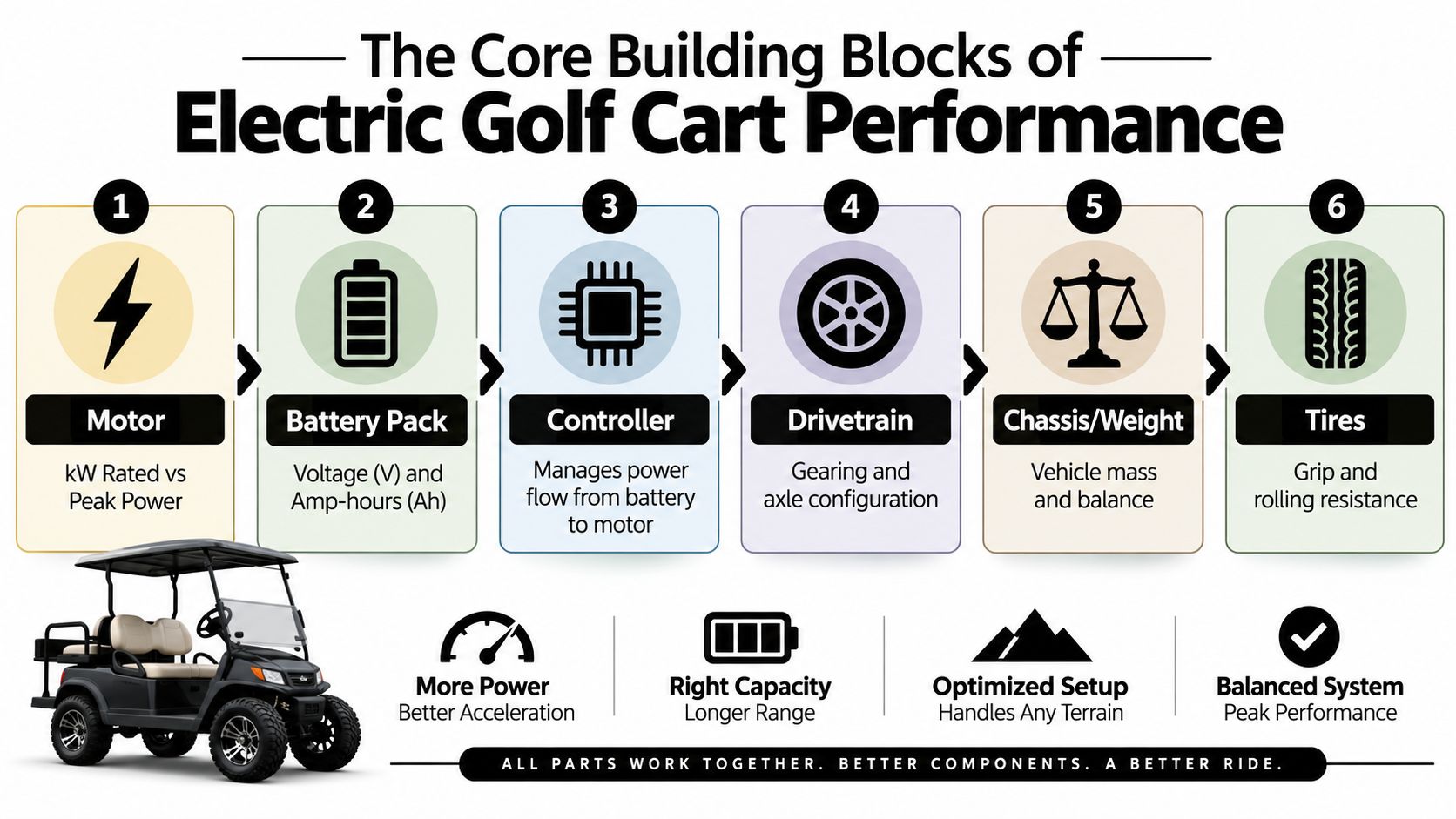
A spec sheet makes more sense once you know what each line does. View a cart as a small electrical system on wheels, where each part either helps or limits the others.
Motor and controller
The motor is the muscle, but it does not work alone. In the market examples provided, a typical 4-seater lithium cart can be configured with 4 kW rated / 9.6 kW peak, 6 kW rated / 12.46 kW peak, or 10 kW rated / 22.43 kW peak motors, and the higher peak numbers improve launch response and gradeability, especially on repeated starts or steeper property routes, as shown in the spec benchmark.
The controller is the brain. It works more like a dimmer switch than an on-off button, deciding how much current the motor gets when you press the pedal. If the controller is conservative, the cart feels soft. If it is tuned well, throttle response feels cleaner and more immediate.
Battery, weight, and tires
The battery pack sets the energy budget. Voltage is like water pressure, while amp-hours are closer to the size of the tank. A stronger battery does not just add range, it helps the cart keep voltage from sagging when you ask for more power.
That voltage sag is one of the easiest things to miss on a quick test drive. A cart may feel lively at first, then lose punch as the battery voltage drops under load, especially when a hill, a passenger, or a stop-start route asks for more from the system.
Weight matters more than many buyers expect. Representative carts in the research sit around 510 kg to 645 kg depending on battery chemistry and chassis, and that extra mass shows up every time the cart starts, stops, or climbs. Lithium usually helps because the lighter setup reduces the load the motor has to move, while lead-acid raises rolling resistance and trims efficiency, again reflected in the spec example.
Tires are the last easy-to-overlook piece. More grip can help on loose ground, but larger or softer tires can also slow the cart down by adding drag. For buyers comparing motor options, browse EV battery specs is a useful way to understand how capacity choices translate into practical route planning, even though the exact cart setup still matters most.
A cart usually does not feel weak because one part failed alone. It feels weak because the battery, controller, weight, and tires stopped working together.
High-output motor options only make sense when the rest of the system can support them.
Voltage Systems and Battery Choices Compared
Voltage shapes how a cart feels before you ever glance at the speedometer. A 48V lead-acid setup can do the job for short, flat routes, but a 48V lithium pack usually feels more responsive because it holds voltage better under load and weighs less. Move up to 60V or 72V lithium, and the conversation changes. Buyers start paying attention to launch feel, hill behavior, and how long the cart can hold output without feeling strained.
A useful anchor comes from the provided specs. One representative 48V cart with a 51.2V 150Ah lithium battery and 5.0 kW motor is listed at 40 km/h maximum speed, while lighter-duty carts with 1000–1300 W motors typically top out around 15–15.9 km/h, depending on pack size and terrain, as shown in the cart performance benchmark.
What higher voltage changes
Higher voltage does more than raise top speed. It gives the controller more room to deliver power without feeling pressed, so the cart responds more cleanly when it starts with passengers or climbs. That does not mean voltage solves everything. A weak battery pack, poor controller mapping, or too much weight can still make a high-voltage cart feel dull.
Speed and range do not rise together. The provided technical notes say range falls sharply as speed rises because drag grows with the square of velocity, so a cart tuned for faster cruising may give up useful distance sooner than buyers expect, especially on rolling ground.
| System | Typical Motor | Top Speed | Range Expectation | Best Fit |
|---|---|---|---|---|
| 48V lead-acid | Lower to moderate output | Conservative | Short to moderate routes | Basic course and light utility use |
| 48V lithium | Moderate output | Stronger than lead-acid | Better under load | Resort and community duty |
| 60V lithium | Higher output | Faster acceleration | Route dependent | Hilly properties and heavier use |
| 72V lithium | High output | Highest responsiveness | More sensitive to driving style | Premium street-capable builds |
If you are comparing pack sizes, browse EV battery specs is a practical reference point for thinking about usable energy, not just nominal voltage.
A 72V lithium pack can make sense on carts that need stronger pull, sharper response, and less voltage drop when the route gets demanding, which is why 72V lithium cart platforms are often discussed for heavier-use builds.
How Terrain, Heat, and Load Change Real-World Performance
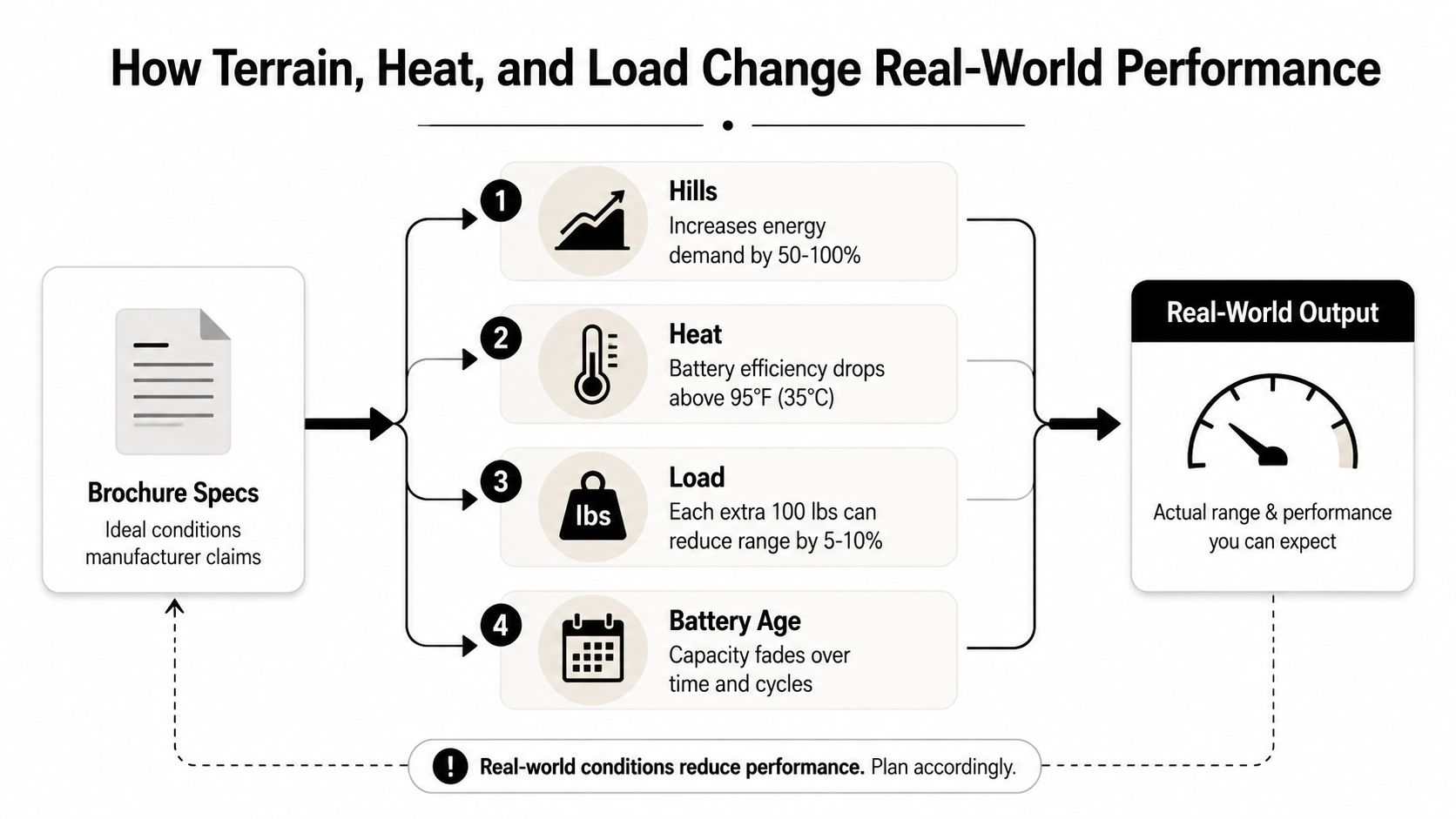
A cart can feel perfect on the demo loop and disappointing on Tuesday afternoon. That isn't buyer imagination, it's the difference between brochure conditions and actual duty.
Hills and passenger weight
Hills demand more current, and current is where weak systems start to show themselves. The provided research notes that voltage sag, heat derate, throttle-sensor or solenoid issues, tire pressure, brake drag, controller settings, and weak or imbalanced battery packs can all look like “bad performance” from the driver's seat. In practice, the cart may be working harder than the test drive suggested.
Load matters the same way. A passenger cart, a utility cart, and an unloaded show cart do not belong in the same performance conversation. The cart that felt quick when empty may slow down once the battery, people, cargo, and grade all stack on top of each other.
Heat and state of charge
Heat changes what the controller and battery can safely deliver. The troubleshooting coverage in the brief points out that performance complaints often show up after a partial discharge, and that's when people blame the motor first even though the battery pack may be the primary limiter. Electric carts usually feel strongest off the line because of instant torque, then fade more noticeably when charge drops or load rises, which is why a healthy pack can still seem “tired” late in the day.
A cart that loses punch halfway through its range usually needs diagnosis, not guesswork.
For fleet operators, the useful lesson is to separate the symptom from the cause. A slow cart on a hill may need battery testing, controller inspection, brake service, or just a more realistic route plan. The payload discussion in this guide to capacity fits that thinking well, because overload is often the hidden reason a cart stops feeling fast.
The buyer who tests only on flat pavement gets a misleading result. The buyer who tests with real passengers, real hills, and real heat gets a usable answer.
How to Measure and Test Performance Yourself
You don't need a dyno to learn a lot about a cart. You need a repeatable route, a phone, and a little discipline.
Simple field checks
Start with a timed hill climb from a dead stop. Use the same passenger count, the same starting point, and the same slope each time, then compare runs instead of relying on memory. If the cart hesitates, surges, or slows sharply before the top, that tells you more than a speed sticker ever will.
Next, test top speed on a flat stretch with GPS on your phone. The point isn't to chase a hero number, it's to see whether the cart reaches a stable cruise and whether the speed is repeatable. A cart that hits its top number only once under ideal conditions is not the same as one that holds it consistently.
Logs and diagnostics that catch early decline
Track a one-week range log with start charge, route length, hills, passengers, and any performance drop you noticed. That log is often the first clue that battery health or controller behavior is changing. Also check tire pressure and brake drag before assuming the pack is failing, because rolling resistance can make a healthy cart feel dull.
If your cart gives controller codes or battery state-of-charge readings, write them down. Those details help you separate a pack problem from a motor problem, which saves time and money during service.
For buyers comparing rugged builds, best all terrain carts can be a useful context check because terrain use exposes weak performance faster than flat driving ever will.
Good test drives feel boring. The same route, the same load, and the same checks make the result trustworthy.
Upgrades That Deliver Real Results
Many upgrades sound exciting, but they change very little on the course or the trail. The ones worth paying for are the ones that change how the whole system works together.
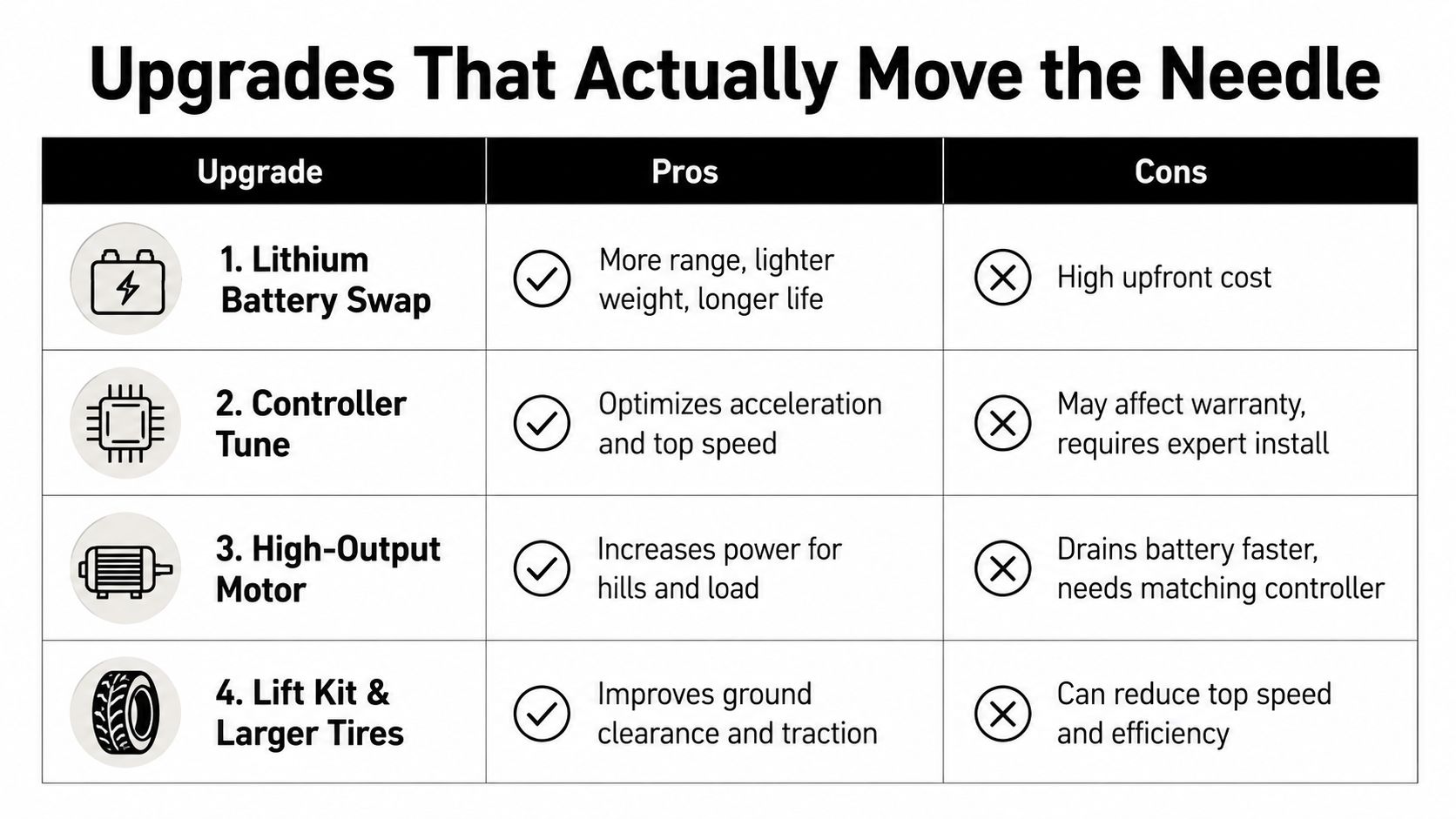
The upgrades with real payoff
Lithium battery swap is usually the biggest change in feel because it cuts weight and helps voltage stay steadier under load. That means better launch, more consistent pull, and less sag when the cart is asked to work hard.
Controller tune can clean up acceleration and make throttle response feel more natural. A well-set controller helps the cart react the way drivers expect, but it needs care because poor tuning can create heat, waste energy, or run into warranty trouble.
High-output motor helps most when the cart regularly carries passengers, climbs grades, or runs across rough property. On its own, though, a stronger motor can drain the battery faster if the controller and pack are not matched to it.
Lift kit and larger tires improve clearance and traction, especially on uneven ground or off-road surfaces. They can also slow the cart down and reduce efficiency, so they are a trade, not a free gain.
If you are comparing upgrade paths, the practical order is usually battery, controller, motor, then tires. That order keeps the electrical system balanced instead of asking one part to cover for another. It also helps buyers separate a real performance gain from a change that only feels faster because the cart is louder or rides differently.
For owners who use a cart in play and still want to track your handicap accurately, that same habit of measuring the right thing matters here too. A cart upgrade should be judged by how it changes speed, range, hill climbing, and payload in real use, not by brochure language.
Solana EV publishes guidance on performance-related tuning and parts, but the same rule applies no matter who builds the cart, power only helps when the battery, controller, and drivetrain are matched as a set.
The fastest-looking cart on the lot is not always the best-performing cart on the route.
Matching Performance to Your Use Case
A course cart and a neighborhood cart don't need the same strengths. Buyers get into trouble when they shop by body style instead of duty cycle.
For golf course use, smooth throttle response and predictable range matter more than high top speed. A cart that starts cleanly, turns tightly, and stays consistent through multiple rounds is usually the better choice than one that merely chases a higher number.
For resort and hospitality fleets, the priorities shift toward passenger comfort, hill behavior, and dependable stop-start performance. Here, higher voltage and better thermal stability can matter more than a flashy speed claim, because guests notice hesitation more than they notice an extra mile per hour. Solana EV's XA 4P, XA 6P, F, and G models fit that conversation as premium passenger and utility options with modern tech touches like Apple CarPlay and Android Auto, plus aluminum chassis construction.
For gated communities and street-legal LSV use, the key is whether the cart is tuned to the route and local rules. The street-legal performance band around 20–25 mph from the speed reference listed earlier is what makes these carts feel meaningfully different from basic course carts.
For off-road recreation, ground clearance, torque feel, and suspension setup matter most. Speed still matters, but only after the cart can handle rough surfaces without making the driver fight the vehicle.
If you're comparing a golf lifestyle route to actual play, track your handicap accurately and then think about how often your cart really needs to be fast versus reliable.
Performance Checklist and Common Buyer Questions
Bring this checklist to the dealer or test drive: voltage, motor kW, battery size and chemistry, controller tuning, tire type and pressure, and warranty plus support coverage. Ask how the cart behaves with passengers, on hills, and after the battery drops below full charge.
FAQ
How fast is realistic on hills? Less than the flat-road number, sometimes much less, because load and grade change the demand.
Is lithium worth it? Usually if you care about weight, consistency, and better usable performance under load.
What does street-legal really mean? It means the cart is built and tuned for low-speed road use, not just course use.
Slow cart, battery or motor? Start with the battery, controller, tire drag, and brake drag before blaming the motor.
Solana EV builds electric carts and UTVs for buyers who care about real route performance, not just brochure speed. If you want a cart that matches your terrain, passenger load, and street-legal needs, visit Solana EV to review models, compare features, and talk with a dealer about the setup that fits your use case.