
Friday evening is when the charging questions show up. A resort valet barn has carts, guest vehicles, and staff vehicles all trying to recharge before the next rush, while a dealer lot may have demo units, service units, and customer handoffs waiting on the same electrical service. The manager usually doesn't need a lecture on EVs, they need a clear answer to one problem, what happens when too many chargers wake up at once?
That's where EV charging load management stops being a buzzword and starts being a planning tool. It can mean the difference between using the electrical service you already have and jumping straight to a costly upgrade. It also changes the conversation from “How many chargers can we buy?” to “How do we run the whole site without tripping over its own load?”
Table of Contents
- What Happens When Too Many Chargers Wake Up at Once
- Defining EV Charging Load Management
- The Four Building Blocks Behind Every Managed System
- Deploying Load Management at Resorts, Campuses, and Dealer Lots
- Real-World Examples and the ROI of Doing It Right
- Mixing EVs with Solar, Storage, and the Rest of the Building
- A Practical Checklist and How Solana EV Fits In
What Happens When Too Many Chargers Wake Up at Once
A resort valet barn doesn't fail dramatically most of the time. It gets busy in layers. One cart plugs in, then another, then a staff cart, then a guest vehicle that came back late, and suddenly the panel is carrying more than someone assumed on paper. A dealer lot has the same issue, just with different labels on the keys.
That's why load management matters at smaller sites too. The pain point is not limited to highway fast-charging depots with giant utility interconnections. Resorts, campuses, gated communities, golf-cart programs, and dealer operations often have a fixed electrical service that was never designed for several charging sessions to start at once.
Practical rule: if charging is just one more load on a site that already has lighting, HVAC, kitchen equipment, pool systems, or shop tools, you should think about the whole service entrance, not just the chargers.
There's a useful way to separate the old model from the managed model. A one-person charger, or a pile of chargers left to act independently, only knows its own cord. A managed network knows the site limit, watches the rest of the building, and then allocates charging so the service stays inside its boundary. That's the core difference between a box that dispenses power and a system that manages it.
If you're looking for a plain-language overview from the home and small-site side, the Connect VPP charger guide Australia is a useful companion read because it frames charger planning around available capacity instead of wishful thinking. For broader infrastructure planning, the internal Solana EV infrastructure guide shows how charging fits into a site's physical layout and electrical decisions.
The emotional part of the problem is simple. Nobody wants to be the manager who learns the limit by tripping it on a busy Friday night. The technical part is just as simple, once you say it plainly, every charger that comes online is asking for the same scarce thing, amperage, and the site either shares it intelligently or it doesn't.
Defining EV Charging Load Management
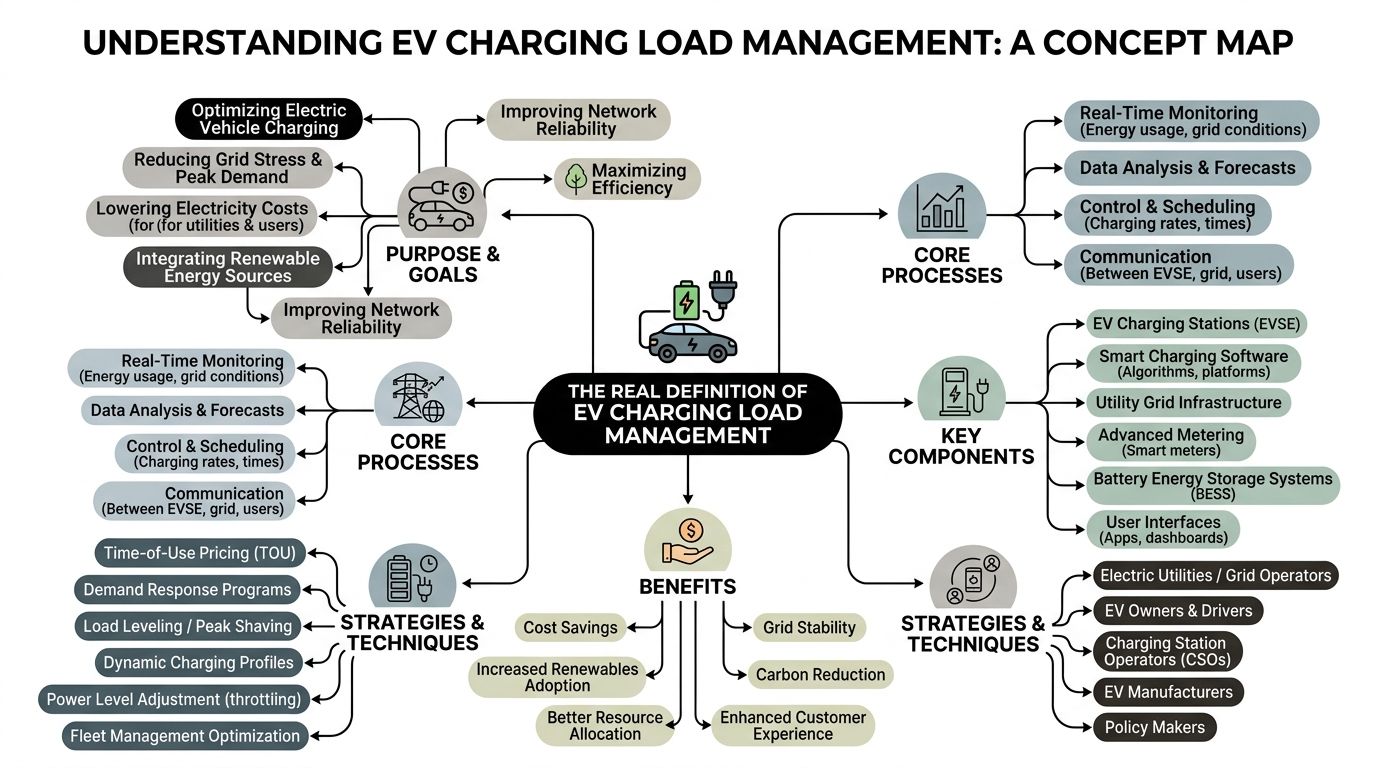
EV charging load management is the control layer that decides how much power each charger gets, when it gets it, and what happens when the site approaches its ceiling. In plain English, it keeps the charging system from asking for more than the electrical service can safely supply.
A useful way to separate the simple setup from the managed one is this. A charger left on its own only knows the vehicle plugged into it. A managed system knows the site limit, watches the rest of the building, and then divides charging so the service stays inside its boundary. That is the difference between a device that dispenses power and a system that allocates it across a whole property.
The difference between static and dynamic control
Some systems use a fixed limit. That basic approach can work when the load pattern is predictable. Other systems adjust in real time, which matters on a resort or dealer site because the rest of the building does not sit still. HVAC cycles, kitchen equipment starts, a maintenance bay opens, and the available headroom changes right along with it.
Eaton describes dynamic load management as creating a digital twin of the site's electrical system and then adjusting charging power in real time so the chargers can use the fastest possible rate without exceeding infrastructure limits. The phrase sounds technical, but the point is simple. The controller is watching the building, not just the chargers, and it is making allocation decisions based on what the site can support at that moment.
What the controller can't ignore
Two rules matter in real installations. Under IEC 61851-1, each port has to preserve a minimum charging floor of at least 6 A per port National EV Charging Authority. At the same time, the site controller still has to enforce a hard aggregate cap based on service capacity or a utility signal.
That creates a real allocation problem. As more vehicles plug in, the available amperage per port falls, so priority rules matter. If you have accessible parking spaces, fleet departures, or guest-facing units that must stay available, the system has to know that. It also has to speak the right language, whether that is OCPP, a proprietary API, or SAE J2847/3. The same authority also notes that these systems are expected to work within the site's electrical limits and communication framework National EV Charging Authority.
A good vendor should be able to explain, in plain terms, what happens at the service entrance, not just what the app looks like.
The simplest test is this. If the vendor only talks about charger count, you are buying hardware. If they can talk about building load, current transformers, metering, and priority logic, you are looking at actual load management.
The Four Building Blocks Behind Every Managed System
A real managed charging site is usually built in layers, not in a single product. Each layer answers a different question, and each one fails in a different way if it is ignored. If one of them is missing, the system can still look polished in a sales deck and still struggle the moment the site gets busy.
1. Local load balancers
These sit closest to the electrical reality of the site. They measure current, watch the aggregate load, and keep charging sessions inside the power available at that moment. Eaton's guidance makes the point clearly, properly placed current transformers and real-time metering matter because the controller has to understand both EVSE demand and the rest of the site load Eaton.
2. Networked smart chargers
The charger is more than a power outlet with a cable attached. Networked units can take commands from a central system and work together instead of competing for the same headroom. That is why OCPP or another compatible protocol matters, because the site needs a clear way to assign power, apply rules, and keep commissioning and operations traceable.
3. An energy management layer
Many projects miss the value of this layer until the site is already crowded. A site controller or EMS does not only watch EVs, it watches the building's total load and makes decisions in context. For a resort, that can mean staying out of the way of kitchen or laundry peaks. For a dealer, it can mean giving service bays and customer-facing units different priorities. At a property where guest movement and shuttle operations also matter, the charging plan has to sit alongside broader site services, as described in Solana EV's resort transportation approach.
4. Integration with solar, storage, and V2G
This layer turns a charging area into part of the wider energy system. Once EV charging is being managed in a disciplined way, it becomes easier to coordinate with solar output, onsite batteries, and, where appropriate, vehicle-to-grid or virtual power plant participation. The broader point is familiar from smart-charging research, site and distribution capacity, EV participation in virtual power plants, and price-responsive control all matter when sites try to balance charging with everything else happening on the property University of California eScholarship.
The trade-off is simple. More integration gives the operator more control, but it also increases the number of settings that have to be right. That is why priority rules matter so much, especially for accessible spaces and mixed-duty fleets.
Deploying Load Management at Resorts, Campuses, and Dealer Lots
A resort manager and a dealer principal don't face the same load profile, even when they buy similar chargers. The resort is usually trying to preserve guest experience and keep the site quiet in the electrical sense. The dealer is trying to keep inventory ready, demo units charged, and service operations moving without making the utility bill a surprise.
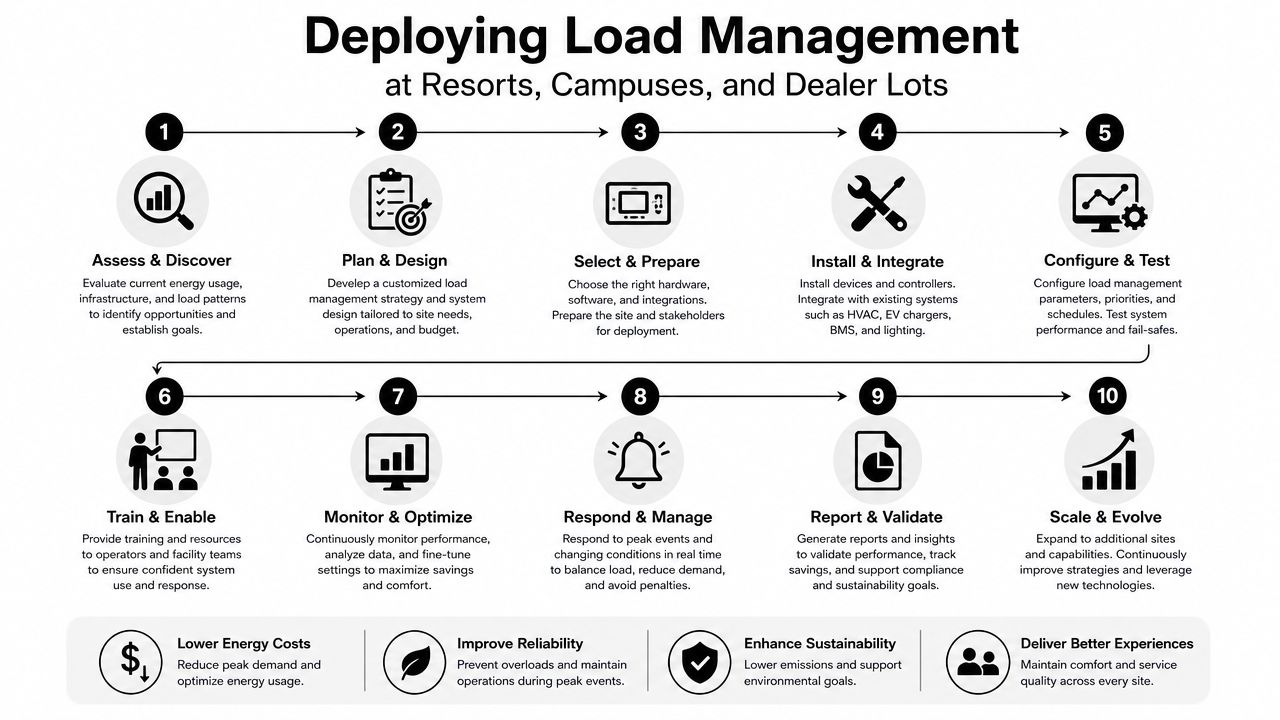
For a resort or campus, the first step is always a site assessment. You need to know what the service can support, what the building already draws, and whether the chargers are sitting in a corner of the site that's easy to meter or a corner that's already congested. From there, the decision is whether the system needs a service upgrade now, a delayed upgrade later, or no upgrade at all because the controller can stay inside the existing envelope.
For a dealer lot, the sequence is similar but the priorities shift. The lot may need fleet-aware charging, quick resets, and a layout that keeps service bays and customer handoff areas separate from inventory charging. If you're serving golf carts or street-legal low-speed vehicles, the equipment may sit in a predictable parking pattern rather than a fast-turnover public setting, which makes control logic and billing design even more important. The Solana EV resort transportation guide is a good example of how charging can sit inside a broader guest-transportation operation rather than act as a standalone amenity.
A practical deployment path usually looks like this:
- Confirm the service boundary: find the true ceiling at the panel or service entrance, not the optimistic one on a spec sheet.
- Choose protocol-compatible hardware: avoid getting locked into a charger that can't speak to the controller you plan to use.
- Define priority rules early: guest-accessible spaces, fleet units, or service-critical vehicles should not be decided after install day.
- Model the tariff before the trenching: utility rates can change the economics even when the hardware works perfectly.
- Plan for monitoring and commissioning: without live visibility, the site is guessing.
- Leave room for future integration: solar, storage, and demand-response features become easier if the original design expects them.
The mistake I see most often is buying for the current parking count and ignoring the site's operating pattern. A resort with calm mornings and busy evenings needs a different strategy than a dealer with midday service peaks. The hardware may look similar, but the operating logic rarely is.
Real-World Examples and the ROI of Doing It Right
The strongest case for managed charging is the cost curve. Analysts at Brattle Group found that active managed charging can reduce annual electric system costs by about 30% compared with passively managed or unmanaged charging. In one case, a site with roughly $800 in annual unmanaged charging cost per EV saw $245 in annual savings per EV.
For a resort or dealer, that changes the conversation quickly. The value is not just “more chargers on the lot.” It is also how much of the existing electrical system you can keep using before you have to expand it.
Capacity is money
That same Brattle analysis found that managed charging can let the primary distribution system host 1.3x more EVs than unmanaged charging and 2.3x more than a passive time-of-use strategy. It also found distribution grid costs can be reduced by up to $230 per EV per year in the long run.
That matters because site owners do not usually buy transformers for fun. They buy them because the site ran out of headroom. When software lets you use more of the service you already paid for, the business case gets easier to defend.
The scale of the grid problem is already large
NYSERDA estimates that unmanaged transportation electrification load in New York rises from 38 MW in 2020 to 26.9 GW by 2050. It also says the peak charging load occurs between 7:00 and 8:00 p.m. across all modeled years, while managed charging can avoid about 14 GW of peak demand by 2050, which is roughly 23% of New York State's expected peak demand.
If the biggest question is “How many chargers can I add?”, the more useful question is often “How much of the site can I coordinate before I buy more infrastructure?”
That is why the economics need to be read through the whole site, not just the chargers. A resort with slow overnight demand, a campus with shared parking, and a dealer lot with service-lane peaks can all arrive at very different answers from the same hardware catalog. The software matters, but so does the transformer room and the tariff sitting underneath it.
For operators who want to think in operational terms, the Solana EV fleet management cost analysis is a useful reminder that charging economics usually live inside a larger vehicle-operations budget, not in isolation.
Mixing EVs with Solar, Storage, and the Rest of the Building
A resort with rooftop solar, a campus with a central plant, or a dealer lot with service bays and evening charging all run into the same problem. EV charging is rarely the only electrical load on the site. It has to share capacity with lighting, HVAC, kitchen equipment, office power, pumps, and whatever else is already drawing from the same service.
That is why the old model of treating charging as a separate island falls apart quickly. Once the first charger is installed, it sits inside a much busier electrical map, and the primary job becomes coordination. You are deciding how to split power across cars, buildings, and any onsite energy assets without pushing the site past what the transformer, panel, or tariff can handle.
A smart-charge survey of priorities put site and distribution capacity management near the top, along with V2G and virtual power plants that include EVs and other site loads, and highly dynamic pricing for EV charging University of California eScholarship. That lines up with what operators are asking for in practice. They do not just want chargers that stay within limits, they want a control system that can make the charging fleet behave like part of the site's energy plan.
That broader view matters even more when solar, storage, HVAC controls, and EV charging share the same electrical service. In microgrid-integrated charging, research has shown that charger settings affect harmonics and voltage stability, and that smart load management techniques such as schedule-based disconnection and load balancing can reduce those problems. In plain language, charger control is not just about who gets power first. It can also change how cleanly the rest of the electrical system behaves.
A useful way to frame the problem is this. EV charging is no longer just a parking amenity. It is one participant in a site-energy strategy that may also include building loads, onsite generation, backup power, and utility participation. That is why I push owners to design for coordination instead of trying to bolt EV charging onto an already strained panel and hoping software will smooth over the mismatch.
The right question is not whether the site can charge cars. It is whether the site can coordinate cars with everything else already drawing power.
For resorts and campuses, that mindset pays off over time. A charger network that only fits today's EV count can become hard to operate once the building adds batteries, changes hours, or shifts how it uses the property. A coordinated system is easier to grow into, because it was designed to share the site rather than compete with it.
A Practical Checklist and How Solana EV Fits In
Before you sit down with an electrician, utility rep, or charger vendor, carry a short checklist with you.
- Verify the service capacity: don't rely on assumptions from the building history.
- Ask how the system enforces the 6 A floor per port: that's a basic compliance question, not a nice-to-have.
- Choose chargers that speak the same control language: OCPP-native or otherwise protocol-compatible hardware is easier to manage.
- Model the tariff before you finalize the design: the utility bill can make a technically sound project hard to operate.
- Reserve money for monitoring and commissioning: a managed site without visibility is only half-managed.
- Plan for solar, storage, and V2G later: you don't have to deploy them now, but you'll be glad if the control stack can accept them.
The tariff question deserves special attention. Grid Strategies recommends kWh-based rates with no demand component for EV charging station owners for at least 15 years to support adoption Grid Strategies. That's not just a policy debate, it's a project viability issue. A site can be technically compliant and still face ugly economics if the rate structure punishes the wrong behavior.
For dealers, Solana EV fits into this conversation as one option in a broader ecosystem because it supports large protected territories, Dealer Direct floor plan financing, retail financing options, and a 24/7 parts portal. Those aren't charging features, but they matter when a dealer is deciding how to build a vehicle and charging business together instead of treating them as separate purchases.
If you're planning chargers for a resort, campus, or dealer lot, start with the service entrance, not the brochure. Then choose the software, hardware, and tariff structure that can live with that limit. If you want a partner that understands how electric carts, site operations, and dealer support fit together, visit Solana EV and use that conversation to shape a charging plan that matches your property.