
So, how much does a new golf cart cost? You can expect to see price tags ranging anywhere from $8,000 to over $20,000. If you're looking at the used market, that range drops to about $4,000 to $10,000.
Of course, the final number depends entirely on what you're buying—a simple, no-frills model, a high-end luxury cart, or a fully street-legal vehicle.
Decoding the Golf Cart Price Tag
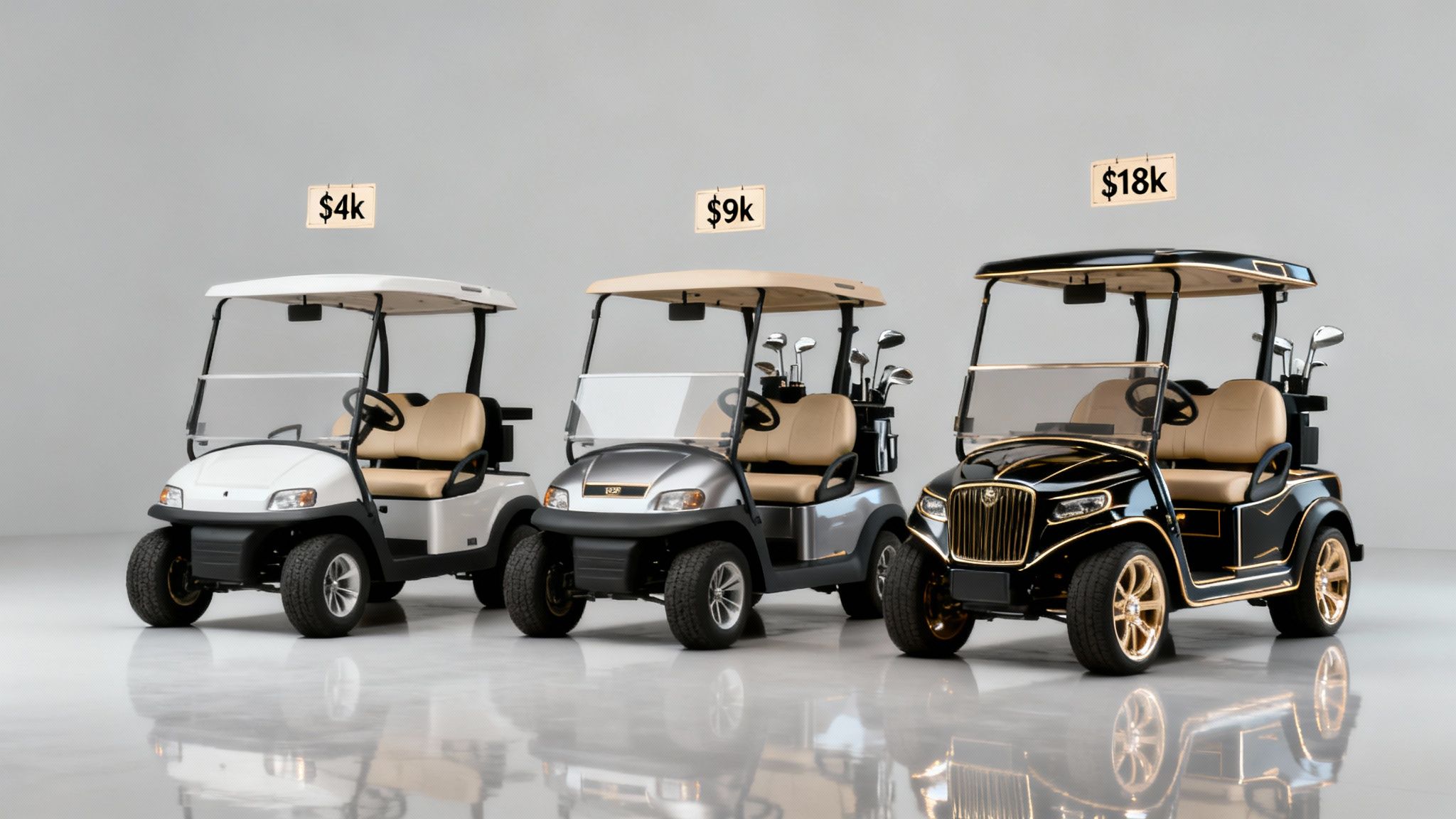
Trying to pin down a single price for a "golf cart" is a bit like asking for the price of a "car." The answer is always, "Well, it depends." A basic two-seater meant for the back nine is a completely different machine—with a completely different price—than a customized, street-legal Low-Speed Vehicle (LSV) built for cruising around the neighborhood.
That sticker price you see is just the beginning. Think of it as a starting point on a very wide spectrum of options and features.
This guide will give you a practical framework for making sense of it all. We’ll break down the typical cost ranges for new and used carts, from the most basic models to premium LSVs. Getting a handle on these initial numbers is the first step to matching your budget with what you actually need, whether you're buying a single cart for the family or an entire fleet for a resort.
At-a-Glance Golf Cart Price Ranges
To get our bearings, let's look at a quick comparison of the different categories. It’s no surprise that a brand-new cart costs more; you're paying for that "fresh off the lot" condition, the latest tech, and a solid manufacturer's warranty. On the flip side, a used cart can save you a bundle upfront, but you have to be mindful of potential wear and tear or an aging battery that might need replacing down the road.
Here's a simple way to think about the different tiers:
- New Basic Carts: Your standard, reliable models perfect for the golf course or managing a large property.
- New Premium & LSV Carts: These are the upgraded models with better performance, more creature comforts, and all the safety gear required to be street legal.
- Used Basic Carts: A great entry point if you're on a budget and don't need all the latest bells and whistles.
- Used Premium & LSV Carts: This is where you can get high-end features for less, but a thorough inspection is a must.
The table below lays out these starting price points to give you a clear visual reference.
| Cart Type | Typical New Price Range | Typical Used Price Range |
|---|---|---|
| Basic Recreational Cart | $8,000 – $12,000 | $4,000 – $7,000 |
| Premium Recreational Cart | $12,000 – $16,000 | $7,000 – $10,000 |
| Street-Legal (LSV) Cart | $14,000 – $20,000+ | $9,000 – $15,000+ |
With these benchmarks in mind, we can now dig into the specific factors that push these prices up or down.
What Really Drives the Final Price?
That base price you see on a golf cart? Think of it as a starting point. Several key factors can swing the final cost up or down, and knowing what they are is the key to building a cart that fits your needs and your budget.
It’s a lot like building a custom home. The floor plan has a base price, but the final number really depends on your choices—are you going with laminate countertops or granite? Standard appliances or a high-end chef's kitchen? The same logic applies here. The powertrain, battery type, and fancy add-ons are what truly shape the final price and performance of your ride.
Powertrain and Battery Tech: The Heart of the Cart
The engine is the heart of any vehicle, and in the golf cart world, you've got a few options that really move the needle on price.
- Gas Engines: You'll often find these in heavy-duty or utility carts. Gas gives you consistent power and a longer range, no doubt. The upfront cost is usually a bit lower, but you have to factor in ongoing fuel costs and more hands-on mechanical maintenance.
- Electric DC Motors: This is your classic electric option. DC (Direct Current) motors are workhorses—reliable and affordable, which is why you see them in so many basic fleet carts. The trade-off is that they aren't as efficient as newer tech.
- Electric AC Motors: This is the premium electric choice. AC (Alternating Current) motors give you more punch, better efficiency, and faster acceleration. That superior performance comes with a higher price tag, but it’s a difference you can really feel, especially on hilly terrain.
For electric carts, the battery is just as important as the motor, and it's one of the biggest single costs.
Choosing between lead-acid and lithium-ion batteries is like picking between a standard car engine and a high-performance hybrid. One gets the job done at a lower upfront cost, while the other is a long-term investment in power, efficiency, and pure convenience.
Lead-acid batteries are the old-school, cheaper route. But they're heavy, need regular upkeep (like topping off water levels), and typically only last about 4 to 6 years. On the flip side, lithium-ion batteries cost more when you buy them, but they’re completely maintenance-free, weigh a lot less (which boosts performance), charge faster, and can last 10 years or more. That long-term value is making them the go-to choice for more and more buyers, even with the higher initial price.
Performance Upgrades and Customization
Beyond the basic guts, performance upgrades are where the price can really start to climb. Many people choose to add enhancements for more speed, better handling, or to get their cart ready for specific environments.
A speed controller upgrade, for instance, can unlock a higher top speed—a must-have in many large communities. Lift kits and heavy-duty suspension don't just give the cart a tough look; they’re essential if you plan on tackling off-road trails. These aren't just cosmetic tweaks; they’re real investments that shape what your cart can do. To make smart choices, it helps to know how to determine the true value of a vehicle beyond just the sticker price.
Accessories: Making It Your Own
Customization is where a golf cart goes from a vehicle to your vehicle. It's also where the costs can add up fast. There’s a reason the accessory market is booming—it lets you add comfort, style, and real utility.
And this market is getting bigger every year. Projections show the golf cart accessory market is expected to jump from USD 459.8 million in 2026 to a massive USD 884.4 million by 2035. In North America, the U.S. alone is set to account for 91% of that revenue.
Some of the most popular (and price-adding) accessories include:
- Premium Seating: Upgraded, contoured seats in high-end materials.
- Sound Systems: Integrated Bluetooth speakers for your tunes.
- Enclosures: Full or partial covers for all-weather riding.
- Custom Wheels and Tires: Bigger, stylish wheels or specialized tires for different terrains.
- LED Lighting: From underglow kits to powerful light bars.
Every add-on makes the cart better, but it also adds to the bottom line. The trick is to figure out which accessories will give you the most bang for your buck based on how you’ll actually use your cart. Don't forget that brand reputation and warranty also play a quiet but important role, often justifying a higher price for the peace of mind that comes with proven quality and solid dealer support.
Street Legal Versus Recreational Carts
When you see a big price jump between two golf carts, it often boils down to one crucial question: is it a simple recreational cart, or a fully street-legal Low-Speed Vehicle (LSV)? They might look similar at a glance, but the price difference is a direct result of what they're legally allowed to do and the equipment required to do it.
Think of it like this: a recreational cart is like a riding lawnmower. It’s perfect for its intended environment—your property, the back nine, or a private community path. An LSV, on the other hand, is more like a subcompact car. It has to meet a strict set of safety and manufacturing standards to be allowed on public roads alongside other traffic.
Those standards, from headlights to seatbelts, are what build up the final price tag.
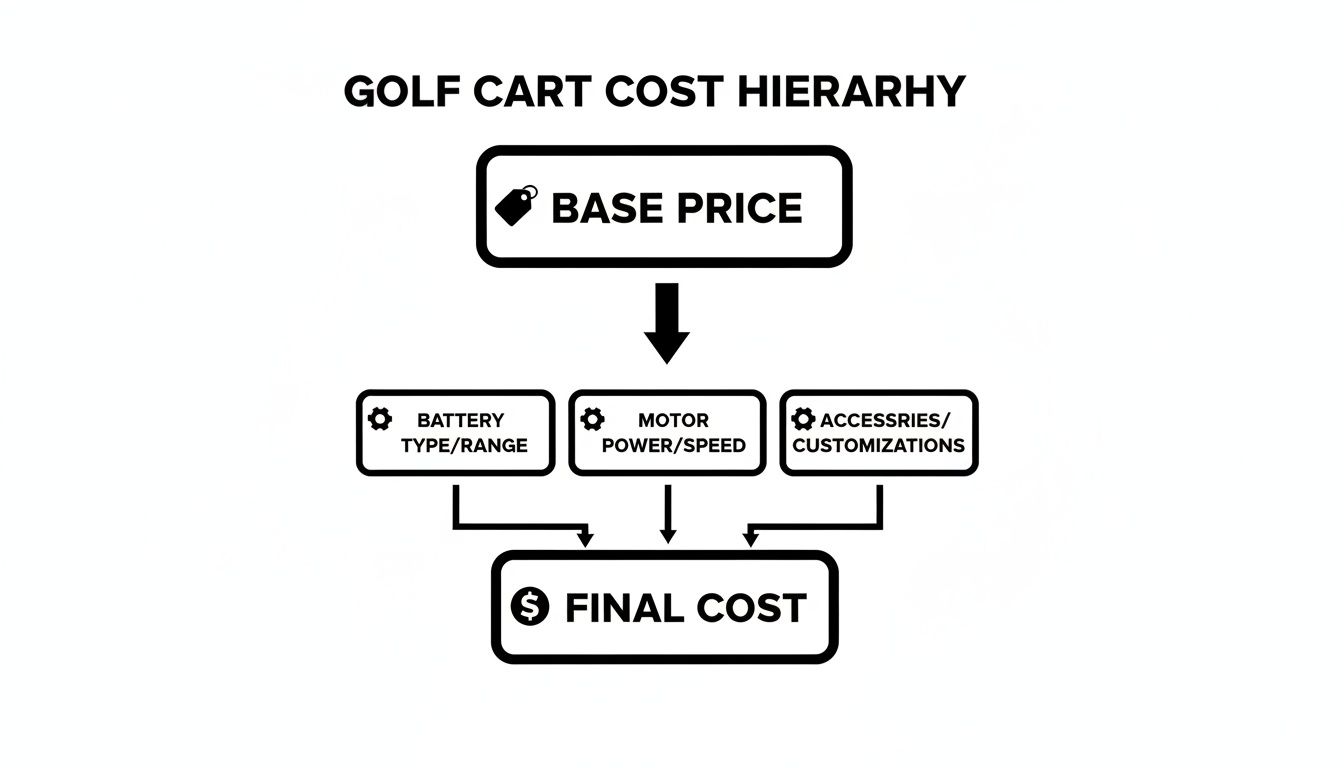
As you can see, a cart’s base price is just the starting point. The motor, battery, and especially the accessories and safety features required for an LSV are what really shape the final cost.
What Makes a Golf Cart an LSV?
A standard golf cart is purpose-built for the golf course or private land. An LSV is engineered from the ground up to legally drive on public roads, almost always those with a speed limit of 35 mph or less. To earn that "street-legal" status, the vehicle has to meet specific federal safety standards set by the National Highway Traffic Safety Administration (NHTSA).
This isn't just about bolting on a few extras. The process of turning a basic cart into a road-ready vehicle involves adding a whole checklist of required safety components. Each of those parts adds a real manufacturing cost, which is directly reflected in the higher sticker price. You're not just paying for cool features; you're paying for compliance and safety.
To give you a clearer picture, let's look at what separates a basic cart from an LSV.
Recreational Cart vs. Street-Legal LSV Feature Comparison
| Feature | Recreational Golf Cart | Street-Legal LSV |
|---|---|---|
| Headlights & Taillights | Optional / Basic | Required |
| Brake Lights | Optional | Required |
| Turn Signals | Not Included | Required |
| Horn | Not Included | Required |
| Windshield | Optional / Plastic | Required (DOT-approved safety glass) |
| Mirrors | Optional | Required (Rearview and side mirrors) |
| Seat Belts | Optional | Required (For all seating positions) |
| Reflectors | Optional | Required (On all sides) |
| Vehicle ID Number (VIN) | No | Required (For registration & insurance) |
As the table shows, an LSV comes factory-equipped with the same essential safety gear as your car. It’s this mandatory equipment that elevates both the cart's utility and its price.
The Anatomy of a Street-Legal Price Tag
So, what are these non-negotiable features? The list is designed to make sure the vehicle is visible, predictable, and safe for everyone on the road.
Key required LSV components include:
- Headlights, Taillights, and Brake Lights so other drivers can see you, day or night.
- Turn Signals to clearly communicate your intentions.
- Reflectors on all sides for enhanced visibility.
- A Horn to alert pedestrians and other vehicles.
- A Windshield made of automotive-grade safety glass, not just acrylic.
- Rearview and Side Mirrors to give you a full view of your surroundings.
- Seat Belts for every single passenger.
Critically, every true LSV is issued a unique 17-digit Vehicle Identification Number (VIN), just like a car or truck. This VIN is essential for getting the vehicle properly registered, titled, and insured—all necessary steps for driving on public roads. Our guide on what makes a golf cart street legal gets into the weeds on these specific requirements.
The higher cost of an LSV isn't just for parts; it's the price of admission to public roads. You're paying for the engineering, compliance, and freedom to go beyond the boundaries of your property or community, which dramatically increases the vehicle's practicality and potential resale value.
Sure, the initial investment is higher. But for anyone living in a planned community, managing a resort, or simply wanting a convenient and efficient way to run local errands, the LSV is an absolute game-changer. That extra cost unlocks a level of freedom and function that a recreational cart just can't match.
Calculating Your Total Cost of Ownership
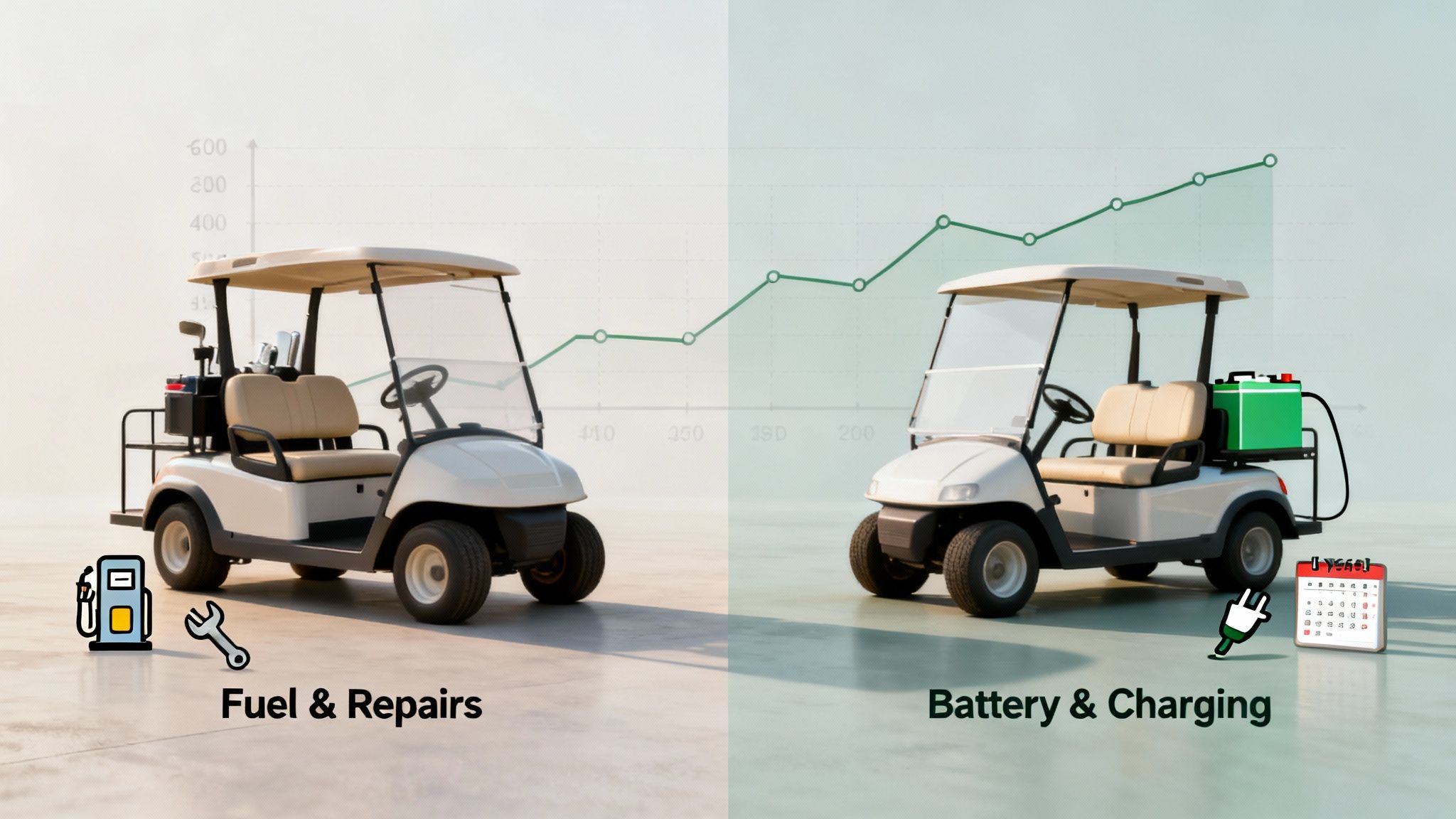
The sticker price is just the tip of the iceberg. To really get a handle on what a golf cart will cost you, you have to look past that initial number and think about the Total Cost of Ownership (TCO).
It's a lot like adopting a dog. The fee to bring them home is one thing, but the real cost comes from years of food, vet bills, and chew toys. It's the same deal with a golf cart—ongoing expenses are part of the package, and they can swing wildly depending on the cart you pick.
Thinking this way is crucial for making a smart long-term decision. The cart that looks like a bargain today might end up costing you a whole lot more over the next five years.
Unpacking Ongoing Maintenance Costs
Maintenance is where the numbers can really start to diverge, and it all boils down to what's powering your cart. Gas carts come with a familiar list of chores: oil changes, filter swaps, and engine tune-ups. These are small, steady costs that add up over time.
Electric carts, on the other hand, are much simpler machines with fewer moving parts to break down. Their main maintenance story is all about the battery, and this is where the difference between old-school lead-acid and modern lithium becomes crystal clear.
- Lead-Acid Batteries: These are the traditional choice and cheaper to buy upfront. But they demand your attention, requiring regular water top-offs and terminal cleaning. Their biggest drawback is a short lifespan; you’ll be buying a whole new set every 4 to 6 years, which is a huge recurring hit to your wallet.
- Lithium-Ion Batteries: They do cost more when you buy the cart, but lithium batteries are a "set it and forget it" solution—zero maintenance required. Better yet, they last 10 years or more, sometimes even outliving the cart. This completely erases the expensive battery replacement cycle, making them a much better deal in the long run.
We break down the numbers even further in our guide on golf cart battery replacement cost.
Factoring in Fuel, Insurance, and Repairs
Beyond the big-ticket items like batteries, there are other day-to-day costs to keep in mind.
For gas carts, you've got a constant fuel bill that goes up and down with pump prices. The electric equivalent is the cost to charge, which is almost always significantly cheaper and more predictable than gas.
The real economic advantage often emerges over time. A premium electric cart with a higher upfront cost can become more economical within five years than a cheaper gas model that constantly requires fuel and mechanical upkeep.
And don't forget insurance, especially if you have a street-legal LSV. Just like a car, an LSV needs proper liability coverage for use on public roads, so you'll need to budget for that premium.
Finally, even the best-built carts will need a little TLC eventually. It’s always smart to have a little cash set aside for things like new tires or brake service. With the U.S. golf cart market projected to hit $1.3 billion in revenue by 2026, it's clear these vehicles are here to stay, and so is the need for parts and service.
Why Do Premium Golf Carts Cost More?
When you’re looking at the price tag on a premium golf cart, it’s fair to ask: what am I actually paying for? The difference isn't just about a fancy logo. It’s a completely different way of thinking about the vehicle—less like a simple purchase and more like a long-term investment in quality. The best brands build value into every bolt, justifying the cost with better engineering, tougher materials, and an ownership experience that’s simply in another league.
This goes way beyond just tacking on a few extra features. It’s about a core commitment to building something that lasts, something you can feel the moment you get behind the wheel.
Better Bones: Quality Engineering and Materials
A top-tier golf cart is built on a superior blueprint. Brands invest a ton into research and development, designing frames that are both stronger and lighter, suspension systems that glide over bumps, and body panels made from advanced materials that won't fade or crack after a few seasons in the sun. It’s like the difference between a mass-produced coffee table and a handcrafted piece of furniture—one does the job, but the other is built to be passed down.
This dedication to quality extends to the parts you don't see. Premium carts use higher-grade wiring, connectors sealed against moisture, and more powerful motors. All these components work in harmony to create a vehicle that not only performs beautifully right off the lot but also holds up to years of real-world use, whether you’re navigating a muddy trail or dealing with salty coastal air.
Smarter Tech for a Superior Ride
Advanced technology is another huge part of the equation. We're not talking about gimmicks; we're talking about integrated systems that genuinely improve how the cart performs, how safe it is, and how easy it is to use.
- Smart Battery Management Systems (BMS): For lithium-powered carts, this is a game-changer. A sophisticated BMS acts like a brain for the battery, constantly monitoring its health and optimizing charging to dramatically extend its lifespan.
- AC Drive Systems: As we mentioned earlier, high-end carts have all but standardized on AC motors. They deliver more torque for climbing hills, run more efficiently, and even recapture energy through regenerative braking.
- Intuitive Digital Displays: Forget squinting at a tiny gauge. Clear, backlit screens give you all the vital info—speed, battery level, system diagnostics—at a quick glance, making the whole experience safer and more enjoyable.
These aren't just bells and whistles. They are meaningful upgrades that create a more reliable and fun-to-drive vehicle, and they absolutely factor into the higher price.
The Value of Warranty, Support, and Resale
A big piece of that premium price is the peace of mind that kicks in after you’ve swiped your card. The best brands stand by their work with comprehensive warranties that cover the important stuff for years, shielding you from the cost of unexpected problems.
A strong warranty and a dedicated dealer network are the bedrock of a premium ownership experience. You're not just buying a vehicle; you're buying access to expert support and the confidence that help is available when you need it.
This level of brand support has a direct impact on what your cart is worth down the road. A well-cared-for cart from a respected manufacturer like Club Car, E-Z-GO, or Solana EV will hold its value far better than a generic, no-name model. When it’s time to upgrade, you’ll get a much bigger chunk of your initial investment back.
This confidence in quality is fueling incredible growth. The global golf cart market was valued at around USD 2.44 billion in 2026 and is on track to hit USD 3.24 billion by 2031. This surge isn’t just happening on the fairway; it's being driven by resorts, master-planned communities, and off-road enthusiasts who all demand vehicles they can count on. You can get more insights on the booming golf cart market on mordorintelligence.com.
In the end, paying for a premium cart means you're getting the whole package: smarter engineering, better tech, stronger support, and a vehicle that’s worth more when it’s time to sell.
Making a Smart Purchase with Financing and Dealer Support
Now that you know what drives the price of a golf cart, you’re ready to make a move. But getting the best overall value isn't just about picking the right model—it's about having a smart strategy for how you'll pay for it and who will support you after the sale.
Financing is a fantastic tool for making a premium, reliable golf cart fit into your budget. Instead of one big upfront payment, you can spread the cost out over time. This makes it much easier to afford a durable, feature-rich cart that will serve you better in the long run.
The right dealer is your partner in ownership, not just a salesperson. They provide the expert service, transparent pricing, and dedicated support that transforms a simple transaction into a great long-term experience.
Think of it this way: choosing the right dealer is just as important as choosing the right cart. A reputable dealer is more than just a place to buy; they become your go-to resource for maintenance, repairs, and genuine accessories for years to come.
Finding the Right Dealer and Financing
When you're checking out different dealers, look for a proven track record. Do they have great reviews? Is their service center clean and professional? A good dealer will be able to answer all your questions about warranties and maintenance schedules without skipping a beat.
On top of that, the best dealers usually have their own financing programs or relationships with lenders, which can simplify the whole process and get you favorable terms. For more general information on this topic, you can find expert guidance on payments and financing from specialized resources.
Good dealership support is becoming more important every day, especially as the market grows worldwide. The Asia-Pacific region, for instance, is projected to see a 7.1% compound annual growth rate from 2026-2035. That market is expected to hit $525 million by 2030, all fueled by commercial and industrial demand.
Negotiating the Complete Package
When it's time to talk numbers, remember that you're negotiating for more than just the sticker price. A truly smart purchase is a complete package.
Make sure your final deal covers all these bases:
- The Vehicle: The exact model and powertrain you’ve decided on.
- Essential Accessories: Any extras you want, like a premium sound system, all-weather enclosure, or a lift kit.
- Warranty Terms: Get clear details on the coverage length for the battery, motor, and other critical parts.
- Ongoing Support: Ask about their service policies and what their labor rates are for future tune-ups and repairs.
Discussing all these elements at once prevents any unwelcome surprises down the road and ensures you’re getting the best total value for your money. And if you have a unique credit situation, don't worry—there are often solutions available. You can learn more about golf cart financing with bad credit in our article.
Got Questions About Golf Cart Prices? We Have Answers.
When you're zeroing in on the perfect golf cart, a few last-minute questions always seem to pop up. Getting straight answers is the best way to make sure you're buying with confidence, not just hope. Let's tackle some of the most common things people ask so you can avoid any surprises down the road.
We’ll dig into whether a custom build really saves you money and what the true cost difference is between gas and electric carts over time. Nailing down these details is how you find the best value for your money.
Is It Cheaper to Build a Cart Myself or Buy One?
It's tempting to think a DIY project will save you a bundle, but in most cases, buying a pre-built cart from a solid brand is actually the more wallet-friendly option. Manufacturers buy parts by the thousand and have their assembly process down to a science, which keeps their costs—and your price—much lower.
A custom build is a classic budget trap. You end up buying parts one by one at retail prices, paying for specialized work if you hit a snag, and burning time troubleshooting parts that don't want to play nice together. All those little things add up fast. With a factory-built cart, you get a clear, upfront golf cart price and a single warranty that covers the whole machine.
What's the Real Cost Difference: Gas vs. Electric?
Looking at the sticker price alone, gas carts often seem like the cheaper way to go. But that’s only half the story. When you zoom out and look at what you’ll actually spend over a few years, electric carts—especially newer ones with lithium-ion batteries—almost always pull ahead.
Think about it: you completely eliminate the weekly gas station runs and the fluctuating fuel prices. Plus, there’s far less maintenance. You can forget about oil changes, spark plugs, and engine tune-ups. That reliability, paired with a quiet, clean ride, makes an electric cart a much smarter investment in the long run.
The initial savings on a gas cart can be quickly wiped out by years of fuel bills and regular engine work. An electric cart might cost a bit more upfront, but it pays you back with lower, predictable costs and way more convenience.
How Much Is a Used Golf Cart Worth?
A golf cart's resale value really hinges on a few key things.
- Brand Reputation: Carts from well-known manufacturers simply hold their value better because people trust their quality and durability.
- Condition & Upkeep: A well-maintained cart with service records will always fetch a higher price.
- Battery Type: This is a big one. Carts with modern, long-lasting lithium batteries are far more desirable and retain their value much better than ones with older lead-acid systems.
- Street-Legal Status: An LSV will always command a higher resale price. Its versatility for neighborhood trips and road use gives it a much broader appeal.
Bottom line? A well-cared-for, street-legal LSV from a top-tier brand is a solid asset that can hold a surprising amount of its original value.
Ready to see what a premium electric vehicle that blends performance, style, and real long-term value looks like? Solana EV offers a full lineup of expertly engineered, street-legal carts designed to elevate every trip. Discover the perfect model for your lifestyle and see why our commitment to quality makes all the difference. Check out our vehicles today.