
Absolutely. Getting golf cart financing with a low credit score isn't just possible—it's something we see happen all the time. A tough credit history can feel like a roadblock, but it's really just a hurdle. Specialized lenders and even in-house dealership programs are designed specifically for buyers who've had a few financial bumps along the way.
It’s all about knowing the new rules of the game and setting yourself up for success.
Your Credit Score Is Not the Final Word
The old myth that a bad credit score is an automatic "no" for any major purchase just doesn't hold true anymore, especially in the world of powersports. Getting the keys to a new or used golf cart is more within reach than ever.
Many lenders—including those we partner with here at Solana EV—have thankfully moved beyond a single number. They're more interested in your complete financial picture, recognizing that a score from years ago doesn't always reflect your situation today.
This means other parts of your application can carry serious weight:
- Steady Income: More than anything, lenders want to see that you have a reliable source of income. A few recent pay stubs or bank statements showing consistent deposits can be your most powerful asset.
- Employment History: A stable job tells a story of reliability. It gives lenders confidence that you can handle future payments.
- A Solid Down Payment: This is the single best way to improve your odds. A larger down payment lowers the amount you need to borrow, which reduces the lender's risk and shows you're serious.
Understanding the Modern Lending Landscape
Let’s face it, financing is how most people buy their golf carts now. The numbers don't lie—roughly 70% of golf cart enthusiasts finance their purchase instead of paying in cash. This huge demand has pushed lenders to be more flexible and create programs for a much wider range of credit profiles.
Many dealerships are now equipped to work with applicants who have scores dipping as low as 550.
This is a huge shift. It means your application gets judged on your current ability to pay, not just past hiccups. Before you dive in, it’s a smart move to get a clear idea of what different models cost. A quick look at https://solanaev.com/electric-golf-cart-prices/ can help you set a realistic budget from the start.
The new financing reality for vehicles like golf carts is this: it's less about punishing past credit mistakes and more about gauging your current financial health. Lenders are in the business of lending, and they’re actively looking for ways to approve you if the risk makes sense.
A Quick Glance at Bad Credit Financing
To get a clearer picture, here’s a quick summary of what to expect when you're navigating the financing process with less-than-perfect credit.
Bad Credit Financing At a Glance
| Factor | What to Expect With Bad Credit | Pro Tip |
|---|---|---|
| Interest Rates | Higher than average, typically 10% – 25% APR or more. | Make a larger down payment to reduce the principal and total interest paid. |
| Down Payment | A down payment of 10% – 20% is often required. | The more you can put down, the better your chances of approval and the lower your monthly payment. |
| Loan Terms | Shorter loan terms, usually 24-48 months, to minimize lender risk. | While this means a higher payment, you'll pay off the cart faster and save on total interest. |
| Lender Options | Fewer options. You'll likely work with subprime or specialized lenders. | Ask the dealership about their financing partners. They often have relationships with lenders who specialize in these situations. |
| Approval Process | More documentation needed (pay stubs, bank statements, proof of residence). | Gather all your documents before you apply to speed things up and show you're organized and serious. |
This table isn't meant to discourage you, but to prepare you. Knowing these details upfront helps you walk into the dealership with confidence and realistic expectations.
Learning from Other Industries
The challenges of getting a loan with a rocky credit history aren't unique to golf carts. Other industries have been navigating this for years, and we can learn a lot from their playbooks.
For example, a great article on restaurant equipment financing with bad credit highlights the same core principles. No matter what you're buying, the fundamentals are the same: show stable income, bring a down payment, and connect with the right lender. It’s proof that a low score is a manageable challenge, not a deal-breaker.
Exploring Your Financing Options Beyond the Bank
When your credit has seen better days, walking into a big bank for a loan can feel like hitting a brick wall. They often lean on rigid, automated systems that flag a low score and shut the door before you’ve even had a chance. The good news is, the world of golf cart financing with bad credit has opened up well beyond those traditional lenders.
Your best bet is to work with lenders who actually get the asset you're buying and are willing to look at your whole story, not just a number. This means focusing on channels that live and breathe powersports or work hand-in-hand with dealerships every day.
Dealership and In-House Financing
This is almost always the easiest and most direct route. Dealerships, particularly Solana EV partners, have built-in networks of lenders. They already know who is flexible and who has a track record of working with buyers in situations just like yours.
Some dealers even offer in-house financing, often called "buy here, pay here." Here, the dealership is the bank. This can be a game-changer because the decision hinges less on your past credit history and more on your current ability to make a solid down payment and handle the monthly payments. The dealer wants to sell a cart, so they're motivated to find a way to make it work.
Why This Works: Dealership financing is built on relationships. The finance manager isn't just processing paperwork; their main job is to get you into a golf cart. They'll actually go to bat for you with their lending partners—a level of personal support you just won't find at a massive bank.
Specialized Powersports Lenders
Think of these folks as the experts in financing fun. Companies that focus on loans for motorcycles, ATVs, and, yes, golf carts, play by a different set of rules than a typical auto lender. They truly understand the value and resale market for these vehicles, which makes them much more comfortable using the cart itself as collateral.
This flow chart gives you a good visual of how different credit scores point you toward different financing paths.
The real takeaway here is that even if you're starting from a "bad credit" position, there are clear, established routes to getting the keys in your hand.
One of the biggest advantages of working with these lenders is their modern application process. Many now use a "soft pull" to pre-qualify you, which means they can check your eligibility without it dinging your credit score. A traditional "hard inquiry" can knock your score down 5-10 points, so being able to shop around for rates without that penalty is a huge relief, especially when every point counts.
Credit Unions
Don't forget about your local credit union. Since they're member-owned, not-for-profit institutions, they tend to be more community-focused. This often translates into more personal service and flexible lending standards compared to big commercial banks.
If you're already a member with a good history, they can see your entire relationship with them, not just that three-digit score. That history can be a powerful tool in getting an approval. You might also find they offer better interest rates than other subprime lenders.
As you get ready to apply, tidying up your existing finances can also make a big difference. It's worth looking into the best debt consolidation loans for bad credit to see if you can simplify your monthly bills and strengthen your position as a borrower.
Comparing Your Top 3 Options
| Financing Source | Pros | Cons | Best For… |
|---|---|---|---|
| Dealership Financing | The ultimate one-stop-shop; high approval rates; direct access to multiple friendly lenders. | Rates might be slightly higher; terms may be less flexible than a credit union. | Buyers who want convenience and need a finance expert who speaks "bad credit." |
| Specialized Lenders | They know the true value of the golf cart; many use score-safe soft pulls to pre-qualify you. | Can be tricky to find on your own if you don't go through a dealer network. | Anyone who wants to shop for rates without worrying about damaging their credit score. |
| Credit Unions | Often have lower interest rates; offer personal service based on your relationship. | You have to be a member; they may still have strict income requirements. | Someone with a steady job and an established history with their local credit union. |
Ultimately, getting the right financing is all about looking in the right places. By steering clear of traditional banks and focusing on dealership programs and specialized lenders, you dramatically boost your odds of driving off in a new cart. A great first step is to connect with a golf cart dealership near you and ask about the specific financing partners they work with.
Preparing Your Application for Success
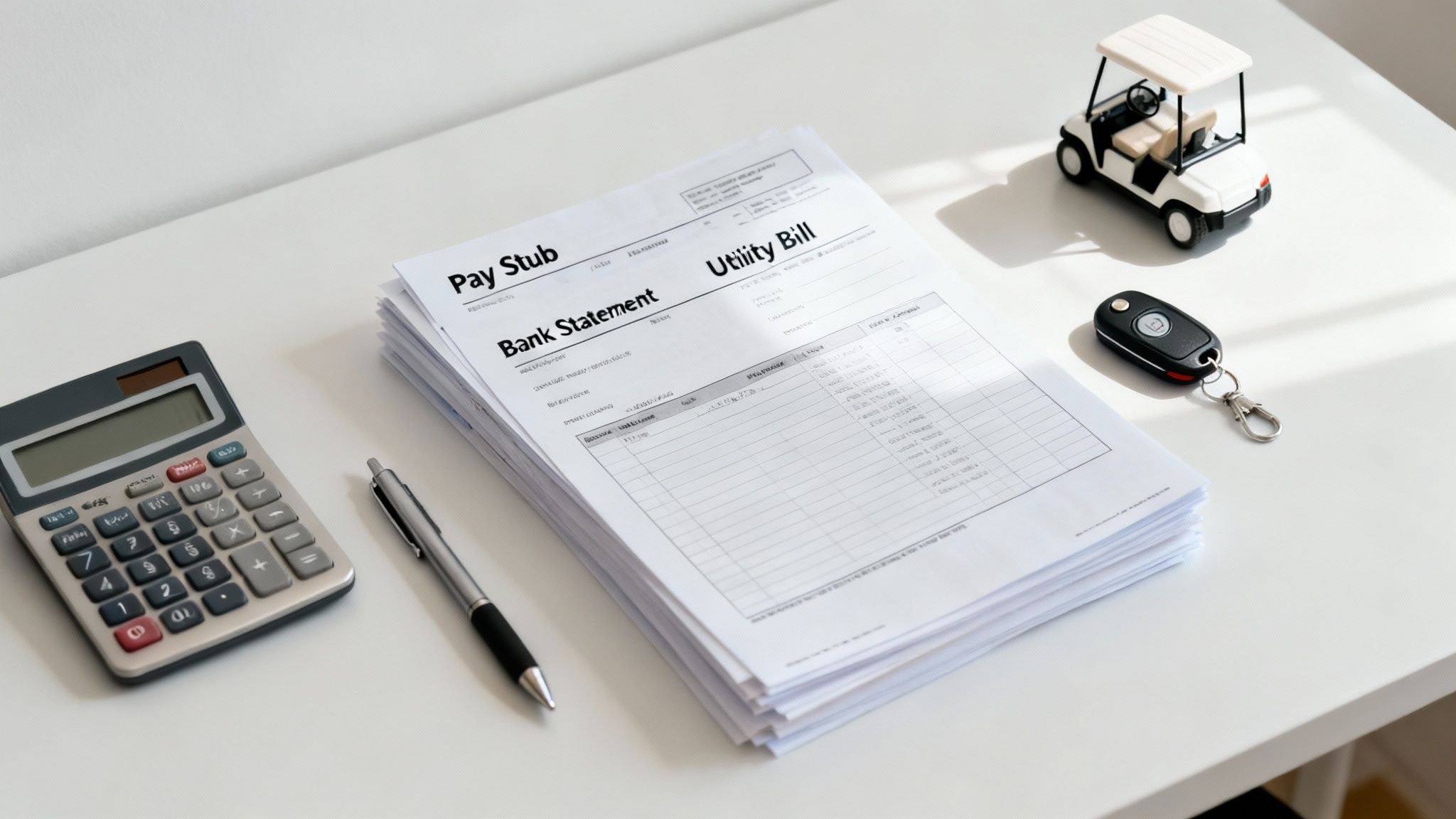
When you're dealing with less-than-perfect credit, your financing application needs to do some heavy lifting. Think of it this way: your credit score is the story of your financial past, but your application paperwork is your chance to prove your current stability.
A well-prepared application can truly make the difference, shifting the lender's focus from a number on a screen to the responsible borrower you are today. It’s all about painting a clear picture of reliability.
Gather Your Financial Story
Before you even start looking at applications, the first step is to get your financial house in order. Walking in with a neat folder of documents—or having them ready to upload—shows you’re organized and serious. It also saves you the headache of scrambling for a pay stub at the last minute.
Here’s a quick checklist of what virtually every lender will ask for:
- Proof of Income: This is your golden ticket. Grab your two most recent pay stubs. If your income is less traditional (you're self-employed or work on commission), get your last two years of tax returns and the last three months of bank statements ready.
- Proof of Residence: Lenders need to see stability. A recent utility bill or mortgage statement with your name and current address works perfectly.
- Identification: A standard, government-issued photo ID like a driver's license is a must.
- Down Payment Funds: Have a bank statement on hand that clearly shows you have the funds available for your down payment.
Pro tip: Scan these documents and save them as PDFs. It makes online applications a breeze.
Your application is your chance to pivot the conversation from your credit score to your income stability. By providing clear, organized proof of consistent earnings, you give the lender a solid reason to say 'yes' based on your ability to pay today.
Know Your Numbers Before They Do
Walking into a negotiation armed with your own financial data is a powerful move. It shows the dealer or lender that you’re prepared and have a realistic grasp on what you can afford. There are two numbers, in particular, you absolutely need to know.
First up is your Debt-to-Income (DTI) ratio. It’s a simple but critical metric lenders use to gauge your ability to take on new debt. To calculate it, just add up all your monthly debt payments (mortgage/rent, car payments, credit card minimums) and divide that by your gross monthly income (what you make before taxes).
For example, if your total monthly debts are $1,500 and your gross monthly income is $4,000, your DTI is 37.5% ($1,500 ÷ $4,000). Lenders generally like to see a DTI below 43%, so calculating this beforehand helps you know how much of a monthly payment you can realistically get approved for.
Second, be ready to own your credit history. Pull your credit report and understand what's on it. If there’s a past bankruptcy or a few collection accounts, don't hide from it. Have a simple, honest explanation ready. Something like, "I had a medical emergency that set me back, but I've been with my current employer for two years and haven't missed a payment since" is far more effective than silence. It allows you to control the narrative.
And if you're leaning toward a pre-owned cart to keep costs down, our guide on buying a used golf cart has some great advice for finding a reliable ride that fits your budget.
Navigating Interest Rates and Loan Terms
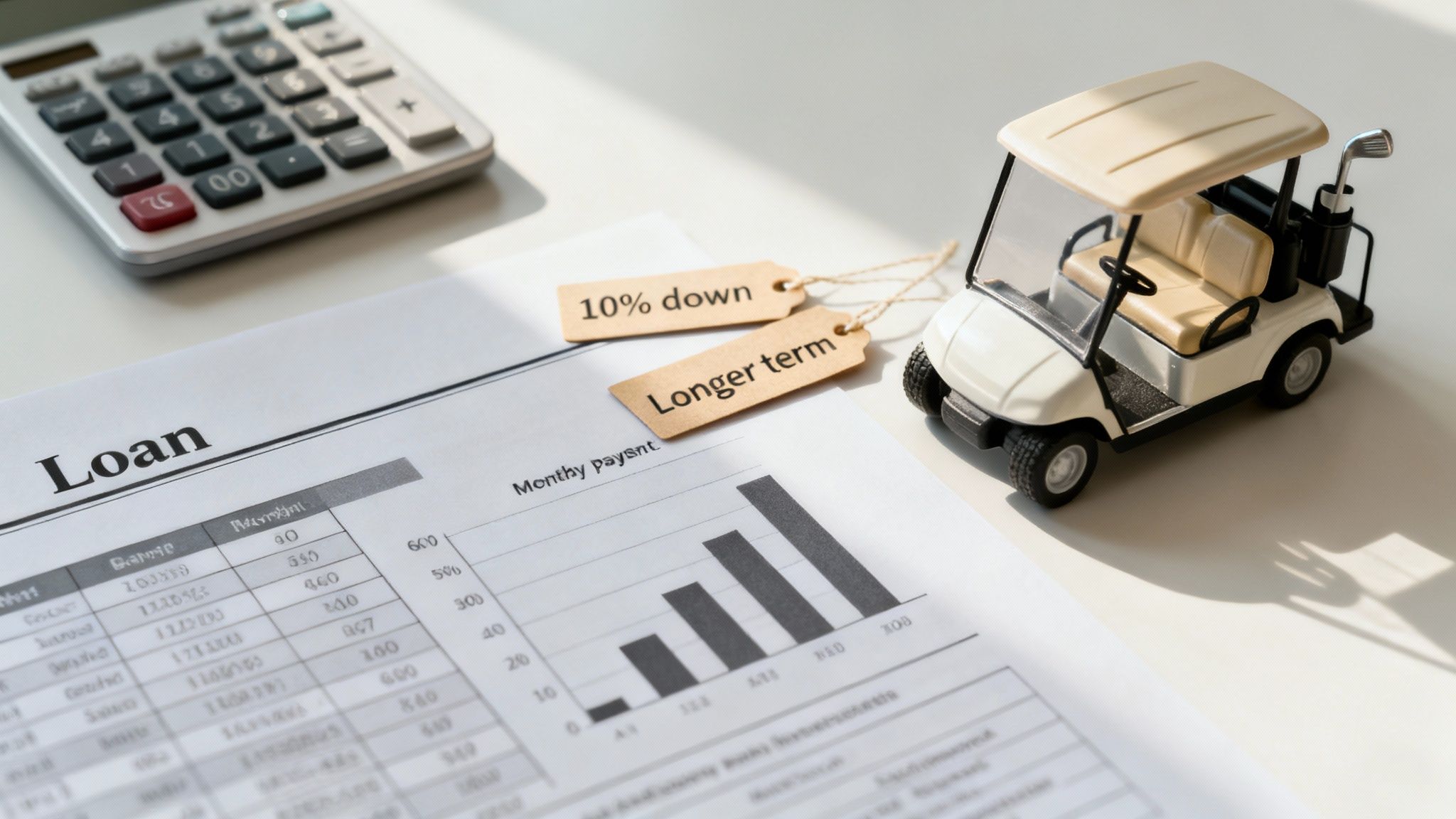
Let's get straight to the point: when you're looking for golf cart financing with bad credit, you're going to see higher interest rates. This isn't personal; it's simply how lenders price for risk. Understanding this from the get-go puts you in the driver's seat, allowing you to focus on finding loan terms that actually fit your budget.
Think of that higher rate as the lender’s insurance policy. They're taking a bigger chance, and that's reflected in the numbers. But here’s the good news—that rate isn't set in stone. You have more leverage than you think to get a better deal.
The Power of a Strong Down Payment
Your single most effective tool for getting better loan terms is a solid down payment. It’s so much more than just a chunk of cash upfront; it’s a powerful signal to the lender that you're a serious buyer. When you put your own money on the line, you're sharing the risk, which instantly makes you a more appealing borrower.
A down payment works its magic in two key ways:
- It shrinks the loan. A smaller loan means less risk for the lender and, more importantly, a smaller monthly payment for you.
- It shows you're committed. It tells the lender you have skin in the game and are invested in the purchase from day one.
While many lenders might ask for at least 10% down on a bad credit loan, pushing for 20% if you can swing it can make a huge difference. It can be the key to unlocking a lower interest rate and more favorable terms. For a deeper dive into the nuances of financing, check out this great resource on the "10 Things to Know About Financing Golf Carts For Sale."
A down payment is your proof of commitment. It's the fastest way to turn a lender's "maybe" into a "yes" and a high interest rate into a more manageable one. Think of it as an investment in a better deal.
To see just how much of a difference this makes, let's look at some real numbers. The table below shows how various down payments affect the total cost of a $15,000 golf cart loan.
Impact of Down Payment on a $15,000 Golf Cart Loan (Example)
| Down Payment | Loan Amount | Estimated Monthly Payment (60 mo. at 15% APR) | Total Interest Paid |
|---|---|---|---|
| 0% ($0) | $15,000 | $357 | $6,420 |
| 10% ($1,500) | $13,500 | $321 | $5,778 |
| 20% ($3,000) | $12,000 | $285 | $5,136 |
| 25% ($3,750) | $11,250 | $268 | $4,815 |
As you can see, putting more money down doesn't just lower your monthly payment—it saves you a significant amount in interest over the long haul. A 25% down payment in this scenario saves you over $1,600 in interest compared to financing the full amount.
Decoding Loan Terms: Short vs. Long
The other major dial you can turn is the loan term—how long you have to pay it back. This creates a classic trade-off between your monthly payment and the total cost of your new golf cart.
- Short-Term Loan (e.g., 36 months): You'll face higher monthly payments, which can be a stretch. The upside? You’ll be debt-free faster and pay way less in total interest.
- Long-Term Loan (e.g., 60 months): This is tempting because it gives you a lower, more manageable monthly payment. Just remember, you'll pay a lot more in interest over the life of the loan, ultimately making the cart more expensive.
Often, lenders will push for shorter terms on bad credit loans to limit their exposure over time. If you can make the higher payment work for your budget, it's a smart move that can save you a bundle.
Look Out for Prepayment Penalties
This is a big one, so pay close attention. A prepayment penalty is a nasty little fee some lenders charge if you decide to pay off your loan ahead of schedule. Your goal with a high-interest loan should be to improve your credit score and refinance for a better rate as soon as you can, maybe in 12 to 18 months.
A loan with no prepayment penalty gives you the freedom to do exactly that. You have to ask the lender directly: "Is there a penalty for paying the loan off early?" If they say yes, treat that as a major red flag. Your first loan is just a stepping stone—don't let a penalty clause trap you in it longer than you have to be.
Creative Strategies for Owning Your Golf Cart
So, you’ve done everything right—you’ve prepped your application, you’ve got a down payment ready, and you still hit a wall with traditional golf cart financing with bad credit. Don't throw in the towel. This isn't a dead end; it's just a detour.
When the main road is blocked, it’s time to find a different path. These strategies can be your bridge to ownership. Each comes with its own set of rules and responsibilities, but they’re powerful solutions for buyers who are determined to get their cart.
Bringing a Co-Signer on Board
One of the most tried-and-true ways to bolster a shaky application is to bring in a co-signer. This is usually a family member or trusted friend with a strong credit history who agrees to put their name on the loan with you.
From a lender's perspective, a co-signer is like an insurance policy. Their good credit score drastically lowers the risk, which often means the difference between a "no" and a "yes." It can even unlock a much better interest rate than you could ever get on your own.
But make no mistake, this is a serious commitment for everyone involved.
- For You (The Buyer): You get the keys to your cart, but the buck still stops with you. Every single payment needs to be on time, because a late payment dings both your credit report and your co-signer's.
- For the Co-Signer: They are legally on the hook for the payments if you can't make them. The loan also shows up on their credit report, which could impact their own ability to get a loan down the road.
This is an arrangement built on trust. It demands a frank, open conversation about expectations before anyone even thinks about signing.
A co-signer isn't just lending you their good name; they're lending you their financial credibility. It's a huge vote of confidence that lenders take seriously, but it comes with a shared responsibility that has to be honored from day one.
Exploring Rent-to-Own Programs
If you need a more gradual on-ramp to ownership without the immediate hurdle of a loan, a rent-to-own program could be a perfect fit. They aren't as common as standard financing, but you can often find them at local dealerships or even with private sellers.
Here’s the typical game plan:
- You agree to rent the golf cart for a set amount of time.
- Each month, a slice of your rental payment gets credited toward the cart's purchase price.
- When the rental term is up, you have the option to buy the cart, using all those accumulated credits as a hefty down payment.
This is a fantastic strategy if you need some breathing room to work on your credit score or save up for the final purchase. You get to use the cart right away while you're paving the way to own it. Just make sure you read the fine print to fully understand the final price, the terms, and what happens if you decide not to buy it in the end.
Using Other Assets as Collateral
Sometimes, the golf cart itself isn't enough to secure the loan, especially if it’s a high-end, custom model. When that happens, some lenders might be open to a secured loan where you pledge another valuable asset as collateral.
This could be a car you own outright, a piece of land, or another item with significant, verifiable value. By putting up this extra security, you dramatically lower the lender's risk, which can make them far more comfortable saying yes to the financing.
Be warned, though—this is a high-stakes play. If you default on the loan, you could lose the collateral. It’s a route best saved for people who are 100% confident in their ability to make the payments but just need that extra nudge to get the deal done.
Frequently Asked Questions About Bad Credit Golf Cart Loans
It's completely normal to have questions when you're looking into golf cart financing with bad credit. Getting straight answers is the best way to feel confident about your decision, so let's tackle some of the most common things people ask.
Our goal here is simple: to clear up any confusion so you can move forward and get the golf cart you really want.
Will Applying for Financing Hurt My Already Bad Credit Score?
This is a big one, and it's a totally valid concern. Nobody wants to see their score take another hit. The good news is that the way lenders handle initial applications has changed for the better.
The trick is to find dealers and lenders that use a "soft credit pull" (or soft inquiry) to pre-qualify you. Think of it as a preliminary check-up. They get to see your credit profile and figure out if you're a good fit for a loan, but it doesn't leave a mark on your credit report. It has zero impact on your score.
A "hard inquiry," which can ding your score by a few points, only comes into play after you've looked at your options, picked a loan you like, and officially decide to apply for it.
Expert Tip: To keep your score safe, get pre-qualified with a few different lenders that use soft pulls. This lets you shop around for the best rates and terms without any risk. Only once you’ve chosen the best offer should you move forward with the formal application that triggers the hard pull.
Can I Finance a Used Golf Cart With Bad Credit?
Absolutely. In fact, it can be a really smart move. Financing is available for both new and used carts, even if your credit has seen better days. Going with a pre-owned cart can actually boost your chances of getting approved.
Why? Because the total price is lower, meaning you're borrowing less money. From a lender's perspective, a smaller loan is a smaller risk, which makes them much more comfortable saying "yes."
Just know that the loan terms might be a little different for a used vehicle. For example, a lender might offer:
- Slightly higher interest rates to account for the cart's age.
- A shorter loan term, like 24 to 48 months instead of a 60-month term for a new one.
But even with those adjustments, the lower overall cost usually makes a used cart a much more manageable option. When you're ready to apply, just have the year, make, and model of the specific cart you’ve picked out.
What’s the Minimum Credit Score to Get a Golf Cart Loan?
There's no magic number here. While a big national bank might want to see a score of 650 or higher, the lenders that specialize in powersports and work directly with golf cart dealerships play by a different set of rules.
Many of these specialty lenders are perfectly happy to work with people who have scores as low as 550.
Better yet, many dealerships with in-house or "buy here, pay here" financing don't really have a strict minimum score at all. They look at the bigger picture.
For them, these factors are way more important:
- How stable is your income?
- What’s your recent employment history look like?
- How much are you putting down?
So, instead of getting hung up on that three-digit number, focus on showing them you're a reliable borrower with a steady income and a decent down payment. That often speaks much louder than an old credit score.
Can I Refinance My Golf Cart Loan Down the Road?
Yes, and you should definitely think of this as part of your long-term plan. That first loan, especially if it has a high interest rate, isn't a life sentence. It's a stepping stone. Every single on-time payment you make is actively helping you rebuild your credit.
After 12 to 18 months of making perfect payments, you should see a real improvement in your credit score. At that point, you'll be in a great position to go to a different lender—like a local credit union or a bank—and refinance into a new loan with a much better interest rate.
Refinancing can slash your monthly payment and potentially save you hundreds, if not thousands, of dollars in interest over time.
Before you sign any loan paperwork, there's one critical question you have to ask: "Are there any prepayment penalties?" This is a fee some lenders charge if you pay off the loan early. You want a loan with no prepayment penalties. That gives you the freedom to refinance the moment your credit is in better shape.
At Solana EV, we believe everyone deserves the fun and freedom of owning a top-tier electric vehicle. Our dealership partners are skilled at finding financing options for every credit situation. Come see our incredible lineup of street-legal golf carts.