
When you hear "golf cart," you probably picture a small two-seater buzzing around a golf course. But the game has changed. A modern 6 seater golf cart is a whole different animal—a versatile, electric shuttle built for families, communities, and businesses.
Why a 6 Seater Is More Than Just a Golf Cart
Let's get one thing straight: these aren't just stretched-out versions of the old course carts. The modern 6 seater has been completely re-imagined. It’s now a practical, often street-legal, way to move a group of people without firing up a full-sized car.
Think of it as the ultimate neighborhood vehicle. It's perfect for taking the whole family to the community pool or for a resort manager to give guests a scenic tour of the property. This evolution from a niche sports vehicle to a multi-purpose people-mover is happening for a reason.
To give you a quick snapshot, here’s what defines these modern electric vehicles.
Key Features of a Modern 6 Seater Golf Cart
| Attribute | Typical Specification | Primary Benefit |
|---|---|---|
| Seating Capacity | 6 forward-facing or 4 forward/2 rear-facing | Easily transports families, guest groups, or work crews. |
| Power Source | Electric (Lithium-ion or Lead-Acid) | Quiet, eco-friendly operation with low running costs. |
| Street-Legal | Often available with lights, signals, mirrors | Can be legally driven on public roads (LSV regulations apply). |
| Common Uses | Gated communities, resorts, large properties | Fills the gap between walking and driving a conventional car. |
As you can see, capacity and convenience are the name of the game.
A Growing Demand for Versatility
The buzz around these larger carts is real. Demand for 6-seater golf carts is booming, making them the fastest-growing segment in the U.S. market. Projections show a sustained growth rate of 7.10% annually through 2033. This isn't just a fleeting trend; it points to a real need for flexible vehicles that can handle more people and more jobs. You can dive deeper into the market growth and its key drivers to see the numbers for yourself.
So, who's actually buying these? The list is longer than you might think and covers everything from personal use to professional operations.
- Large Families: In planned communities, a 6 seater is a lifesaver. It’s the go-to for hauling kids and their friends to the park or heading to a neighbor's barbecue without the hassle of a car.
- Hospitality and Resorts: For managers, these carts are an instant upgrade to the guest experience. They offer quiet, comfortable, and green transportation from the lobby to the villas.
- Property and Facility Managers: On sprawling university campuses, large estates, or event venues, these carts are indispensable workhorses for moving staff, tools, and supplies.
The real magic of a 6 seater golf cart is how it blends capacity with convenience. It perfectly fills that gap between a small personal vehicle and a big car, offering a solution that's both incredibly useful and just plain fun to use for short trips.
What's Under the Hood? A Look at the Tech That Powers Your Ride
To really pick the right 6-seater golf cart, you need to know what's going on under the seat. The technology is what separates a great cart from a mediocre one, dictating its performance, how much work it needs, and ultimately, how much you'll enjoy it. Let's lift the hood and look at the components that make it all happen, starting with the most critical part: the battery.
Think of the battery as the heart of your electric cart. It's the engine, the fuel tank, and the power source all rolled into one. It determines how far you can go, how well you can climb hills, and how much time you'll spend tinkering in the garage versus cruising around. You'll run into two main types, and they offer very different experiences.
This quick overview shows just how versatile a 6-seater cart can be in different settings.
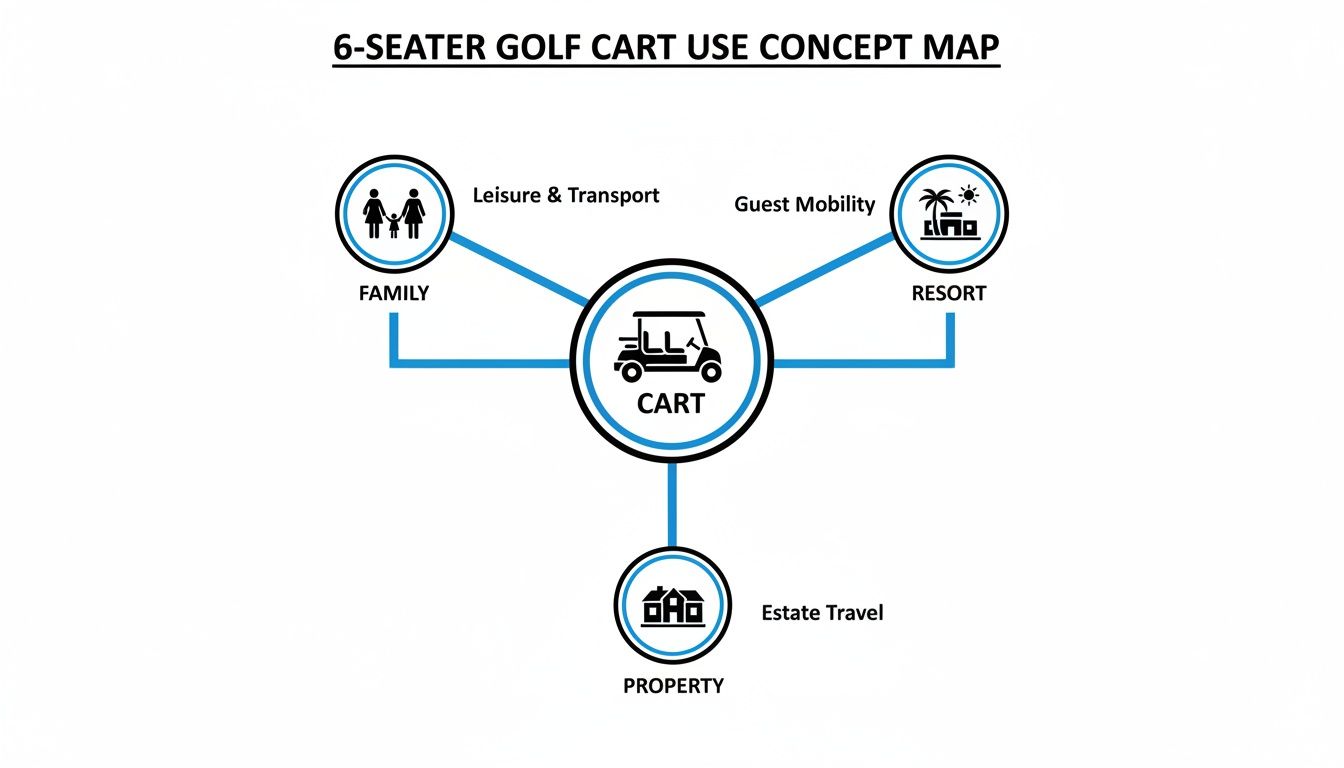
As you can see, these carts are a perfect fit for everything from family outings and resort transport to managing large properties. They’re true utility players.
The Great Battery Debate: Lithium vs. Lead-Acid
Choosing your battery technology is probably the single biggest decision you’ll make. A modern Lithium-ion battery is a lot like the one in your smartphone—it’s light, charges fast, lasts for years, and is completely maintenance-free. You just plug it in and go. The power is also incredibly consistent, so your cart won’t start to feel sluggish as the battery level drops.
On the flip side, you have the traditional Lead-Acid batteries. These are the old-school workhorses, much like a standard car battery. They are a proven, reliable technology and usually cost less upfront. The trade-offs? They're incredibly heavy, need regular check-ups (like topping off water levels), and their power tends to fade as they discharge.
Here’s how they stack up in the real world:
- Weight: A Lithium battery can be up to 75% lighter than a full set of lead-acid batteries. That weight reduction makes the cart feel more nimble and efficient.
- Lifespan: You can expect a Lithium battery to last 2-3 times longer than its lead-acid cousin, often delivering more than 3,000 charge cycles.
- Efficiency: Lithium batteries are over 95% efficient. This means nearly every bit of electricity you pay for goes directly into powering your ride.
If you really want to get into the nuts and bolts, you can learn more about the benefits of a golf cart lithium battery in our detailed guide. This choice really does shape the entire ownership experience.
Turning Tech Specs Into Real-World Performance
Those numbers on a spec sheet can seem a bit abstract, but they have a direct impact on your day-to-day use. Let's break down what the most important metrics actually mean when you’re behind the wheel of a 6-seater golf cart.
Range: What It Really Means for You
Range is just a fancy way of saying how far your cart can go on a full charge. A brochure might claim a "40-mile range," but what does that look like in practice? For a resort manager, it means a full day of shuttling guests and their luggage without having to plug in. For a family in a big gated community, it means you’ve got enough juice for a whole weekend of trips to the pool, the park, and friends’ houses.
Think about your typical day. A cart with a 25-mile range might be plenty for a small neighborhood, but a large estate or a commercial operation will get a lot more out of the 50+ mile range you see in premium lithium models.
Speed: How Fast Is Fast Enough?
Most street-legal 6-seaters, which fall under the Low-Speed Vehicle (LSV) classification, are legally capped at 25 MPH. Frankly, that's plenty of speed for safely navigating neighborhood roads and resort paths. Carts designed only for private property might top out a bit lower, usually around 15-19 MPH. The real goal isn't just blistering top speed; it's about having consistent power, so the cart doesn't bog down with six people on board or struggle to get up a hill.
Payload Capacity: Hauling People and Gear
Payload capacity is the total weight your cart can safely carry, and that includes everyone and everything on board. For a typical 6-seater, you’re looking at a capacity between 800 to 1,200 pounds. This number is more important than you might think.
For a family heading to the beach, it means the cart can handle six people plus a cooler, chairs, and all the gear without putting a strain on the motor or suspension. For a maintenance crew, it ensures they can move their team and tools across a campus without a problem. Pushing past this limit is a sure way to hurt performance and cause extra wear and tear.
Finding the Right Cart for Your Lifestyle
Specs and numbers are great, but the real question is: how would a 6-seater golf cart actually fit into your life? The true value of these vehicles comes out when you see them solving real-world problems and making day-to-day life a whole lot easier and more enjoyable. It's more than just a machine; it's a practical tool that molds itself to your needs, whether that’s for your family, your business, or your property.
So, let's step away from the spec sheet for a moment and look at a few real-life scenarios. By seeing how a 6-seater shines in different settings, you can get a much clearer picture of which model and features will be a perfect match for you.
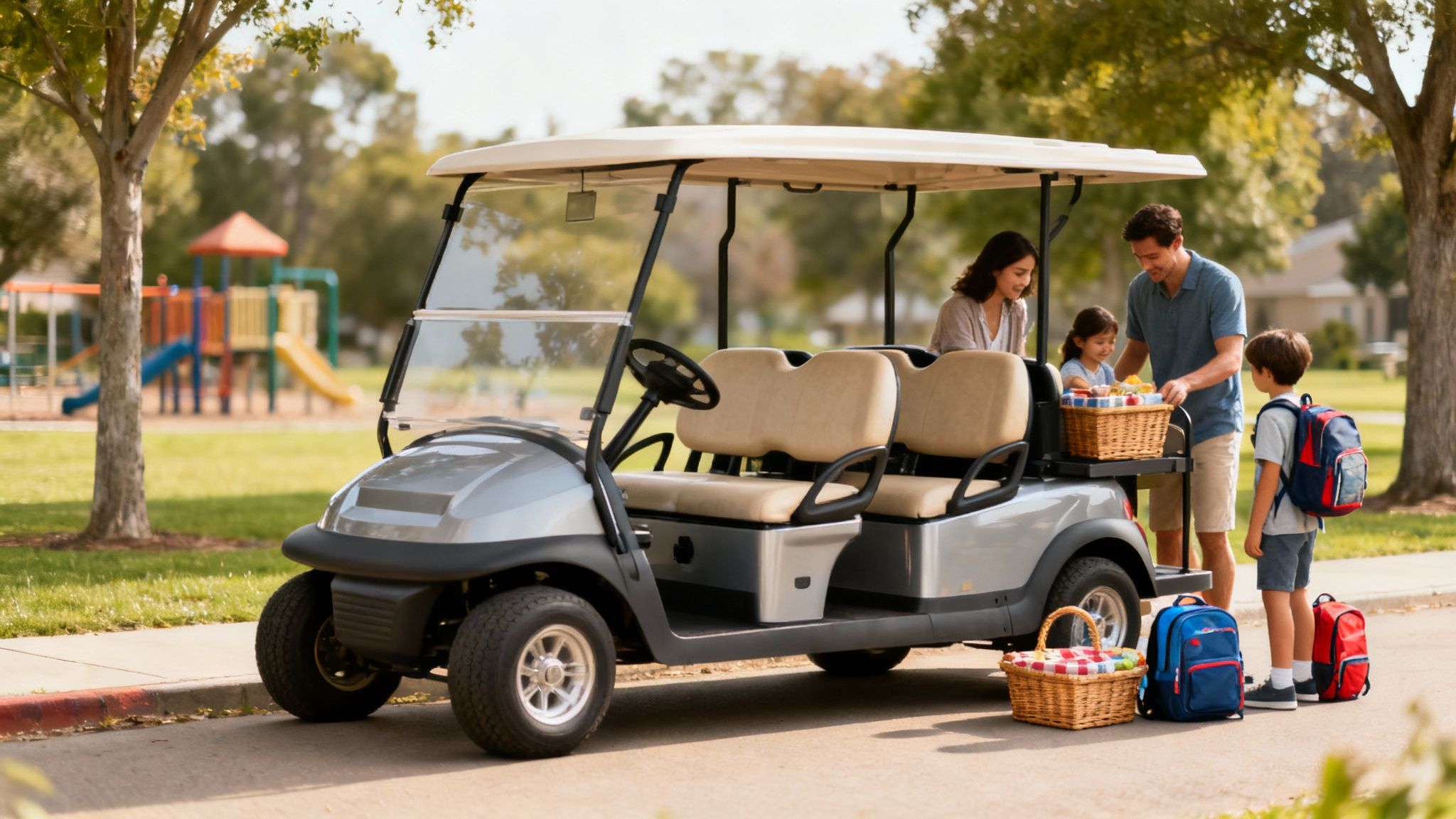
The Master-Planned Community Family
Picture a family living in one of those big, beautiful master-planned communities. Their weekends are a blur of activity—hopping over to the community pool, running the kids to soccer practice, or heading to a neighbor's barbecue a few streets away. Firing up the full-sized SUV for these quick trips feels like overkill. Parking is a pain, and let's be honest, it’s not much fun.
This is where their 6-seater golf cart becomes the family's MVP. It’s quiet, a breeze to park, and has plenty of room for their kids, a few friends, and all the pool toys and sports gear they need. The open-air ride turns a simple trip into a mini-adventure, making memories out of a quick drive to the park.
For this lifestyle, the must-haves are:
- Safety Features: With kids on board, seatbelts for every single passenger are an absolute must.
- Street-Legal Kit: Headlights, turn signals, and mirrors are essential for safely navigating community roads alongside other cars.
- Comfy Seating: Upgraded, cushioned seats make even the shortest trips more pleasant for everyone.
The Efficient Resort Manager
Now, let's shift gears to a manager running a luxury coastal resort. The property is sprawling, with guest villas, multiple restaurants, a spa, and beach access all spread out. In this world, the guest experience is everything, and it starts the second they arrive.
Instead of using loud, clunky gas shuttles or making guests wait around, the manager has a fleet of silent, stylish electric 6-seaters. A bellhop can smoothly load up a family and all their luggage, giving them a peaceful, scenic tour on the way to their suite. Suddenly, the carts aren't just transport; they're part of the resort’s luxurious, eco-friendly brand.
A silent, smooth ride enhances the peaceful atmosphere of a premium property. For a resort manager, a 6-seater isn't just transportation; it's an extension of the brand's hospitality, ensuring every guest interaction is seamless and pleasant from check-in to check-out.
Priorities for this use case would include:
- Durability and Reliability: These carts have to run all day, every day, with minimal downtime for maintenance.
- Aesthetics: A clean, modern look that matches the resort’s high-end image is non-negotiable.
- Long Range: Lithium-ion batteries are the only way to go, ensuring the fleet can operate a full shift on a single charge.
The Large Property Owner
Finally, imagine someone who owns a good chunk of land—maybe a small farm or just a large property with wooded trails and open fields. Daily chores could be anything from checking fence lines and hauling tools to just taking the family out to enjoy the land. A regular car can’t handle the trails, and a standard ATV doesn't have enough seats for company.
For them, a rugged, lifted 6-seater golf cart with beefy all-terrain tires is the ultimate solution. It’s a workhorse and a recreational vehicle all in one. On Tuesday, it's hauling feed to the barn. On Saturday, it’s taking the grandkids on a sunset tour through the backwoods. That kind of versatility makes it an indispensable tool for both managing and enjoying the property.
Navigating Street Legal Golf Cart Rules
Taking your 6-seater golf cart off your property and onto public roads is a game-changer. Suddenly, it’s not just for the back nine or cruising around the estate—it’s a legitimate vehicle for local trips. But this new freedom comes with a new set of rules. You can't just drive a standard cart into traffic; it needs to be properly equipped and classified as a Low-Speed Vehicle (LSV) to be street legal.
Think of it this way: a basic golf cart is built for the slow, predictable environment of a course. An LSV, on the other hand, is built to safely share the road with cars. This isn't just a minor difference. It involves specific safety gear, official registration, and following the same traffic laws as everyone else. Getting it right isn't complicated, but you need to know what you’re looking for.
What Makes a Golf Cart an LSV
For a 6-seater golf cart to earn its street-legal status, it has to meet safety standards set by the National Highway Traffic Safety Administration (NHTSA). These aren't just fancy suggestions; they're mandatory features that make the vehicle safe for you, your passengers, and everyone else on the road.
These upgrades are what officially transform a recreational cart into a road-ready LSV. Every piece of equipment has a job to do, whether it's signaling a turn or making sure you're visible during those early morning coffee runs or evening drives.
The core difference between a regular golf cart and a street-legal LSV comes down to one word: safety. An LSV is legally recognized for road use because it’s outfitted with the same basic safety systems you’d find on a car, making it a predictable part of the traffic flow.
Your Street Legal Checklist
As you're looking at different 6-seater golf carts with plans to drive them on public roads, keep this checklist handy. A good manufacturer, like Solana EV, will have models that already include these features or offer a straightforward street-legal package.
Here's the essential gear your cart must have:
- Proper Lighting: We're talking the full setup—headlights, taillights, brake lights, and turn signals. This is non-negotiable for being seen.
- Mirrors: You’ll need a rearview mirror and side-view mirrors to keep a clear eye on the traffic around you.
- Reflectors: To boost visibility, especially after dark, red reflex reflectors are required on the sides and rear of the cart.
- Parking Brake: A solid parking brake is mandatory to keep the cart from rolling away when parked, particularly on hills.
- A Windshield: The cart needs an approved windshield, usually made of AS1 or AS5 safety glass, for occupant protection.
- Seat Belts: A seat belt is required for every single seat. For a 6-seater, that means six separate seat belts, no exceptions.
- Vehicle Identification Number (VIN): Just like a car, an LSV needs a unique 17-digit VIN to be registered, titled, and insured with your local DMV.
Always Check Local Rules
While federal rules establish the foundation for an LSV, the laws for where and how you can drive one can change from state to state, or even town to town. Many areas restrict LSVs to roads with a posted speed limit of 35 MPH or less.
Before you make a purchase, spend a few minutes on your local DMV's website or looking up your city's ordinances. It’s a simple step that will save you from a lot of potential headaches and ensure your new 6-seater golf cart is all fun and no fuss.
Making It Your Own: Customizing Your Cart for Work and Play
A stock 6-seater golf cart fresh off the lot is a great vehicle, but it's really just a starting point. Think of it as a blank canvas. The real magic happens when you start customizing it to fit exactly what you need, whether that's tackling chilly morning drives, hauling equipment for a job, or just turning heads around the neighborhood.
What’s so great about today’s carts is how adaptable they are. The same base model can be kitted out in a thousand different ways. A cart for a university campus patrol, for instance, might get decked out for all-weather duty. On the other hand, one meant for family trips to the lake house would probably focus more on comfort and entertainment. It's all about building a vehicle that feels like it was made just for you.
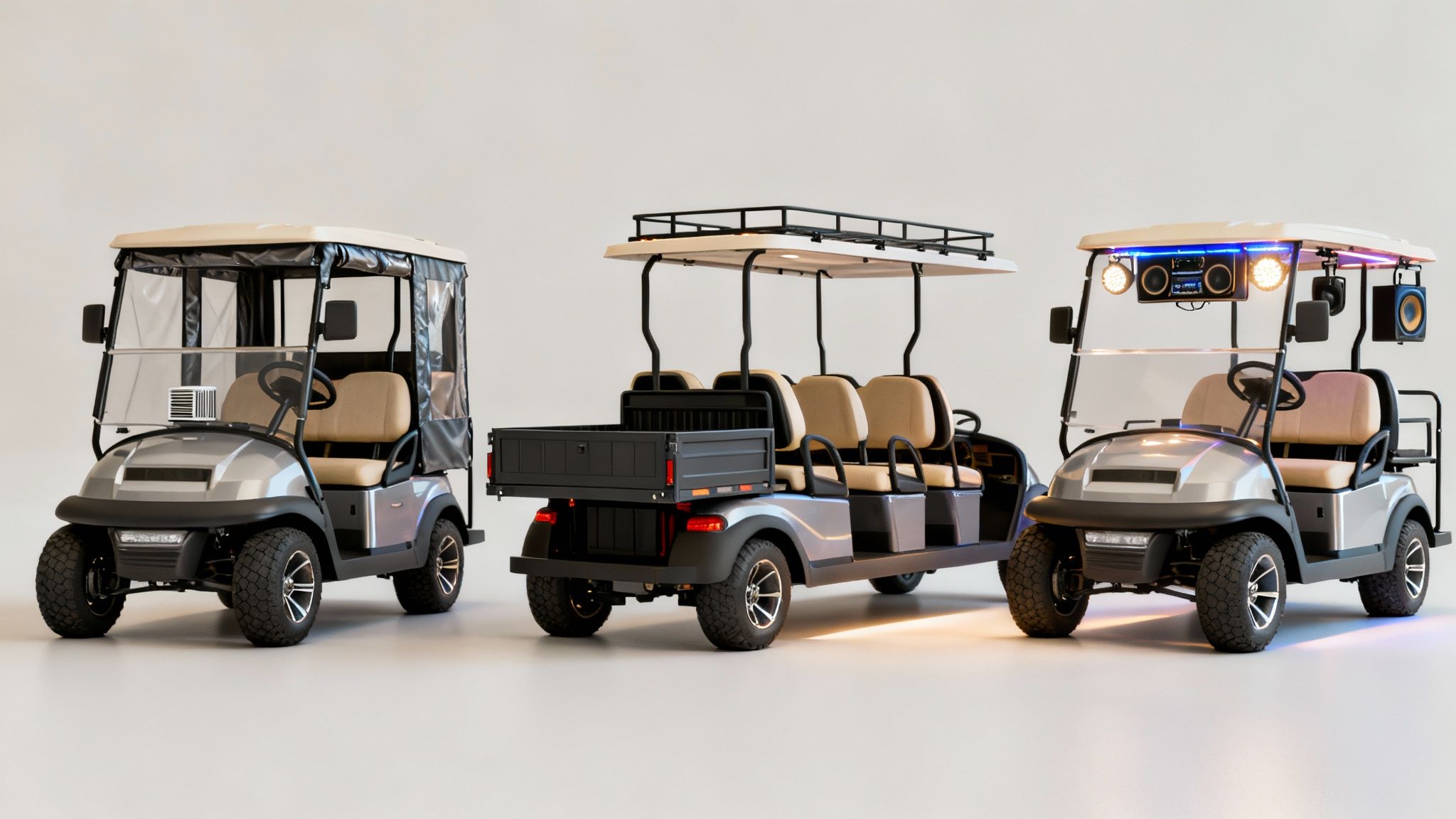
Upgrades for All-Weather Comfort
Don't let a bit of rain or a cool breeze force you to park your cart. With a couple of smart additions, you can make your ride comfortable no matter what the weather report says. These are especially must-haves if you live somewhere with four proper seasons.
- Full Enclosures: A good vinyl or canvas enclosure with clear windows basically turns your cart into a protected bubble, keeping all six passengers shielded from wind and rain.
- Heaters: For those colder climates, a portable or professionally installed electric heater can make a world of difference. It’s surprisingly effective and extends your carting season well into the fall and even winter.
These upgrades mean your cart is ready to roll year-round, not just on those perfect, sunny afternoons.
Enhancements for Hauling and Utility
For anyone who plans to put their 6-seater golf cart to work, utility upgrades are non-negotiable. These accessories add some serious muscle, making it a breeze to move tools, supplies, or weekend gear. A cart built for utility is every bit as practical as it is fun.
- Rear Cargo Beds: Many 6-seaters come with a "flip-flop" rear seat that folds down to become a tough little cargo bed. It’s perfect for hauling anything from bags of mulch to a heavy cooler.
- Roof Racks: A roof rack is a game-changer for carrying bulky but light items like surfboards, fishing poles, or a stack of beach chairs. It keeps the inside of your cart free for passengers.
- Trailer Hitches: Slap a hitch on the back, and you can tow small trailers. This is ideal for moving landscaping materials or other heavy loads around a large property without firing up a truck.
If you’re thinking about using your cart for commercial purposes, checking out work-related apparel and accessories from collections like the Cart Girl Collection can offer some great ideas.
Customizations for Tech and Style
Finally, let's talk about the fun stuff—personalizing your cart’s look and sound with tech and style upgrades. These additions are all about making the ride more enjoyable and making a statement. This is how you turn a standard cart into a head-turner that shows off your personality.
Customization is where you inject your personality into the vehicle. It's the difference between owning a 6-seater golf cart and owning your 6-seater golf cart.
Some of the most popular tech and style choices include:
- Premium Sound Systems: Bluetooth speakers or full-on soundbars let you bring the tunes along for every trip.
- LED Underglow and Accent Lighting: Custom lighting not only looks sharp but also makes your cart much more visible at night.
- Custom Seating: Upgrading to premium, comfortable seats adds a huge touch of luxury and makes longer rides much more pleasant. There's a whole world of options when you decide to get custom seats for your golf cart.
Understanding the True Cost of Ownership
The sticker price on a new 6 seater golf cart is a big number, but it’s really just the starting line. To get the full picture of your investment, you need to think about the total cost of ownership—what it actually costs to run, maintain, and keep the cart on the road for years to come. Looking at it this way helps you budget properly and avoid nasty financial surprises later on.
It’s a bit like buying a house. The mortgage is the obvious expense, but you also have property taxes, insurance, utilities, and the occasional leaky faucet to consider. The same logic applies to a golf cart, and this is where the long-term value of an electric model really comes into focus.
Electricity Versus Gasoline: A Clear Winner
The biggest and most immediate savings you'll see with an electric 6-seater is at the "pump." Gas prices are always a rollercoaster, but the cost of electricity is much more stable and affordable. A full charge for an electric cart typically costs just a few dollars and will get you 40-60 miles of range.
Now, compare that to a gas cart, which usually gets about 30-40 miles per gallon. With gas often sitting above $3.50 per gallon, the savings pile up quickly. For anyone using their cart regularly, going electric can easily mean saving hundreds of dollars a year on fuel alone.
Routine Maintenance and Upkeep
Beyond fuel, the maintenance differences between gas and electric carts are night and day. An electric vehicle's powertrain is incredibly simple, with far fewer moving parts. That means you can cross a whole bunch of chores off your list for good.
- No Oil Changes: Electric motors don't need oil, so you can forget about that messy, recurring cost.
- No Spark Plugs or Filters: There are no spark plugs to replace, no fuel filters to clog, and no exhaust systems to maintain.
- Fewer Mechanical Breakdowns: With a simpler motor, there are simply fewer things that can go wrong.
Most of the time, keeping an electric cart in shape just means checking the tire pressure, looking at the brake pads, and making sure the battery terminals are clean. It's a straightforward routine that keeps maintenance costs low. To dive deeper, check out our guide on reducing the total cost of ownership for your EV.
Long-Term Expenses to Plan For
While the day-to-day costs are minimal, there are a couple of bigger expenses to keep in mind for the long haul. The main one is eventually replacing the battery. A quality lithium-ion battery pack should give you 8-10 years of solid performance, but it is a component that will need to be replaced down the road.
If you go for a street-legal LSV model, you’ll also need to factor in insurance, just like you would for a car. Thankfully, these policies are usually quite affordable, but it's still a fixed cost to add to your annual budget.
The demand for electric 6-seater golf carts is booming, and it's changing the entire market. As more businesses and communities see the benefits, the global industry is expected to grow from USD 3.5 billion to USD 7.2 billion by 2035, all thanks to people looking for reliable, green transportation. Discover more insights about the evolving golf cart market.
When you add it all up—from the small cost of a daily charge to long-term battery life and insurance—you get a much clearer, more honest view of what you're buying. This foresight makes it obvious that an electric 6-seater isn't just a practical vehicle; it's an incredibly smart and cost-effective one over its entire life.
Frequently Asked Questions
Thinking about getting a 6-seater golf cart? You’ve probably got a few questions. Below, I’ve answered some of the most common things people ask, drawing from years of experience helping buyers find the right fit. Let's clear things up so you can feel great about your choice.
What Is the Average Range of an Electric 6 Seater Golf Cart?
How far you can go on a single charge really boils down to the battery. It's the heart of the machine. Carts with older-style lead-acid batteries will typically get you about 20-30 miles. That's perfectly fine for a quick trip around the neighborhood, but it can feel a bit limiting.
If you want real freedom, look for a cart with a modern Lithium-ion battery. These are a game-changer, pushing the range up to 40-60 miles per charge. That's enough power to cruise all day at a resort or handle a full schedule of community errands without constantly worrying about where the next outlet is.
Think of it this way: a Lithium-ion battery provides more than just extra miles; it offers peace of mind. You can use your cart all day long, knowing you have plenty of power in reserve for that last-minute trip or an unexpected detour.
Do I Need a Special License to Drive a Street Legal Cart?
Yes, you'll need your regular driver's license. Once a 6 seater golf cart is certified as a street-legal Low-Speed Vehicle (LSV), the rules of the road apply. It’s no longer just a golf cart; it’s a registered vehicle.
That means you'll have to get it registered with the DMV, secure proper insurance, and mount a license plate. These rules are all about safety and apply to any road with a posted speed limit of 35 MPH or less.
How Difficult Is It to Maintain a 6 Seater Golf Cart?
This is one of the best parts about going electric—the maintenance is incredibly simple. Compared to a gas-powered vehicle with all its moving parts, an electric cart is a breeze to take care of.
You're mostly looking at basic upkeep:
- Checking Tire Pressure: Just like on your car, keeping the tires properly inflated is key for a good ride and long-term wear.
- Inspecting Brakes: Give the brakes a quick look and test to make sure they're responsive. Safety first!
- Managing the Battery: If you have lead-acid batteries, you'll need to check the water levels now and then. With Lithium-ion batteries, there is virtually no maintenance required.
No oil changes, no spark plugs, no filters. It’s just simple, straightforward, and easy on the wallet.
Can I Use a 6 Seater Golf Cart for Off Road Trails?
You bet. Many 6-seaters are built tough enough for more than just paved paths. If you plan on hitting the trails, you just need to make sure you get a model with the right equipment.
Here’s what to look for in an off-road 6 seater golf cart:
- Lifted Suspension: Extra ground clearance is a must for getting over rocks, roots, and ruts without bottoming out.
- All-Terrain Tires: These have a much deeper, knobbier tread that bites into dirt, gravel, and grass for way better grip.
- Durable Frame: A heavy-duty frame is non-negotiable. It has to be able to withstand the bumps and twists of uneven terrain.
These carts aren't meant for intense rock crawling, of course, but for exploring dirt roads, crossing fields, or getting to that perfect fishing spot? They’re absolutely perfect. Just be sure to check the manufacturer's specs to confirm it's built for the kind of adventure you have in mind.
Ready to find a stylish, reliable, and street-legal 6 seater golf cart that fits your life? Explore the premium lineup at Solana EV and discover the perfect model for your family, business, or community. Visit our website to see our vehicles and learn about our dealer opportunities.