
Think of your golf cart's serial number as its fingerprint. It's the one thing that tells you exactly what you've got—the model, the year it was made, and all its original specs. This isn't just trivia; it's the key to ordering the right parts, figuring out what your cart is worth, and keeping it running smoothly.
Why That Serial Number Is Everything
That little string of letters and numbers is your cart’s entire history, straight from the factory. It’s the difference between a quick, easy repair and a costly, frustrating headache.
Knowing your serial number takes all the guesswork out of ownership.
From Fleet Maintenance to a Fair Trade-In
Let's say you manage a golf course with a fleet of 20 carts. A controller goes out on one of them. Without the exact serial number, you're just guessing. You might order a part that looks right but is totally incompatible, wasting both time and money. A quick serial number lookup avoids that mess completely.
It’s the same story if you're a homeowner looking to upgrade. When you're ready to trade in your old cart for a new, street-legal Solana EV, the dealer will ask for the serial number to give you a solid trade-in value. Knowing your cart's exact year and model ahead of time puts you in a much better position to negotiate.
Your golf cart's serial number is the single source of truth. It cuts through the confusion and makes sure every decision, from buying a simple part to registering your vehicle, is based on hard facts.
From Guesswork to Confidence
Ultimately, that number turns uncertainty into confidence. It ensures you're making the right call every time. This guide will show you exactly where to find it, how to read it, and what to do with that information.
Proper identification is also non-negotiable for vehicle registration. If you're looking to make your cart street-legal, you'll need this number handy. You can find out more in our detailed guide on golf cart registration.
Finding the Serial Number on Any Golf Cart
Before you can look up your golf cart's history, you have to find that all-important serial number. Think of it as a little treasure hunt—one that unlocks your cart's complete identity. Knowing where the major brands typically hide these tags will save you a ton of time and frustration.
Each manufacturer has its go-to spots for the serial number plate or sticker. These locations can change depending on the model and year, which can make the search a bit tricky if you're flying blind.
Locating the EZ-GO Serial Number
With EZ-GO, the location really comes down to the cart's age. For older models from 1976 through 1993, especially the classic Marathon series, the serial number tag is usually right on the dashboard, tucked under the glove box on the passenger's side. The last two digits of the code are a dead giveaway for the year—if you see '84', your cart was made in 1984. You can find more details on cracking these older codes by checking out resources that specialize in EZ-GO serial number systems.
For newer EZ-GOs, the placement has moved around a bit. Here are the most common places to check:
- Frame Rail: Look for a sticker on the frame, often just behind the front wheel on the passenger's side.
- Under the Seat: Pop the seat up and scan the horizontal frame cross-member.
- Glove Box: Some TXT and RXV models have the plate inside the passenger-side glove compartment.
Finding this number is the critical first step to getting the right parts, confirming your cart's identity, and understanding its real value.
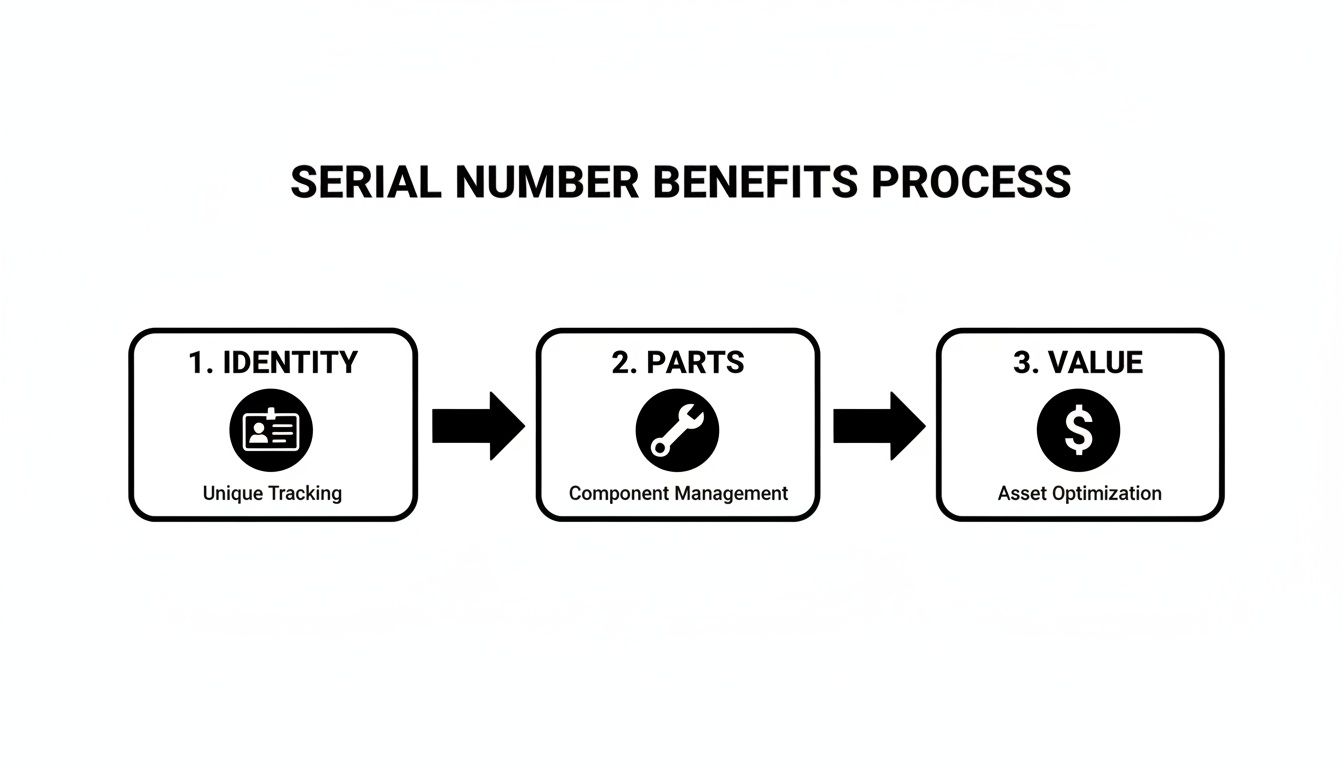
As you can see, that single string of characters is the key that unlocks everything else.
Finding Club Car and Yamaha Serial Numbers
Club Car and Yamaha are pretty consistent with their serial number placements, though they can still be in some hard-to-see spots. A methodical search is your best bet.
For Club Car models, you’re almost always going to find the serial number in one of three places. On modern carts like the Precedent, check for a sticker inside the passenger-side glove box or on the dash right above the pedals. On older DS models, it's often on the frame just below the driver's side of the seat.
When it comes to Yamaha carts, focus your search around the frame and undercarriage. A good place to start is under the rear bumper on the main frame rail. You can also lift the seat and inspect the frame where it connects to the motor compartment. Some Yamaha models also place the tag inside the driver's side glove box.
Pro Tip: Keep a rag and a small wire brush with you. Over the years, serial number plates get caked in dirt, grease, and sometimes even a light layer of rust. A quick cleanup is often all it takes to make the numbers perfectly readable.
Common Serial Number Locations by Manufacturer
To make things a little easier, here's a quick-reference table for where the big three manufacturers typically place their serial numbers.
| Brand | Common Location(s) | Appearance Notes |
|---|---|---|
| EZ-GO | Inside passenger glove box, on the frame behind the front wheel, under the seat on a cross-member. | Often a sticker on newer models; a metal plate on older ones. |
| Club Car | On the dashboard above the pedals, inside the passenger glove box, on the frame below the driver's seat. | Typically a sticker or a small aluminum plate. |
| Yamaha | Under the rear bumper on the frame, under the seat near the engine, inside the driver's glove box. | Can be a sticker, a stamped plate, or sometimes directly stamped into the frame. |
While this table covers the most frequent spots, remember that models can vary, so always give the entire frame a thorough look if you don't find it right away.
What to Do If the Tag Is Missing
It happens. Sometimes the serial number plate is just gone—worn off, pressure-washed into oblivion, or removed during a past repair. If you can't find it, don't panic.
Your first move should be to carefully inspect the frame in all the common locations for a secondary stamping. Manufacturers sometimes stamp the number directly into the metal as a permanent backup.
If that doesn't work, your next best step is to get in touch with an authorized dealer for your cart's brand. Snap a few clear photos of the cart from different angles and send them over. An experienced dealer can often identify the model and approximate year just by looking at the body style, design features, or even the type of motor it has. Their expert eye can be a real lifesaver when the primary ID is missing.
How to Decode Your Golf Cart's Serial Number
Alright, so you've found that all-important string of characters on your cart. Now for the fun part: translating it into useful information. Think of it like cracking a code that unlocks your cart’s entire history.
Each manufacturer has its own unique "language" for serial numbers, but they all point to the same core details—the model and the year it was built. The good news is, you don't need any special software or tools, just a little know-how about the patterns hidden in the number itself.

Unlocking Club Car Serial Numbers
Club Car probably has the most straightforward system out there, especially for any model built after 1981. Their format is almost like a time machine for your cart, with the first few characters telling you nearly everything you need to know.
A typical post-1981 Club Car serial number will look something like 'PH0901-123456'. Here's how to break that down:
- PH: These first two letters are the model code. In this example, 'PH' tells us it's a Precedent i2 electric model.
- 09: The next two digits are the last two numbers of the manufacturing year. So, '09' means the cart rolled off the line in 2009.
- 01: The following two numbers pinpoint the week of production. '01' means it was built during the very first week of that year.
This is critical information, especially since many carts see 5-7 years of use before owners start thinking about major upgrades. Knowing the exact age gives you a much clearer picture of its history. You can dig deeper into these specifics with these Club Car identification methods.
Translating E-Z-GO Serial Numbers
E-Z-GO serial numbers can be a little trickier since their format has changed over the years. But once you know what to look for, there's a clear logic. The key is often found in the manufacturer's code, which is usually stamped separately from the longer serial number.
This code is typically a letter followed by three or four numbers, like 'J2903'.
- The letter points to the model type (for instance, 'J' might be a TXT).
- The last two numbers almost always reveal the year. In this case, '03' means the cart was made in 2003.
A common pitfall with E-Z-GO carts is mixing up the manufacturing date on the chassis plate with the date codes stamped on individual parts. Always trust the serial number on the main frame—that’s the true birthdate of your cart.
Deciphering Yamaha Serial Numbers
Yamaha also keeps things pretty direct, embedding the model and year right at the beginning of the serial number. The format usually kicks off with a three-character prefix, followed by a hyphen and the unique production number.
For instance, you might see a Yamaha serial number that looks like 'JW1-123456'.
- The prefix—'JW1' in this case—is what you need to focus on. This code tells you both the model and the powertrain. This specific one identifies it as a G29, also known as a "Drive," electric model.
With Yamaha, the model and year are often interconnected within that prefix. Your best bet for a quick and accurate ID is to use a reliable online chart or a lookup tool from a dealer's website, as their codes can get very specific.
Once you get the hang of these formulas, that confusing jumble of characters turns into a clear and actionable profile of your golf cart.
Using Your Serial Number for Parts and Upgrades
Once you've tracked down your golf cart's serial number and figured out the exact model and year, you're officially in the driver's seat. This isn't just about satisfying your curiosity; it’s about having the critical information you need to maintain, customize, and upgrade your cart intelligently.
Think of that serial number as your cart’s unique fingerprint. It’s the one piece of data that eliminates the expensive guesswork that so often leads to buying a motor controller that's incompatible or a lift kit that just won't fit the frame.

Guaranteeing the Perfect Fit for Parts
Ordering parts online without a serial number is a total shot in the dark. You might find a battery kit that looks like it's made for your older Yamaha, but a tiny, unseen difference in terminal placement between model years could render it useless. Your serial number cuts through the noise, allowing you to filter search results to see only the parts guaranteed to fit your specific cart.
Take Yamaha, for instance. You’ll often find their serial numbers under the seat or on the rear bumper frame. A number like 'JUJ-123456' isn't random; the 'JUJ' tells you the model (like a G29 Drive), and the digits decode the year. With a reported 450,000 new golf carts registered in the U.S. in 2022 alone, experts estimate that proper serial number lookups prevented over $200 million in mismatched part orders.
Communicating Clearly with Technicians
Walking into a shop and saying, "I have an old Club Car that's making a noise," isn't going to get you very far. But if you call up with a serial number like 'PH0901-123456,' you’re giving them everything they need. That number instantly tells a pro it's a 2009 Precedent, so they can pull up service bulletins, check for common issues, and even pre-order the right parts. It saves them time and saves you money.
The serial number transforms your conversation from a vague description into a precise diagnosis. It’s the language that service professionals understand best, ensuring repairs are done right the first time.
Maximizing Your Trade-In Value
That string of letters and numbers is also your ticket to getting a fair shake when it's time to trade in. If you’re looking to upgrade to a modern, street-legal vehicle like a Solana EV, the dealer will use the serial number to determine an exact valuation for your old cart.
Knowing your cart’s identity empowers you to:
- Verify its market value before you ever start negotiating.
- Present your vehicle accurately, which builds trust with the dealer.
- Calculate a precise trade-in credit toward your new ride.
This single piece of information ensures you get the maximum value for your old cart, making the jump to a new, high-performance EV that much smoother. And when it comes to finding quality components for any cart, it helps to know where to look. Check out our guide on trusted electric vehicle parts suppliers to get started.
The Solana EV Advantage in Vehicle Management
Here at Solana EV, we think managing your vehicle should be completely straightforward. That's why we built our entire identification system around one simple idea: clarity. We’ve ditched the confusing, brand-specific serial numbers you see elsewhere and put a standardized, federally regulated 17-digit VIN on every single vehicle we make.
This isn't just a number; it's your key. Whether you're driving a versatile Solana XA, a rugged Solana F, or a practical Campus E, that one consistent VIN unlocks everything—warranty details, service schedules, and a perfect-fit list of approved accessories for your specific model. No more guesswork.
Empowering Our Dealer Partners
This standardized approach is a huge win for our dealer network, too. When you’re looking at a potential trade-in, knowing exactly what you're dealing with is everything. Our training gives dealers the confidence to look at any brand of golf cart, decode its unique serial number, and nail down its true age and model.
This isn't just about getting the specs right; it's about building trust with customers. When our dealers can offer a fair and transparent trade-in value based on solid data, it makes the entire experience better for everyone.
Knowing the precise history of a trade-in vehicle empowers dealers to create a smooth upgrade path for customers, helping them transition confidently into the modern Solana EV lineup. This level of professionalism sets our network apart.
Ultimately, this structured system is good for the entire community. If you’re interested in the nitty-gritty of how vehicle data is tracked at a professional level, resources on automotive inventory management software offer a great look into the best practices that inspired our own system.
Our goal is to make every part of the ownership journey, from the first test drive to a future upgrade, feel seamless. You can see more on how we apply these principles in our guide to electric vehicle fleet management.
Common Questions About Golf Cart Serial Numbers
Finding and decoding a golf cart serial number isn't always a straightforward affair. You can run into all sorts of snags, especially with older carts that have seen a lot of use or have been modified over the years. Let's tackle some of the most common questions and roadblocks people hit, so you can get the answers you need and move on.
What if My Serial Number Is Missing or Unreadable?
This is a classic problem, but don't panic. You've still got options. If the sticker or metal plate is gone, the first thing I always do is look for a secondary number stamped directly into the frame. Manufacturers often hide a backup number this way. Grab a wire brush and a flashlight, then gently clean off common spots like the frame rails near the rear axle or under the main chassis.
If you've searched high and low and come up empty, your next call should be to an authorized dealer for that brand. These folks are pros at identifying carts just by looking at them. Get ready to send them a bunch of clear pictures—front, back, sides, and close-ups of the body style, motor, and any other distinguishing features. A seasoned technician can often nail down the model and a ballpark year from those details alone.
Expert Tip: Don't give up just because the plate is gone. The cart's design, its specific components, and even the frame itself tell a story. An expert can often read that story and get you the info you need for parts or a proper valuation.
Can a Serial Number Reveal a Cart's Full History?
Think of the serial number more like a birth certificate than a full biography. It's the official record of the manufacturer, model, and year it was made. That's about it. It's not a comprehensive vehicle history report like you’d get for a car, so it won’t tell you about previous owners, accident history, or specific repairs.
Even so, that serial number is the most important piece of the puzzle when you're looking at a used cart. It's your way of verifying what the seller is telling you about the cart's age and model. This is absolutely crucial for figuring out its real market value and making sure you don't get taken for a ride.
Does the Serial Number Identify a Gas or Electric Cart?
Yep, almost always. The model prefix—usually the first few letters in the serial number—is the dead giveaway for the powertrain. Big brands like Club Car and Yamaha use different letter codes to separate their gas and electric models. For instance, a Club Car starting with 'PQ' is likely a gas Precedent, while one starting with 'PH' would be its electric counterpart.
Decoding the model from the serial number is by far the quickest and most reliable method to confirm if you're dealing with a gas or electric cart. It can save you the trouble of having to lift the seat to check for an engine or a battery pack.
What Is the Difference Between a Serial Number and a VIN?
This is a key distinction, especially as more carts become street-legal.
A serial number is what the manufacturer assigns for their own tracking, helping with parts orders and general identification. Your typical neighborhood golf cart will have one of these.
A 17-digit Vehicle Identification Number (VIN) is a federally regulated number assigned to street-legal Low-Speed Vehicles (LSVs), like every single model from Solana EV. A VIN is a legal requirement to get a title, register the vehicle, and get it insured for use on public roads. It officially makes it a motor vehicle.
A standard serial number just won't cut it for on-road registration. You need that proper 17-digit VIN.
Ready to skip the lookup hassles and get behind the wheel of a modern, street-legal vehicle with a clear and simple VIN? The team at Solana EV is here to help you find the perfect model for your lifestyle. Explore our lineup of premium electric vehicles and discover a better way to ride.