
Ever wonder why the official range on your EV's sticker never seems to match what you get on the road? You're not alone. That number from the manufacturer is a good starting point, but it's based on tests run in a perfect, climate-controlled lab—a world that looks nothing like your daily drive.
Think about it like the MPG rating on a gas-powered car. Your actual mileage always depends on whether you're idling in rush-hour traffic, flying down the highway, or towing a trailer. Electric vehicles work the same way, but the factors that drain the battery are even more sensitive to real-world conditions.
Moving Beyond a Single Number
That’s why thinking of EV range as one fixed number is a mistake. It’s better to see it as a dynamic forecast, almost like a weather report for your battery. It changes constantly based on where you are and how you're driving. This is where an electric vehicle range calculator comes in.
This kind of tool helps answer the practical, day-to-day questions that every EV owner has:
- Resort Managers: "Can our Solana XA shuttle guests all day in the summer heat with the AC blasting, or will we need a mid-day charge?"
- Off-Road Enthusiasts: "Will my Solana F have enough juice to get up that steep mountain trail in the cold, especially with all my camping gear packed in?"
- Families in Gated Communities: "What's the difference in battery use between a quick run to the community pool versus a longer trip to visit friends on the other side of the neighborhood?"
To answer these questions, you have to look past the sticker and understand the real forces affecting your battery.
An EV's range isn't a static number—it's a conversation between the battery and its environment. Factors like temperature, terrain, and driving style constantly influence how much energy is consumed per mile, making a real-world calculator indispensable for accurate planning.
This guide will pull back the curtain on how these calculators work, breaking down the key inputs that shape your actual driving distance. Once you grasp the simple physics behind EV efficiency, you can stop worrying about range and start driving with confidence. Whether you’re managing a whole fleet of Solana EVs or just planning a weekend adventure, this knowledge puts you in the driver’s seat.
How an Electric Vehicle Range Calculator Works
An EV range calculator isn't just making a wild guess; think of it as a sophisticated trip planner for your battery. At its core, the logic is pretty simple: it takes your battery's total available energy (measured in kilowatt-hours, or kWh) and divides it by how much energy your car is using to travel each mile.
Imagine your EV’s battery is a full tank of gas. The calculator’s job is to figure out your "miles per gallon" for the specific trip you're about to take, but it's doing this by juggling a dozen different factors all at once. It’s not just looking at the size of your "tank"—it's predicting how efficiently your "engine" will run in the real world.
This basic formula—Total Energy ÷ Energy Consumption = Estimated Range—is just the beginning. The real magic happens in how the tool figures out that second part of the equation: your energy consumption.
The Core Calculation and Key Inputs
Everything starts with the one constant: your vehicle’s battery capacity. For example, a Solana XA has a specific kWh rating, and that number is the foundation for any range estimate. It's the maximum energy you have to work with.
From there, the calculator starts layering on all the things that change from one minute to the next. It processes dynamic inputs like:
- Driving Speed: The faster you go, the more air you have to push out of the way. That aerodynamic drag eats up a surprising amount of energy.
- Temperature: Cold weather is a double whammy. It makes the battery less efficient and forces you to run the cabin heater, which is a major power drain.
- Terrain: Going uphill is a workout for your EV, demanding far more energy than cruising on a flat road.
This is how an EV calculator turns a static, "official" range number into a dynamic forecast that actually reflects what you'll experience on the road.
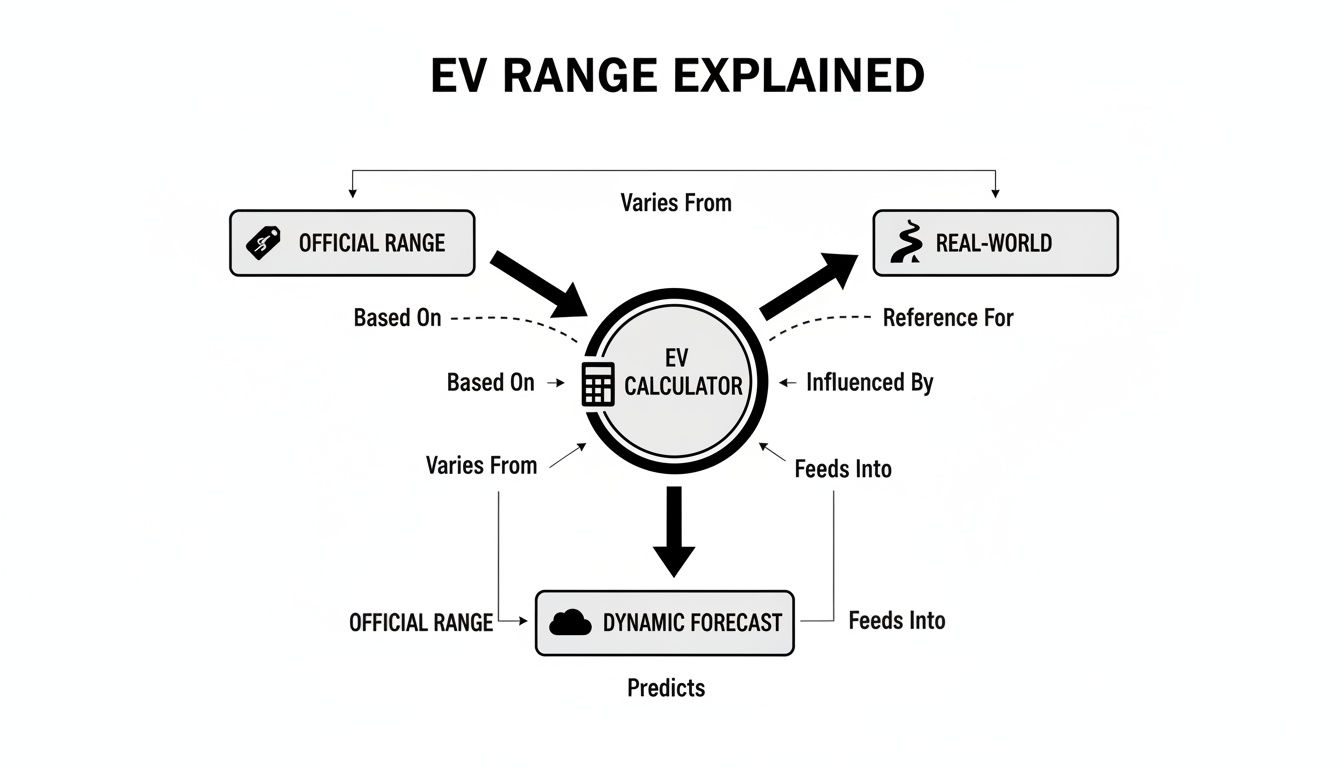
As you can see, the calculator is the critical link between a lab-tested figure and your real-life drive. It gives you a number you can actually trust.
From Simple Math to Predictive Analytics
Modern range calculators are a world away from the simple estimators of the past. Today’s tools are predictive powerhouses, blending your driving history with real-time conditions to give you forecasts that are much more reliable than the static EPA or WLTP figures. And that accuracy is becoming more important than ever.
The number of EVs on the road is expected to hit 60 million globally by 2025—a huge jump from just 26 million in 2022. With real-world range often falling 10-20% short of official ratings, these advanced tools are what help drivers close that gap.
This is especially true for vehicles like the Solana F, where a predictable range is crucial for getting around a large property or navigating trails without a single worry. The calculator essentially becomes your trusted co-pilot.
The goal of an EV range calculator is to replace uncertainty with confidence. By translating complex variables into a single, understandable number, it empowers you to plan any trip—whether across a resort or through your community—without worrying about your battery.
The system is constantly re-evaluating, too. The moment you turn on the air conditioning or start heading up a steep hill, the algorithm immediately adjusts its forecast. It also learns your personal driving style—whether you’re an aggressive accelerator or prefer a gentle pace—and bakes that behavior into its predictions. It's a smart system working hand-in-hand with your vehicle's core electronics. To learn more about that, see our guide on what a battery management system is and how it protects your EV's most important part. This constant feedback loop is what makes the range you see on your dashboard so reliable.
The Key Factors That Impact Your EV's Range
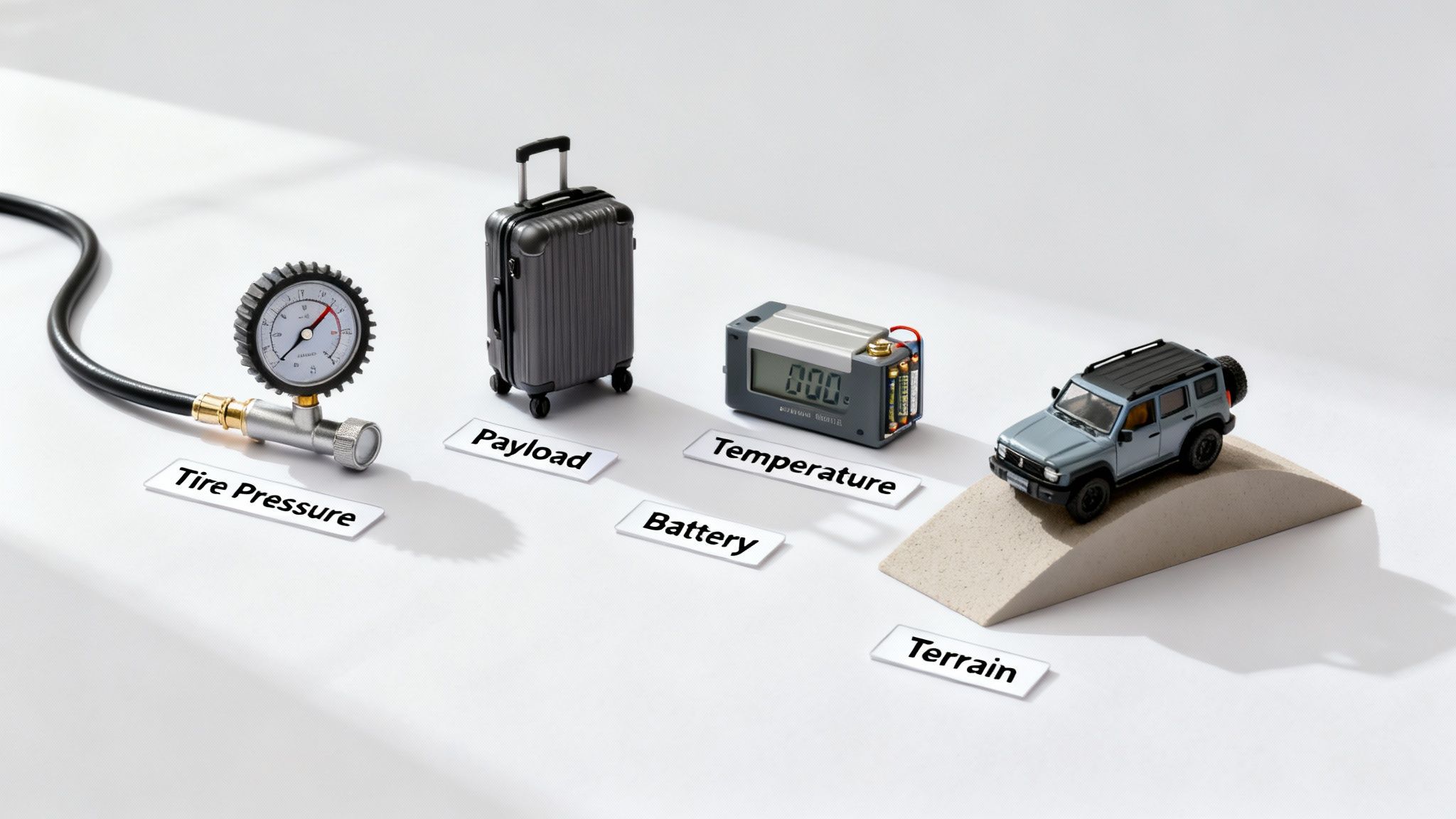
An electric vehicle range calculator is constantly juggling a handful of real-world variables, each with the power to dramatically alter your driving distance. Understanding these factors is the first step toward mastering your EV's energy consumption and planning your trips with total confidence.
Think of your battery's charge as a budget. Every decision you make—from how fast you drive to what you pack—is a withdrawal from that budget. Let's break down the biggest expenses.
Speed and Driving Style
The way you drive has one of the most direct and immediate impacts on your range. Aggressive driving, with rapid acceleration and hard braking, forces the motor to draw significant amounts of power quickly, draining the battery much faster than smooth, consistent travel.
Speed is an even bigger energy thief. As your vehicle moves faster, it has to fight harder against air resistance, a force that increases exponentially with speed. Cruising at 65 mph instead of 55 mph might not feel like a big difference, but it can easily reduce your total range by 10-15% or more.
An electric vehicle range calculator takes these habits into account, often by asking for your typical driving style (e.g., "gentle," "normal," or "spirited") to adjust its predictions accordingly.
The Unseen Forces of Terrain and Payload
Your EV’s motor works much harder when it’s fighting gravity. Climbing a steep hill demands a massive surge of energy, similar to how a cyclist has to pedal much harder to go uphill.
A range calculator with topographical data will see that upcoming mountain pass and adjust your estimated range downward. Conversely, it knows that regenerative braking will recapture some of that energy on the way back down, adding a few miles back to your estimate.
Payload, or the total weight your vehicle is carrying, works in a similar way. Every extra passenger, piece of luggage, or set of golf clubs adds mass that the motor has to move.
Imagine carrying a backpack on a hike. A light daypack is easy, but a heavy one filled with camping gear requires far more effort. Your EV feels the same way—more weight equals more work and, consequently, less range.
For example, a fully loaded Solana G model carrying four adults and their gear up a steep resort road will consume energy at a much higher rate than a single driver in the same vehicle on a flat community street.
Temperature: The Silent Battery Thief
Ambient temperature is one of the most significant external factors affecting your EV's battery. Cold weather is particularly brutal on range for two main reasons.
First, the electrochemical reactions inside the battery slow down when it's cold, making it less efficient at delivering power. This means you have less usable energy from the start.
Second, heating the cabin is incredibly energy-intensive. Unlike a gasoline car that uses waste heat from the engine, an EV must power its heater directly from the main battery. Using the heater on a cold day can slash your range by as much as 30%. To learn more about how this works, you can explore the fundamentals of electric vehicle battery technology and see what makes them so sensitive to the elements.
To give you a clearer picture, here’s how these common variables can chip away at your maximum range.
How Common Factors Impact EV Range
| Factor | Condition | Potential Range Reduction |
|---|---|---|
| Speed | Driving at 75 mph vs. 65 mph | ~15% |
| Temperature | 20°F (-7°C) with heater on | Up to 40% |
| Payload | Adding 400 lbs of weight | 5-10% |
| Tire Pressure | 10 PSI under-inflation | ~3% |
| Terrain | Consistent uphill driving | Highly variable, can exceed 50% |
These numbers are estimates, of course, but they show just how quickly small adjustments can lead to significant changes in your real-world mileage.
The Small Details That Add Up
Beyond the big three, a few other factors contribute to range calculations. A good calculator will often let you input these for even greater accuracy.
- Tire Pressure: Underinflated tires create more rolling resistance, forcing the motor to work harder to maintain speed. Keeping your tires properly inflated is one of the easiest ways to protect your range.
- Accessory Use: Everything from the air conditioning and heated seats to the high-end sound system draws power from the battery. While each one might be a small drain individually, their combined use can noticeably reduce your total mileage.
- Wheel Size: Larger, heavier wheels can sometimes reduce efficiency compared to smaller, more aerodynamic options.
By understanding how each of these elements impacts your battery, you can use an electric vehicle range calculator not just as a predictive tool, but as a guide to becoming a smarter, more efficient driver.
So, What About Those Official EPA and WLTP Range Ratings?
When you glance at an EV’s window sticker, you’ll see an official range number. It’s tempting to take that figure as gospel, but the truth is a bit more complicated. These ratings, from the Environmental Protection Agency (EPA) in North America and the Worldwide Harmonized Light Vehicles Test Procedure (WLTP) in Europe, are best thought of as standardized benchmarks, not ironclad guarantees.
Think of it this way: these official numbers come from highly controlled lab tests. It's like putting the car on a treadmill in a perfect, climate-controlled room. There’s no wind, no traffic, no steep hills—none of the chaos of a real commute. This sterile environment is necessary to create a fair, apples-to-apples comparison between different electric vehicles, but it’s a far cry from your daily drive.
Why the EPA Adjusts the Numbers Down
The EPA's process is particularly interesting because it openly acknowledges the gap between the lab and the road. To give you a more grounded, realistic figure, they make a significant adjustment.
This is exactly why an electric vehicle range calculator is such a powerful tool. It helps you connect the dots between that standardized lab test and what you'll actually experience. For example, a hospitality manager looking to add a Solana Campus E to their fleet doesn't just care about a lab number; they need to know its reliable range on a hot summer day with the air conditioning blasting.
EV range testing has come a long way. The EPA now uses a mix of tests that simulate city, highway, and even aggressive driving to get a better picture of real-world use. But here’s the key step: after all that testing, the EPA takes the raw lab result and multiplies it by a 0.7 adjustment factor. That means they chop 30% right off the top. So, if a vehicle manages 500 miles in the lab, its official sticker rating gets knocked down to 350 miles. This is done on purpose to manage expectations and combat range anxiety by providing a more trustworthy number from the start. If you're curious, you can learn more about how modern testing calculates EV range.
A Benchmark, Not a Guarantee
At the end of the day, the official EPA or WLTP rating is an excellent starting point. It gives you a solid baseline for comparing the potential of a Solana XA against one of its competitors. But it’s definitely not the final word on what you'll get.
Treat the official range rating as the vehicle's "on paper" potential. Your real-world results will always be a conversation between that potential and your driving environment, habits, and conditions for the day.
Understanding this is crucial for anyone who depends on an EV. A family in a gated community needs to know their car can handle a day of short, stop-and-go trips without a surprise dead battery. A resort operator needs predictable performance from their entire fleet. Official ratings set the stage, but a personalized calculation gives you the script for your actual journey. By seeing these numbers for what they are—standardized reference points—you can make smarter decisions and avoid being disappointed when your real-world mileage differs.
How to Calculate Range for Your Specific Needs
Knowing the physics behind EV range is a great start, but the real magic happens when you apply it to your day-to-day life. This is where an electric vehicle range calculator becomes your best friend.
Let's run through a couple of real-world scenarios with our Solana EV models. You'll see how a simple "sticker range" transforms into a practical, reliable forecast you can actually plan around. Think of it less like math and more like telling the story of a specific trip, with all its unique twists and turns.
Scenario 1: The Coastal Resort Shuttle
Picture this: you're running guest transportation at a busy coastal resort with a Solana XA. It's the middle of summer, and the shuttle is in constant motion. What's the real-world range you can expect?
Let's break down the variables for a typical day.
- Terrain: Mostly flat, with a few gentle slopes down to the beach. This is perfect for efficiency since the motor isn't constantly battling gravity.
- Speed: The XA is cruising at a steady 20-25 mph. That's the sweet spot for getting the most out of the battery.
- Temperature: It's a hot one—95°F. That means the air conditioning is cranked up all day to keep your guests cool, and that AC unit is a major power drain.
- Payload: You're carrying multiple guests and all their beach gear, adding several hundred pounds to the vehicle's weight.
A good electric vehicle range calculator will take the Solana XA's baseline range, give it a small boost for the flat terrain and ideal speed, but then make a pretty big deduction for the non-stop AC and the heavy payload.
The final number gives you a clear, actionable forecast. You'll know exactly how many hours the shuttle can operate before it needs to plug in, keeping guest service smooth and avoiding any surprise downtime.
By inputting these simple, real-world variables, a generic range estimate becomes a precise operational tool. It answers the critical question: "Will this vehicle meet my needs under these specific conditions?"
Scenario 2: The Off-Road Trail Adventure
Now for a completely different environment. An adventurer is taking their rugged Solana F up a mountain trail on a crisp autumn day. The demands on the battery are going to be totally different.
Here’s how the factors stack up for this trip:
- Terrain: The trail is steep, rocky, and uneven. Those big inclines demand a huge amount of torque and power from the motor, which eats into the battery.
- Speed: Driving is slow and choppy, with lots of stops and starts. This kind of driving is far less efficient than cruising at a steady speed.
- Temperature: It's a cool 50°F outside. The AC is off, but colder temperatures naturally reduce a battery's peak efficiency.
- Payload: The Solana F is loaded down with camping gear, supplies, and two people, adding significant weight.
In this case, the calculator starts with the Solana F's impressive baseline range and immediately starts subtracting. The steep, power-hungry terrain is the biggest range-killer, followed by the heavy payload.
The resulting estimate will be much lower than the sticker range, but it's also incredibly valuable. It tells the driver exactly how far they can push into the wilderness before they need to head back. It turns a potential risk into a well-planned adventure. Of course, good planning also means knowing your charging options. For more on that, check out our guide on the importance of electric vehicle charging infrastructure.
These examples make one thing clear: an EV's range isn't a fixed number. It’s a dynamic figure that changes with its environment. By using a calculator to account for your unique situation, you can plan with confidence and unlock the full potential of your Solana EV.
Actionable Tips to Maximize Your Real-World EV Range
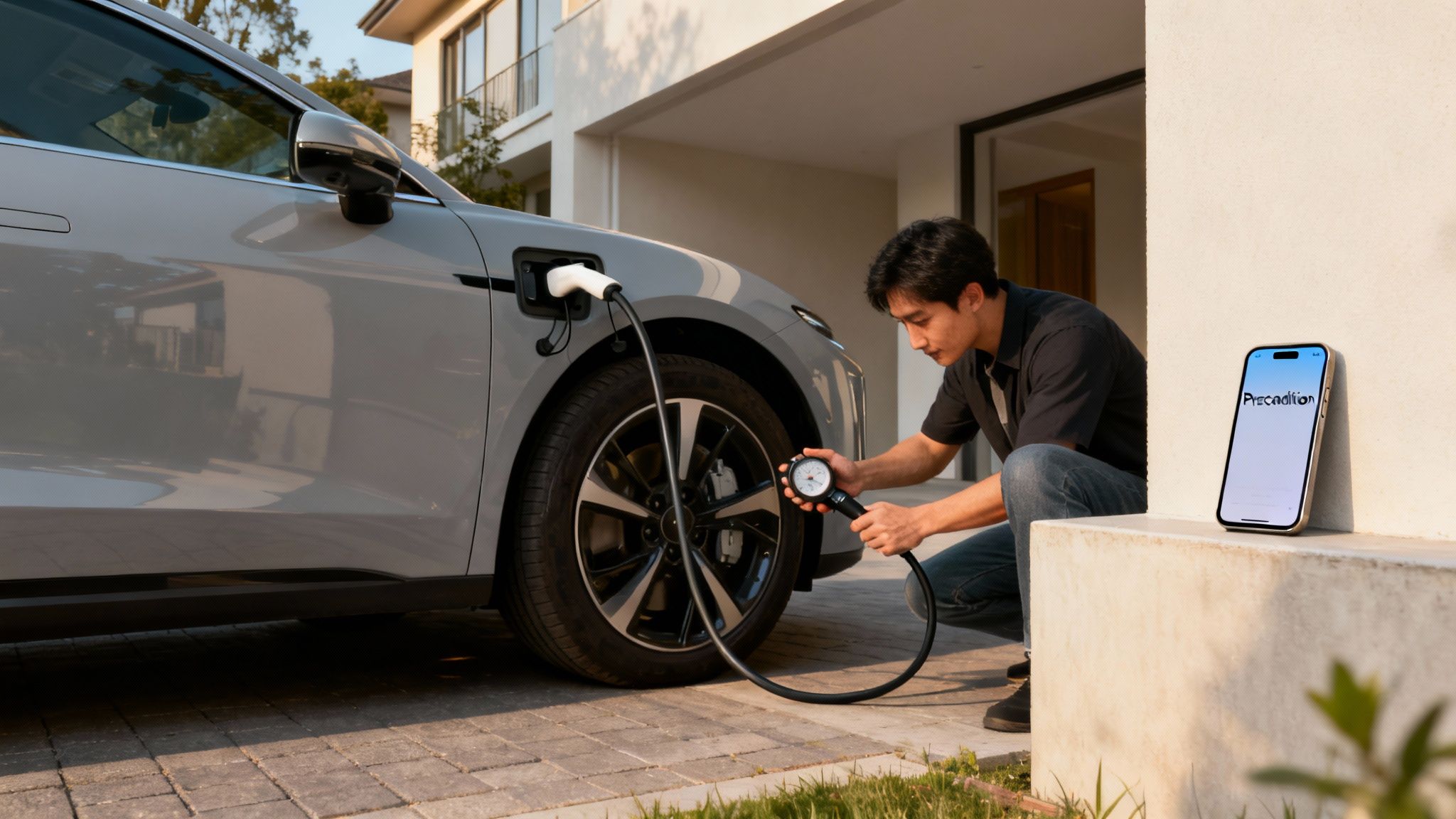
Knowing what affects your EV's range is one thing. Actually doing something about it is where the real magic happens. By tweaking a few simple habits, you can become a much more efficient driver and squeeze every last mile out of each charge.
These aren't drastic lifestyle changes, but they deliver real results. Whether you're managing a fleet of Solana Campus E models or just running errands around town, a few small adjustments to your driving and routine will noticeably boost your range.
Master Your Driving Habits
The way you drive is easily the biggest factor in how much energy your car uses. Smooth and steady really does win the race.
- Go Easy on the Pedals: Mashing the accelerator and slamming on the brakes are your battery's worst enemies. Aim for gradual starts and gentle stops to keep the power draw smooth and low.
- Embrace One-Pedal Driving: Most modern EVs, including our Solana models, have a one-pedal driving mode. This brilliant feature cranks up the regenerative braking, capturing the energy usually lost when you slow down and sending it right back to the battery. It’s like getting free energy every time you lift your foot off the pedal.
- Reduce Your Cruising Speed: On the highway, dropping your speed just a little can pay off big time. Easing up from 70 mph to 65 mph can cut energy use by over 10% simply by reducing aerodynamic drag.
Optimize Your Vehicle Before You Go
A couple of minutes of prep before you even pull out of the driveway can make all the difference, especially when the weather is extremely hot or cold.
Preconditioning your cabin while the vehicle is still plugged in is one of the smartest things an EV owner can do. It uses grid power—not your precious battery reserves—to get the interior to a comfortable temperature, preserving miles for the road.
This is a game-changer in the winter, since heating the cabin is a massive power drain. Beyond that, a quick check of your car’s physical setup is always a good idea.
- Maintain Proper Tire Pressure: Underinflated tires create more friction with the road, making your motor work harder for every mile. Check your pressures weekly to keep them at the recommended level.
- Shed Unnecessary Weight: It's simple physics. More weight takes more energy to move. If you don't need those golf clubs or that roof rack for your trip, take them out.
Combining these proactive habits with a smarter driving style turns you into an active manager of your EV’s energy. It's empowering. And with battery tech getting better all the time, these tips help you take full advantage of today's incredible capabilities.
In 2026, the average electric vehicle now comfortably exceeds 300 miles of real-world range—a huge leap from a decade ago when hitting 100 miles was a major achievement. You can read more about the evolution of electric car range to see just how far we've come. By putting these tips into practice, you’ll ensure you're getting every single mile out of that amazing engineering.
Your EV Range Questions, Answered
Even with the best tools, you probably still have some questions floating around. That’s perfectly normal. Let's walk through a few of the most common ones we hear from drivers who are new to the electric lifestyle.
How Accurate Are These EV Range Calculators, Really?
Today’s range calculators are surprisingly good, often getting your remaining mileage right within a few percentage points. They’re not just guessing; they’re constantly crunching real-time data from your car—think recent driving habits, outside temperature, and even the hills and valleys on your navigation route.
That said, they're smart predictors, not fortune tellers. An unexpected traffic jam or a last-minute detour up a steep mountain pass can definitely change the final number. It’s best to think of the estimate as a very well-informed guide that gets more accurate the more you drive.
Does Blasting the Heat or AC Genuinely Drain the Battery?
Absolutely, and it's one of the biggest factors you can control. A gas car has tons of waste heat from the engine to warm the cabin, but an EV has to power its heating and air conditioning system straight from the high-voltage battery.
Running the cabin heater is a major power draw, especially in the bitter cold. In some scenarios, it can slash your total range by as much as 30%. This is exactly why preconditioning—warming or cooling the car while it’s still plugged in—is such a game-changer for EV owners.
Why Does My Range Plummet in the Winter?
Cold weather is a double-whammy for an EV battery, which is why you see such a noticeable drop in range.
First, the chemistry inside the battery cells physically slows down when it's cold. This makes the battery less efficient at both storing and delivering power. It's just a law of physics.
Second, you're cranking up the heat to stay comfortable, as we just discussed. So you’ve got a less efficient battery trying to power one of the most energy-hungry systems in the car. That combination is precisely why winter range is always lower than what you see in the summer.
Ready to see how a Solana EV delivers confident, predictable performance all year round? Come explore our lineup and find the right fit for your daily drive.