
When you start typing "street legal golf carts for sale near me" into a search bar, you’re doing more than just looking for a fun ride. You're looking for a legitimate vehicle, and that means understanding the local rules of the road is just as important as finding the right model.
The smartest way to start is by finding certified local dealers who live and breathe Low-Speed Vehicles (LSVs). They’re your best resource for getting a compliant cart, a solid warranty, and expert advice from day one.
Starting Your Search for a Local Street Legal Cart
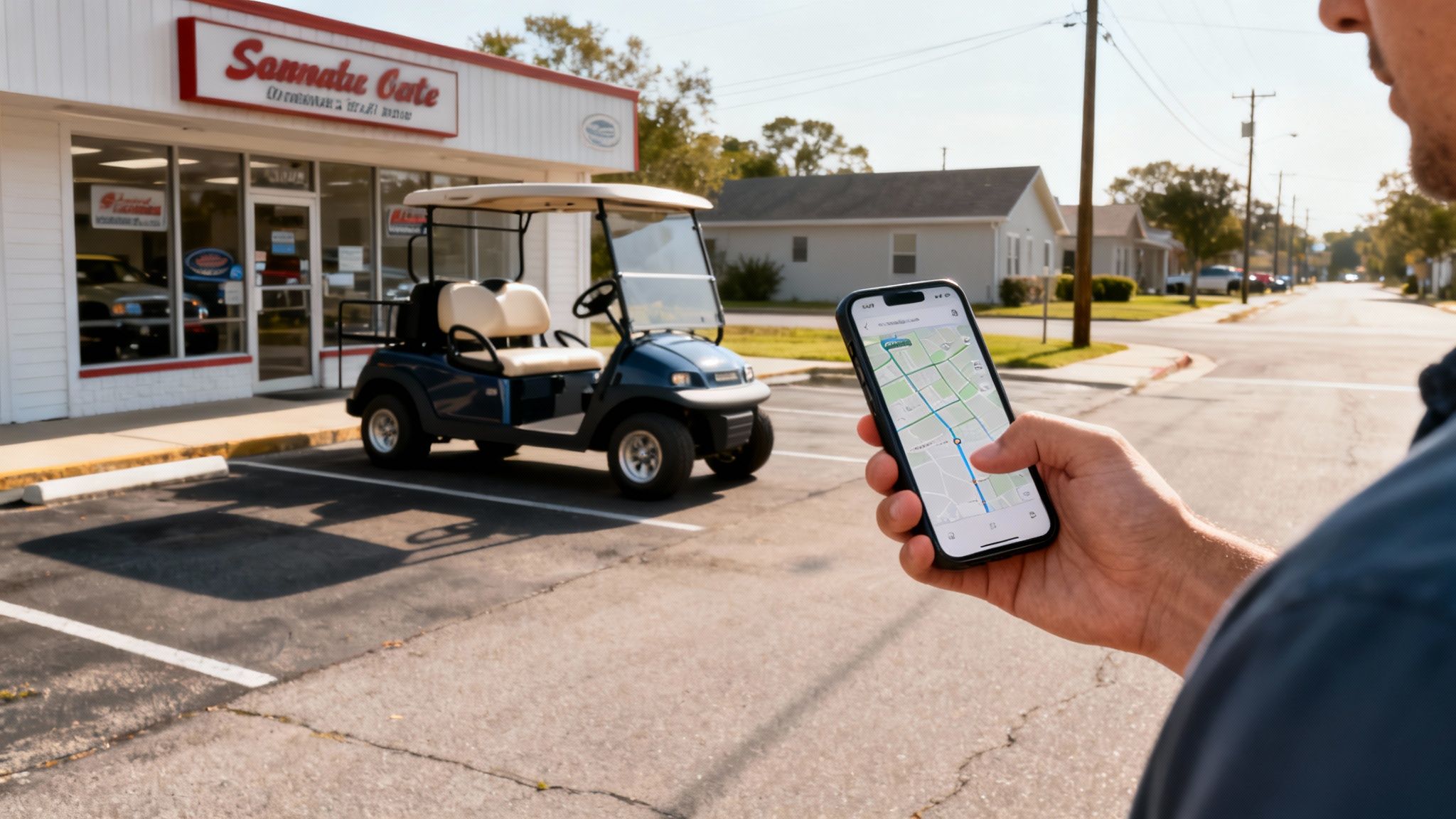
It’s easy to feel a bit lost when you first start shopping for a street-legal golf cart. This isn't like buying a standard cart for the course; you’re buying a vehicle that needs to meet specific safety and legal requirements to be on public roads. So, before you even think about colors and cup holders, you need to get a handle on what "street legal" really means where you live.
Understanding the Basics
Officially, a "street legal" golf cart is classified as a Low-Speed Vehicle (LSV). The National Highway Traffic Safety Administration (NHTSA) sets the ground rules for what makes a vehicle an LSV, but that’s just the beginning. States, counties, and even cities can layer their own regulations on top, which is why a local-first approach is absolutely critical. A cart that’s good to go in a Florida beach town might not pass muster on the streets of a California community.
Here’s a quick breakdown of what you need to look into:
- Federal LSV Requirements: These are the must-haves. Think headlights, brake lights, turn signals, seatbelts, mirrors, and a real Vehicle Identification Number (VIN).
- State and Local Ordinances: Your state's DMV website is your best friend here. Look for rules on what roads you can drive on (usually those with speed limits of 35 mph or less), insurance requirements, and how to get it registered.
- Neighborhood and HOA Rules: Don't forget this one! If you live in a planned community or have a Homeowners Association, they often have their own set of rules that can be even stricter than the city's.
I’ve seen this mistake a hundred times: someone buys a regular golf cart, slaps on a headlight kit, and thinks it's "street legal." A true LSV is built from the ground up to meet federal motor vehicle safety standards and is issued a VIN by the manufacturer. That VIN is non-negotiable for getting a title and registration.
Where to Begin Your Local Search
Once you know the rules of the game in your area, you can start looking for your cart with confidence. Your first and best stop should always be an authorized dealer.
A good local dealer won't just sell you a cart; they'll ensure it’s fully compliant with all federal, state, and local laws, completely removing the guesswork for you. Finding the right partner makes all the difference, and our guide on choosing a golf cart dealership near me is a great resource to help you find a trusted professional. Plus, dealers provide warranties, service, and financing—things you just won't get from a private seller on an online marketplace. While you might find a cheaper deal from a private listing, the risk of ending up with a non-compliant headache or a mechanical money pit is much, much higher.
What Actually Makes a Golf Cart Street Legal?
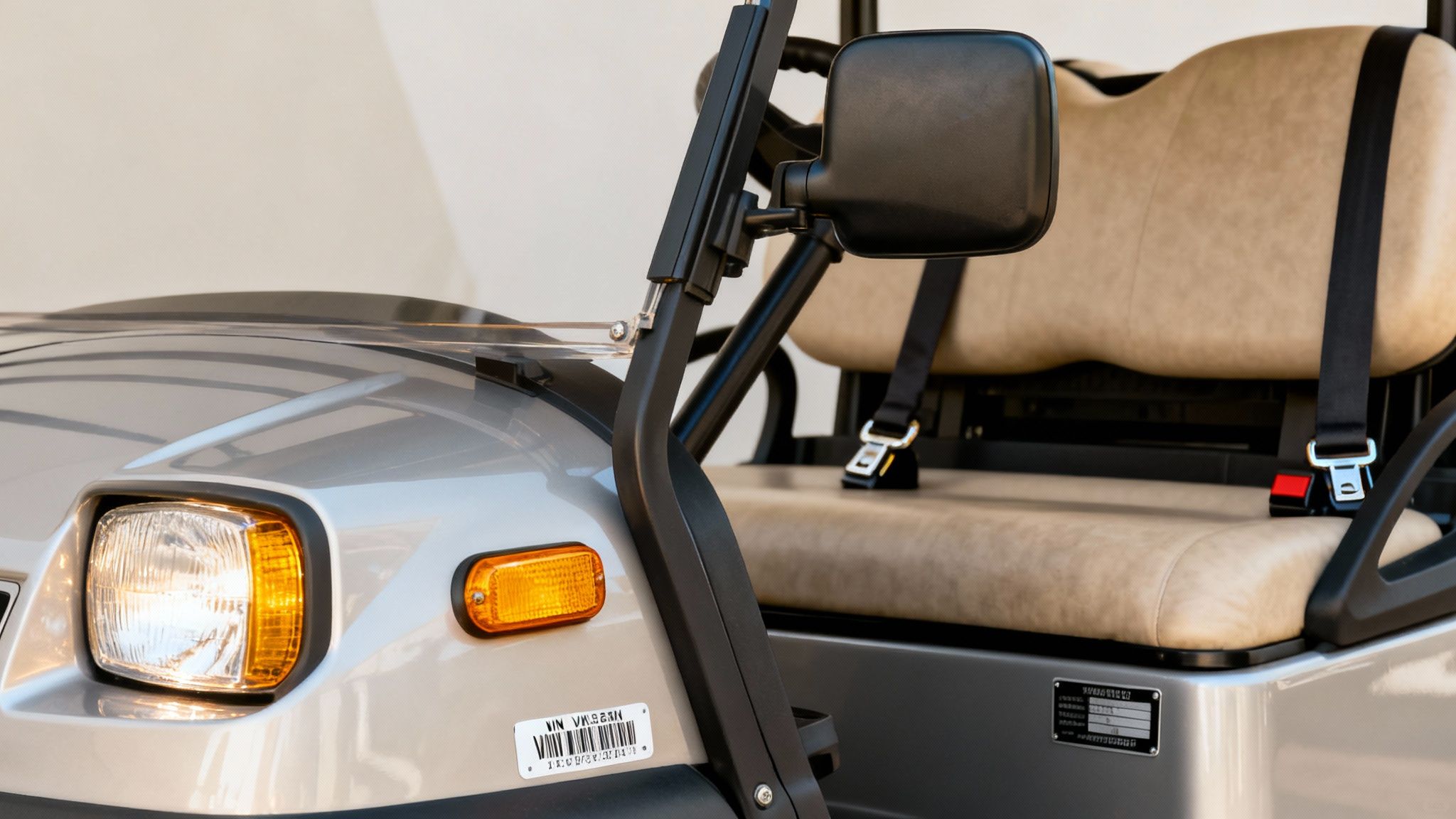
Before you even start imagining that perfect cruise through your neighborhood, let's clear something up. There’s a world of difference between a regular golf cart and a true street-legal Low-Speed Vehicle, or LSV. It’s not about slapping on a headlight kit and calling it a day. We’re talking about a specific set of federally mandated safety features that legally permit a vehicle on public roads.
A genuine LSV is built from the ground up to meet strict standards laid out by the National Highway Traffic Safety Administration (NHTSA). These aren't just suggestions; they're hard-and-fast rules. Knowing them is your best tool for telling a legitimate, road-ready vehicle from a DIY project that could land you in trouble.
The Federal LSV Safety Checklist
At the heart of it all, the federal government defines an LSV as a four-wheeled vehicle capable of hitting a top speed between 20 and 25 mph. To get that official classification and a legitimate Vehicle Identification Number (VIN), the cart has to roll out of the factory with a full suite of safety equipment.
Think of this as your non-negotiable checklist:
- Headlamps, Tail Lamps, and Brake Lights: Essential for being seen, day or night.
- Front and Rear Turn Signals: So other drivers know what you’re doing.
- Reflex Reflectors: Placed on all corners to make you more visible.
- DOT-Approved Tires and Windshield: These meet the same safety standards as your car.
- Rearview and Side Mirrors: No more blind spots.
- A Horn: A must-have for alerting others.
- Seat Belts: Required for every single seat.
That last one is a big deal. More and more states are passing laws that specifically require seatbelts for younger passengers, making factory-installed restraints a must for both safety and legal compliance.
Here's the bottom line: The single most important thing to look for is a factory-issued VIN. Without it, you can't title, register, or insure the vehicle as an LSV for public roads. Period.
Why Local Rules Still Matter
Getting a federally compliant LSV is just step one. After that, it's all about local rules. State, county, and even city ordinances will tell you where you can actually drive it. For example, most states limit LSVs to roads with a posted speed limit of 35 mph or less, but that's not a universal rule. A cart that’s perfectly legal in a Phoenix retirement community might have totally different restrictions in a small town on the Florida coast.
This is exactly why buying from a local, reputable dealer is your best bet. They won't just sell you a vehicle that meets the federal specs; they'll be experts on the specific local laws you need to know to stay on the right side of the law.
For a complete rundown of all the requirements, our guide on what makes a golf cart street legal goes into even greater detail.
Where to Find the Best Local Street Legal Carts
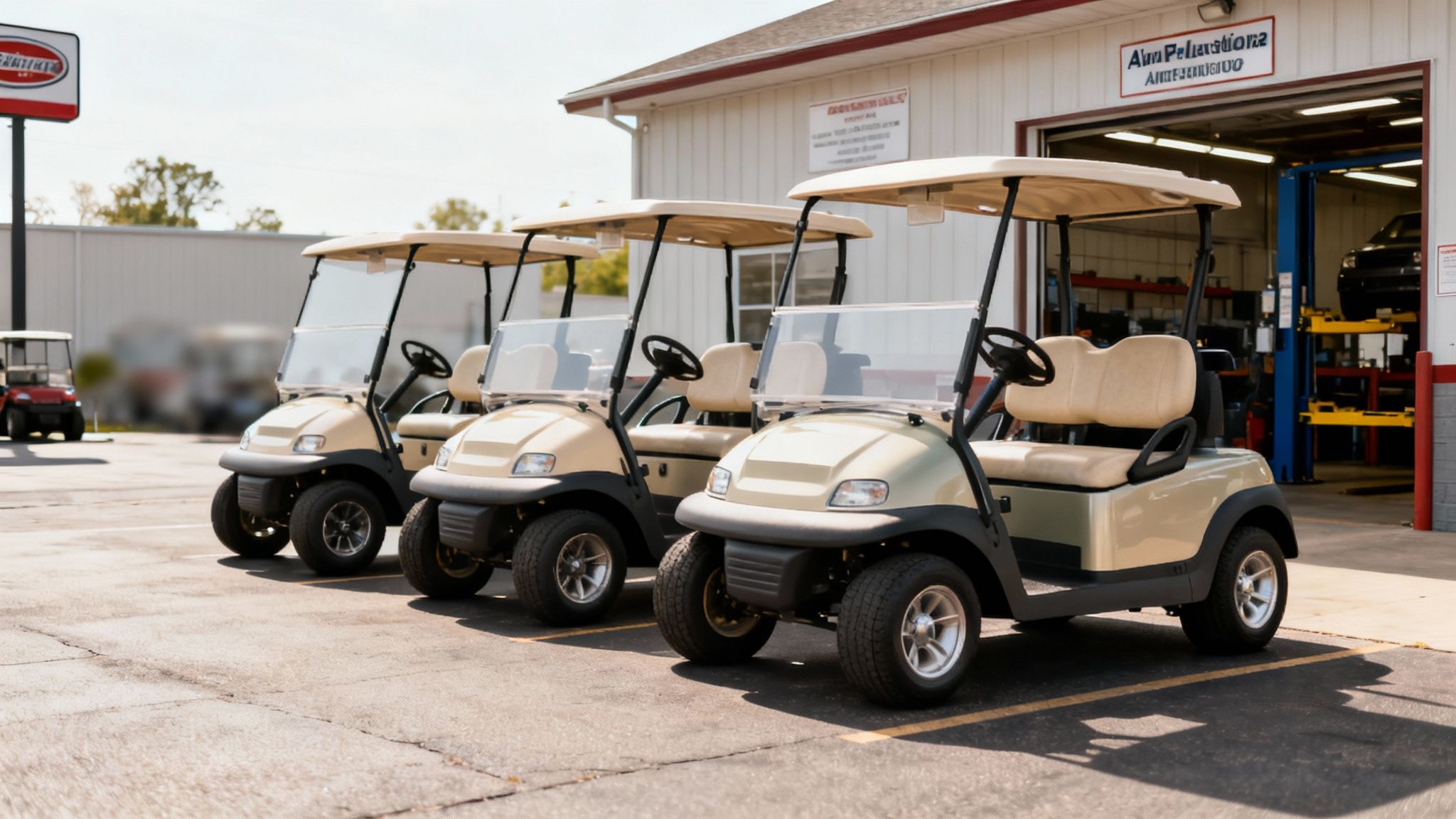
Alright, you've got a handle on the safety features and legal rules that make a golf cart truly "street-legal." Now comes the fun part: finding one. A quick search for "street legal golf carts for sale near me" will point you to a few different places, and knowing the pros and cons of each is just as critical as picking the right model.
For most people, the best starting point is an authorized dealer. Think of them as the specialists in this world. Their entire reputation is built on selling vehicles that are fully compliant, so you're not left guessing. They provide warranties, have professional service shops, and can get you the latest models with the newest features. A Solana EV dealer, for example, doesn't just hand you the keys; they offer expert training and support to make sure you're comfortable with your new ride.
Evaluating Your Local Buying Options
Once you venture beyond the dealership, you’ll run into a mix of private sellers and online ads. While you might find a lower price tag, this path comes with some real risks. A private seller won't offer a warranty, leaving you on the hook for any mechanical problems that pop up. More importantly, it’s up to you to confirm the cart is actually legal for the road.
Here’s a quick look at your main options:
- Authorized Dealerships: This is your safest bet. You get a guaranteed street-legal vehicle with a factory VIN, a solid warranty, and professional support you can count on.
- Specialty Cart Shops: These are often smaller, independent businesses that might sell both new and used carts. Just make sure they truly specialize in LSVs and can give you all the right paperwork.
- Online Classifieds & Marketplaces: You can find some interesting deals on places like Facebook Marketplace or Craigslist, but you need to be extra careful. Be ready to give the cart a top-to-bottom inspection and verify its VIN and title yourself.
- Private Sellers: This route demands the most work from you. You absolutely have to confirm the vehicle is a genuine, factory-built LSV and not just a standard golf cart someone illegally modified in their garage.
If you want total peace of mind, nothing beats an authorized dealer. They take care of all the tricky paperwork for titling and registration and make sure every single safety feature is installed and working perfectly. This is especially important as states like South Carolina introduce new laws, such as requiring seatbelts for younger passengers.
The street-legal cart market is booming. You see them everywhere now—from resort towns and gated communities to people just running daily errands. It's a huge shift in local transportation. In fact, industry analysts expect the global market to hit around $2.30 billion by 2025 as more people discover how convenient these vehicles are. You can read more about this growing market from Future Market Insights.
To help you decide where to start your search, here’s a breakdown of what to expect from each buying source.
Comparing Local Buying Options for Street Legal Carts
| Buying Source | Key Advantages | Potential Drawbacks | Best For |
|---|---|---|---|
| Authorized Dealers | Guaranteed legal compliance, warranties, financing, professional service, and access to new models. | Higher initial cost compared to private sales. | Buyers who want maximum security, a new vehicle, and long-term support. |
| Specialty Cart Shops | Can offer a mix of new and used models, potentially with some customization options. | Inventory and expertise can vary widely; may not offer the same level of warranty or support as a major dealer. | Buyers looking for both new and used options who have vetted the shop's reputation. |
| Online Marketplaces | Wide selection and the potential for a good deal. | High risk of scams, misrepresented vehicles, and no buyer protection. | Experienced buyers who are highly skilled at vehicle inspection and VIN verification. |
| Private Sellers | Often the lowest prices. | No warranty, no support, and the full burden of legal verification falls on the buyer. High risk of buying an illegal cart. | DIY-savvy buyers on a tight budget who are willing to accept significant risk. |
Ultimately, your comfort level with risk and your need for post-purchase support will guide you to the right place.
Navigating Private Sales and Classifieds
If you do decide to check out the private market, you need a game plan. Never just take a seller's word that their cart is "street legal." You need to see the proof.
Always ask to see the official title, and make sure it clearly classifies the vehicle as a Low-Speed Vehicle (LSV). Look for red flags that point to a DIY conversion, like shoddy wiring for the lights and signals or mismatched parts. A real LSV is built to federal standards right from the factory. That lower price might look good now, but it's nothing compared to the potential cost of fines, expensive repairs, or the nightmare of finding out you can't even register what you just bought. Starting with a reputable dealer from the get-go helps you avoid all of that drama.
Your Hands-On Inspection and Test Drive Guide
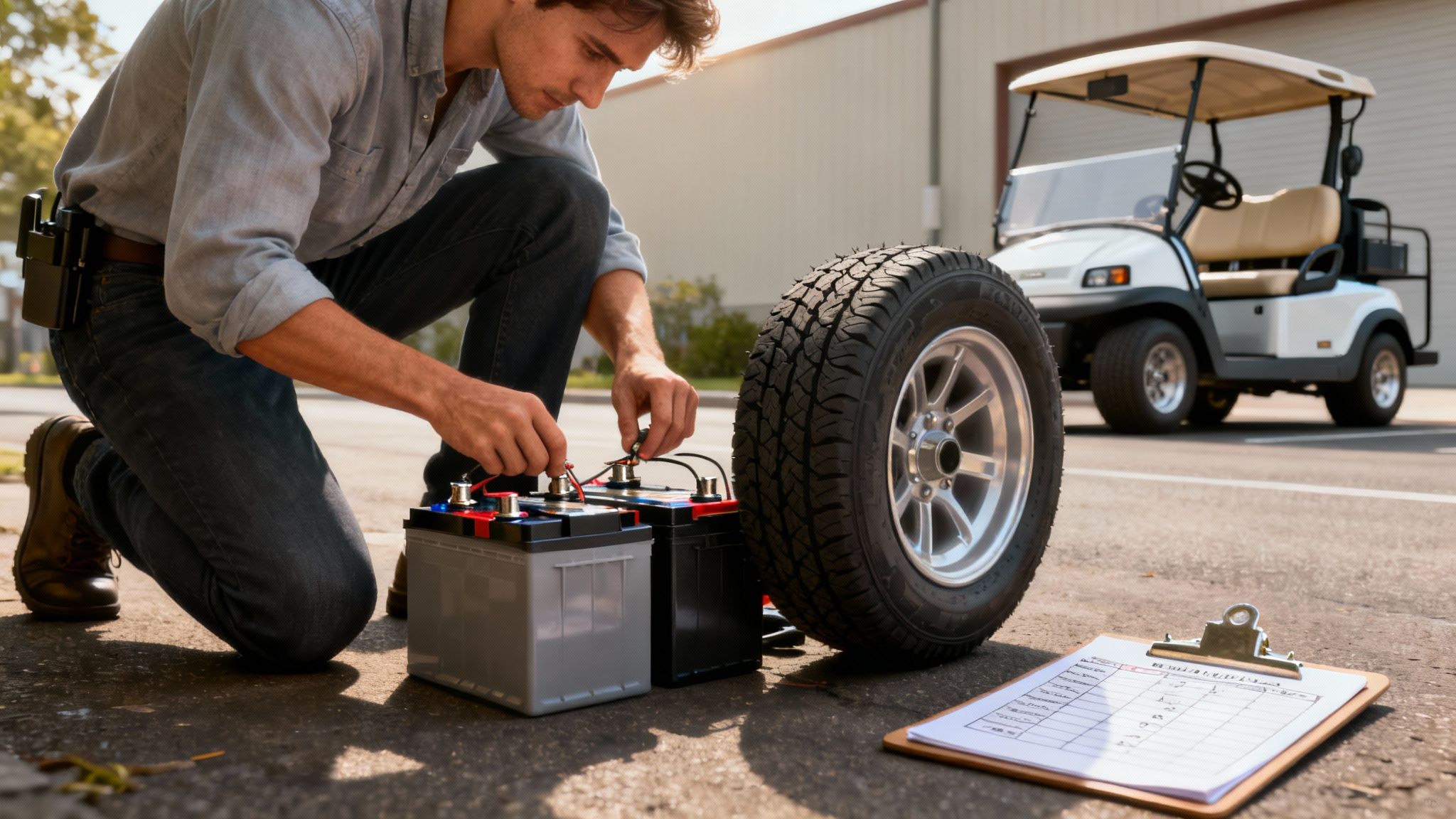
Alright, you've found a cart that looks promising online. Now comes the crucial part—seeing if it holds up in person. This is where you need to roll up your sleeves and get a little dirty, because a thorough inspection is the single best way to avoid a bad purchase, whether you're at a dealership or in a private seller's driveway.
Start with a simple walk-around. Get up close. Don't be shy about crouching down to look underneath for signs of frame damage or rust, paying special attention to the welds and the battery tray, where leaks can cause serious corrosion over time.
The Pre-Ride Inspection Checklist
Before you even think about turning the key, a quick but systematic check can tell you a ton about how the cart was treated. This is especially true if you're looking at a used model.
- Batteries Are Everything: On an electric cart, the batteries are its heart and soul—and its biggest potential expense. Pop the seat and look for the date stamp on the battery terminals. It's usually a letter for the month and a number for the year (like C-22 for March 2022). If the batteries are four or five years old, you're likely looking at a replacement in the near future.
- Tires and Suspension: Check for uneven tire wear, which is a dead giveaway for alignment problems. Look for cracks in the sidewalls, too. Next, give each corner of the cart a firm push down. It should bounce once and settle. If it feels spongy or overly stiff, the suspension might need work.
- Verify the Street-Legal Gear: Go through every single safety feature like a pilot doing a pre-flight check. Headlights, taillights, turn signals, horn, brake lights. Check the windshield for any cracks, and make sure the seatbelts click in and retract smoothly.
Here's a pro tip: look for mismatched equipment. If the turn signals look like a cheap, bolted-on kit with messy wiring, you're probably looking at a DIY conversion, not a true, factory-built LSV. A professionally assembled cart will always have clean, integrated components.
For a deeper dive, especially if you're leaning toward a used cart, our complete guide on what to inspect when buying a used golf cart has you covered.
Mastering the Test Drive
Now for the fun part. The test drive is where the cart’s true personality comes out. Ask the seller if you can take it for a solid 10-15 minute ride. If you can, try to hit a few different surfaces—a smooth, straight road, a small hill, and a few turns.
Once you're moving, kill the radio and just listen. You’re trying to catch any strange grinding sounds from the motor, squealing from the brakes, or clunks from the suspension. The ride should feel tight and predictable, not like a collection of loose parts.
Specifically, you’re checking for three things:
- Acceleration and Power: Does it get going smoothly, without any weird hesitation or jerking? When you hit a small incline, it should maintain its speed without feeling like it’s about to give up.
- Steering and Alignment: On a straight, flat road, let go of the wheel for just a second (be safe!). The cart should continue straight ahead, not pull hard to one side. The steering should feel connected and responsive, not sloppy.
- Braking Performance: Find a safe spot and test the brakes. They need to feel firm and bring you to a stop in a straight line without pulling or making any awful noises. Spongy brakes are a huge red flag.
This hands-on approach is your best defense against buying a lemon. By taking the time to carefully inspect and test-drive any street legal golf carts for sale near me, you can confidently tell the good from the bad and find a vehicle that won't give you headaches later on.
Smart Questions to Ask Before You Buy
The test drive tells you how a street-legal golf cart feels, but a good conversation with the seller reveals its real story—and its future costs. Asking the right questions, especially at a dealership, is your best tool for seeing past the shiny exterior and understanding the true value of what you're buying. This is what separates a great deal from a future headache.
Before you even start negotiating, it helps to have a baseline understanding of vehicle valuation. Taking some time to learn how to determine a vehicle's true market value can give you a massive advantage. This knowledge is just as relevant for a high-end cart as it is for a car, empowering you to assess the asking price with confidence.
Digging Into Warranty and Service
Your first questions should always be about what happens after you drive away. A warranty isn’t just a formality; it’s your main line of defense against unexpected, and often expensive, repair bills down the road.
Don’t just ask if it has a warranty. Get into the details:
- What exactly does the warranty cover? Is it a comprehensive, bumper-to-bumper plan, or does it only cover the big-ticket items like the powertrain or batteries?
- How long does the coverage last? Be sure to ask about the duration for different components. Often, the battery warranty is completely separate from the rest of the vehicle's.
- Where do I go for service? Do you have to bring it back to this specific dealership, or can any authorized shop handle warranty work? This is a huge factor if you don't live nearby.
- Do you offer maintenance plans? Sometimes, pre-paid service plans can save you a decent amount of money on routine upkeep like battery conditioning and brake adjustments.
A solid warranty and a clear service plan are hallmarks of a dealer who stands behind their product. If the answers you get are vague or the coverage seems thin, that’s a pretty big red flag.
Understanding the Cart’s Past and Future
Beyond the paperwork, you need a clear picture of the vehicle’s background and what it will take to keep it running well for years to come. This is obviously critical for used models, but it’s just as important for new ones.
These days, carts are used for much more than just golfing. They've become primary transportation in planned communities, resorts, and even small towns. This means they’re being driven more and harder, making their history and battery health more important than ever.
You’ll want to ask about the battery lifecycle. How old are they? What’s their expected lifespan, and what will it cost to replace them when the time comes? Also, ask about parts availability. For a well-known brand like Solana EV, dealers can get parts quickly, but for an older or more obscure model, you could find yourself waiting weeks for a simple repair.
Finally, a great question to ask is if they help with the registration and titling process. A top-notch dealer will handle all of that paperwork for you, making the entire purchase feel seamless and getting you on the road without the hassle.
Got Questions? We’ve Got Answers.
As you get closer to pulling the trigger on a new golf cart, a few last-minute questions always seem to pop up. This is perfectly normal. Getting straight answers to these common queries is the final piece of the puzzle, ensuring you drive away with total peace of mind.
Let's tackle the things that most buyers wonder about when they start searching for street legal golf carts for sale near me. Think of this as your final sanity check before making it official.
Is a "Street-Legal" Cart Really Different From a Regular One?
In a word, yes. The difference is night and day, and it all comes down to federal safety standards and a special classification. A true street-legal golf cart is officially known as a Low-Speed Vehicle (LSV). This isn't just a fancy name; it means the vehicle was built from the ground up to meet specific Department of Transportation rules.
A factory-built LSV is legally required to have a full suite of safety features you won't find on a standard course-cruiser:
- Headlights, taillights, and turn signals
- Seat belts for every single passenger
- A horn, plus both rearview and side mirrors
- A DOT-approved shatter-resistant windshield
- A unique 17-digit Vehicle Identification Number (VIN)
That last one—the VIN—is the most important part. A regular golf cart is just a piece of equipment designed for private land. An LSV with a VIN is a registered vehicle, just like a car, and can be titled, insured, and legally driven on public roads.
Do I Really Need a Driver's License and Insurance?
You bet. Because an LSV is a registered motor vehicle, you absolutely must have a valid driver's license to operate it on public roads. There are no exceptions.
You're also legally required to carry your state's minimum liability insurance, just as you would for your car. Before you finalize any purchase, a quick call to your insurance agent and a check on your local DMV's website is a smart move. They'll give you the exact rundown for your area so there are no surprises.
Can I Just Buy a Regular Cart and Make It Street Legal Myself?
Technically, it's possible, but I almost always advise against it. The process of converting a standard golf cart into a compliant LSV is a serious undertaking—both in terms of cost and complexity. You'd have to source and professionally install a full street-legal kit that checks every single federal and state box.
Even if you get all the parts right, the vehicle then has to go through a tough state inspection process to be reclassified as an LSV and (hopefully) get assigned a new VIN. For the vast majority of people, the hassle, expense, and potential for failing inspection just aren't worth it. It’s far, far easier and more reliable to buy a vehicle that was designed, built, and certified as a street-legal LSV right from the factory.
Ready to skip the headaches and find a street-legal cart that's built right from the start? Solana EV offers a premium lineup of LSVs designed for performance, style, and complete legal compliance.
Explore our collection of street-legal electric vehicles today!