
Purchasing a set of used golf cart batteries can be a brilliant way to save some cash, but it’s a decision you’ll want to walk into with your eyes wide open. You can often snag a set for 50-70% less than the price of new ones, which is a massive draw for anyone trying to stick to a budget. The catch? The real value is hidden in their history—how old they are, how well they were cared for, and how much life they have left.
Weighing the Pros and Cons of Used Batteries
Choosing between used and new batteries really comes down to what you value more: upfront savings or long-term peace of mind. For some folks, the immediate cost reduction is the perfect fit. For others, the gamble of a shorter lifespan and potential headaches just isn't worth it. Figuring out which camp you're in is the first step to making a smart buy.
The demand for golf cart batteries is on the rise, with the global market expected to hit a staggering USD 267.3 billion by 2035. Lead-acid batteries still dominate this space because they're a known quantity and relatively cheap, which is exactly why you'll find so many of them on the second-hand market.
When Used Batteries Make Sense
Going with a pre-owned set is a genuinely practical move in a few common scenarios. If your golf cart is only used lightly—maybe for a few trips around the neighborhood or during a seasonal stay at a vacation spot—a used set can deliver all the power you need without the brand-new sticker price.
They're also a fantastic stop-gap. Let's say you want to get your cart back on the road right now but are saving up for a high-end lithium upgrade next year. A used set can tide you over perfectly.
Consider these situations:
- Light Recreational Use: Your cart is more of a weekend toy than a daily workhorse.
- Tight Budget: You need to get moving now but don't have the cash for a new battery pack.
- A Temporary Fix: You just need something to get you through a season or two before a bigger upgrade.
When to Invest in New Batteries
On the flip side, sometimes buying new is the only sensible option. If your golf cart is part of a commercial fleet at a resort or works hard on a large property, you can't afford a breakdown. Reliability is everything.
The same goes for anyone who uses their cart as their primary vehicle in a planned community. The confidence that comes with a full warranty and a predictable, long lifespan is priceless. For a deeper dive into the numbers, you can explore a detailed breakdown of how much golf cart batteries cost to see the full price spectrum.
To make the decision a bit easier, here’s a quick rundown of the key differences.
Used vs New Golf Cart Batteries at a Glance
Use this quick comparison to weigh the key differences between buying used and new batteries for your golf cart.
| Factor | Used Batteries | New Batteries |
|---|---|---|
| Initial Cost | Significantly lower (50-70% savings) | Full retail price |
| Lifespan | Shorter, often unpredictable | Full, predictable lifespan (4-8 years) |
| Reliability | Variable; depends on past use | High and consistent |
| Warranty | Typically none, or very limited | Full manufacturer's warranty |
| Best For | Light use, temporary solutions, tight budgets | Daily use, commercial fleets, peace of mind |
Ultimately, a new set of batteries is an investment in predictability.
You know exactly what you're getting: maximum performance, a full lifespan, and a manufacturer's warranty to back it up.
How to Properly Inspect and Test Used Batteries
Before you even think about grabbing a multimeter, the best tools you have are your own two eyes. A good visual once-over can tell you almost everything you need to know and help you sidestep a bad deal right from the start.
First, get a good look at the battery casings. You're hunting for any signs of physical abuse. Look for cracks—even tiny hairline fractures—or any noticeable bulging or swelling on the sides. These are immediate red flags. They often signal that a battery has been overcharged, allowed to freeze, or is suffering from internal failure. If you see any of this, walk away.
Next, zoom in on the terminals. A little bit of corrosion can be cleaned up, no problem. But if you see thick, crusty buildup that looks like it's been eating away at the lead posts, that's a bad sign. It points to long-term neglect, and that kind of damage can seriously compromise the battery's ability to hold a charge.
The Tools for a Deeper Dive
A battery can look brand new on the outside and be completely dead on the inside. To get the real story on its health, you need to run a few simple tests. This is where we move from a quick inspection to a proper diagnosis, and you'll need three key pieces of equipment.
- Multimeter: This is your first stop. It gives you a quick, basic reading of the static voltage for each battery, telling you its immediate state of charge.
- Hydrometer: If you're dealing with traditional flooded lead-acid batteries, this tool is an absolute must-have. It measures the specific gravity of the electrolyte fluid, which directly reflects the battery's health and remaining capacity.
- Load Tester: This is the moment of truth. A load tester puts the battery under the kind of strain your cart will, revealing whether it can actually deliver power when it counts. A battery that can't handle a load is just a heavy box.
This diagram helps break down how to balance your cart's requirements with what you're willing to spend.
Ultimately, your decision comes down to where these two factors—your cart's needs and your budget—intersect.
Reading the Results Like a Pro
Alright, you've got your tools. Now it's time to see what they tell you.
With a multimeter, a fully charged 6-volt battery should read somewhere around 6.3 to 6.4 volts. For an 8-volt, you want to see 8.4 to 8.5 volts, and a 12-volt should be up at 12.6 to 12.7 volts. If you're getting a reading significantly lower than that, especially on a battery that the seller claims is fully charged, you're likely looking at a weak or dying cell.
When you use a hydrometer on a lead-acid battery, a healthy, full cell should give you a specific gravity reading between 1.265 and 1.280. The real key here isn't just the number, but the consistency across all the cells. If five cells are sitting pretty at 1.270 but one is down at 1.150, that single weak cell is going to cripple the performance of the entire pack.
Finally, the load test tells the story voltage can't. You'll apply a load for 10-15 seconds. A good battery's voltage will dip but will stay strong—for instance, a 12V battery should stay above 9.6 volts under load. If the voltage takes a nosedive, the battery just doesn't have the guts to do the job anymore.
Once you have your new (or new-to-you) batteries installed, keeping an eye on them is key. Learning how to read a dedicated battery meter for your golf cart is the best way to track their day-to-day performance and catch problems early.
Expert Tip: Always, always test each battery in the set individually. A battery pack is only as strong as its weakest link. Testing the whole series at once can easily mask one failing battery that’s about to take the rest of your investment down with it.
Understanding Battery Types and Cart Compatibility
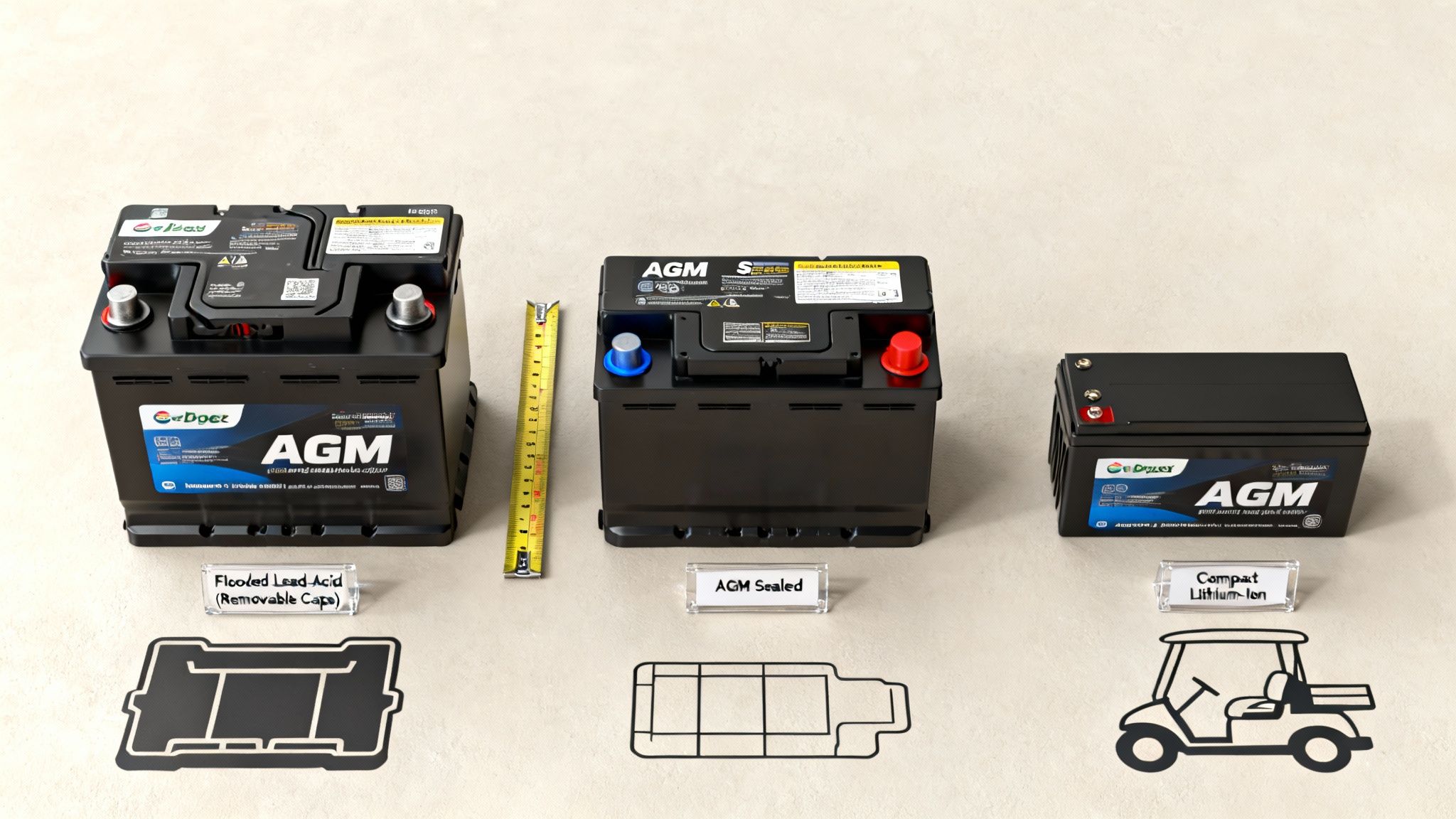
Scoring a deal on used golf cart batteries feels great, but that feeling evaporates the moment you realize they don't work with your cart. It’s a frustrating and expensive mistake to make. The used market is basically a tale of two technologies: the classic lead-acid batteries and the newer, increasingly popular lithium-ion. Knowing the difference is everything.
Lead-acid batteries are the old-school workhorses. They're heavy and have been the standard for decades. You'll mostly find two kinds:
- Flooded Lead-Acid: These are the most common and cheapest you'll find, but they come with homework. You have to regularly check and top off the water levels.
- AGM (Absorbent Glass Mat): Think of these as the set-it-and-forget-it version of lead-acid. They’re sealed and maintenance-free, which is a nice perk for a slightly higher cost.
Then you have lithium-ion, the modern contender. These are a different beast altogether—they’re way lighter, charge up in a fraction of the time, and have a much longer lifespan. They also require zero maintenance. The industry is definitely shifting this way; forecasts show the U.S. lithium market for golf carts is on track to blow past USD 1 billion by 2028. What that means for you is that more high-quality, used lithium packs are hitting the market as the early adopters upgrade. You can dig into the numbers on this trend over at Strategic Market Research.
Matching Batteries to Your Cart's System
Before you even think about handing over cash, you have to nail down three critical compatibility points. Get any of them wrong, and you're looking at poor performance, potential damage to your cart's electronics, or batteries that just plain don't fit.
The first thing to check—and it's non-negotiable—is your system voltage. Is your golf cart a 36-volt (36V) or a 48-volt (48V) system? The easiest way to tell is to look at the label on your charger or count the water-fill caps on all your current batteries and multiply by two. A 36V system typically runs on six 6V batteries, while a 48V setup often uses six 8V batteries or four 12V batteries. Whatever your cart's voltage is, the total voltage of the replacement set must match it perfectly.
A quick but crucial tip: Never mix battery types, brands, or ages in the same pack. A battery set is only as strong as its weakest cell. One bad battery will drain the life out of all the others, leading to premature failure for the whole set.
Physical Fit and Power Requirements
Next, let's talk about the physical fit. This sounds obvious, but you’d be surprised how many people get it wrong. Grab a tape measure and get the exact dimensions of your battery tray—length, width, and height. Compare those numbers to the specs of the used batteries you're eyeing.
This is especially important when switching types. Lithium batteries are often much more compact, which might mean you'll need spacers to keep them secure. On the flip side, some beefier lead-acid models could be too tall or wide for your compartment. If you’re thinking about making the jump, our guide on the benefits of a golf cart lithium battery is a great resource.
Finally, you have to consider your cart's power demands. Do you have a souped-up motor? An upgraded controller? If so, you need batteries that can handle the extra amperage. The battery pack's discharge rating has to meet or, ideally, exceed what your cart needs to perform, especially if you’re dealing with steep hills or heavy loads. An underpowered battery set will constantly struggle, degrade quickly, and wipe out any money you thought you saved.
Finding and Negotiating Your Battery Purchase
Alright, you know what to look for in a decent used battery. Now, where do you actually find them? Sourcing good used golf cart batteries is all about balancing cost with reliability, and each place you look has its own trade-offs.
A great starting point is your local golf cart shops and dedicated battery wholesalers. These guys are constantly getting trade-ins or swapping out old inventory when a fleet upgrades. The best part? They’ve usually already done the basic testing and can give you solid data, not just a vague "they work great." You might even snag a limited 30-day warranty, which is a huge confidence booster when buying used.
Of course, you can also dive into the wild west of online marketplaces like Facebook Marketplace and Craigslist. This is where the real bargains live, since you're often buying directly from the previous owner. The catch is the risk. There are no guarantees, so all the testing and due diligence is 100% on you. It can be a high-reward game, but you have to be prepared for the gamble.
How to Negotiate Like a Pro
Once you've zeroed in on a promising set of batteries, your ability to negotiate will make or break the deal. Don't be timid here—it's your hard-earned cash on the line. A few smart questions can tell you everything you need to know about the battery's history and potential lifespan.
Before you even waste gas driving out, get on the phone and ask these critical questions:
- What's the date code? This is non-negotiable. It tells you exactly how old they are. A four-year-old battery is on its last legs, while a one-year-old set has plenty of life left.
- Why are they for sale? The seller's story matters. "I'm upgrading to lithium" is a fantastic sign. "They just don't hold a charge like they used to" is your cue to hang up and move on.
- Can I test them on-site? If a seller gets defensive or refuses to let you bring your multimeter, hydrometer, or load tester, it's a massive red flag. Thank them for their time and walk away.
Your test results are your best friend during negotiation. A low hydrometer reading or a steep voltage drop under load is undeniable proof that the batteries aren't perfect, and the price should reflect that.
Making a Smart Offer
The data you collect is your leverage. Let's say the batteries are only two years old and every test you run comes back strong. Offering around 50% of the retail price for a new set is a solid, fair deal for both parties.
But what if things aren't perfect? If one battery in a six-pack has a low specific gravity reading, you can rightly point out that it will drag the whole set down. Use that fact to negotiate a lower price that accounts for having to replace that weak link sooner rather than later.
Always be respectful, but stand your ground. Explain that your offer is based directly on their age and the real-world condition you've just tested. The real skill here isn't just about getting a low price—it's about knowing what a fair price is and being willing to walk away if the deal doesn't make sense.
Safe Installation and First Use Procedures
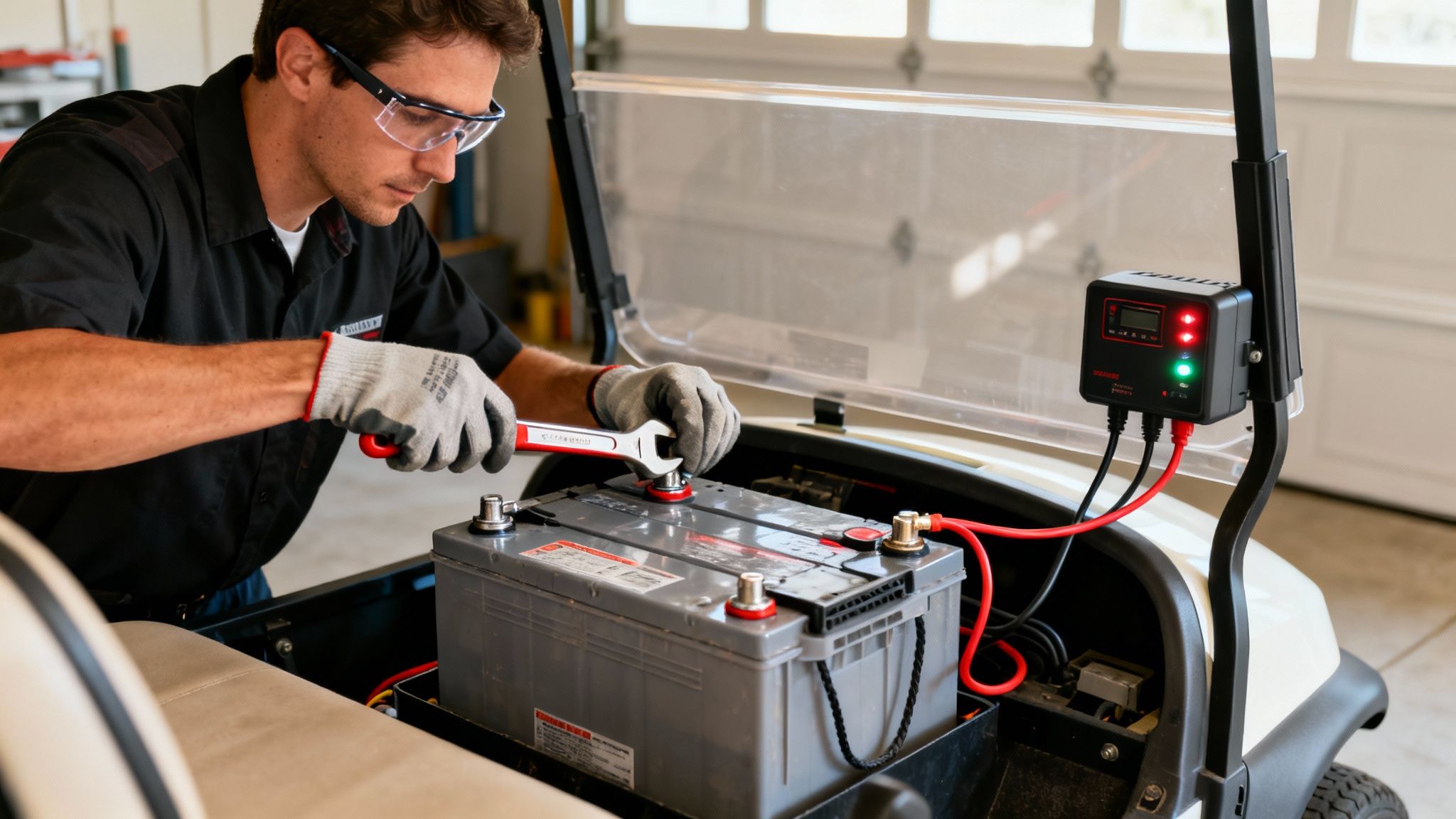
Alright, you’ve put in the legwork—inspecting, testing, and getting a good deal on your used batteries. Now for the most important part: getting them installed safely so they have a long, useful life in your cart. This isn't just about hooking up a few cables; it's about being methodical and putting safety first to avoid hurting yourself or damaging the cart.
First things first, gear up. Before you even think about touching a terminal, put on your safety glasses and gloves. There's corrosive acid and potentially flammable hydrogen gas in play, so protecting your eyes and skin is absolutely non-negotiable.
Next, you need to power down the cart completely. Flip the tow/run switch to "Tow" and then disconnect the main positive and negative cables from the old battery pack. This ensures the system is dead, which is exactly what you want when you're working in there.
The Right Connection Sequence
The order you connect the terminals is critical. Get it wrong, and you risk creating a dangerous spark right next to a battery. I always recommend using insulated wrenches—they're cheap insurance against accidentally grounding a positive terminal to the cart's frame.
The trick is to build the battery pack circuit first, before connecting it to the cart's system. Here’s how I do it:
- Get all the batteries settled and secured in the battery tray. Make sure they aren't going to slide around.
- Start connecting the jumper cables between the batteries to build your 36V or 48V series. You’ll be connecting the positive post of one battery to the negative post of the next, and so on, down the line.
- When you're done, you'll have one main positive and one main negative terminal left unconnected at opposite ends of the pack.
- Now, connect the cart’s main positive cable to the battery pack’s main positive terminal.
- Finally—and this is the key step—connect the cart's main negative cable to the pack's main negative terminal. Connecting this ground cable last is the single best way to prevent a spark from completing the circuit.
Here's a little mantra I've used for years: Last on, first off. The main negative cable is the last one on during installation and the first one off during removal. Burn that into your brain. It drastically reduces the risk of accidental shorts.
First Use and Conditioning
Okay, the batteries are in, but you're not ready to hit the links just yet. That first charge cycle is your best opportunity to condition the pack and get all the cells working together.
Before you go for a spin, plug the cart in and let the charger run through a full, uninterrupted cycle. Don’t be tempted to unplug it early. This initial long charge helps the charger balance out the cells, which is especially important for a used set that has seen some action.
Once it's fully charged, take the cart for a gentle test drive—nothing too demanding. After you get back, pop the seat and do a quick check. Carefully feel each of the cable connections. If any of them are hot to the touch, you've got a loose connection that needs to be re-tightened. Following this simple process sets you up for reliable performance and helps you get the most out of your smart investment.
Your Top Questions About Used Golf Cart Batteries Answered
When you're shopping for used golf cart batteries, you're bound to have questions. That’s a good thing. Getting solid answers is the only way to make a smart purchase you won't regret later. Let's dig into some of the most common things people ask.
How Long Will a Used Set Really Last?
This is the big one, and the honest answer is: it all comes down to how they were treated. A set of two-year-old lead-acid batteries that was meticulously maintained could easily give you another two to four years of solid performance.
On the flip side, a neglected set of the same age might be on its last legs, barely lasting a year. Always check the date code stamped on the battery. If it's already past half of its expected lifespan, you should be paying a whole lot less for it.
What About Mixing Batteries or Getting Rid of Old Ones?
I see this all the time, and it’s a costly mistake. Never mix different brands, types, or ages in your battery pack. Think of your cart’s batteries as a team—they all have to work together. The entire pack's performance is dragged down by its single weakest link.
Mixing them up means they charge and discharge at different rates. The stronger batteries get overcharged while the weaker ones are constantly drained too low. This creates a vicious cycle that will absolutely destroy the entire pack, killing your investment way ahead of schedule.
When your batteries finally reach the end of the road, you can't just toss them in the trash. They’re filled with nasty stuff like lead and sulfuric acid, which are seriously hazardous.
The best (and often most profitable) way to handle old batteries is to recycle them. Most places that sell new cart or automotive batteries are required by law to take your old ones. They'll usually give you a "core charge" credit, which knocks a few bucks off the price of your new set.
This guide on where to recycle lead-acid batteries is a great resource for doing it right. Properly disposing of them is the final, crucial step that protects the environment and your wallet. Knowing these key details, from lifespan to disposal, helps you buy used batteries like a pro.
Ready to explore premium electric vehicle options for your community or business? Solana EV offers a full lineup of stylish, reliable, and street-legal carts designed for modern transportation needs. Discover the difference quality engineering makes at https://solanaev.com.