
Think of an off-road electric utility vehicle as your go-to workhorse, but powered by a battery instead of a gas tank. These rugged machines are built to haul cargo and move people over tough terrain, all while running silently and producing zero emissions. They mark a huge step up from the loud, gas-guzzling UTVs of the past, offering a smarter, cleaner way to get work done for both businesses and recreational users.
The Quiet Revolution in Off-Road Utility
Imagine managing a sprawling resort property or acres of farmland without the constant drone of a gas engine. That's the new reality that an off-road electric utility vehicle delivers. We’re witnessing a fundamental shift away from traditional UTVs toward these quieter, more efficient electric alternatives, and this guide will walk you through exactly why industries from agriculture to property management are making the switch.
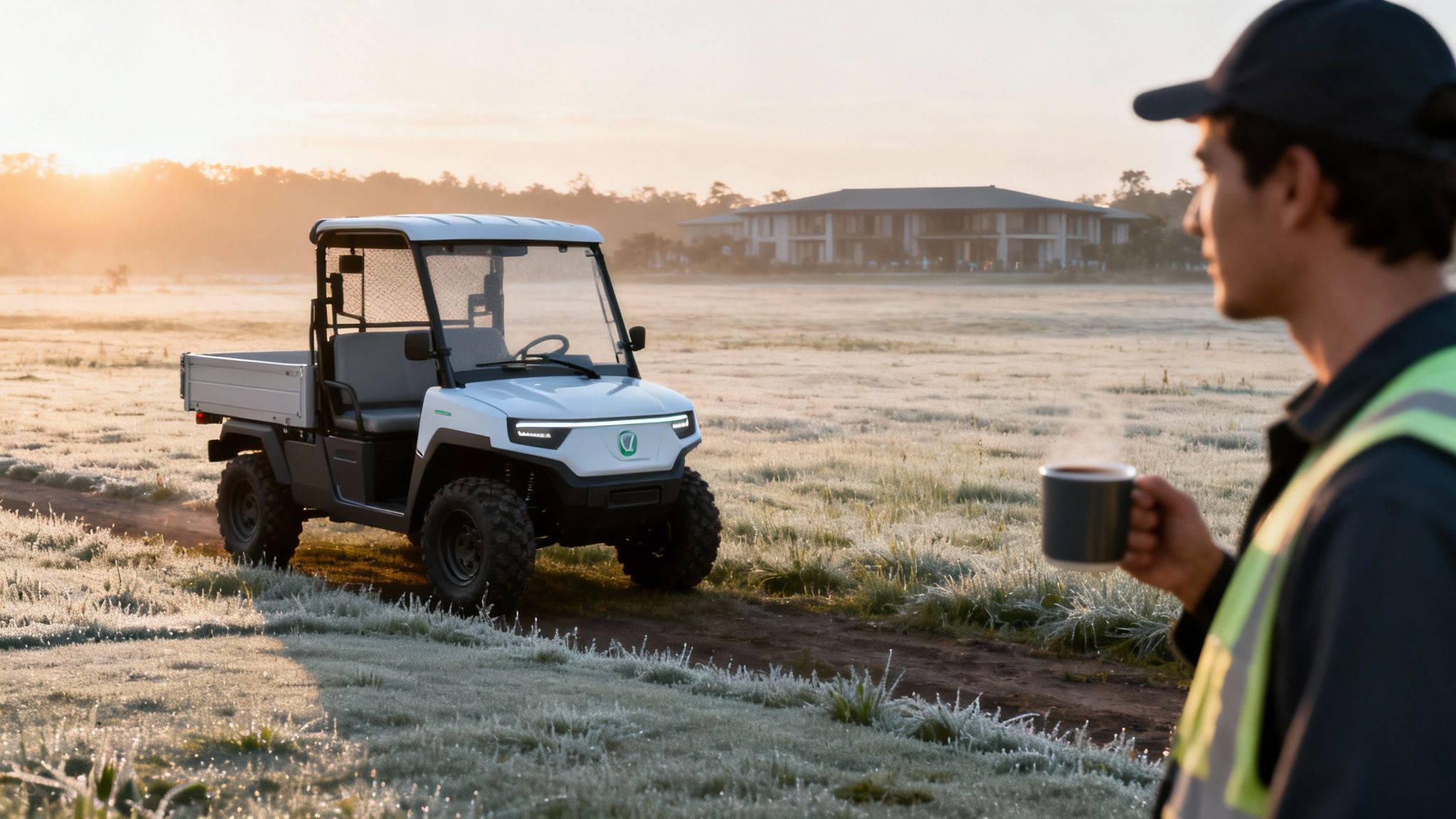
The appeal is simple but incredibly powerful. These vehicles offer real-world advantages that go far beyond just being "green." Businesses are turning to them for practical, dollars-and-cents reasons that directly boost their bottom line and make day-to-day operations smoother.
Why Operators Are Making The Switch
The move to electric isn't just a trend; it's a smart business decision driven by financial, operational, and environmental perks. Unlike gas models that need constant refueling and finicky engine maintenance, an electric UTV just makes the workday easier.
- Drastically Lower Running Costs: Electricity is far cheaper than gasoline, so you start saving money from day one. With way fewer moving parts in an electric motor, maintenance becomes a breeze, which means less downtime and smaller repair bills.
- Near-Silent Operation: This is a complete game-changer in any setting where noise is an issue. Resorts can shuttle guests around in peace, and maintenance crews can start their rounds at dawn without waking anyone up.
- Zero On-Site Emissions: Getting rid of exhaust fumes creates a healthier environment for your team. It's also a necessity for working in enclosed spaces like barns or warehouses, or in ecologically sensitive areas where you can't risk pollution.
This isn't just a niche movement. The market numbers tell the story. The global off-road electric vehicle market was valued at USD 20.21 billion in 2024 and is projected to explode to USD 76.78 billion by 2035. That's a compound annual growth rate of 12.9%, pointing to a massive industry-wide shift toward electric power. You can learn more about the off-road EV market growth and see the data for yourself.
It’s like swapping a loud, high-maintenance gas lawn mower for a quiet, reliable robotic one. The electric utility vehicle brings that same kind of smart efficiency to heavy-duty work, letting you get the job done with less noise, less cost, and a much smaller environmental footprint.
Consider this guide your go-to resource. We'll dive deep into the technology, the real-world applications, and the financial benefits to give you the confidence you need to invest in the right electric UTV for your operation.
Looking Under The Hood: What Really Matters in an Off-Road EV
When you start shopping for an off road electric utility vehicle, the spec sheet can look like a foreign language. But don't get bogged down in the technical jargon. A few key numbers tell you almost everything you need to know about how that machine will perform on your property.
Think of it less like an engineering exam and more like hiring a new crew member. You just need to understand their core strengths to know if they’re right for the job.
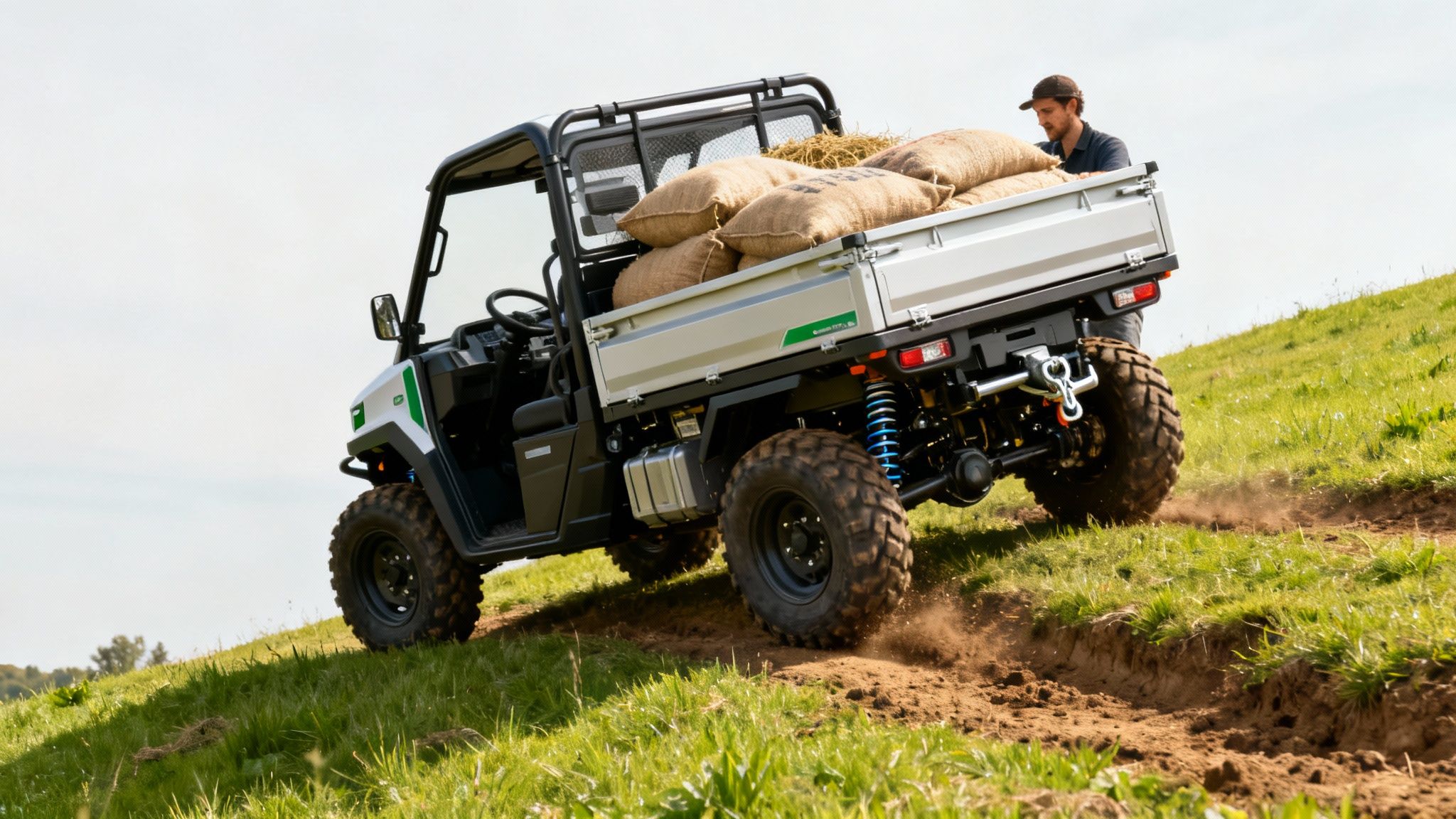
Let's break down what those specs really mean in the real world, so you can see how they translate directly into getting the work done.
The Heart of The Machine: Battery and Motor
At the core of any electric UTV are its battery and motor—the dynamic duo that dictates its power and endurance. The battery's capacity, measured in kilowatt-hours (kWh), is basically the size of its fuel tank. A bigger kWh number means you can go farther on a single charge.
For example, a high-capacity battery might deliver a solid 40-80 miles of range, perfect for sprawling properties where you can't just pop back to the barn for a top-up. A smaller battery might give you 20-40 miles, which is plenty for more contained work areas.
The motor is the muscle. It’s what turns that stored battery energy into raw, usable power.
Think of it like this: The battery (kWh) is your water canteen on a long hike. The motor is how efficiently you can drink that water to climb a steep hill. A huge canteen won't help if you can't get a good drink when you need it most.
Modern, high-quality electric UTVs almost always use AC (alternating current) motors. Their big advantage is providing instant torque, meaning you get 100% of the vehicle's power the second your foot touches the pedal. This is a game-changer when you're trying to start from a dead stop on a hill with a bed full of supplies—something a gas engine just can't do without revving up.
Measuring Raw Strength: Payload and Towing
Once you know how the vehicle is powered, the next question is simple: how much work can it actually do? This is where payload and towing capacities come in. These two specs define the machine’s pure, brute strength.
Payload capacity tells you the total weight the vehicle can carry. This isn't just what's in the bed; it includes you, your passengers, and any gear you've bolted on. A lighter-duty model might top out around 800 pounds, while a serious industrial workhorse can handle over 3,000 pounds of materials, tools, or feed.
Towing capacity is all about what you can pull behind the vehicle. If you need to move trailers, log splitters, or other heavy equipment, this number is critical. Most mid-range utility vehicles can pull between 5,000-7,500 pounds, which covers the vast majority of tasks on a farm, resort, or large estate.
If you want to dig deeper into how these specs come together, exploring what defines a modern electric utility vehicle can give you a clearer picture of how different models are engineered for specific jobs.
Essential Off Road EV Utility Vehicle Specifications
To make sense of it all, here's a quick breakdown of the most important specs. This table translates the numbers into what they mean for your day-to-day operations.
| Specification | What It Means | Why It Matters for Your Work |
|---|---|---|
| Range (Miles) | How far the vehicle can travel on a single full charge. | Larger properties need more range to avoid constant recharging. A 40-80 mile range is ideal for extensive use. |
| Payload (lbs) | The maximum weight the vehicle can carry, including passengers and cargo. | This determines if you can haul heavy materials like soil, tools, or feed. An industrial model might handle 3,000+ lbs. |
| Towing (lbs) | The maximum weight the vehicle can pull behind it. | Crucial for moving trailers, water tanks, or other implements. 5,000-7,500 lbs is a strong benchmark. |
| Ground Clearance (in) | The distance from the lowest part of the frame to the ground. | Higher clearance (8-12 inches) lets you cross rough terrain, logs, and rocks without getting hung up or damaging the vehicle. |
| Motor Type | The technology that converts electrical energy into motion (e.g., AC motor). | AC motors provide instant torque for better climbing and pulling power, especially from a standstill. |
Understanding these five metrics gives you the power to look past the marketing and choose a vehicle that truly meets the demands of your work.
Taming The Terrain: Ground Clearance and Suspension
An off-road vehicle is useless if it can't handle the "off-road" part. Its ability to navigate rough, unpredictable ground comes down to two things: ground clearance and suspension.
-
Ground Clearance: This is simply the space between the ground and the lowest point of the vehicle's chassis. More clearance means you can roll over bigger rocks, deeper ruts, and fallen branches without bottoming out. A basic UTV might have 4-6 inches, but a true off-road model will offer 8-12 inches or more for real confidence.
-
Suspension System: This is what keeps the ride smooth and the vehicle stable by absorbing bumps and jolts. A good independent front suspension, which you'll find on quality UTVs, lets each wheel react to the terrain on its own. This makes for a much more comfortable ride and dramatically better control on uneven paths.
Ultimately, you need a vehicle that can reliably get to every corner of your property. Matching the suspension and clearance to your terrain is just as vital as matching the payload to your workload.
How Electric UTVs Perform in the Real World
Specs on a page are one thing, but the real test for any off road electric utility vehicle is how it handles the day-to-day grind. The numbers for payload and range matter, of course, but it’s the stories from the field that truly show how these machines solve actual problems.
Let's look at a few scenarios where electric UTVs aren't just a simple substitute for gas models—they're a genuine upgrade.
Quiet Operations at Resorts and Venues
Picture a high-end resort tucked away in a serene, natural setting. The entire guest experience is built around peace and quiet. The last thing you want is the constant drone and smell of gas-powered carts ruining the atmosphere.
This is a perfect use case for an electric fleet. Suddenly, staff can shuttle guests, deliver room service, and haul luggage in near silence. Maintenance crews can get a jump on their work at sunrise without a single noise complaint. The lack of exhaust fumes also keeps the air crisp and clean, reinforcing that eco-friendly image that so many guests are looking for.
The Power to Get Work Done on the Farm
Now, let's shift gears and head out to a farm. The daily chores are demanding, and the terrain is unforgiving. Imagine needing to haul a few hundred pounds of feed up a steep, muddy hill to reach a remote pasture. A gas engine would be screaming at high RPMs just to get traction.
This is where the instant torque of an electric motor really proves its worth. The second you touch the pedal, you get 100% of the vehicle's power. The UTV just digs in and climbs, no engine strain, no hesitation, even with a bed full of supplies.
It's not just about making the job easier; it's about being more efficient and reliable. You save time, put less wear on the vehicle, and know you can count on your machine to tackle the toughest spots on your property, day in and day out. That's a practical advantage you feel immediately.
On top of that, the quiet operation is a massive bonus around livestock. An electric UTV doesn't spook the animals, which reduces stress during feeding or herding. It’s a small detail, but it makes a world of difference for animal welfare and makes daily tasks that much smoother.
Treading Lightly in Natural Spaces
Municipal parks and recreation departments have a tricky job. They need to maintain huge natural areas without disturbing the very wildlife and visitor experiences they're there to protect. Driving a loud, polluting gas vehicle down a sensitive nature trail just doesn't make sense.
An electric UTV is the ideal tool for the job. A parks crew can clear fallen trees, maintain remote trails, and haul tools without sending animals scattering or ruining a visitor's peaceful hike. People get to hear the sounds of nature, not the roar of an engine.
The vehicle’s zero-emissions profile is just as important. It means the team isn’t accidentally introducing pollutants into a protected ecosystem. This commitment to sustainability is something the community notices and values, reinforcing the department's role as a true steward of the environment. For anyone managing these kinds of properties, exploring the world of off-road electric carts can completely change how you approach operations.
Versatility in Action
These examples all point to the same conclusion: the off road electric utility vehicle shines in any environment where noise, emissions, and on-demand power are critical. Its strengths aren't just theoretical—they're proven every single day in all sorts of demanding jobs.
- Construction Sites: Need to move materials inside a partially enclosed building? An electric UTV can do it safely without any worries about ventilation.
- Event Management: At a sprawling outdoor festival, these vehicles provide quiet, clean transport for staff, security, and medical teams, easily navigating crowds without adding to the noise and fumes.
- Large Estates: For property owners with acreage to manage, they're a simple, low-maintenance solution for everything from hauling mulch to checking fence lines.
Each scenario shows how the unique advantages of electric power deliver real, tangible benefits. These machines aren't just a novelty; they are more than ready for serious work.
Calculating Your Total Cost of Ownership
The sticker price on an off-road electric utility vehicle is just the first page of a much longer financial story. To really get the full picture, you have to look at the Total Cost of Ownership (TCO). It’s when you zoom out and consider the long-term expenses that the real economic advantages of going electric start to shine.
When you buy a gas-powered UTV, you're also signing up for a future of predictable, recurring costs. Think fuel, oil changes, filter replacements, and engine tune-ups. An electric vehicle, on the other hand, just wipes most of that off the board. The two biggest ongoing expenses—gas and complex engine maintenance—are almost completely gone, leading to huge savings that pile up year after year.
The Real Price of Fuel Versus Electricity
The most immediate and obvious win is at the pump—or rather, the outlet. Swapping out trips to the gas station for simple overnight charging fundamentally changes your operating budget. On a per-mile basis, electricity is just consistently cheaper than gasoline.
Here's a simple way to think about it: a gas UTV might cost you $0.08 to $0.15 per mile to run, depending on fuel prices. An electric UTV, drawing power from the grid, typically rings in at just $0.02 to $0.05 per mile. Over thousands of miles, those pennies add up to hundreds, then thousands of dollars in savings.
It's like choosing between a subscription service with a hefty monthly fee versus a one-time purchase with minimal upkeep. The electric model gives you predictable, low costs that make budgeting way easier.
This is a big part of why the entire off-road market is shifting. We're seeing better batteries and more accessible charging, even in remote areas, making these vehicles more practical and financially sound than ever.
Streamlining Your Maintenance Schedule
Maintenance is the other area where electric UTVs really pull ahead. An internal combustion engine is a complicated beast, packed with hundreds of moving parts that need constant attention—oil, filters, spark plugs, belts, and exhaust systems all need regular service or replacement.
An electric motor, by comparison, is incredibly simple. With very few moving parts, the maintenance checklist shrinks dramatically. Your main tasks become much more straightforward:
- Tire Checks: Making sure they have proper inflation and even tread wear.
- Brake Inspections: Periodically checking pads and fluid levels.
- Battery Care: Keeping connections clean and following good charging habits.
This simplicity means far less time in the shop and more time getting work done. Annual maintenance costs can be 40-60% lower for an electric vehicle, a major saving for any business fleet or private owner. Understanding these long-term costs is crucial; you can get a broader perspective from guides on the true cost of electric vehicle maintenance that applies to many EV platforms.
This versatility is exactly why so many different industries are making the switch.
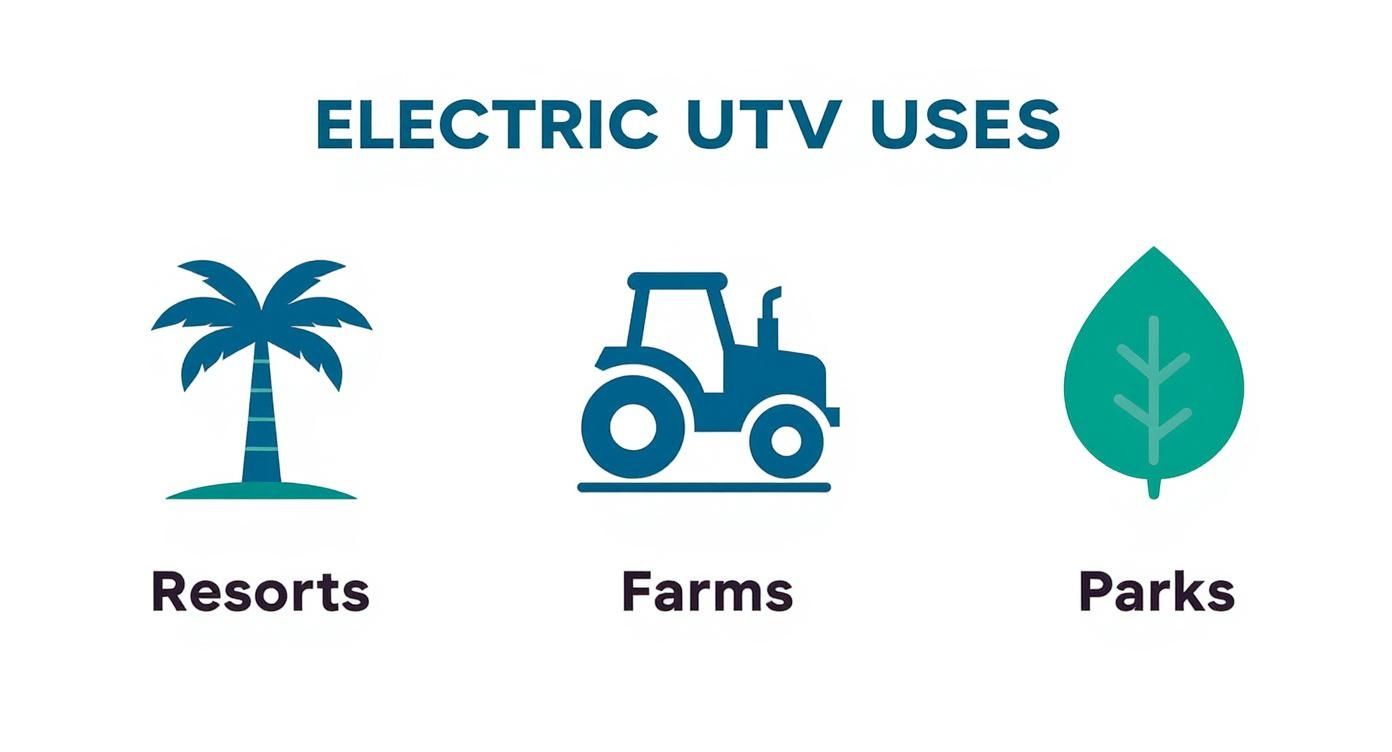
From hospitality and farming to park maintenance, electric UTVs are becoming go-to tools for quiet, efficient operations.
Let's look at a simple breakdown of how those annual costs can differ.
Gas UTV vs Electric UTV Annual Operating Cost Comparison
| Cost Category | Typical Gas UTV (Annual Est.) | Solana EV UTV (Annual Est.) | Potential Savings |
|---|---|---|---|
| Fuel/Energy | $900 | $180 | $720 |
| Routine Maintenance | $450 | $150 | $300 |
| Total Annual Cost | $1,350 | $330 | $1,020 |
Note: Estimates based on 5,000 miles/year, $3.50/gal gas (19 MPG), and $0.14/kWh electricity. Actual savings will vary based on usage, local energy prices, and maintenance needs.
As you can see, the annual savings are substantial, making the initial investment pay for itself over the vehicle's lifespan.
Charging Your Vehicle Smartly
Finally, knowing your charging options helps you get the most out of your vehicle without spending more than you need to. For most people, standard charging is more than enough.
- Level 1 Charging: This is the easiest method, using a standard 110-volt wall outlet. It’s perfect for plugging in overnight so your UTV is ready to go with a full battery every morning.
- Level 2 Charging: For businesses that need a faster turnaround, a 220-volt Level 2 charger can cut charging time roughly in half. This is great for high-use commercial fleets that might need a quick top-up during the day.
By combining massive fuel savings with radically lower maintenance needs, the total cost of ownership for an off-road electric utility vehicle makes a clear financial case. The return on your investment isn't a question of if, but when.
Customizing Your Vehicle for Specific Jobs
An off-road electric utility vehicle is a workhorse right off the factory floor, but its real power comes from smart customization. Think of the base model as a blank canvas. With the right accessories, you can transform it into a specialized tool perfectly dialed in for the exact job you need it to do. This isn't just about bolting on a few extras; it's about creating a purpose-built solution for your day-to-day operations.
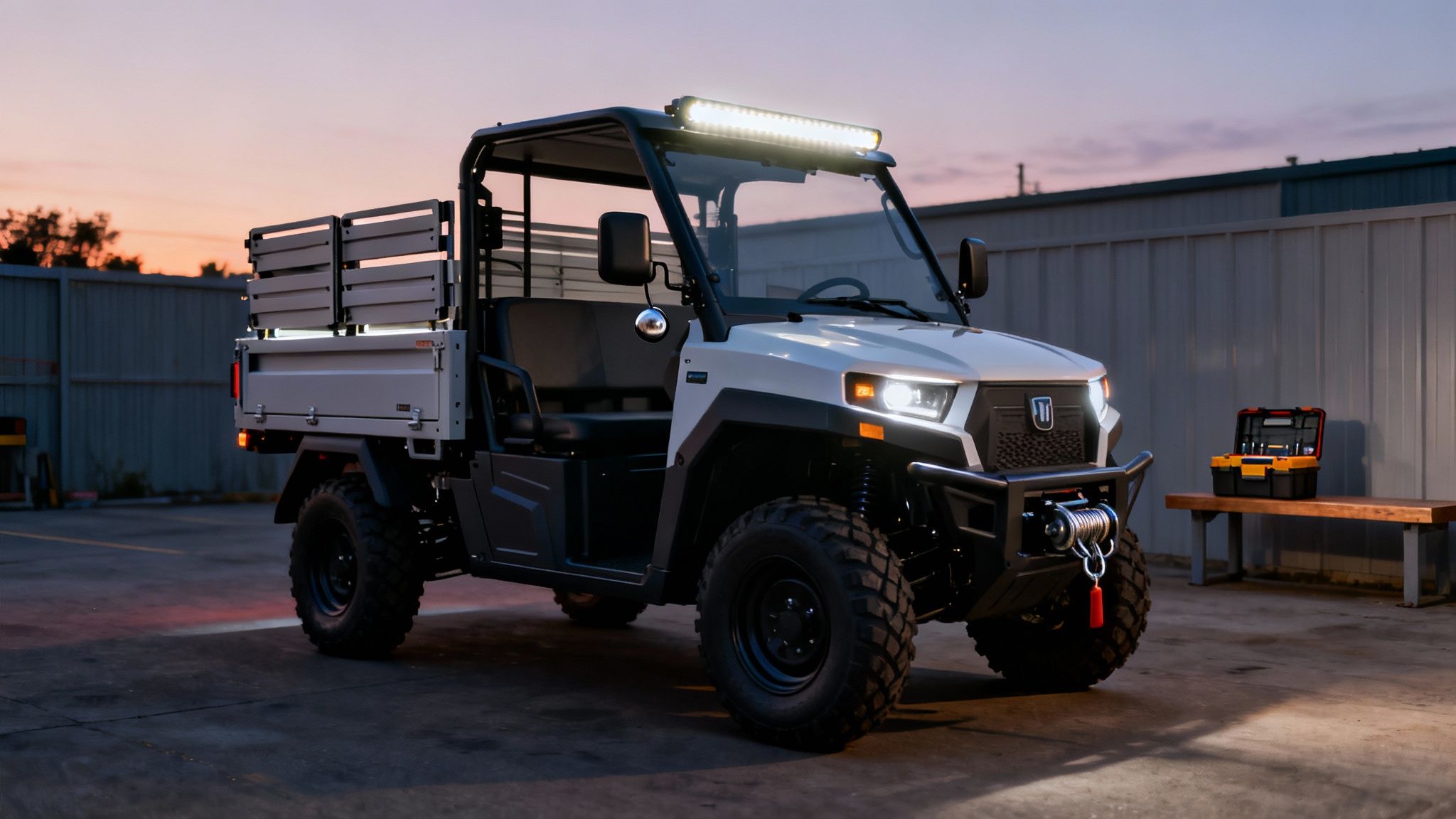
Whether you’re trying to improve safety or just get more done, the right add-ons can make your vehicle an absolutely essential part of your workflow.
Equipping Your UTV for Maximum Productivity
The best customizations are the ones that solve your biggest headaches. If you’re a property manager dealing with muddy, unpredictable terrain, a powerful winch isn’t just a nice-to-have—it’s a lifeline when a vehicle gets stuck. In the same way, a grounds crew spread across a huge campus can get way more done with a versatile bed setup.
Some of the most common productivity-boosting accessories include:
- Powerful Winches: For pulling yourself out of a ditch or dragging heavy logs and debris, a winch with a 3,500 to 5,000-pound capacity is a non-negotiable for serious off-road work.
- Versatile Bed Configurations: Options like hydraulic dump beds make unloading gravel or mulch a breeze. You can also get enclosed cargo boxes to keep expensive tools dry or stake sides to haul bulky, awkward loads securely.
- Enhanced LED Lighting: For crews working before sunrise or long after sunset, bright LED light bars and spotlights can light up a whole work area, which is critical for both safety and getting the job done right.
Being able to tailor a vehicle to a specific job is a huge reason the UTV market is growing. In fact, North America holds about a 33% share of the electric utility vehicle market revenue as of 2024, partly because so many industries and recreational users here demand highly specialized vehicles.
Navigating Street Legal Regulations
One of the most practical upgrades you can make is getting your electric UTV street legal, but you have to pay close attention to local laws. A "street legal" UTV, which is often classified as a Low-Speed Vehicle (LSV), can be driven on public roads—usually those with a posted speed limit of 35 mph or less. This simple change takes your machine from being stuck on your property to being a flexible, short-range transport vehicle.
To get there, you’ll typically need a kit that includes a few key components:
- Turn signals for the front and rear
- Brake lights and taillights
- A horn that can be heard from a distance
- DOT-approved tires and a proper windshield
- Side and rearview mirrors
- A lighted license plate bracket
It's critical to understand that these rules are not the same everywhere. What makes a vehicle street legal in one state might not cut it in the next town over. Always, always check with your local DMV before you buy a street legal kit.
Taking this step is a game-changer for businesses like resorts or large university campuses where you need to cross public roads to get around. Once your off road electric utility vehicle is street legal, you get the ultimate freedom to work seamlessly on and off the pavement.
If you're ready to start building your ideal machine, exploring a full range of high-quality off-road vehicle accessories is the perfect place to begin.
Choosing the Right Solana EV Model
We’ve covered a lot of ground—from what makes an off road electric utility vehicle tick to the real-world savings they can bring to your bottom line. Now, let’s get down to the most important part: finding the right machine for your specific needs. All the talk about torque and range is just theory until it’s put to work by a vehicle that can actually handle the job. That’s where Solana EV's design philosophy comes in.
Our vehicles aren't just built to meet a spec sheet; they're engineered to solve the real problems you face every day. That instant torque from our AC motors? That's what gives you the confidence to haul a full load up a slick, muddy hill without a second thought. And those payload capacities we list are more than just numbers—they represent the dependable strength you can count on, whether you're moving bags of concrete or a week's worth of luggage for resort guests.
Built for Work, Not Just for Show
Let's be honest, a utility vehicle is a tool. And like any good tool, it has to be tough and reliable. We get that. It’s why we build our models with heavy-duty frames and components that are meant to take a beating in a commercial setting, day after day.
We also know that a vehicle sitting at a charging station isn't making you any money. That’s why our extended-range battery options are so popular. They are designed to give you more than enough power to get through a demanding workday, keeping your crew moving and your operations on schedule without being tethered to an outlet.
At Solana EV, we don't just see ourselves as a manufacturer. We're a partner in your success. Our reputation is built on providing a complete solution—a tough, dependable machine that works as hard as you do.
This commitment is really what defines us. It’s a core belief that shapes everything from how we build our vehicles to how we support our customers and dealers.
The Solana EV Partnership Advantage
When you choose Solana EV, you’re not just buying a piece of equipment; you're gaining a support system. Our customer service team and our growing dealer network are always on standby, ready to make sure you're getting the absolute most out of your vehicle.
For fleet managers and business owners, this means less stress and more productivity. We focus on making sure parts are available and expert service is nearby, because we know that minimizing downtime is critical to protecting your investment.
- Expert Dealer Network: Get local, hands-on support for sales, service, and parts right in your area.
- Comprehensive Support: Our team is here to help you solve problems and keep your operations running without a hitch.
- Built for Longevity: We design our vehicles for the long haul, ensuring you get a great return on your investment.
In the end, choosing an off-road electric UTV comes down to trust. You need to know that the machine you rely on will start every morning and handle whatever you throw at it for years to come. With our focus on engineering, support, and quality, we’re confident that a Solana EV can turn your biggest operational headaches into simple, everyday tasks.
Frequently Asked Questions
Even with all the specs and features laid out, you probably still have a few practical questions kicking around. That's perfectly normal. Let's tackle some of the most common things we hear from people who are thinking about making the switch to an electric UTV.
How Long Will The Batteries Actually Last?
This is usually the first question on everyone's mind, and it's a two-part answer: how long the battery pack itself lasts, and how far it will go on a single charge.
Think of the battery's lifespan like the engine in a truck. The high-quality lithium-ion batteries used in today’s top vehicles are built to last, typically giving you a solid 8 to 12 years of service before a replacement is even on the radar.
As for daily range, most models will get you 40 to 80 miles on a full charge. For most farms, resorts, or maintenance crews, that’s more than enough juice to get through a demanding workday.
Can An Electric UTV Handle Extreme Weather?
Yes, absolutely. These machines are designed to be tough, year-round workhorses. The one thing to keep in mind is that extreme cold can affect battery chemistry—it’s just physics. On a frigid day, you might see a temporary drop in your total range, sometimes by 20-40%.
The key takeaway is that while your total distance might be a bit shorter on the coldest days, the vehicle’s power and performance won't suffer. You still get that instant torque for heavy work; you just might need to plug it in a little sooner.
What Is The Real Towing Capability?
When you see a towing number from a manufacturer, like 7,500 pounds, remember that's based on perfect conditions—think flat, dry pavement. The real world is rarely that cooperative. If you're trying to pull that same load up a steep, muddy hill, your effective capacity is going to be lower.
But here’s where electric shines. That instant torque from the electric motor gives you a massive advantage over gas engines in tough spots. You get all that pulling power right from a dead stop, which means better control and more grunt right when you need it most.
Ready to experience the power, quiet, and efficiency of a top-tier electric UTV? Explore the full lineup from Solana EV and find the perfect model to transform your workday. Visit us at https://solanaev.com to get started.
Nice Post.
Cool Post.