
A 4-seater electric golf cart is pretty much what it sounds like: a battery-powered vehicle built for four people. But thinking of them as just for golfers is a thing of the past. These quiet, eco-friendly rides are now popping up everywhere—from master-planned communities and vacation resorts to large commercial properties—thanks to their sheer usefulness for moving small groups.
Why Is Everyone Suddenly Talking About 4-Seater Electric Carts?
Let's face it, the classic golf cart has officially left the fairway. The 4-seater electric golf cart has become a real game-changer in how we think about getting around locally. It’s no longer just a piece of golf equipment; it's the new family wagon for a trip to the community pool, the perfect shuttle for event staff, and a must-have for groundskeepers at sprawling resorts.
This isn't just a hunch, either. The numbers show that the 4-seater electric cart is the fastest-growing part of the entire global market, on track to make up over 38% of all sales. A huge part of that boom is coming from commercial users like hotels and college campuses, where demand is growing at an incredible 8.98% compound annual rate. That completely blows away the growth rate for traditional golf course use.
So, what's really behind this shift? It comes down to a few simple, powerful benefits:
- It’s Just More Practical: Having room for four instantly makes the cart more useful. It can handle a family outing, move a small work crew across a job site, or shuttle guests from the parking lot to the lobby.
- It Builds Community: There’s something special about cruising through the neighborhood in a quiet, open-air cart. You wave to neighbors and stop for a chat—it’s a more connected experience than being sealed up inside a car.
- They're Cheaper to Run: Going electric means no more gas station stops. Plus, with fewer moving parts than a gas engine, maintenance is simpler and less frequent, which saves a lot of money in the long run.
This isn't just a passing fad; it's a smart evolution in local transport. People are realizing that a 4-seater electric cart can solve a lot of everyday logistical headaches in a way that's efficient, fun, and better for the environment.
To get a feel for how the wider world of golf is changing and why certain gear becomes so popular, checking out the latest golf trends and changes can offer some great context. This guide is designed to give you all the information you need, taking you from just being curious to feeling confident about finding the perfect cart.
Decoding the Specs That Actually Matter
Staring at a technical spec sheet can feel like trying to read a foreign language. To really get a feel for how a 4-seater electric golf cart will handle in the real world, you have to translate that jargon into something meaningful. Let's break down the numbers that will actually impact your day-to-day driving.
Battery and Range: The Heart of Your Cart
Think of the battery as the heart and lungs of your cart. Its capacity, which you'll see measured in amp-hours (Ah), is basically the size of its fuel tank. A higher Ah number, especially with modern lithium-ion batteries, means you'll get a longer range. That translates to more trips to the community pool or around the resort grounds before you even have to think about plugging it in. To see just how much this choice matters, you can learn more about the advantages of different golf cart batteries and how they affect performance.
The market for these vehicles is booming, particularly for commercial use. It’s no surprise, given their versatility.
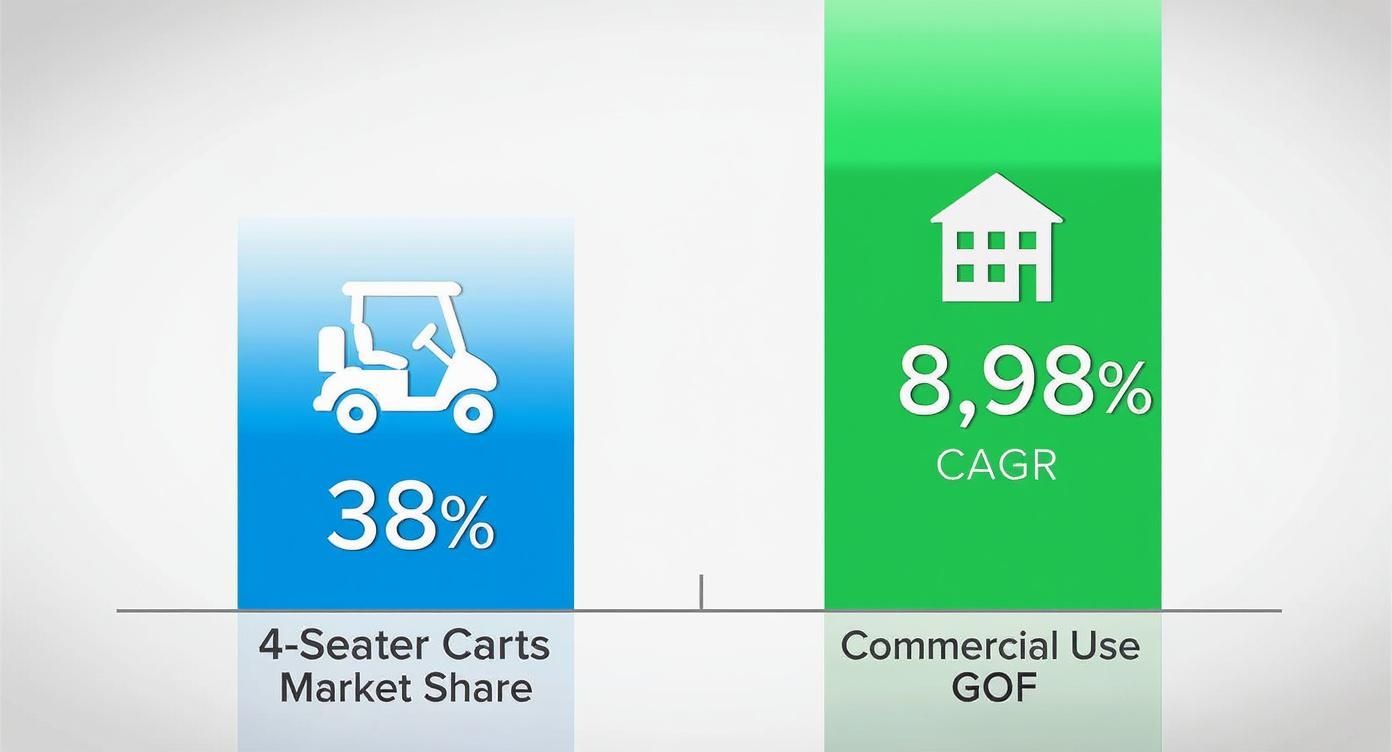
As the data shows, the 4-seater isn't just a niche product—it's the leading choice for many buyers, commanding over 38% of the market share.
Motor Power and Real-World Performance
Next up is the motor—the muscle of the operation. You’ll usually run into two types: AC (Alternating Current) and DC (Direct Current). The engineering behind them is complex, but what they mean for you is actually pretty straightforward.
- AC Motors: These are the modern gold standard. They're more efficient, need less maintenance, and are fantastic at delivering consistent power. This makes them a beast on hills and gives you that smooth, zippy acceleration you want when pulling away.
- DC Motors: This is older technology. While they still get the job done, DC motors are generally less efficient. You might feel them struggle a bit more on inclines, and they don't have the same peppy feel as their AC counterparts.
For a family living in a hilly community or a resort that needs to shuttle guests up steep paths, an AC motor is a game-changer. It delivers a much more confident and capable ride.
A cart's motor type is the difference between effortlessly gliding up a steep driveway and anxiously wondering if you'll make it to the top. An AC motor gives you the torque you need, right when you need it.
Practical Numbers for Everyday Use
Looking past the powertrain, a few other specs are crucial for making sure a cart actually fits your life. To give you a better sense of what to look for, here's a quick breakdown of the key metrics.
Key 4 Seater Electric Golf Cart Specifications at a Glance
| Specification | Typical Range / Type | What It Means for You |
|---|---|---|
| Battery Range | 40-60 miles | A longer range means less "range anxiety" and fewer interruptions for charging during a busy day. |
| Motor Power | 5 kW AC Motor | Provides the necessary torque for climbing hills without losing speed and offers zippy acceleration. |
| Payload Capacity | 800 – 1,000 lbs | The maximum weight the cart can safely handle, including people and gear. Crucial for safety and durability. |
| Turning Radius | 10 – 12 feet | A tighter radius makes the cart incredibly nimble for U-turns on narrow paths or navigating tight spaces. |
Payload capacity is one of the most important but often-overlooked figures. It’s the total weight the cart can safely carry, which includes you, your passengers, and any gear you've tossed in the back. A typical 4-seater can handle around 800 pounds. Pushing past that limit puts a serious strain on the motor, suspension, and brakes, which can lead to expensive repairs down the road.
Finally, pay attention to the turning radius. This tells you the smallest circle the cart can make in a single turn. A smaller number, often around 10 to 12 feet, means the vehicle is way more agile. It's your secret weapon for snagging a tight parking spot at the clubhouse, weaving through a crowded event, or pulling a quick U-turn on a narrow path without a three-point-turn fiasco.
How These Carts Are Used Beyond the Fairway
Let's be clear: the modern 4-seater electric golf cart has officially outgrown the golf course. For a long time, that’s where they lived, but their quiet, green, and group-friendly nature has turned them into a go-to vehicle for all sorts of situations. Forget the 18th hole—think of these as the new MVPs of neighborhood transport.
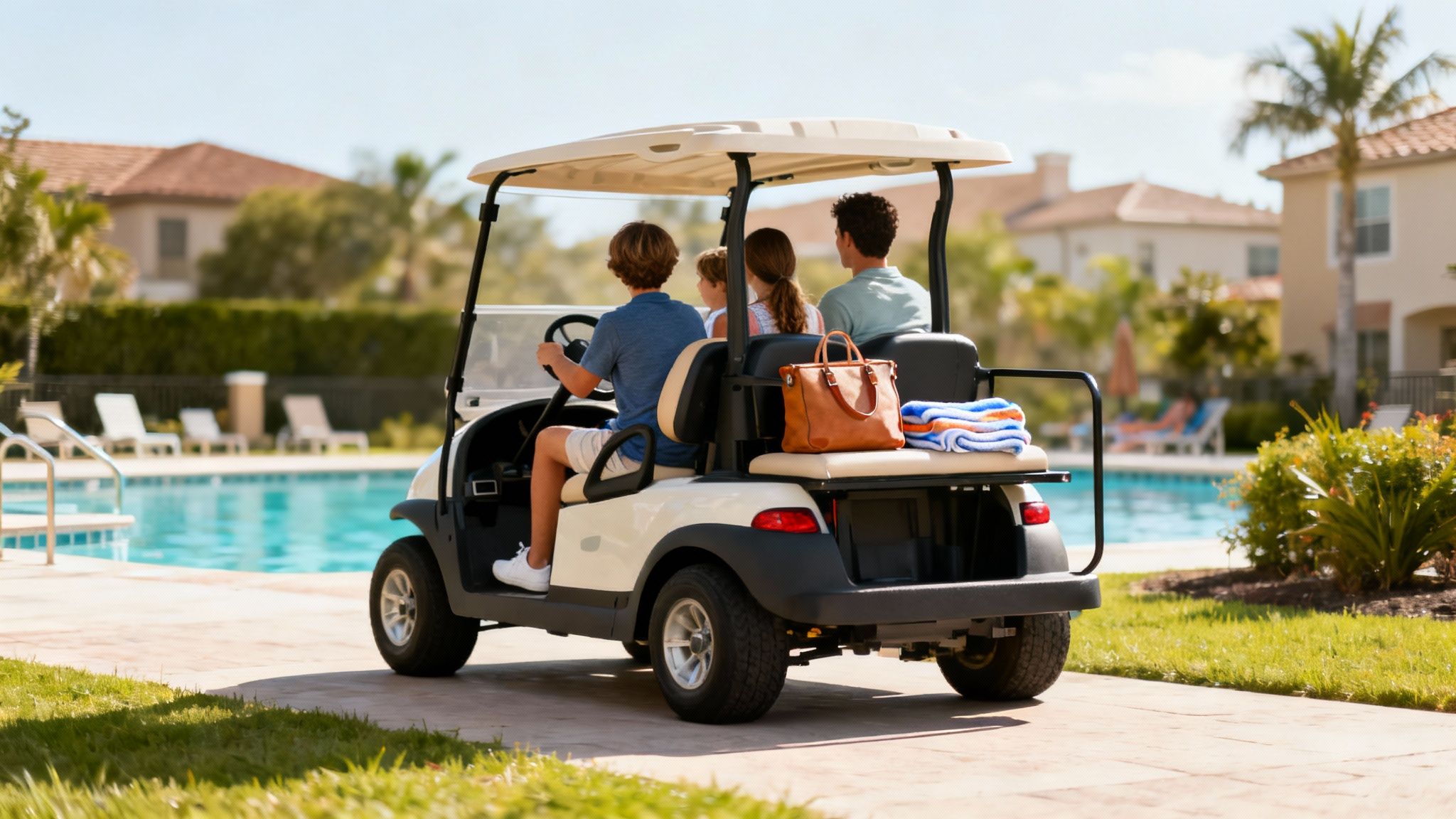
For families living in gated communities, a four-seater cart is often the first choice for quick trips around the block. It's just easier to pile everyone in to head to the community pool, visit neighbors for a cookout, or swing by the mail center without ever having to start the car. That open-air ride just makes everything feel a little more connected.
Residential and Community Living
In big, master-planned neighborhoods, these carts aren't just a fun toy; they're a genuinely practical way to get around. They help cut down on car traffic on private roads and get rid of the noise and fumes, making the whole community feel more peaceful.
- Social Outings: It’s the perfect ride for a family heading to a block party or the local park.
- Quick Errands: Many residents grab the cart for short trips within the community, saving both time and gas.
- Enhanced Safety: Their slower speeds make them a much safer option on streets where kids are often out playing.
The trend is undeniable. The 4-seater electric golf cart has evolved from a recreational vehicle into a key piece of the transportation puzzle in planned communities, making daily life simpler and more enjoyable.
Commercial and Hospitality Powerhouses
Businesses have really caught on to just how useful these carts are. On large properties like resorts, sprawling university campuses, or big corporate parks, they're absolute workhorses for keeping things running smoothly. Moving small teams, gear, and guests around quickly and without a lot of noise is a game-changer.
Think about a resort. The hospitality staff can zip guests around on a property tour or shuttle them from their rooms to the main lodge. At the same time, the maintenance crew can load up another cart with tools and get to a repair job on the other side of the campus without disturbing anyone.
This same utility plays out in all kinds of large venues:
- Event Management: Staff at festivals or outdoor concerts use them to get through crowds and haul supplies.
- Industrial Sites: They provide a safe and efficient way to move people and conduct inspections across large factory floors or construction sites.
- Farms and Ranches: Farmers love them for checking on crops or moving small loads across their property.
Rugged Off-Road Adventures
But the evolution doesn't stop at the pavement. There's a whole world of lifted, rugged 4-seater models out there built for the dirt. Kitted out with all-terrain tires and heavy-duty suspension, these carts are designed to tackle trails, bumpy ground, and light off-road work.
These beefed-up versions are a hit with anyone who owns a large piece of land and needs a reliable way to get around. They're also popular with hunters, anglers, and trail riders. And that silent electric motor? It’s a huge plus when you’re out in nature, as it won’t spook wildlife like a noisy gas-powered ATV would.
Making Your Golf Cart Street Legal
https://www.youtube.com/embed/22Dpu0cAH5I
This is probably the number one question we get from buyers: "So, can I actually drive this thing on my street?" The answer is usually a resounding "yes," but it's not quite as simple as just rolling it off the dealership floor and onto the main drag. In the eyes of the law, there's a world of difference between a standard golf cart and a street-legal vehicle.
To get your 4 seater electric golf cart road-ready, it needs to be officially classified as a Low-Speed Vehicle (LSV). While this is a federal designation, the specific hoops you have to jump through can change quite a bit depending on your state, county, or even your city.
Understanding LSV Requirements
Think of the LSV classification as a mandatory safety upgrade. Federal law sets the ground rules, starting with speed. To qualify as an LSV, a vehicle has to be capable of speeds between 20 and 25 mph. Any slower, and it’s considered a standard golf cart. Any faster, and you're in an entirely different vehicle category with its own set of rules.
But it’s not just about speed. An LSV has to come equipped with a specific set of safety features, much like a car. This isn't about adding fancy options; it's about meeting the legal bar for sharing the road with other traffic, usually on streets with a speed limit of 35 mph or less.
At its core, the distinction is simple: a regular golf cart is built for private property—a golf course, a large ranch, a planned community. An LSV is purpose-built and certified to operate safely on public roads.
The Essential Safety Equipment Checklist
To meet those federal LSV standards, your cart needs to be outfitted with some specific gear. These aren't suggestions; they are non-negotiable for getting your vehicle registered and driving it legally.
Here’s a quick rundown of what you absolutely must have:
- Headlights, taillights, and brake lights so other drivers can see you, day or night.
- Turn signals and reflectors to clearly signal your intentions on the road.
- A rearview mirror and side mirrors to give you a full picture of what's happening around you.
- A reliable braking system, which almost always means hydraulic brakes for real stopping power.
- Seatbelts for every single passenger. No exceptions.
- A proper windshield, typically one made from AS-1 or AS-5 automotive safety glass.
- A valid Vehicle Identification Number (VIN). This is crucial for getting the vehicle titled, registered, and insured.
Wading through these regulations can feel like a headache, but getting it right from the start saves you a world of trouble later. If you want to get into the nitty-gritty, you can explore our guide on what makes a golf cart street legal for a complete breakdown.
Remember, while federal law sets the foundation, your local and state regulations are the final word. Before you even think about buying, do yourself a favor and check with your local DMV. They'll tell you exactly what you need to do to register and legally drive your new cart in your neighborhood.
Personalizing Your Cart with Essential Accessories
A stock 4-seater electric golf cart is a great machine right out of the box, but the real magic happens when you start making it your own. Think of it less like a finished product and more like a blank canvas. The right accessories can transform a standard cart into a personalized ride that’s perfectly suited to your needs—whether that’s for rugged utility, ultimate comfort, or just turning heads around the neighborhood.
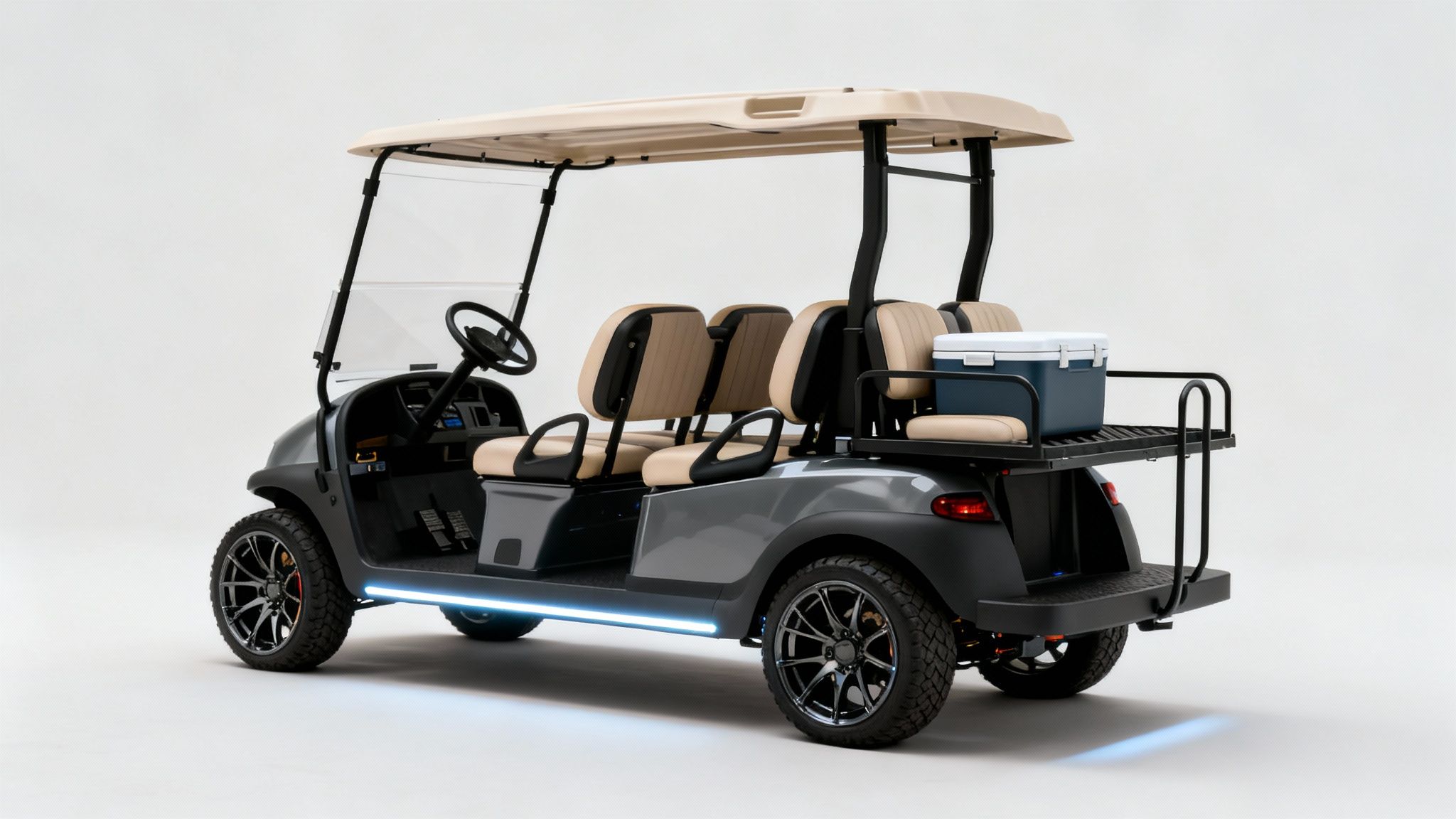
The world of add-ons is massive, but it helps to break them down into three key areas. This approach lets you zero in on the upgrades that will truly make a difference for you.
Upgrades for Practicality and Function
First, let's look at the purely functional upgrades. These are the workhorses—the accessories that solve everyday problems and make your cart more of a tool. If you deal with unpredictable weather or need to haul gear, these are non-negotiable.
- All-Weather Enclosures: A good vinyl enclosure is a game-changer. It keeps you dry in a sudden downpour and blocks that biting wind on a cool evening.
- Rear Cargo Beds: A flip-down rear seat that converts into a cargo bed is one of the most versatile additions you can make. It’s perfect for hauling anything from beach gear to bags of mulch.
- LED Light Bars: Standard headlights are fine, but if you’re driving after dark, a powerful light bar illuminates the path ahead like daylight, making every trip safer.
Enhancing Comfort for a Better Ride
Next up are the accessories that are all about the experience. These upgrades are designed to make every ride more pleasant for you and your passengers, turning a quick trip into a comfortable cruise. It's the difference between just driving and enjoying the drive.
The right comfort accessories elevate your cart from a simple mode of transport to a mobile lounge. It’s about creating an experience, not just getting from point A to point B.
A quality Bluetooth sound system is a must-have for many, letting you set the mood with your favorite playlist. Upgraded, high-back cushioned seats can also make a world of difference, especially on longer rides, offering way more support than the factory standard. For more ideas, this guide to the best golf cart accessories is a great resource.
Customizing for Style and Personality
Finally, we get to the fun stuff—the accessories that let your personality shine. These are the finishing touches that make your cart uniquely yours and ensure it stands out from the pack.
Custom wheels and tires are usually the first thing people notice, instantly giving your cart a more aggressive, sporty, or luxurious stance. From there, you can add things like underglow LED lighting for a cool vibe on evening drives or custom floor mats and steering wheels to complete the look inside. It's these details that turn your cart into a true reflection of your style.
What's the Real Cost of Ownership?
When you're looking at a 4 seater electric golf cart, the price tag is really just the starting line. To get the full financial picture, you have to consider the total cost of ownership (TCO). This means thinking about every single expense that will pop up over the life of your cart.
Looking at the TCO from the get-go is the best way to avoid nasty surprises down the road. The initial purchase is your biggest one-time cost, sure, but it’s the long-term expenses that really define the investment. With a bit of foresight, these costs are predictable and totally manageable.
Breaking Down the Long-Term Costs
Let's be honest: the biggest long-term expense you'll face is battery replacement. It's the one that catches most people off guard.
If you go with traditional lead-acid batteries, plan on swapping them out every 3-5 years. That's a significant hit to the wallet. On the other hand, modern lithium-ion batteries might cost more upfront, but they typically last 8-10 years or even longer, which often translates to better value over the cart's lifetime.
Beyond the battery, you've got the usual upkeep. Think of it like a car, just on a smaller scale. These are the regular, smaller costs that keep your cart safe and running like a top.
- Tires and Brakes: They wear out, simple as that. You'll need to replace tires eventually, and your brakes will need inspections and new pads from time to time.
- Routine Servicing: Getting a pro to give your cart a once-over each year is a smart move. They can check the motor, electrical system, and suspension to catch small problems before they become big ones.
- Insurance: If you're driving a street-legal LSV, insurance is non-negotiable. The good news is that rates are usually quite affordable, adding just a small amount to your annual budget.
The real cost isn't what you pay at the dealership. It's everything you spend over the years you own the vehicle. The best way to keep those costs down? Smart maintenance and good charging habits.
For instance, you can dramatically extend your battery's lifespan with a few simple tricks. Don't leave it plugged in for days after it's fully charged, and try not to run the battery completely dead all the time. These small habits add up to a huge financial difference, making sure your 4 seater electric golf cart remains a fun and affordable part of your life.
Your Top 4-Seater Electric Cart Questions Answered
Even after digging into the details, you probably still have a few questions rolling around in your head. That's completely normal. Let's tackle some of the most common things people ask when they're getting ready to buy a 4-seater electric golf cart.
Performance and Range
The first question is almost always about distance: "So, how far can this thing actually go?" On a single charge, you can typically expect to get somewhere between 25 to 40 miles.
Of course, that number isn't set in stone. Your real-world range depends heavily on things like the battery type (lithium batteries usually win here), whether you're climbing hills or cruising on flat ground, and the total weight of passengers and gear.
Speed is another big one. Most standard golf carts top out around 15 mph. But if you're looking at a street-legal Low-Speed Vehicle (LSV), the rules change. Those are built to hit a top speed between 20 and 25 mph so they can safely keep pace with neighborhood traffic.
Maintenance and Daily Care
"What am I getting into with maintenance?" This is a great question, and the answer is one of the best parts about going electric. Compared to a gas-powered cart, the upkeep is a breeze. Your main job is just keeping the battery happy.
- Battery Health: If you have traditional lead-acid batteries, you'll need to check the water levels occasionally and make sure the terminals stay clean. Go with lithium? They’re pretty much a "set it and forget it" situation.
- Tires and Brakes: Just like with your car, it’s smart to keep an eye on tire pressure and listen for any changes in how the brakes feel.
- Annual Check-up: Having a technician give it a once-over every year is a great way to catch any small issues with the motor, wiring, or suspension before they become big ones.
And for those little hiccups like a misplaced key? It happens. This helpful electric vehicle key replacement guide walks through what's generally involved.
Family Safety and Use
When you've got kids in the mix, safety is everything. "Are these carts actually safe for my family?" Absolutely, as long as they're used the right way and have the right features.
When you're shopping for a family cart, make seatbelts for every spot a non-negotiable. A solid roof for protection and a braking system you can count on are also must-haves. Always stick to the passenger limits and drive at sensible speeds—that’s the key to keeping every trip a fun one.
Getting these basics down will help you feel completely confident in the cart you choose and how you care for it.
Ready to find the perfect vehicle that combines style, performance, and eco-friendly technology? Explore the full lineup of premium, street-legal electric carts from Solana EV and discover how our models can fit your lifestyle or business needs. Visit us at https://solanaev.com to see the future of local transportation.