
The best electric side by side UTV is the one that fits the job you need it for, plain and simple. Whether you're hauling hay on the farm, hitting the trails for fun, or sneaking up to a hunting blind, the “best” machine isn’t one-size-fits-all. It's about finding the right mix of power, range, and features that perfectly match your daily tasks. This guide will help you figure out what those tasks are and find the right electric UTV to get them done.
Why Electric UTVs Are a Smarter Choice
Electric UTVs are no longer a niche curiosity; they’ve become the go-to choice for property owners, commercial fleets, and anyone who wants serious performance without the constant noise and exhaust fumes of a gas engine. People aren't just switching to be "green"—they're switching for practical, real-world benefits that completely change what a utility vehicle can do.
Let's cut through the marketing fluff. This guide gives you a solid framework for evaluating these machines based on what actually matters for your day-to-day work.
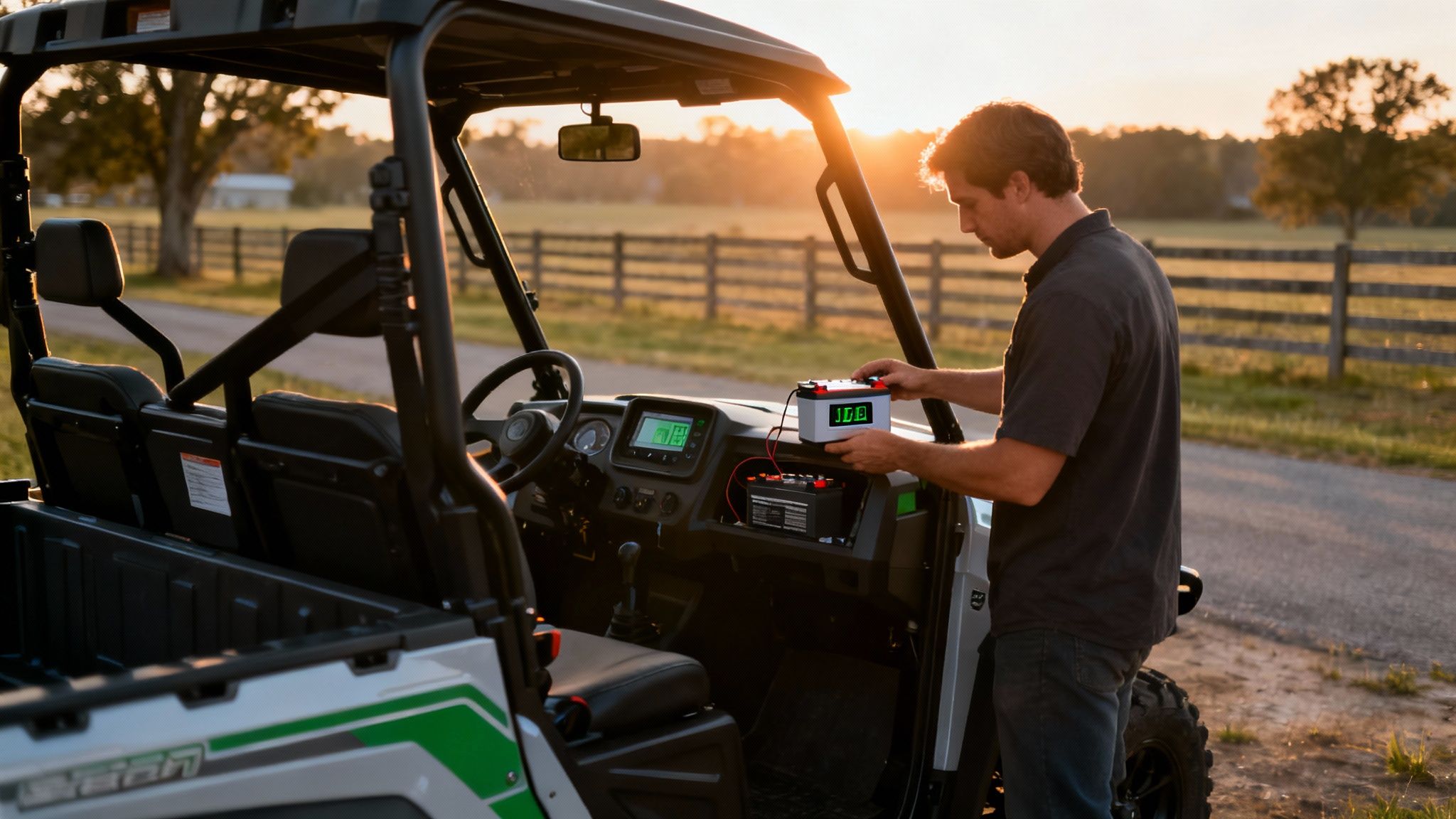
The advantages of going electric are pretty clear once you see them in action, and they solve some of the biggest headaches that come with gas-powered UTVs.
Here are the big ones:
- Silent Operation: This is a true game-changer. For hunters, it means a stealthy approach. For anyone working near homes, resorts, or golf courses, it means getting the job done without disturbing anyone. The quiet ride is something you have to experience to fully appreciate.
- Instant Torque: Gas engines need to rev up to get their power. Electric motors, on the other hand, give you 100% of their pulling power the second you touch the pedal. This makes a huge difference when towing heavy loads, crawling up steep hills, or navigating tricky terrain.
- Lower Maintenance Costs: Forget oil changes, spark plugs, and finicky exhaust systems. The maintenance routine for an electric UTV is incredibly simple. That means less time in the shop, less money spent on upkeep, and more time actually using your machine.
Matching the UTV to the Job
Before you start comparing models, you have to be honest about what you'll be doing with your UTV most of the time. A machine built for hauling tools and feed around a ranch is going to have a very different setup than one designed for weekend trail rides.
I see it all the time: people get fixated on top speed or maximum range, but what they really need is low-speed torque and a beefy payload capacity. The single most important thing you can do is match the UTV’s strengths to your most common jobs.
This simple step ensures you focus on the specs that are critical for you and don't end up paying a premium for features you'll hardly ever use.
To get you started, here’s a quick breakdown of what to prioritize for different needs.
Quick Guide to the Best Electric UTV by Use Case
This table gives you a high-level look at which features matter most depending on how you plan to use your electric side by side. It's a great starting point for narrowing down your options.
| Use Case | Key Feature Priorities | Recommended UTV Type |
|---|---|---|
| Farm & Property Management | High Payload/Towing Capacity, Durability, Moderate Range | Work-Focused EV UTV |
| Recreational Trail Riding | Long-Range Battery, Advanced Suspension, Agility | Sport/Recreation EV UTV |
| Hunting & Wildlife Observation | Silent Operation, Off-Road Capability, Accessory Support | Hybrid or Quiet Utility EV UTV |
This simple chart helps you align your specific needs with a general category of UTV, making it much easier to start your search for the perfect machine.
Making Sense of the Electric UTV Market
To make a smart purchase, you first need to understand the lay of the land. The electric side-by-side market is buzzing right now, with a fascinating mix of established powersports giants and hungry, EV-focused startups. This competition is great news for you, the buyer.
On one side, you have the legacy brands—think John Deere and Polaris. They're bringing their decades of manufacturing muscle and massive dealer networks to the table, adapting their trusted gas-powered platforms for electric drive. This often means reliability and familiar designs, but they can sometimes lag in adopting the very latest battery or motor tech.
On the other side are the nimble startups, which are really pushing the envelope of what an electric UTV can do. Since they aren't constrained by old gas-vehicle architecture, these companies are often the first to introduce game-changing features, longer-range batteries, and slick, integrated technology. When you're looking at a brand, it’s just as important to evaluate their long-term vision as it is to look at a single model.
Key Market Trends That Affect Your Choice
A few big trends are shaping the next generation of electric UTVs. Keeping an eye on these will help you spot the manufacturers who are truly leading the pack and ensure you’re investing in a vehicle built for the future.
The biggest push right now is for better battery density and efficiency. In simple terms, manufacturers are figuring out how to pack more power into smaller, lighter batteries. This translates directly to more real-world range without forcing you to give up payload capacity. We're also seeing more integrated solar charging options, which is a fantastic feature for topping off the battery while parked in a remote field.
Modular designs are also becoming a big deal. This approach lets you customize your UTV on a deeper level—adding or swapping out battery packs, cargo systems, or specialized tool mounts—so the machine perfectly fits the job you need it to do.
The growth in this space is impossible to ignore. The global electric ATV and UTV market was valued at a hefty USD 1,408.8 million in 2024 and is expected to explode to USD 3,682.6 million by 2030. This isn't just a niche trend; it’s a clear signal that people are moving toward electric for all kinds of work and recreation.
Street-Legal Status and The Changing Rules
More and more, people want a machine that can handle the trails and the local roads. This demand has turned street-legal capability into a huge selling point when looking for the best electric side by side utv.
Getting a UTV street-legal means meeting specific federal and state safety rules for things like headlights, turn signals, mirrors, and a proper windshield. When a manufacturer builds their vehicles to be street-legal right from the factory, it saves you a ton of hassle and money compared to trying to do an aftermarket conversion yourself. As regulations continue to shift, having a compliant vehicle is a real asset.
Getting a handle on these market forces—from who’s making what to the tech on the horizon and the rules of the road—gives you the power to make a much smarter decision. It helps you see beyond a simple spec sheet and choose a partner for the long haul, not just a product for today.
Core Features to Compare in Electric UTVs
When you're in the market for an electric side-by-side, it’s easy to get lost in the marketing hype. To find the right UTV, you need to look past the flashy brochures and get down to the specs that actually matter for how you’ll use it. A spec sheet can be misleading; a huge battery number doesn’t mean much if the motor is inefficient and drains it halfway through the workday.
We're going to break down the essential features—from the battery that dictates your daily range to the suspension that keeps the ride smooth. My goal is to help you see how these numbers translate into real-world capability, so you can compare models like a seasoned pro and choose a machine that truly fits your needs. It's clear that buyers are getting smarter, too. The ATV and UTV market remains remarkably resilient, with new unit sales seeing decreases of less than 1%, a stark contrast to other powersports segments facing double-digit declines.
Electric UTV Core Feature Comparison
This table offers a snapshot of how different electric UTVs stack up. I've categorized them based on their primary intended use—work, recreation, or a mix of both—to help you see how features align with different tasks.
| Feature | Model A (Work-Focused) | Model B (Recreation-Focused) | Model C (Hybrid-Use) |
|---|---|---|---|
| Battery Type | LiFePO4 (Long Cycle Life) | NMC (High Energy Density) | LiFePO4 (Balanced) |
| Advertised Range | 60-80 miles | 80-100+ miles | 70-90 miles |
| Real-World Range | 35-50 miles (under load) | 50-70 miles (trail riding) | 45-60 miles (mixed use) |
| Top Speed | 25-30 mph | 50-60+ mph | 35-45 mph |
| Torque | Extremely High (Instant) | High (Tuned for acceleration) | High (Good for work & play) |
| Charging (L2) | 4-6 hours | 6-8 hours | 5-7 hours |
| Build/Frame | Heavy-duty welded steel | Lightweight alloy/steel | Reinforced steel |
| IP Rating | IP67+ | IP65 | IP67 |
Keep in mind that "real-world range" is an estimate. Your actual mileage will always depend on how you drive, what you're hauling, and the terrain you're on.
Battery Technology and Real-World Range
The battery is the heart of an electric UTV. It's the single most important component to understand, but manufacturers' range claims can be tricky. They often advertise numbers based on perfect conditions: flat ground, no payload, and a light foot. That’s not how these machines get used in the real world.
To get a realistic idea of range, you have to think about what drains the battery:
- Payload and Towing: Hauling a bed full of feed or towing a small trailer can easily slash your range by 30-50%.
- Terrain: Driving up steep hills or through thick mud takes a lot more energy than cruising on a gravel path.
- Driving Style: Punching the accelerator will drain the battery far faster than maintaining a steady, moderate pace.
When you're comparing models, don’t just look at the kilowatt-hour (kWh) number. Ask about the battery chemistry. Lithium Iron Phosphate (LiFePO4) is a workhorse known for safety and a long lifespan, while other lithium-ion types might pack more power into a smaller space. For a deeper dive, our guide on electric vehicle battery technology covers this in detail.
Performance Metrics: Torque vs. Top Speed
This is where electric UTVs really stand out. Unlike a gas engine that has to rev up, an electric motor gives you 100% of its torque the instant you press the pedal. It's a game-changer for getting work done.
A UTV with massive torque but a modest top speed will feel like an unstoppable force when pulling a fence post or towing a heavy load up a hill. For anyone on a farm or managing a large property, that instant grunt is far more useful than a high top speed you'll never hit.
If you're more into recreational trail riding, the equation changes a bit. You still want that torque for climbing, but you'll also appreciate a higher top speed for the open stretches. The trick is to match the UTV’s performance to what you'll actually be doing. There's no sense in paying for a 60 mph machine if it will spend its life cruising at 15 mph around your property.
Charging Infrastructure and Practicality
Figuring out how and where you'll charge your UTV is a logistical step you can't skip. Most electric side-by-sides use one of two charging methods.
Level 1 Charging is just plugging into a standard 120-volt wall outlet. It’s simple and you can do it anywhere, but it’s slow. A full charge can easily take 8-12 hours, sometimes longer.
Level 2 Charging uses a 240-volt outlet, like the one for an electric clothes dryer. This is a must-have for anyone using their UTV daily, as it can cut charging time down to just 4-6 hours. For a commercial operation, installing a Level 2 charger is practically a necessity. Making sure you're properly caring for your battery is key to its longevity, and this guide on charging lithium batteries safely and efficiently offers some great advice.
Build Quality and Durability
Finally, let's talk about how the machine is put together. An electric UTV is a serious investment, and you want it to last. Get up close and inspect the frame, suspension parts, and weatherproofing. A fully welded steel frame is almost always going to be tougher than one that's bolted together.
You should also look for high IP (Ingress Protection) ratings on the critical electronics like the motor, controller, and battery. A rating of IP67, for instance, means the components are totally sealed from dust and can even be dunked in a meter of water. That's a huge confidence booster when you're crossing a creek or get caught in a downpour. Suspension travel is another number to watch—more travel usually means a much smoother ride over rough ground, which saves your back and reduces wear and tear on the vehicle itself.
Choosing the Right UTV for Your Mission
The "best" electric side-by-side isn't the one with the biggest battery or the fastest top speed. It's the one that’s built for what you do every day. A spec sheet is meaningless without context; the real trick is matching a machine’s strengths to the demands of your world, whether that’s a sprawling ranch, a network of rugged trails, or a busy job site.
Instead of a one-size-fits-all list, let's walk through how these powerful machines get used in the real world. When you line up your main goal with a specific set of features, you can make a smart choice that will serve you well for years.
The first, most critical question is simple: are you buying this for work or for play?
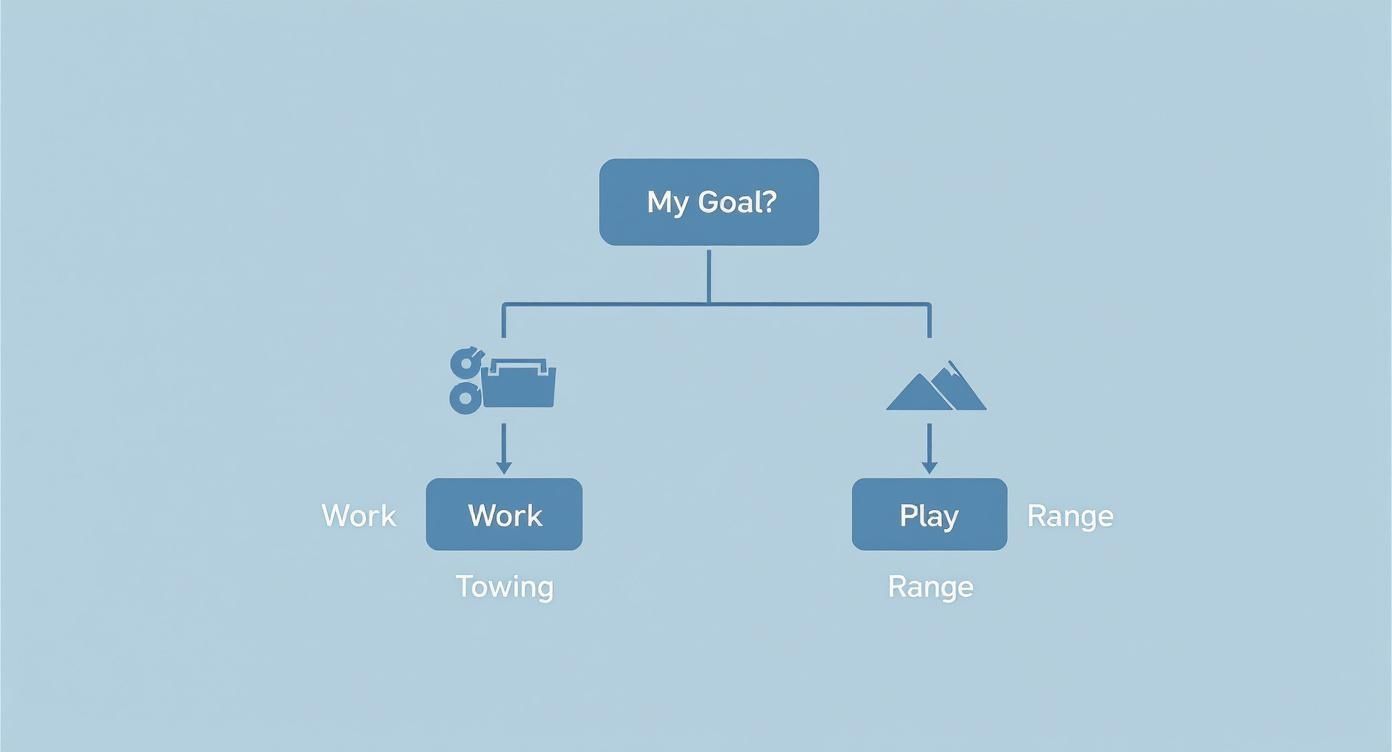
As this flowchart shows, that one decision immediately tells you which specs—like towing or range—should be at the top of your list.
For the Large Property Owner
If you’re managing acres of land, your UTV is less of a toy and more of a daily tool. Your needs are worlds apart from a recreational rider. You’re looking for durability, raw hauling power, and no-nonsense efficiency.
Your checklist should be focused on these core features:
- Payload and Towing Capacity: Look for a UTV with a beefy frame and a high payload rating, often over 800 pounds. The power to tow at least 1,500 pounds is a must for pulling trailers with feed, tools, or fencing materials.
- Quiet Operation: This is a massive, often-overlooked benefit. The near-silent motor lets you work at dawn without waking up the whole neighborhood, and it won't spook your livestock.
- Durability: Zero in on models with simple, tough drivetrains and minimal maintenance. The less time it spends in the shop, the more work gets done.
For this job, top speed is almost an afterthought. The real winner is the machine with an unstoppable, instant torque for pulling heavy loads, even if its range is just moderate.
For the Avid Trail Rider
When your goal is pure recreation, the script flips entirely. Now it's all about performance, agility, and the endurance to stay out on the trail all day. You're pushing the machine to its limits for the fun of it, not for utility.
Here's what you should be prioritizing:
- Long-Range Battery: You need a battery that can handle hours of hard riding without quitting. Look for the highest kWh rating you can find and dig into real-world reviews on trail range, not just the optimistic numbers in the brochure.
- Advanced Suspension: Long-travel shocks and a fully independent suspension are non-negotiable. They soak up the bumps, keep you stable at speed, and make for a far more comfortable and controlled ride when the terrain gets nasty.
- Ground Clearance and Agility: More ground clearance means you can roll over rocks and logs without getting hung up. A nimble, responsive chassis is what makes navigating tight, wooded trails a blast.
Trail riders still need that low-end torque for climbing hills, but it has to be balanced with a higher top speed and quick, predictable handling.
The most common mistake I see is a recreational buyer choosing a work-focused UTV. They get a machine that's built like a tank but feels sluggish and clumsy on the trail. Define your mission first, then find the UTV that excels at it.
For the Commercial Operator
For a business—whether it's a resort, a construction company, or a municipality—the best electric UTV is the one with the lowest total cost of ownership and the highest reliability. Simple as that. Every hour of downtime is money lost.
Key features for a commercial workhorse include:
- Durability and Low Maintenance: The simplicity of an electric drivetrain is a huge win here. With no oil changes, belts, or complex engine service, these UTVs spend more time working and less time in the shop.
- Towing and Payload Power: Just like the property owner, commercial users need serious utility. The instant torque from an EV motor is perfect for hauling tools, materials, and equipment around a job site with zero fuss.
- Safety and Compliance: Features like headlights, turn signals, and the option for street-legal configurations can be essential for operating on large campuses or roads with public access.
In this context, the long-term savings on fuel and maintenance often make an electric UTV a much smarter financial investment than a gas model that might seem cheaper upfront.
For the Hunter and Outdoorsman
For anyone venturing into the backcountry, stealth is the ultimate unfair advantage. An electric UTV delivers something no gas-powered vehicle ever could: a silent approach.
Hunters and outdoorsmen should be looking for:
- Silent Operation: The ability to move through the woods without sounding an alarm for miles around is a total game-changer for getting closer to wildlife.
- Off-Road Capability: A true 4WD system, good ground clearance, and tough, all-terrain tires are must-haves for getting to those remote spots where the game is.
- Accessory Integration: Find a UTV with a robust electrical system that can easily power a winch, light bars, and GPS units without putting a major dent in your main battery.
By first figuring out your primary mission, you can cut through all the marketing noise and focus on the handful of features that will actually deliver the most value for your money.
Analyzing the Total Cost of Ownership
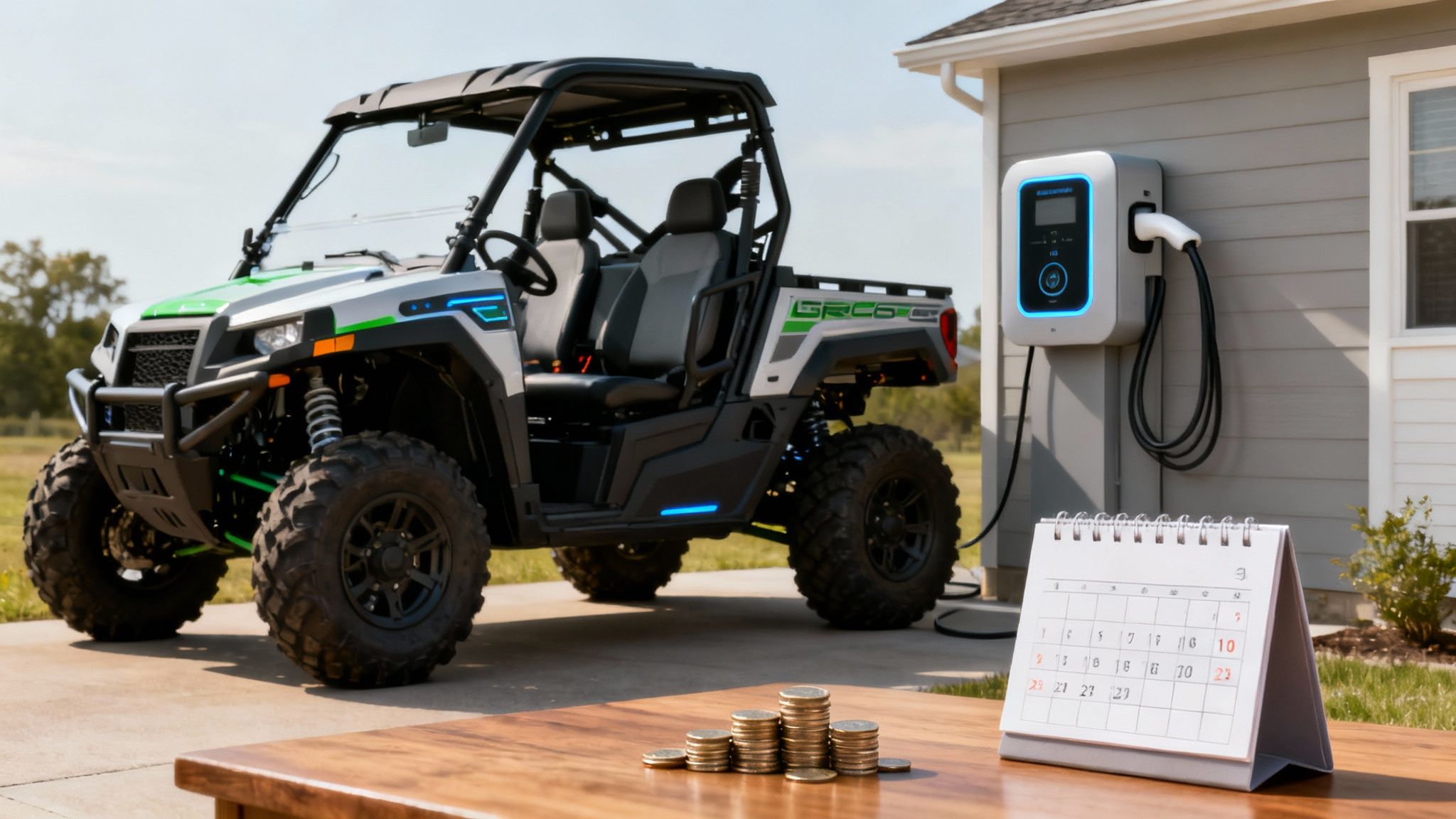
The sticker price is just the first chapter, not the whole story. To really get a handle on the value of an electric UTV, you have to look at the total cost of ownership—the full financial picture over years of hard work. This is where the best electric side by side utv models truly leave their gas-guzzling cousins in the dust.
Sure, the initial investment for an electric UTV can sometimes be higher, but the long-term savings create a powerful return. Those financial benefits stack up day after day, year after year, turning what might seem like a premium purchase into a genuinely smart economic move.
Quantifying the Savings on Fuel and Maintenance
The most obvious win is waving goodbye to the gas station. Instead of dealing with fluctuating fuel prices, your power comes from a standard wall outlet at a fraction of the cost. Depending on what you pay for electricity, you could slash your running costs by 70% or more compared to a gas UTV.
But the savings go way beyond fuel. Think about what's not under the hood. A gas engine is a complicated beast with pistons, valves, and fluids that demand constant upkeep. An electric motor, on the other hand, is refreshingly simple with very few moving parts.
This fundamental difference wipes a ton of recurring expenses right off the books:
- No Oil Changes: Forget about the cost of oil, filters, and labor. Forever.
- No Spark Plugs or Filters: No more replacing air filters, fuel filters, and spark plugs.
- No Exhaust System Repairs: There’s no muffler or exhaust pipe to rust out, get clogged, or break.
Of course, you still need to take care of your machine. Following essential vehicle maintenance tips for things like tires, brakes, and suspension will keep your investment in top shape for years to come.
When you add it all up, the minimal maintenance and nonexistent fuel bills mean an electric UTV is significantly cheaper to operate every single month. For a commercial fleet, these savings can easily run into thousands of dollars per vehicle, per year.
Long-Term Financial Considerations
Smart buyers always look down the road, and the biggest question is usually about the battery. Modern lithium-ion batteries are built to last, engineered for thousands of charge cycles, which typically translates to 8-10 years of reliable service. Most manufacturer warranties cover a big chunk of that lifespan, giving you real peace of mind.
Don't forget to look into government incentives, which can seriously knock down the upfront cost. Federal tax credits and state voucher programs can take a huge bite out of the purchase price, making the switch to electric an even easier decision. You can dive deeper into this topic by exploring our guide on https://solanaev.com/reducing-total-cost-of-ownership/.
The overall UTV market is massive—estimated at around $10 billion in 2023 and projected to hit over $14 billion by 2028. While electric models currently represent less than 5% of that market, their growth is picking up speed as more and more people recognize the long-term financial payoff.
By looking at the hard numbers, it becomes crystal clear: a higher initial investment in an electric side-by-side often leads to a much lower total cost and a better return on your money over the long haul.
Got Questions About Electric UTVs? Let's Dig In.
It’s totally normal to have a few questions lingering in the back of your mind, even after you’ve done your homework. Making the move to an electric UTV is a big decision, and you should feel confident you've covered all the angles before pulling the trigger.
Let's tackle some of the most common questions and concerns we hear from people just like you. My goal here is to give you straight, honest answers to clear up any final doubts so you can make the right call.
How Long Do Electric UTV Batteries Actually Last?
This is usually the first thing people ask, and for good reason—the battery is the heart of the machine. The good news is that modern lithium-ion batteries, especially the tough LiFePO4 chemistry, are built for the long haul. Most are rated to handle between 1,000 and 2,000 charge cycles.
So, what does that mean in the real world? For most owners, that translates to a solid 8-10 years of reliable use. Of course, just like the battery in your phone, how you treat it matters. Your charging habits (try not to run it completely dead all the time), the climate you're in, and how hard you run the machine will all have an impact.
Here's a pro tip: always check the manufacturer's warranty. A long, comprehensive battery warranty is the best sign that a company truly stands behind its tech. It's your peace of mind in writing.
Can You Really Take an Electric UTV Through Rain and Mud?
Absolutely. Any UTV worth its salt is built to get dirty, and the best electric models are no different. Reputable brands design their machines for true all-weather, all-terrain work.
The key thing to look for is a high IP (Ingress Protection) rating on the important stuff—the motor, battery pack, and electronics. A rating of IP67, for example, means those components are completely sealed from dust and can even be dunked in a meter of water for a short period without issue.
This kind of weatherproofing means you don't have to worry about rain, mud puddles, or even shallow creek crossings. Just be sure to respect the manufacturer's maximum fording depth to stay safe. And one more thing: avoid hitting the electronics directly with a high-pressure washer after you're done playing in the mud. A little care goes a long way.
Are Electric UTVs Strong Enough for Real Work?
Yes, and honestly, for many jobs, they’re even better. This is one of the biggest surprises for people who are new to electric power. It all comes down to how they deliver that power.
A gas engine has to rev up to hit its peak torque. An electric motor, on the other hand, gives you 100% of its torque instantly. The second your foot touches the pedal, you have all the pulling power it's got.
That instant torque is a game-changer for tough jobs. It gives electric UTVs a huge advantage over gas for things like pulling a heavy trailer from a dead stop, yanking equipment out of the mud, or crawling up a steep hill without a running start.
You'll find that many work-focused electric UTVs meet or beat the towing and payload capacities of similar-sized gas models. For anyone in farming, construction, or property management, that on-demand grunt makes them an incredibly capable tool.
What Kind of Maintenance Does an Electric UTV Need?
This is where electric UTVs really pull away from the pack. The savings in time, money, and sheer frustration over the life of the vehicle are massive. Because the drivetrain is so simple, a whole list of chores you’re used to just disappears.
With an electric UTV, say goodbye to:
- Oil and Filter Changes: No engine oil, period.
- Spark Plugs and Air Filters: They don't exist here.
- Fuel System Headaches: No clogged filters, gummed-up carbs, or dirty injectors.
- Exhaust System Repairs: There's no muffler or pipes to rust out and replace.
So what's left to do? The basic stuff. You'll still need to check your tire pressure, keep an eye on brake pads and fluid, grease the suspension points, and make sure the electrical connections are clean and tight. This drastically lower maintenance burden means more time getting things done and less time in the garage. It’s one of the most powerful arguments for going electric.
Ready to experience the quiet power, instant torque, and low-maintenance freedom of a top-tier electric UTV? The team at Solana EV is here to help you find the perfect machine for your property, business, or weekend adventures. Check out our lineup of street-legal, high-performance models and see a smarter way to ride.
Your article helped me a lot, is there any more related content? Thanks! https://www.binance.com/ro/register?ref=HX1JLA6Z