
A battery meter for a golf cart isn't just another gadget—it's your cart's fuel gauge. It's the one tool that tells you exactly how much juice you have left, so you don't end up stranded on the back nine or halfway through a trip around the neighborhood. Think of it as your direct line of communication with your battery pack.
Why Your Golf Cart Needs an Accurate Battery Meter
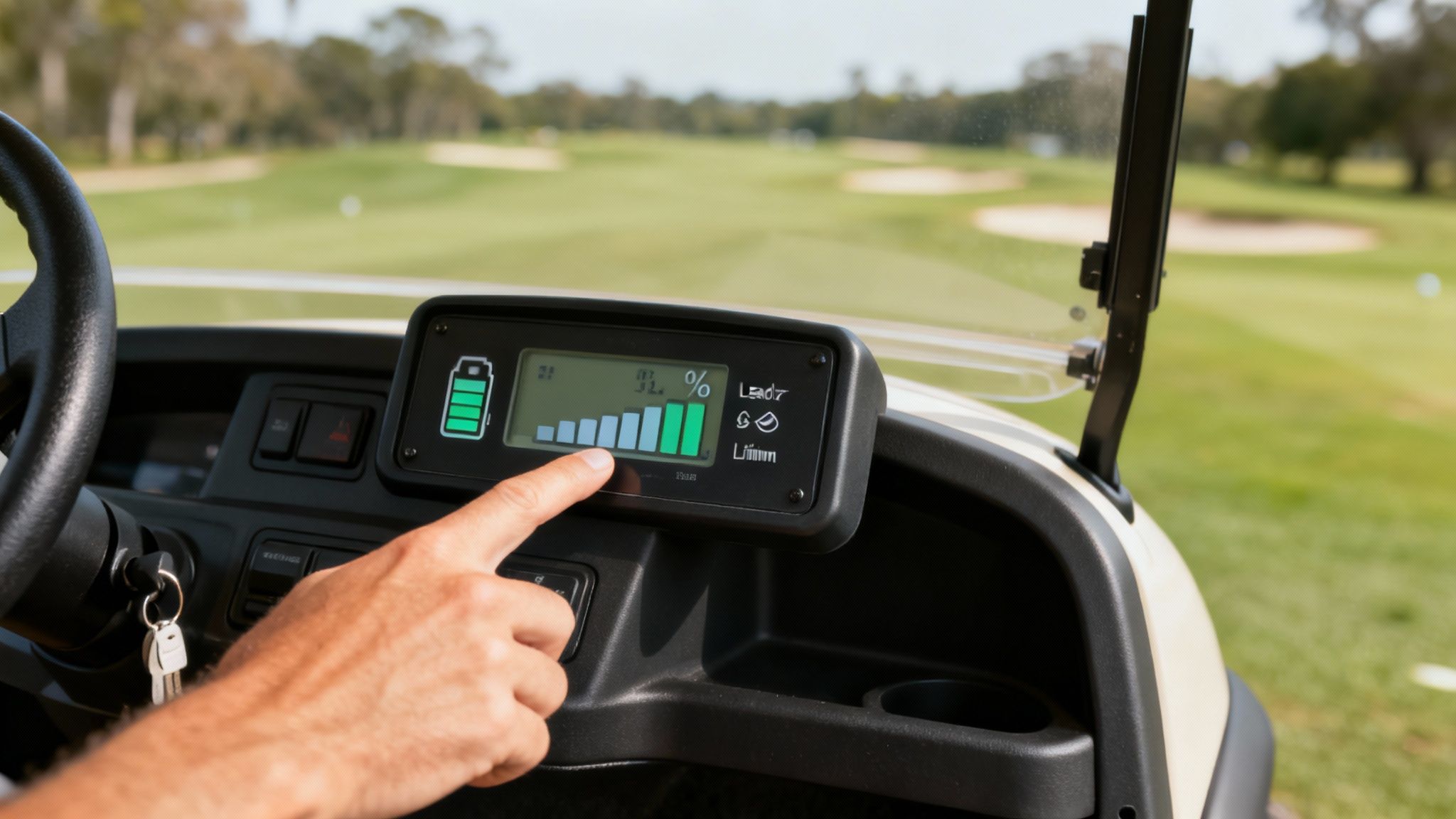
We’ve all felt it: that nagging doubt in the back of your mind as you head out. "Do I have enough charge to make it back?" Relying on guesswork or a simple, blinking warning light is a risky game that often ends with a long walk home.
An accurate battery meter takes all that anxiety out of the equation. It gives you a clear, easy-to-read measurement of your battery's real-time charge, letting you plan your trips with confidence. It’s the difference between guessing and knowing.
Protecting Your Investment
A good meter does more than just offer peace of mind. It’s a critical tool for protecting your battery pack, which is one of the most expensive parts of your golf cart. Routinely running your batteries down too far, known as deep discharging, causes permanent damage, especially to traditional lead-acid batteries. This habit drastically shortens their lifespan.
A high-quality meter acts as an early warning system. By showing you precisely when it's time to head back for a charge, it helps you avoid the deep discharge cycles that destroy battery chemistry and force you into an early, expensive replacement.
Proper battery management is all about getting the most out of your investment. When you extend the life of your batteries, you push back the significant cost of buying a new set. You can learn more about this in our guide on how to maximize your golf cart battery lifespan.
The Rise of Smarter Monitoring
As more and more people choose electric carts for work and play, the demand for better technology has skyrocketed. The global market for golf cart batteries was valued at USD 149.9 million in 2024 and is climbing fast. This growth underscores just how important reliable power management has become for cart owners who want efficiency and longevity.
Ultimately, installing a dependable battery meter brings some major benefits:
- Prevents Stranding: You'll always know your true remaining range.
- Extends Battery Life: You can avoid the deep discharges that kill batteries.
- Improves Performance: A healthy, properly charged battery delivers consistent power.
- Boosts Peace of Mind: Drive with confidence, free from "range anxiety."
Comparing the Three Types of Battery Meters
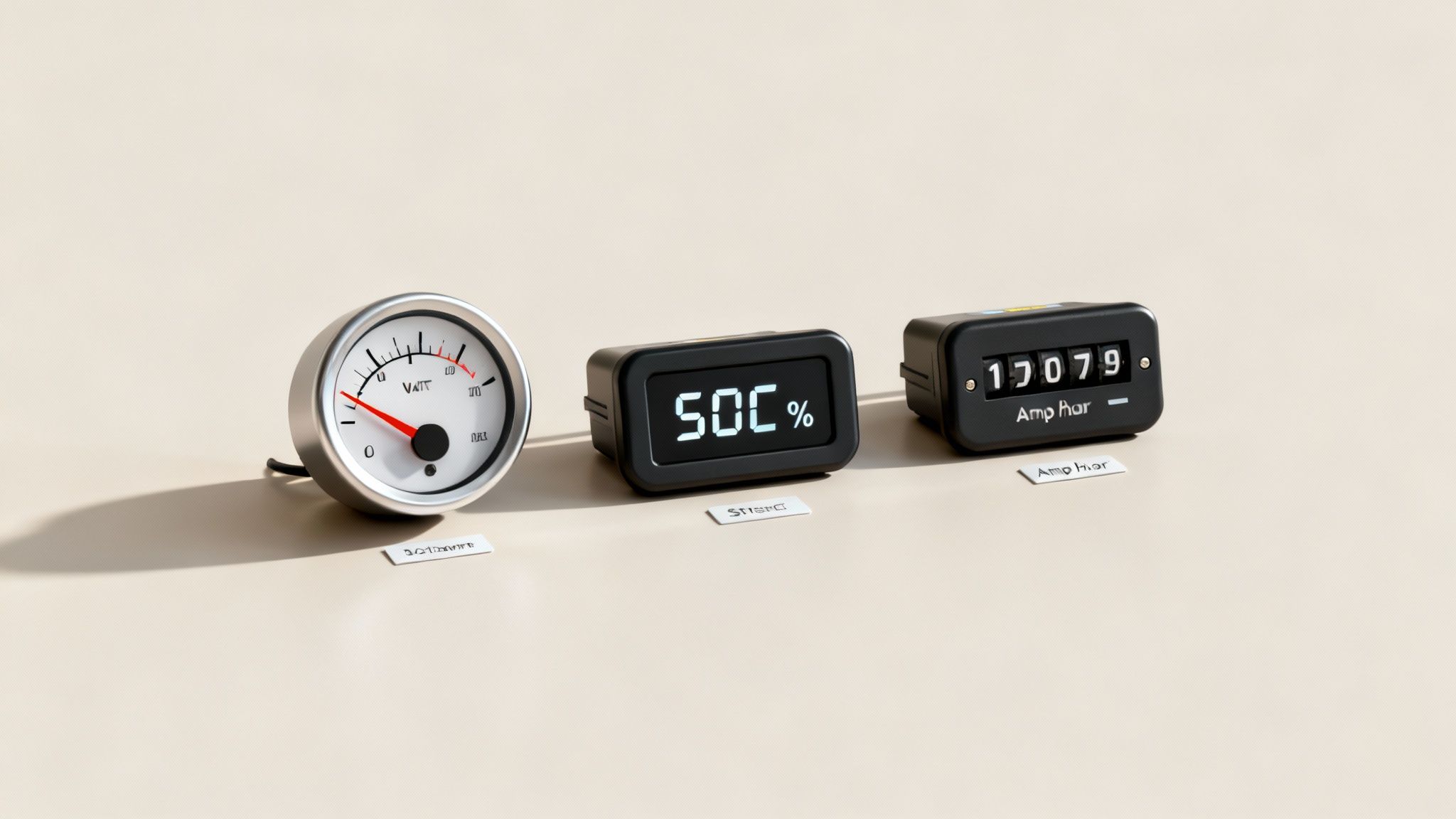
When you start looking for a battery meter for your golf cart, you’ll realize pretty quickly that they aren't all the same. The technology inside these little gadgets makes a huge difference in how much you can trust the reading. Let's walk through the three main types, from the old-school basics to the high-tech options, so you can figure out what makes the most sense for your cart.
Basic Voltmeters: The Pressure Gauge
The most straightforward and common meter you'll find is a simple voltmeter. It does exactly what its name implies: it measures the real-time voltage of your battery pack. From there, it gives you a rough estimate of how much juice is left.
Think of it like a tire pressure gauge. A full tire has high pressure, and a flat one has low pressure. Likewise, a fully charged battery pack shows a higher voltage, which drops as you use it. It's a decent indicator, but it doesn't really tell you how many more holes you can play.
The biggest issue with a voltmeter is that the reading can be a bit of a moving target. Voltage dips significantly when you're asking a lot from the batteries, like climbing a steep hill. Then, it bounces right back up when you're cruising on a flat path. This "voltage sag" can make it tough to get a clear, steady picture of your actual range.
State-of-Charge (SOC) Meters: The Modern Fuel Gauge
A State-of-Charge (SOC) meter is a major improvement over a basic voltmeter. It still keeps an eye on voltage, but it's smarter about it. A tiny microchip inside runs an algorithm that translates those bouncy voltage readings into a stable and much more accurate percentage.
If a voltmeter is a simple pressure gauge, the SOC meter is the digital fuel gauge in a modern car. It’s designed to ignore the temporary dips and spikes, giving you a clear estimate you can actually use—like 75% full. These algorithms are tuned for specific battery types, like lead-acid or lithium, because they understand how each one loses power.
An SOC meter essentially smooths out the chaotic readings caused by voltage sag. This gives you a percentage you can trust, offering a far better idea of how much driving time you really have left.
For most cart owners, SOC meters hit the sweet spot. They offer a huge leap in accuracy without being overly expensive or complicated.
Amp-Hour Counters: The Ultimate Trip Computer
If you're the kind of person who wants to know exactly what's going on with your battery, then an amp-hour counter is what you're after. This is the gold standard for battery monitoring. Also known as a coulomb counter, this device acts like a meticulous accountant for your battery's energy.
Instead of guessing based on voltage, it precisely measures every bit of energy that flows in and out of your battery pack. This is done using a special sensor called a "shunt." It tracks the exact number of amp-hours used, giving you the most precise reading possible. It’s like having a trip computer in your car that calculates your "miles to empty" down to the last drop.
These are, without a doubt, the most accurate meters available. However, they also tend to be the most expensive and require a more involved installation. You'll often find this technology built right into the Battery Management System (BMS) of high-quality lithium battery packs.
To make the choice clearer, let's break down how these three technologies stack up against each other.
Comparison of Golf Cart Battery Meter Technologies
| Meter Type | How It Works | Accuracy | Typical Cost | Best For |
|---|---|---|---|---|
| Voltmeter | Measures the battery pack's real-time voltage. | Low | $ | Basic, budget-conscious setups where a general estimate is sufficient. |
| State-of-Charge (SOC) Meter | Uses an algorithm to interpret voltage and provide a stable percentage. | Medium-High | $$ | Most golf cart owners; a great balance of accuracy and affordability. |
| Amp-Hour Counter / BMS | Directly measures energy (amp-hours) flowing in and out of the battery. | Highest | $$$ | Performance enthusiasts and lithium battery users who need maximum precision. |
Ultimately, the best meter for you comes down to what you need. If you just need a rough idea to get you back to the clubhouse, a voltmeter might be fine. But if you want the confidence to take longer trips without worrying, an SOC meter or an amp-hour counter is a much better investment.
How to Choose the Right Meter for Your Golf Cart
Picking the right battery meter for your golf cart isn’t about finding the single “best” one on the market. It’s about finding the right one for your cart. Think of it like buying a good pair of boots—the most expensive, feature-packed pair is worthless if it doesn’t fit you perfectly. Your only real goal here is to get a meter that can talk to your cart's power source and give you the straight story.
To get there, we have to start with two absolute deal-breakers: your cart’s system voltage and its battery chemistry. If you get either of these wrong, the meter will give you garbage readings, which makes the whole exercise pointless.
Match Your Cart's Voltage and Battery Chemistry
First things first, the meter has to match your cart's total system voltage. Most golf carts are either 36V or 48V systems. You simply can't use a 36V meter on a 48V cart (or the other way around) and expect it to work. It’s a basic check, but it's the most important one.
Just as critical is matching the meter to your battery chemistry. A classic lead-acid battery pack discharges very differently than a modern lithium-ion one. Meters built for lead-acid are programmed to expect a slow, steady, predictable drop in voltage. Lithium batteries are a completely different animal; they hold their voltage high and steady right until the very end, then the power falls off a cliff.
If you hook up a standard lead-acid meter to a lithium battery, it’s going to lie to you. It will probably read close to 100% for your entire ride, then suddenly dive to empty without any warning. You absolutely need a meter that’s calibrated for the specific discharge curve of your batteries.
This is more important now than ever. In 2024, lithium-ion batteries have grabbed an estimated 47.18% of the market share, and for good reason—they’re packed with power and last forever. If you want to dive deeper into what makes them tick and why they need special monitoring, check out our complete guide to golf cart lithium batteries.
Consider Key Features for Usability
Once you’ve got the essentials of voltage and chemistry locked down, you can start thinking about the features that make a meter easy to live with day-to-day. These are the details that separate a great meter from an annoying one.
- Display Clarity: Can you actually read the thing in the middle of a sunny afternoon? A good backlit screen or a high-contrast LCD is a must for visibility in all lighting conditions.
- Weather Resistance: Your cart lives outside, and so will your meter. Look for a solid IP rating, like IP65 or higher, which tells you it’s built to handle dust and rain without shorting out.
- Ease of Installation: How much of a project are you looking for? Some meters are simple plug-and-play units, while others will have you breaking out the drill and splicing wires. Check what’s in the box and how clear the instructions are.
- Form Factor: Will the meter look like it belongs on your dash, or will it be a clunky afterthought? Pay attention to its size and shape (round or rectangular) to make sure it integrates cleanly.
If you start with the non-negotiables—voltage and chemistry—and then weigh these practical features, you’ll end up with a battery meter that not only works perfectly but feels like it was made for your cart.
Reading Your Meter Like an Expert
Installing a new battery meter for your golf cart is a great first step, but the real power comes from knowing what those readings actually mean. A simple "full" or "empty" gauge doesn't tell you the whole story. To avoid getting stranded on the back nine, you need to understand the nuances behind the numbers.
This is all about matching the right meter to your cart's specific needs, focusing on voltage, battery type, and how the information is displayed.
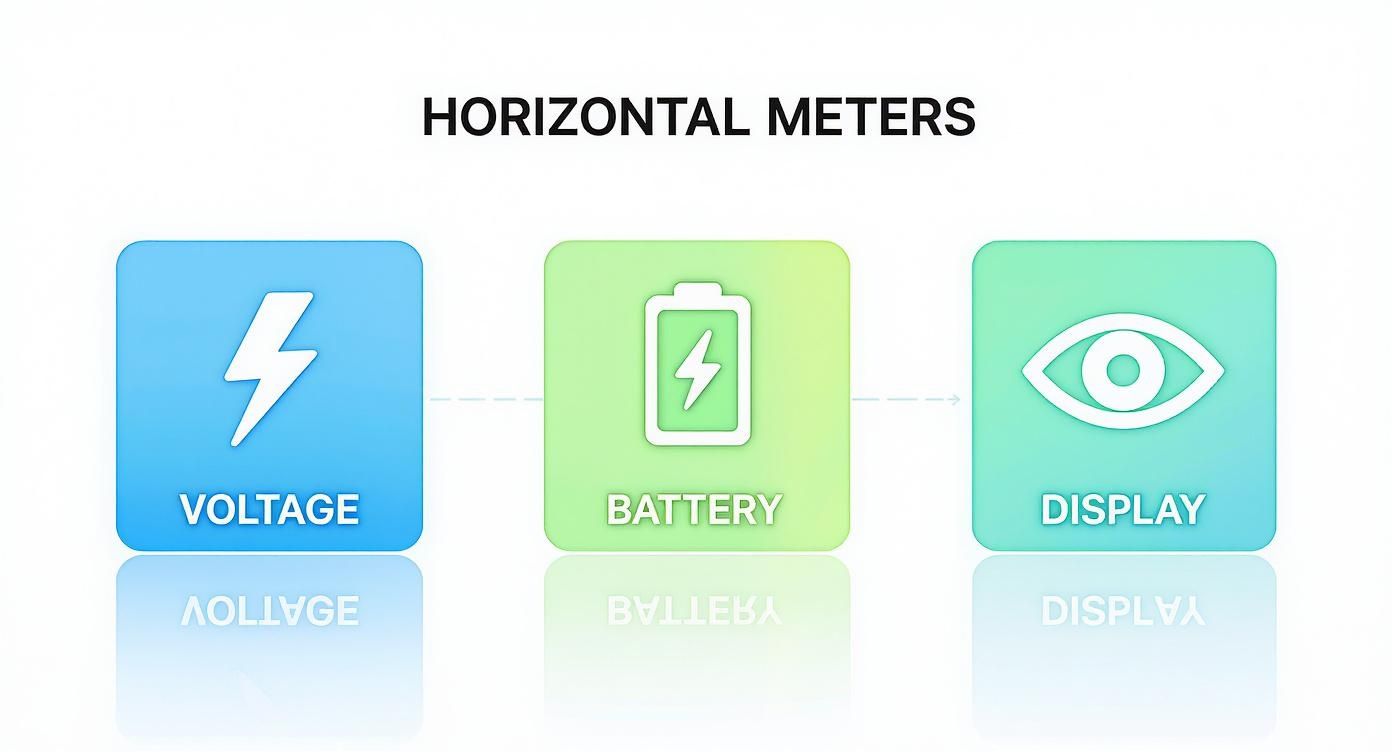
Getting these three elements right ensures the data you see on your dash is something you can actually trust.
The Myth of Surface Charge
One of the most common pitfalls, especially for owners of carts with lead-acid batteries, is checking the meter right after unplugging the charger. It's a classic rookie mistake.
Immediately after charging, your batteries will show a "surface charge"—an artificially high voltage that has no real substance. It’s like the foam on a freshly poured soda; it looks like the glass is full, but it settles in a hurry. Once you start driving, that inflated reading will drop like a rock.
To get a true picture of your battery's health, you have to let it rest. After a full charge, give the pack at least a few hours—or even better, let it sit overnight. This allows the surface charge to dissipate, revealing the true resting voltage, which is the only number that matters.
Learning to read your meter properly is a skill, much like monitoring energy device performance to make sure your whole system is operating as it should.
Translating Voltage to Real-World Range
Once you have that true resting voltage, you can finally translate it into a meaningful percentage. This is where you move from just guessing to actually knowing how much juice you have left.
For the traditional lead-acid battery packs, this chart is your go-to reference. It’s a straightforward way to see where you stand with the two most common golf cart systems.
Voltage to State-of-Charge Conversion Chart
| Voltage Reading | 36V System State-of-Charge (%) | 48V System State-of-Charge (%) |
|---|---|---|
| 38.2V | 100% (Full Charge) | N/A |
| 37.5V | 75% (Good Range) | N/A |
| 36.8V | 50% (Time to Head Back) | N/A |
| 36.3V | 25% (Very Low) | N/A |
| 36.0V | 10% (Charge Immediately) | N/A |
| 50.9V | N/A | 100% (Full Charge) |
| 50.0V | N/A | 75% (Good Range) |
| 49.1V | N/A | 50% (Time to Head Back) |
| 48.4V | N/A | 25% (Very Low) |
| 48.0V | N/A | 10% (Charge Immediately) |
Here’s the single most important rule to remember: never let your lead-acid batteries drop below a 50% state of charge. Consistently pushing them past this point will drastically shorten their lifespan.
Think of the 50% mark not as "half-empty" but as your absolute "plug it in now" signal. Sticking to this simple rule can add years to the life of your expensive battery pack.
A Look at Advanced Battery Management Systems
While the meters we've discussed give you a good peek into your battery's charge, a Battery Management System (BMS) is the full-blown command center. Found built directly into modern lithium battery packs, a BMS isn't just a gauge—it's the smart brain actively protecting and managing your entire power system.
Think of it like having a dedicated technician constantly watching over your investment. This onboard computer monitors every detail of the battery's health in real-time, making sure every part is working safely and at its best. It's a level of oversight that a simple dash-mounted battery meter for a golf cart just can't provide. If you're curious about the specifics, you can learn more about what a battery management system is and see how it works.
All that constant supervision directly leads to a battery that lasts longer and runs more reliably. In fact, the BMS is the single biggest reason why lithium batteries can often outlive their lead-acid cousins by up to ten times.
Core Functions of a Modern BMS
A BMS is always on the job, handling several critical tasks behind the scenes that are absolutely vital for safety and a long battery life. It's the guardian angel that stops common problems from causing permanent damage to the delicate cells inside a lithium battery.
Here's what it's constantly doing:
- Overcharge Protection: The moment your battery hits full, the BMS cuts off the charge. This simple act prevents overheating and the kind of cell damage that can shorten a battery's life.
- Over-Discharge Protection: It also stops you from running the battery completely dry. It will shut off the power before the cells reach a critically low voltage, which is a major cause of irreversible damage in lithium chemistry.
- Temperature Monitoring: If things get too hot during a fast charge or a long trip up a steep hill, the BMS will temporarily shut things down to cool off and prevent a dangerous thermal event.
- Cell Balancing: It acts like a traffic cop for energy, making sure all the individual cells inside the battery pack charge and discharge at the same rate. This maximizes the pack’s total capacity and ensures it wears evenly over time.
By actively managing these factors, a BMS doesn't just display the state of charge; it actively preserves it. It's the difference between a simple weather report and a complete climate control system working to maintain perfect conditions.
The results of this smart monitoring are hard to ignore. One study of a fleet of 60 golf carts found that switching to lithium batteries with an integrated BMS resulted in a 70% reduction in breakdowns. Even better, the average daily run time for each cart jumped from 6.2 to 9.5 hours, proving just how valuable this technology is in the real world. For a deeper dive, you can read the full analysis of the golf cart battery market and see the data for yourself.
Common Questions About Golf Cart Battery Meters
Even after you’ve picked out and installed the perfect meter, you’ll probably have a few questions once you start using it day-to-day. Let's tackle some of the most common head-scratchers so you can feel confident in what your battery meter for a golf cart is telling you.
Can I Use a 12V Meter on a 48V Cart?
In a word: no. You absolutely cannot. A battery meter is built and calibrated for one specific voltage. If you slap a 12V meter onto a 36V or 48V system, you won't just get useless, wildly incorrect readings—you’ll almost certainly fry the meter itself.
Always double-check that the meter you're buying is explicitly designed for your cart's total system voltage. It's a non-negotiable first step.
Why Does My Meter Reading Drop When I Accelerate?
That’s a classic case of "voltage sag," and it’s completely normal, especially if you have a basic voltmeter. When you step on the pedal, the motor suddenly demands a huge gulp of power (current), which temporarily pulls down the battery's voltage.
You’ll see the reading bounce right back up once you’re cruising at a steady speed or come to a stop. This is exactly why the more sophisticated State-of-Charge (SOC) meters are so popular—their smart algorithms are designed to smooth out these momentary dips and give you a more stable, realistic picture of your remaining juice.
Remember, that sudden drop doesn't mean your battery just lost 20% of its charge. It's just the battery flexing under load. For a true reading, always trust the voltage when the cart is at rest.
Do I Need a Dash Meter if My Lithium Battery Has an App?
While having a detailed Bluetooth app connected to your lithium battery's BMS is fantastic, I still strongly recommend a dedicated dash-mounted meter. Nothing beats a quick, at-a-glance check without having to fumble for your phone, unlock it, and open an app.
Think of the dash meter as your car's fuel gauge—it’s there for immediate, essential feedback. That instant readability is a huge convenience and, more importantly, a safety feature when you're on the move.
How Often Should I Calibrate My Battery Meter?
For most digital voltmeters and standard SOC meters, you don't have to do a thing. They come ready to go out of the box and don't require user calibration.
However, the more advanced amp-hour counters sometimes need to be "re-synced" to stay accurate. This usually just means charging your battery pack all the way up until the charger clicks off on its own. This simple step lets the meter re-establish its 100% "full" point. When in doubt, always consult your meter's manual for specific instructions, particularly right after you install it or if the readings start to feel a little off.
Ready to take the guesswork out of your ride? Explore the premium, street-legal electric vehicles from Solana EV, equipped with the latest in battery monitoring technology for ultimate peace of mind. Find your perfect cart today at https://solanaev.com.