
When you think of a golf cart, you probably picture manicured fairways and a relaxing round of golf. But what happens when you swap out the back seats for a rugged cargo bed? It becomes something else entirely: a golf cart with utility bed is a compact, powerful workhorse ready for just about any job site or large property.
This guide is all about how to choose, use, and get the most out of one of these incredibly practical vehicles.
How Utility Beds Transform Golf Carts into Workhorses
Think of a standard golf cart as a people-mover. It’s designed to get a few folks and their clubs from point A to point B. Bolting on a utility bed completely changes its DNA. It’s no longer just a ride—it’s a tool.
This isn't just about adding some extra storage space. It’s about adding serious capability. A utility bed turns your cart into a mini-truck, perfect for jobs that are way too big for a wheelbarrow but don't quite justify firing up a full-sized pickup. It fills that sweet spot, giving you a nimble and affordable way to haul materials right where they're needed.
From Recreation to Reliable Partner
That simple switch from carrying passengers to hauling cargo opens up a whole new world of possibilities. The same machine that could take you to the first tee can now tackle some pretty demanding work.
- Landscaping: Think of hauling bags of mulch, soil, or flats of flowers directly to a garden bed without tearing up the lawn.
- Property Maintenance: It’s perfect for moving toolboxes, pressure washers, or debris for quick repairs and general upkeep.
- Agriculture: Farmers and nursery owners use them to move feed, supplies, and even small harvests across their property.
- Resort Operations: These carts are a common sight, quietly carrying luggage, fresh linens, and groundskeeping equipment.
The real magic of a golf cart with utility bed is its versatility. It can replace several other pieces of equipment, all in one easy-to-use package. Instead of dealing with a loud, gas-guzzling truck for a small task, you’ve got a silent, electric partner on standby. You can find a whole range of powerful and efficient electric utility carts built specifically for these kinds of jobs.
The true value of a utility bed boils down to efficiency. It cuts down on manual labor, saves on fuel, and makes routine tasks faster, which means more productivity for any property.
At the end of the day, adding a utility bed is a practical solution to everyday problems. It gives you a purpose-built tool designed to make your work easier and faster, turning a simple cart into the most reliable member of your team.
When you're in the market for a golf cart with a utility bed, it's easy to get focused on the basics. But to find the right vehicle, you need to dig into the numbers that define its true capabilities. These specs aren't just details; they tell the real story of what a cart can handle day in and day out.
Think of it this way: the modern utility cart didn't just appear overnight. It evolved from a simple recreational vehicle into a true workhorse, built for tough jobs.
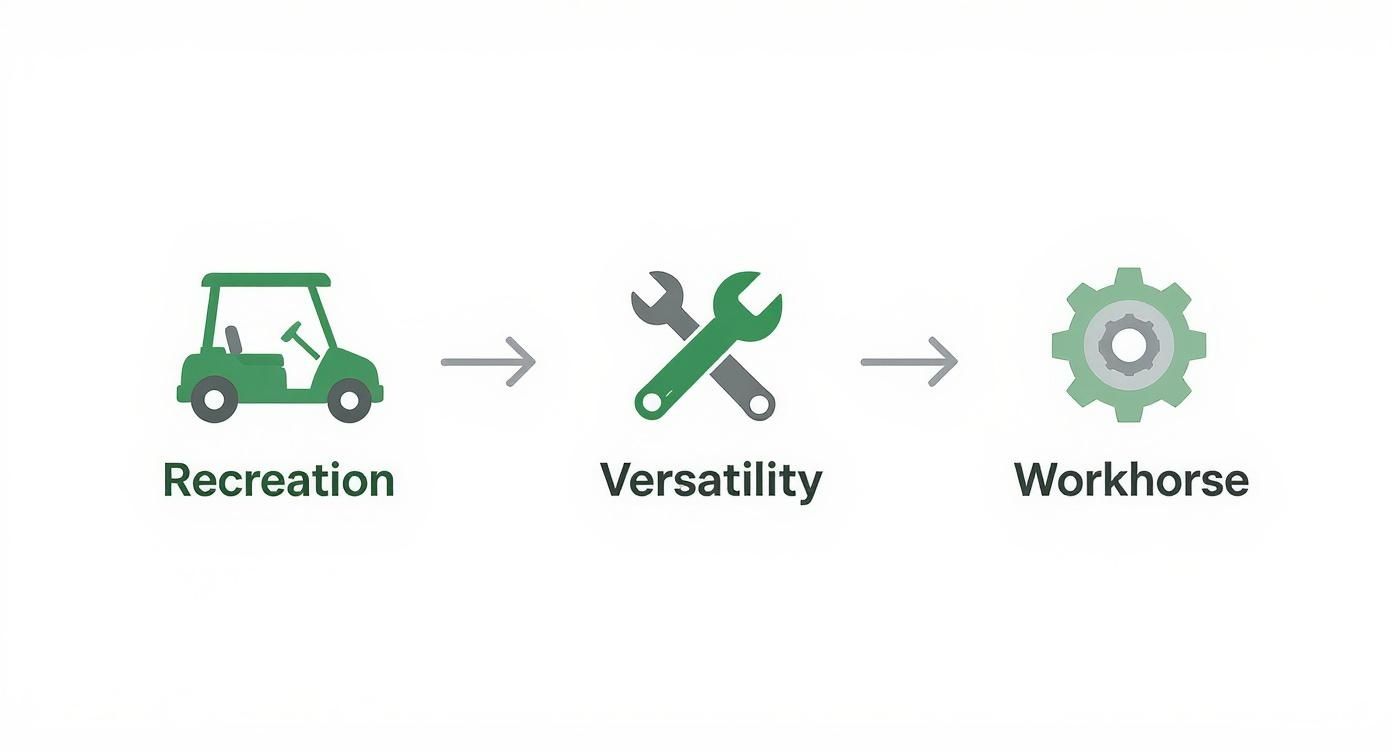
This shift from fairway cruiser to versatile hauler is all thanks to a few key engineering upgrades. Let's break down what really matters.
Decoding Payload and Bed Design
If there's one number to pay attention to, it's the payload capacity. This tells you the total weight—cargo, passengers, everything—the cart can safely carry. A standard model might top out at 300 to 500 pounds, but a heavy-duty commercial cart can easily manage over 1,000 pounds.
Pushing past that limit is asking for trouble. It puts a massive strain on the frame, motor, brakes, and suspension. It’s a major safety risk, plain and simple.
The utility bed itself is just as important. The material it's made from says a lot about its durability and purpose.
- Steel Beds: These are the tanks. They’re incredibly strong and can take a beating from rocks, gravel, or heavy equipment. The trade-off is that they're heavy and can rust if the coating gets scraped off.
- Aluminum Beds: A fantastic middle ground. Aluminum offers great strength without the extra weight and is naturally rust-proof, making it perfect for humid climates or messy jobs.
- Polyethylene Beds: These plastic beds are light, affordable, and shrug off dents and corrosion. They are the go-to for general hauling of things like mulch, tools, or event supplies.
A cart's utility is a direct result of its engineering. The payload capacity isn't just a suggestion; it's a structural limit tied directly to the vehicle's suspension, frame, and braking system.
Powertrain: The Heart of Performance
The motor or engine is what gives your utility cart its muscle. The decision between electric and gas really boils down to your work environment and what you value most.
Electric vs Gas Utility Golf Cart Comparison
The choice between electric and gas models often comes down to a few key differences in performance, maintenance, and long-term cost. Here’s a quick head-to-head comparison to help you decide which powertrain fits your needs.
| Feature | Electric Golf Cart | Gas Golf Cart |
|---|---|---|
| Upfront Cost | Often slightly higher. | Generally lower initial cost. |
| Running Costs | Significantly lower—no fuel, fewer moving parts. | Higher due to fuel and regular engine maintenance. |
| Noise Level | Nearly silent operation. | Noticeable engine noise. |
| Emissions | Zero tailpipe emissions. | Produces exhaust fumes. |
| Performance | Instant torque for quick acceleration and hauling. | Consistent power, longer range on a single tank. |
| Maintenance | Minimal: battery care, tire checks, brakes. | Regular: oil changes, spark plugs, filters. |
| Refueling/Recharging | Requires several hours to recharge. | Can be refueled in minutes. |
As you can see, electric carts offer a quieter, cleaner, and often cheaper ownership experience, which is why they dominate the market. On the other hand, gas models provide the convenience of quick refueling and extended range, which can be critical for certain applications.
Electric models have become the clear favorite for a reason. As of 2024, they make up about 81.81% of the market share. They're whisper-quiet, have instant torque that’s perfect for getting heavy loads moving, and cost up to 62% less to operate than their gas counterparts.
Gas-powered carts still have their place, especially in remote areas where a charging station isn't an option. Their longer range and quick refueling are hard to beat in those scenarios. But for most users, the noise, emissions, and routine engine maintenance are major drawbacks.
Suspension and Bed Dimensions
Suspension is the unsung hero of a true utility vehicle. A regular golf cart is built to give passengers a comfortable ride, not to support a half-ton of gravel. That’s why utility models are beefed up with heavy-duty leaf springs and shocks.
This upgraded suspension prevents the rear end from sagging under weight, which is critical for maintaining stability and proper steering control. Without it, you’re looking at an unsafe ride and potential damage to the cart.
Finally, don’t forget to check the bed dimensions. The length, width, and depth determine what you can actually haul. Before you buy, take a minute to measure the tools, bins, or equipment you use most often to make sure everything will fit. It's also helpful to learn more about typical golf cart dimensions to understand how the bed size impacts the vehicle's overall footprint.
Real-World Uses Across Industries and Properties

The real test of any tool is how it performs in the field, and this is where a golf cart with a utility bed truly proves its worth. These aren't just recreational carts with a box bolted on; they're purpose-built workhorses that solve everyday logistical headaches in a surprisingly wide range of environments. They bridge the gap perfectly—handling jobs too big for a wheelbarrow but too small or delicate for a full-sized truck.
From sprawling college campuses to busy farms, the utility cart has become an essential piece of equipment. Its compact frame, quiet motor, and impressive carrying capacity make it the go-to solution for getting work done efficiently without the noise and hassle of traditional vehicles. Let’s dive into a few places where these carts are making a real impact.
Landscaping and Groundskeeping Operations
For anyone managing turf, gardens, or general green spaces, the utility cart is a complete game-changer. Think about it: a landscaping crew can drive a cart loaded with mulch, plants, and heavy tools right up to a garden bed—all without tearing up the lawn. That’s because its low ground pressure and nimble handling are perfect for navigating delicate terrain.
- Material Transport: Forget endless trips with a wheelbarrow. Hauling soil, gravel, pavers, and plants becomes a one-trip job.
- Debris Removal: Clearing branches, grass clippings, and leaves is fast and easy, especially with a dump bed feature.
- Tool Caddy: You can even add specialized racks to carry rakes, shovels, and trimmers, keeping everything organized and within arm's reach.
This is a textbook case of how electric work carts can transform daily operations, making landscaping jobs quicker and a whole lot less strenuous. The near-silent operation of electric models is a huge bonus, allowing crews to start work early without waking up an entire neighborhood.
A utility golf cart allows groundskeepers to be more productive by bringing the tools and materials to the job, not the other way around. This simple shift minimizes downtime and maximizes the time spent on core tasks.
It's no surprise that the demand for these versatile machines is climbing. The U.S. golf cart market was valued at around USD 0.59 billion in 2024 and is on track to hit USD 0.92 billion by 2033. Much of that growth is coming from commercial and residential users who need efficient, eco-friendly ways to get things done.
Hospitality and Campus Management
Large properties like resorts, universities, and sprawling apartment complexes operate like small towns, each with its own set of logistical challenges. A golf cart with a utility bed is often the perfect vehicle for keeping these bustling places running smoothly.
Maintenance teams can quietly zip across campus with toolboxes and supplies without disrupting a lecture or waking up a hotel guest. At a resort, you’ll see staff using them for everything from moving luggage and delivering room service to restocking poolside cabanas—all by using pathways that are off-limits to larger vehicles.
- Event Setup: Quickly move tables, chairs, and decorations for weddings or conferences.
- Waste Management: Efficiently collect trash and recycling from bins spread across the property.
- Security Patrols: Allow security guards to cover more ground while carrying all their necessary gear.
Agriculture and Large Private Estates
On farms, ranches, and large private properties, the work never stops. A utility golf cart offers a nimble and budget-friendly way to tackle daily chores without firing up a gas-guzzling tractor or truck for every little task.
It's the ideal runabout for moving bags of feed, checking on fence lines, or hauling firewood from the woodpile to the house. At an equestrian facility, it's invaluable for carrying hay bales, saddles, and grooming equipment from the barn to the paddocks. By adding a utility bed, a simple cart becomes a reliable farmhand ready for whatever the day throws at it.
Essential Accessories to Build Your Perfect Utility Cart
A stock golf cart with a utility bed is a good start, but the real magic happens when you customize it. Think of the base cart as a blank canvas. With the right accessories, you can transform it from a generic hauler into a specialized tool that solves your specific problems, making your daily grind that much easier.
The whole point is to match the upgrades to your actual workflow. If you’re constantly struggling to unload mulch or working in the pouring rain, there’s an accessory for that. You want to build a vehicle that works for you, not the other way around.
Let's dig into the add-ons that really make a difference.
Upgrades for the Utility Bed
Since the cargo bed is the heart of the machine, any upgrades you make here will give you the most bang for your buck. These are all about making hauling and unloading quicker and easier.
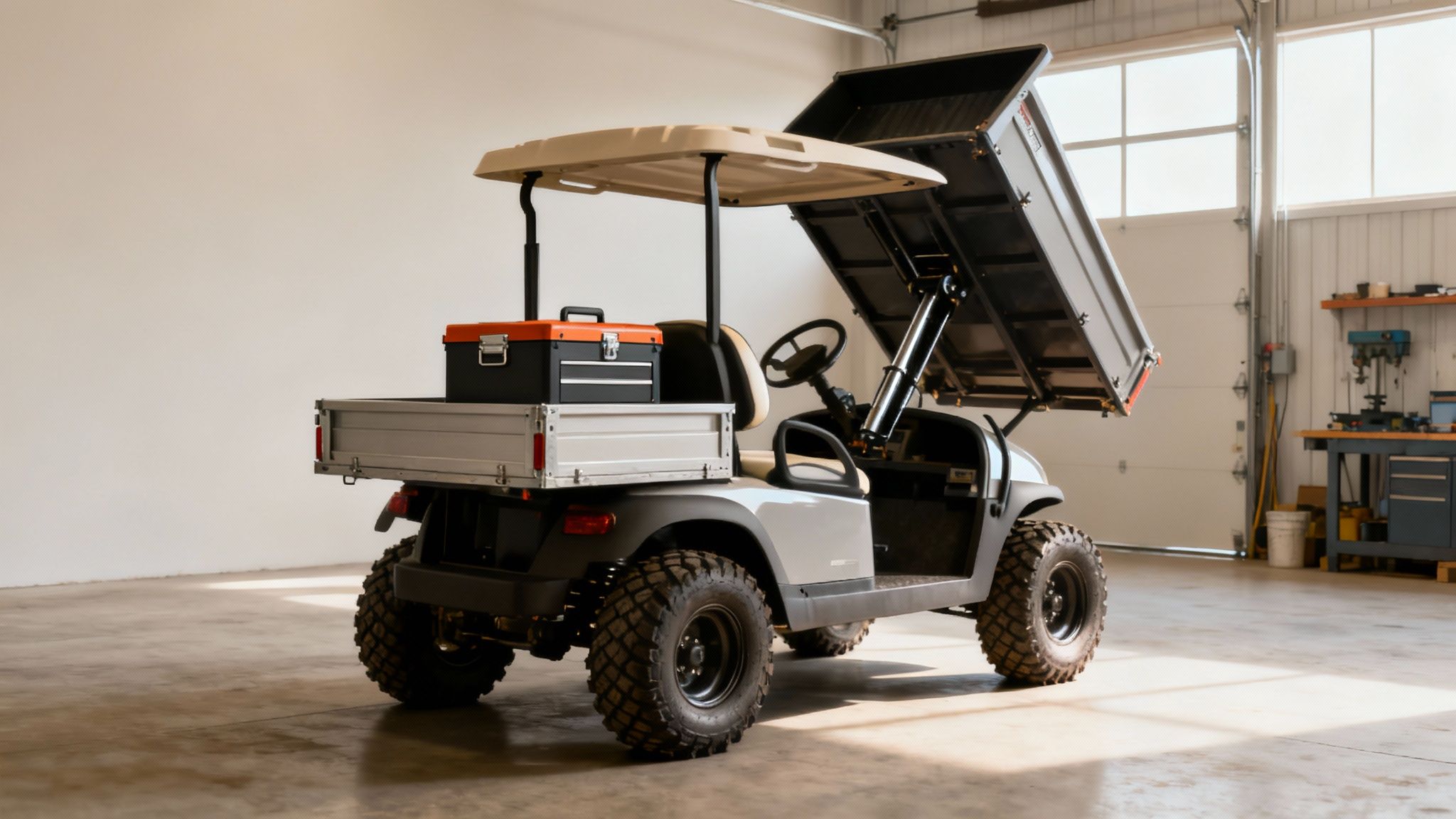
A hydraulic dump kit is probably the single best upgrade for anyone moving loose stuff. If you're a landscaper dumping mulch, a groundskeeper clearing fallen leaves, or a construction crew moving gravel, this feature is a game-changer. It turns a job that takes hours of shoveling into a simple push of a button.
Other key bed accessories include:
- Toolboxes: Bolt a tough, weather-resistant toolbox right onto the bed or frame. It keeps your expensive tools locked up, organized, and out of the rain, effectively turning your cart into a mobile workshop.
- Bed Walls and Extenders: If you're hauling bulky or awkward items, adding side rails or a bed extender gives you more cargo space and keeps everything from sliding off when you take a turn.
- Specialized Racks: For really specific jobs, look into custom racks. Things like ladder racks, chainsaw mounts, or holders for long-handled tools keep your gear secure and out of the way, freeing up the bed for other materials.
Adding the right accessories can completely change how you work. Here’s a quick rundown of some of the most popular options and what they’re best for.
Top Utility Bed Accessories and Their Uses
| Accessory | Primary Function | Ideal For (Use Case) |
|---|---|---|
| Hydraulic Dump Kit | Tilts the cargo bed for effortless unloading of loose materials. | Landscaping, construction, groundskeeping, farm work. |
| Weatherproof Toolbox | Provides secure, organized, and protected storage for tools. | Maintenance crews, mobile mechanics, contractors. |
| Bed Wall Extenders | Increases the bed's volume and height to contain bulky loads. | Hauling brush, trash, or irregularly shaped items. |
| Ladder/Tool Racks | Secures long or specialized equipment safely above the cargo bed. | Facilities maintenance, painting crews, arborists. |
| Bed Liner | Protects the metal bed from scratches, dents, and corrosion. | Anyone hauling heavy or abrasive materials like rock or scrap. |
As you can see, a few smart additions can equip your cart for almost any task you can throw at it.
Performance and Durability Enhancements
While the bed holds the cargo, the rest of the cart has to be tough enough to handle the workload. Performance upgrades are all about making sure your vehicle can carry heavy loads and get around tricky job sites without breaking down.
The absolute first place to start is the suspension. A standard golf cart suspension is built for a couple of people and their clubs, not a half-ton of gravel. Upgrading to heavy-duty rear leaf springs is non-negotiable. It stops the rear end from sagging, keeps the cart stable, and gives you proper steering control with a full bed. Without it, the ride is unsafe and you’re asking for long-term frame damage.
A utility cart's true strength lies in its foundation. Upgrading the suspension isn't just about performance; it's a fundamental safety requirement for anyone planning to use their cart for serious hauling.
Tires are another big one. Ditch the standard turf tires and get a set of all-terrain tires. They give you way better grip on dirt, gravel, mud, and uneven ground. That simple swap means you can drive a loaded cart right off the pavement without worrying about getting stuck.
Comfort and Safety Additions
A workhorse vehicle should be safe and comfortable, especially if your crew is going to spend hours in it every day. These add-ons protect the driver and make the cart usable in more situations.
For anyone working outside, a full cab enclosure is a must. Whether it’s fabric or hard-paneled, it’ll shield the operator from wind, rain, and cold, meaning you can use the cart year-round. Even a basic windshield makes a huge difference by blocking wind, dust, and debris.
For safety, don’t skip these:
- LED Light Kits: Bright headlights, taillights, and turn signals are essential for being seen, especially if you're working at dawn, dusk, or inside a warehouse.
- Mirrors: A set of side and rearview mirrors helps you see what’s going on around you, which is critical when navigating busy work sites.
- Seatbelts: It's a simple addition, but it's a vital one, especially if the cart is driven on rough terrain or used to move people around.
Street-Legal Rules and Local Compliance
Thinking about taking your utility golf cart off your property and onto public roads? It’s a great way to expand its usefulness, but it’s not as simple as just rolling it off the curb. Doing so opens up a whole new set of rules you need to follow. The key is understanding the critical difference between a standard golf cart and a street-legal Low-Speed Vehicle (LSV).
An LSV is basically a golf cart that's been beefed up to meet specific federal and state safety standards. A regular cart is built for the gentle slopes of a golf course; an LSV is equipped for the blacktop. Getting this distinction right from the start will save you from potential fines and a lot of headaches down the road.
Meeting Low-Speed Vehicle Requirements
To get the official LSV designation, your cart has to be outfitted with a specific package of safety gear. These aren't just nice-to-have accessories—they're non-negotiable requirements mandated by law for any vehicle sharing the road with cars. The whole point is to make your cart visible, predictable, and safe for everyone.
Most places will require your cart to have the following features to be considered street-legal:
- Headlights and Taillights: Absolutely essential for being seen at dawn, dusk, or in bad weather.
- Turn Signals and Brake Lights: These let other drivers know what you’re doing, which is fundamental to avoiding accidents.
- A Horn: A simple but effective tool for getting the attention of pedestrians or other drivers.
- Mirrors: You'll typically need both rearview and side-view mirrors to get a complete picture of what's happening around you.
- A Windshield: A proper, automotive-grade windshield is required to protect the driver.
- Seatbelts: Every single seat needs its own seatbelt. No exceptions.
- A Vehicle Identification Number (VIN): Just like a car, your LSV needs a VIN to be registered and insured.
Here's the most important piece of advice I can give you: always check with your local Department of Motor Vehicles (DMV). The rules can change dramatically from one state, county, or even city to the next. What's perfectly fine in one town could be illegal just a few miles away.
Factory-Built vs. DIY Conversion
So, how do you get a street-legal utility cart? You really have two main options: buy a model that’s already street-legal right from the factory, or take on the project of converting your existing cart yourself.
Going with a factory-built LSV is hands-down the easier and more foolproof route. These vehicles are engineered from the get-go to meet every federal safety standard. They arrive with a Manufacturer's Certificate of Origin (MCO) and a pre-assigned VIN, which makes the titling and registration process about as smooth as it gets.
Converting a standard golf cart is definitely doable, but it’s a bigger project. You'll need to buy and install a street-legal kit that contains all the required parts we just covered. Once you've got everything installed, the cart has to pass an official inspection to confirm it's up to code before you can get it titled. It can be a satisfying project, but it requires a real eye for detail to make sure you tick every single box.
Maintenance and Load Safety You Can't Ignore
A golf cart with a utility bed is an incredible workhorse. But like any piece of equipment you rely on, it needs a little TLC to keep running safely and dependably for the long haul. Skimping on maintenance or ignoring how you load it isn't just bad for the cart—it's a real safety risk for the driver and anyone nearby.
Think of routine upkeep as protecting your investment. A few minutes spent on prevention can easily save you from a world of headaches, expensive repairs, and unexpected downtime down the road.
The proof is in the numbers. These carts are popping up everywhere in commercial and industrial settings because they get the job done. The global golf cart market was valued at USD 6.2 billion in 2025 and is expected to hit USD 9.0 billion by 2035. That growth is all about their practical use for hauling tools and materials. You can discover more insights about this growing market and see just how essential they've become.
Your Essential Maintenance Playbook
Keeping your utility cart in top-notch shape is far less complicated than you might imagine. It really just comes down to a consistent routine to spot little issues before they snowball into big, expensive ones.
Here are the absolute must-dos:
- Battery Health is Everything (Electric Carts): On an electric cart, the batteries are the engine. Make it a habit to clean the terminals to keep corrosion at bay, top off water levels on lead-acid batteries, and always charge them according to the manufacturer's instructions. This is the single best way to get the most life out of them.
- Check Tire Pressure Weekly: Improperly inflated tires are trouble. They mess with the cart's handling, drain the battery faster, and wear out unevenly. A quick weekly check with a pressure gauge is all it takes to keep your cart stable and efficient, especially when you're hauling a heavy load.
- Don't Ignore Your Brakes: Your ears are your best tool here. Listen for any squeaking or grinding sounds. When you test the brakes, they should feel firm and stop the cart evenly. If it pulls to one side or feels sluggish when stopping, it's time to get them looked at by a pro.
Mastering Load Safety for Every Haul
The moment you put a load in that utility bed, you've changed the entire dynamic of the vehicle. The extra weight raises the cart's center of gravity and shifts its balance, which means you have to be a lot more careful behind the wheel.
Respecting the payload capacity isn't just a friendly suggestion—it's a hard limit. Overloading puts a massive strain on the frame, suspension, motor, and brakes, which is a surefire recipe for premature failure and dangerous instability.
Stick to these simple rules to make every trip a safe one:
- Know Your Limit: Every single utility cart has a maximum weight it can carry, and that includes you, any passengers, and your cargo. Find that number in your owner’s manual, commit it to memory, and never push past it.
- Distribute the Weight Evenly: This is huge. Place your heaviest items in the center of the bed, as low as you can get them, and try to keep them positioned over the front axle. A poorly balanced load makes steering a nightmare and dramatically increases the risk of a rollover, particularly on turns or bumpy ground.
- Drive for the Load: A heavy cart needs more room and time to stop. Slow down, take your turns wider to stay stable, and avoid mashing the accelerator or slamming on the brakes. Be especially careful on hills, where that extra weight will have a big impact on how the cart climbs and brakes.
Frequently Asked Questions
When you're looking into getting a golf cart with a utility bed, a few key questions always seem to pop up about what they can do, what they cost, and how you can tweak them. Let's tackle the most common ones head-on so you can feel confident in your choice.
Understanding Capacity and Modifications
The first thing people usually ask is about muscle—how much can these things actually carry? And can you just bolt a bed onto a regular golf cart? The answer really depends on whether you're looking at a standard cart for around the property or a true commercial workhorse.
What is the typical payload capacity of a golf cart with a utility bed?
Payloads can be all over the map. Your standard, run-of-the-mill models will usually handle somewhere between 300 to 500 pounds. But if you step up to a heavy-duty commercial utility cart, you're in a different league. Those are built tough and can often haul over 1,000 pounds.
The golden rule is to always check the manufacturer’s specs. Pushing past that limit is just asking for trouble—it's unsafe and a great way to wreck your cart.
Can I add a utility bed to my existing standard golf cart?
Yes, you absolutely can. There are plenty of aftermarket utility bed kits designed to fit the big names like Club Car, E-Z-GO, and Yamaha, and they usually take the place of the rear seats.
But here's the catch: you need to think about whether your cart's frame and suspension are up for the job. Adding a bed and then loading it with gear puts a lot of strain on the original parts. If you plan on hauling anything heavy, upgrading to heavy-duty rear leaf springs isn't just a good idea—it's pretty much essential.
The main thing to remember is that adding a utility bed changes the whole dynamic of your cart. Beefing up the suspension isn’t an optional tweak; it's a crucial step for keeping the cart stable and safe when you're carrying a real load.
Cost and Investment
Of course, the price tag is a huge factor. The cost for a new utility golf cart can vary quite a bit, depending on how it's built and what it's for. Knowing what drives the price up will help you set a realistic budget.
How much does a new golf cart with a factory-installed utility bed cost?
You're looking at a pretty wide range. A basic electric model with a simple, no-frills utility bed will probably start somewhere in the $8,000 to $10,000 neighborhood.
However, if you need something more serious for commercial work—think hydraulic dump beds, reinforced suspension, and a higher payload—the price can easily climb past $15,000 and even top $20,000. Battery tech also plays a big role; carts with advanced lithium-ion batteries cost more upfront. These higher-end models are engineered for tough, all-day jobs where you just can't afford a breakdown.
At Solana EV, we live and breathe premium electric vehicles built for real-world performance. Check out our lineup of utility carts and see how we can set your property or business up with the right tool for the job. Visit us at https://solanaev.com to see what we're all about.