
If you've ever wondered what makes an electric golf cart go, the answer isn't just the batteries or the motor. The real hero is a small, unassuming box of electronics: the golf cart controller. This device is the brain of your entire vehicle, the crucial link between you, the batteries, and the motor. Without it, your cart is just a heavy rolling chassis.
The Brain of Your Electric Golf Cart
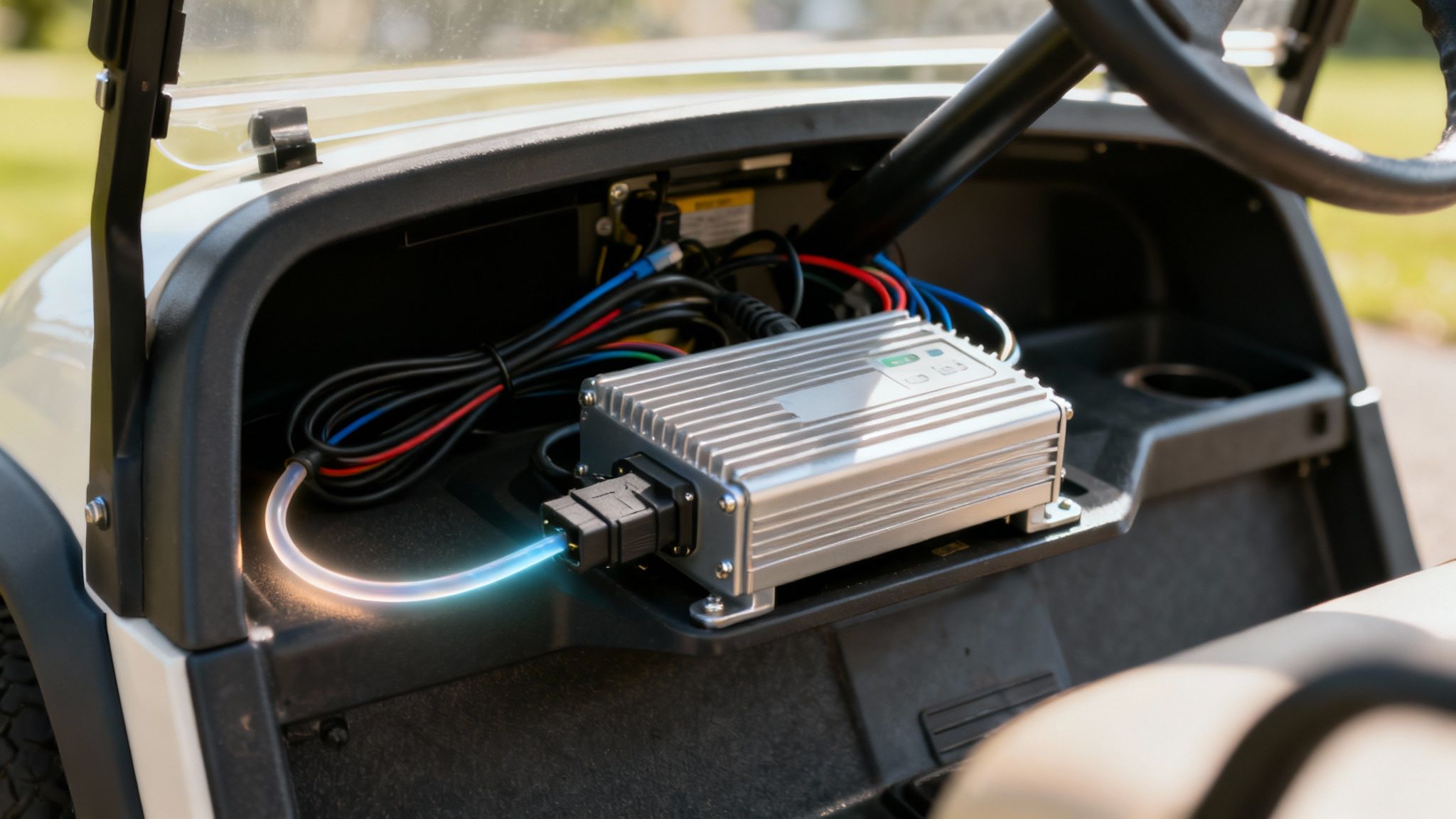
Here’s a simple way to think about it: the controller is like a sophisticated dimmer switch for a powerful light bulb. When you press the accelerator, you aren't just dumping raw power from the batteries directly into the motor. That would be like flipping a massive switch to "full blast"—a recipe for a jerky, uncontrollable ride that would quickly burn out your components.
Instead, your foot on the pedal sends a signal to the golf cart controller. The controller then reads that signal and intelligently manages the flow of electrical current from the battery pack to the motor. It meters out the exact amount of power you need, giving you smooth acceleration, steady cruising speed, and precise control.
This role as the central command unit makes the controller one of the most vital—and often overlooked—components in your electric cart's powertrain. It doesn't just decide how fast you go; it also has a huge impact on how efficiently your cart uses its precious battery life.
The Controller's Core Responsibilities
At its core, the controller is a traffic cop for electricity. It's constantly making decisions to translate your driving commands into real-world motion. Every time you accelerate up a hill, cruise down a fairway, or gently slow to a stop, the controller is managing a delicate dance of voltage and amperage. This isn't just for performance; it's also critical for protecting the entire electrical system from damage.
The controller acts as the central nervous system for your cart's powertrain. It ensures that every command from the driver is executed safely, smoothly, and efficiently, protecting the motor and maximizing battery range.
The incredible evolution of these electronic brains is a big reason why electric carts have become so popular. Modern controller technology means better efficiency, more hill-climbing torque, and a far more enjoyable ride. It's no surprise that electric models now dominate the market, accounting for a massive 66.72% of unit shipments in North America alone. These advanced power management systems are a key part of that story, which you can explore further by reading about the rise of electric carts.
Primary Functions of a Golf Cart Controller
To really appreciate what this little box does, it helps to break down its main jobs. Each one has a direct and noticeable impact on how your cart feels and performs out on the course or around the neighborhood.
The table below gives you a quick snapshot of the controller's key duties.
| Function | What It Does | Impact on Your Ride |
|---|---|---|
| Speed Regulation | Modulates power from the batteries to control motor RPM. | Ensures smooth acceleration and maintains a consistent speed. |
| Torque Control | Adjusts amperage to the motor based on load. | Provides the necessary power to climb hills without stalling. |
| Directional Control | Works with the forward/reverse switch to change motor polarity. | Allows you to switch between driving forward and backing up. |
| System Protection | Monitors for over-current and over-voltage situations. | Prevents damage to the motor and other electrical parts. |
In short, the controller is always working behind the scenes to give you the performance you expect while also playing defense for your cart's most expensive components.
How a Golf Cart Controller Manages Power
When you step on the accelerator and feel that smooth take-off, you're experiencing the work of a sophisticated little device: the golf cart controller. Think of it as the cart's brain. It’s the critical link between your foot on the pedal and the electric motor spinning the wheels, translating your simple command into a precise flow of power.
The process kicks off the moment you press down. The accelerator isn't just a simple on/off switch; it sends a variable voltage signal to the controller. A light touch sends a low voltage, while flooring it sends the maximum signal. The controller reads this input, understands how fast you want to go, and then taps into the raw power waiting in your batteries.
The Secret is in the Pulse
So, how does it deliver just the right amount of juice? Early electric vehicles used giant resistors that basically "burned off" extra energy as heat to go slow—wildly inefficient. Today’s controllers use a much smarter technique called Pulse Width Modulation (PWM).
Instead of choking the flow of electricity like a kink in a hose, PWM acts like an incredibly fast light switch. It flicks the power to the motor on and off hundreds, sometimes thousands, of times every second.
It’s a bit like using a high-tech spray nozzle on a garden hose.
- For a gentle mist (low speed), you’d tap the trigger in very short, quick bursts.
- For a powerful stream (high speed), you’d squeeze the trigger for longer periods.
That’s exactly what your controller does with electricity. For slow speeds, it sends short pulses. For top speed, the pulses get longer until it's a near-constant stream of power. The motor feels the average of these pulses, giving you that smooth, responsive acceleration without wasting precious battery life.
A golf cart controller doesn't just reduce power; it chops it into thousands of tiny, manageable pieces. This rapid pulsing is the key to providing precise speed adjustments while maximizing battery efficiency and preventing component damage.
Directing Power for Different Motor Types
Now, how the controller directs that pulsed energy depends entirely on the type of motor you have. The two main players are brushed DC and brushless DC (BLDC) motors, and each one needs its own specific kind of controller.
Brushed DC Motor Controllers
This is the classic, more straightforward setup. A brushed motor has physical carbon "brushes" that make contact with the spinning part of the motor to deliver power. The controller’s job here is pretty simple:
- It gets the speed signal from the accelerator.
- It uses PWM to send pulses of direct current (DC) straight to the motor.
- To go in reverse, a separate heavy-duty switch simply flips the electrical polarity.
Brushless DC (BLDC) Motor Controllers
BLDC motors are the more modern, efficient, and complex option. With no brushes to wear out, they rely entirely on the controller to electronically "commutate" or switch the power between different windings in the motor to create rotation. This is a much bigger job for the controller. It has to:
- Take the battery's DC power and convert it into a three-phase AC signal.
- Perfectly time the delivery of this power to energize the motor’s windings in the exact right sequence.
- Use sensors to constantly track the motor’s rotational position to keep the timing perfect.
This advanced digital management is what makes BLDC systems so much more efficient and reliable. It’s a major reason the global electric golf cart market, valued at USD 2.6 billion, is projected to hit USD 4.1 billion by 2032. You can find more market insights on this growth from Persistence Market Research. To really get a feel for how a controller handles these demands, it helps to understand the principles of electrical load calculation.
All this power management starts and ends with your batteries. Keeping them healthy is non-negotiable. For a deep dive, check out our guide on charging golf carts correctly.
Understanding Controller Specs and Types
Trying to make sense of a golf cart controller's spec sheet can feel like you're reading a foreign language. But once you grasp a few key numbers, you're well on your way to picking the right "brain" for your cart. These specs aren't just for engineers; they directly translate into real-world performance—how your cart tackles a steep hill or gets up to speed on a long, flat path.
This diagram lays out the fundamental power flow. It all starts with your foot on the pedal, sends a signal to the controller, which then tells the motor exactly what to do.
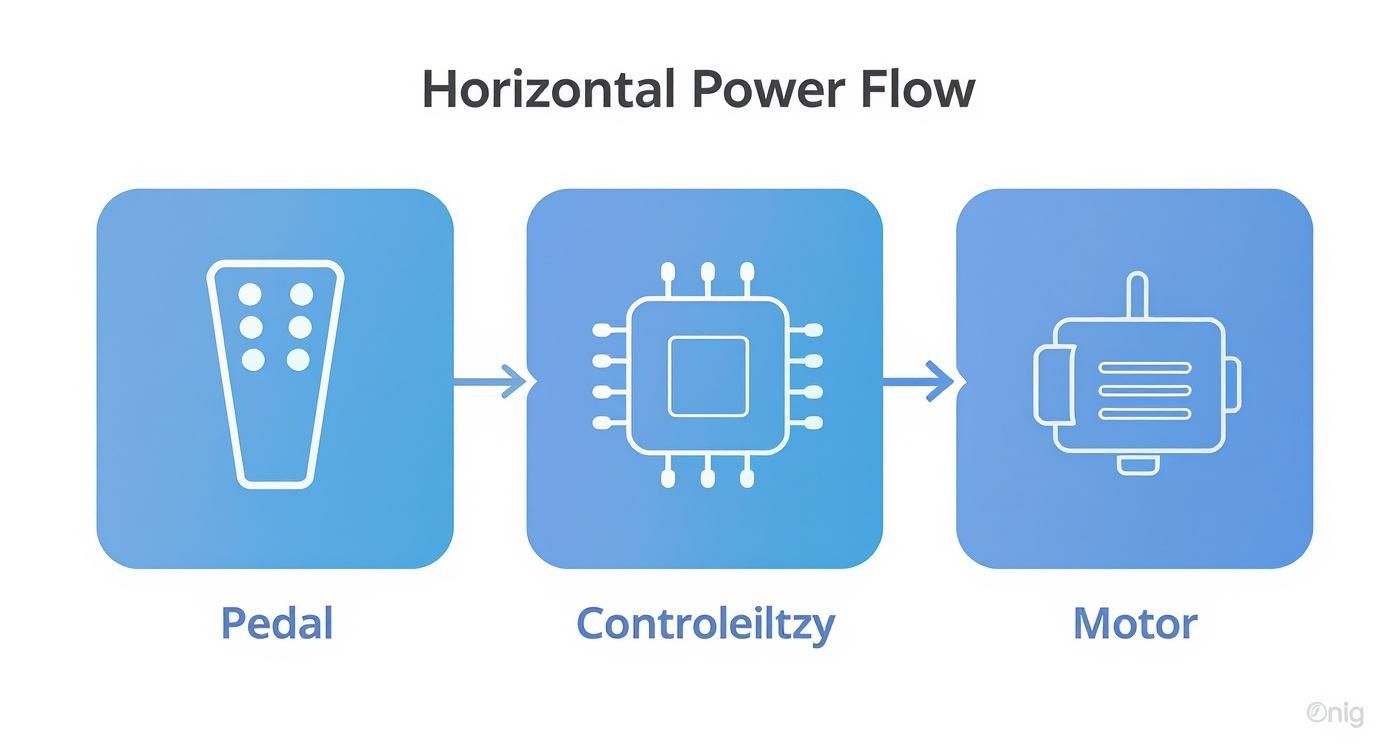
Think of the controller as the central command hub, turning your simple request for "more go" into precise, controlled power that the motor can use.
The Two Most Important Numbers
When you're comparing golf cart controllers, you'll immediately notice two primary ratings: Voltage (V) and Amperage (A). The easiest way to think about them is with a water hose analogy. Voltage is the water pressure, and amperage is the size of the hose.
- Voltage (V): This is the electrical "pressure" your entire system runs on. It's critical that the controller's voltage matches your battery pack and motor (e.g., 36V, 48V, 72V). Generally speaking, higher voltage helps you achieve higher top speeds.
- Amperage (A): This is all about the volume or "flow rate" of the electrical current. More amps deliver more torque—the raw, twisting force you need for snappy acceleration and climbing hills without slowing to a crawl.
Imagine you're trying to push a heavy boulder. Voltage is how hard you can push, while amperage is how many people are pushing alongside you. A 400A controller will give you a ton more hill-climbing muscle than a 250A model, even if they're both running at the same voltage.
A common mistake is focusing only on voltage for speed. Amperage is the key to torque and real-world power. A high-amp controller will make your cart feel more responsive and capable, especially under load.
Upgrading to a controller with a higher amperage rating is one of the single most effective performance boosts you can give a golf cart. It gives the system the muscle it needs for just about any terrain.
The Main Types of Golf Cart Controllers
Beyond the basic voltage and amperage ratings, controllers are built to communicate with specific motor technologies. There are a few different systems out there, but you'll almost always run into one of three main types: Series, Shunt (often called SepEx), and AC. Each one operates a little differently and gives your cart a distinct personality on the road.
To help clear things up, here’s a quick rundown of how these controllers stack up against each other.
Comparison of Golf Cart Controller Types
A comparative look at the most common controller technologies, their performance characteristics, and best-fit applications.
| Controller Type | Key Characteristic | Best For | Considerations |
|---|---|---|---|
| Series | Simple, rugged design that delivers massive low-end torque. | Heavy-duty work, utility carts, off-roading, and older carts where raw power is the priority. | Less efficient, typically lacks regenerative braking, and can have a lower top speed. |
| Shunt (SepEx) | Allows independent control of motor speed and torque. | Neighborhood cruisers and personal carts needing a good balance of speed, torque, and modern features. | More complex than Series systems, but offers better overall performance and control. |
| AC (Alternating Current) | Converts DC battery power to 3-phase AC for the motor. | Premium street-legal LSVs, high-performance builds, and commercial fleets where efficiency is critical. | Highest efficiency, lowest maintenance (brushless motor), and superior overall power. |
While older technologies still have their place, modern carts, especially high-performance ones like the Solana EV models, have moved decisively toward AC systems for a reason. Let's dig into what makes each one tick.
Series Controllers
This is the classic, old-school workhorse of the golf cart world. Series systems are known for being incredibly simple, tough as nails, and absolute monsters when it comes to low-end torque.
- How it Works: In a Series circuit, the controller pushes all the electrical current through both the motor's armature and field windings in one single loop. It's a very direct and forceful way to get things moving.
- Best For: Heavy-duty applications. Think farm utility vehicles, hunting buggies, and older carts where brute strength off the line matters more than anything else.
- Key Trait: They are unbelievably powerful from a dead stop but tend to be less efficient at higher speeds and almost never include modern features like regenerative braking.
Shunt (SepEx) Controllers
Shunt, or Separately Excited (SepEx) controllers, are a big step up in sophistication. They offer a much more refined level of control compared to the brute-force approach of a Series system.
- How it Works: The controller can manage the power going to the motor's armature and its field windings independently. This separation is the key, as it allows for much finer control over the motor's speed and torque.
- Best For: Most modern personal golf carts. They’re perfect for neighborhood cruisers and any vehicle where you want a nice balance of speed, torque, and handy features.
- Key Trait: This technology is what makes regenerative braking possible. It can use the motor's momentum to slow the cart down, sending a small bit of charge back to the batteries in the process.
AC Controllers
Alternating Current (AC) systems are the top of the food chain—the most modern, efficient, and powerful option on the market today. When paired with an AC induction motor, these controllers deliver a driving experience that's in a different league.
- How it Works: The AC controller is a sophisticated piece of tech. It takes the DC power from your batteries and uses electronics to invert it into a 3-phase AC signal that powers the motor. This gives it unparalleled control and efficiency.
- Best For: Premium, street-legal Low-Speed Vehicles (LSVs), high-performance custom carts, and commercial fleets where fuel efficiency and low maintenance are top priorities. You'll find powerful AC systems in all Solana EV models.
- Key Trait: AC motors don't have brushes that can wear out, so they require less maintenance. They also run cooler and deliver fantastic torque and speed across their entire power band, all while sipping energy from the batteries.
Troubleshooting Common Controller Issues
Sooner or later, even the most bulletproof golf cart controller can act up. When your cart decides to go on strike—refusing to move, lurching forward, or crawling at a snail’s pace—it’s easy to jump to the conclusion that the controller is toast. But hold on. A little bit of systematic detective work can often uncover the real culprit, saving you a lot of headache and money.
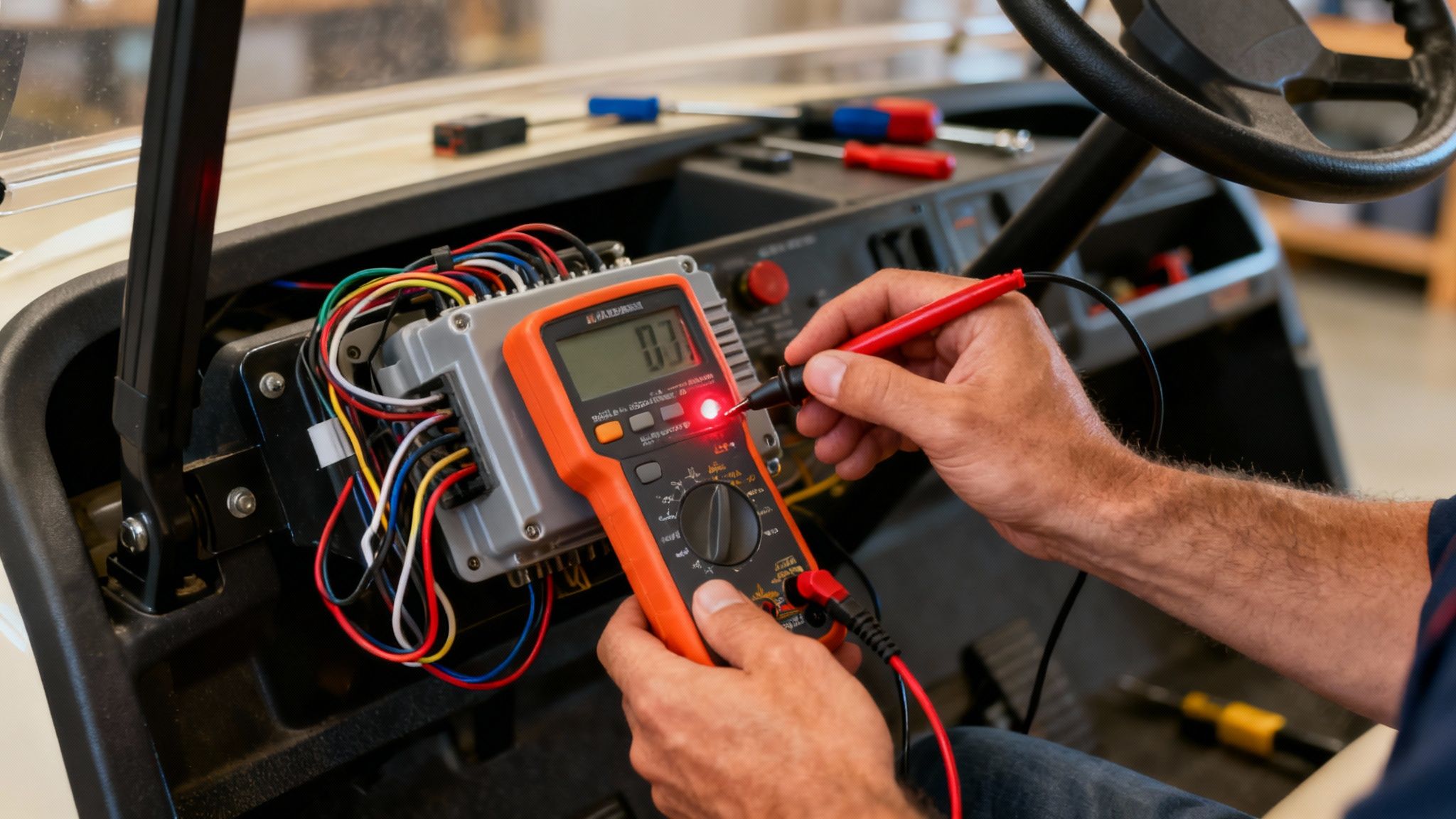
Before you condemn the controller, remember it’s just one part of a bigger electrical team. Issues with the batteries, solenoid, wiring, or even the motor itself can all disguise themselves as a controller failure. The trick is to start simple and work your way up to the more complex stuff.
Initial Diagnostic Checklist
When you’re staring down a misbehaving cart, applying some effective maintenance problem-solving strategies is the way to go. Don't break out the multimeter just yet. First, just use your eyes and ears. You’d be surprised how often the fix is right in front of you.
- Check Your Power Source: Is the battery pack actually fully charged? A low state of charge can cause all sorts of problems, from a sluggish ride to a cart that won't move an inch.
- Listen for the "Click": Turn the key, put it in gear, and press the pedal. You should hear a confident "click" from the solenoid. If it’s silent, the problem likely lies with the solenoid or its activation circuit—not the controller.
- Inspect All Connections: Take a close look at all the heavy-gauge cables running between the batteries, controller, and motor. Are any connections loose, corroded, or frayed? A bad connection can choke off the power the controller needs to do its job.
- Look for Blinking Lights: Many modern controllers have a built-in diagnostic LED. It flashes a specific pattern, like a secret code, to tell you exactly what it thinks is wrong. You’ll need to check your controller's manual to translate the flashes.
Common Symptoms and What They Mean
If those basic checks don’t turn up anything, you can start narrowing down the possibilities based on the cart's specific behavior. Each symptom points to a different set of potential suspects.
- Symptom 1: Cart Won't Move, Solenoid Clicks
This is a classic. The click tells you the solenoid is working and the controller is getting the signal to go. If the cart still won't move, it often means the controller isn't sending power out to the motor. - Symptom 2: Jerky or Stuttering Acceleration
This kind of erratic movement points to an inconsistent delivery of power. While it could be a failing controller, it’s also a hallmark sign of a bad throttle sensor (like an ITS or potentiometer) sending a jumpy signal. - Symptom 3: Cart is Stuck in "Limp Mode"
Is your cart suddenly stuck at half speed? The controller might have put itself into a protective "limp mode" after detecting a serious fault. It’s designed to prevent more damage while giving you just enough power to get back home. - Symptom 4: A Distinct Burning Smell
That sharp, acrid smell of fried electronics is the one you don't want. If you smell it, disconnect the batteries immediately. This is a dead giveaway of an internal short inside the controller.
Pro Tip: Always use a multimeter to confirm a diagnosis before you start ordering parts. Checking voltage at key points—like the controller's main input and output terminals—is the only way to prove for sure if it's receiving power and sending it out correctly.
When to Seek Professional Help
While most owners can handle these basic troubleshooting steps, there are times when calling in a pro is the smartest play. If you're not comfortable working around high-amperage electrical systems or if it seems like multiple things are wrong at once, it's best to tap out and call a qualified technician. They have the specialized tools and experience to diagnose complex issues safely and accurately.
For a wider look at potential issues, our guide on troubleshooting electric golf cart problems offers more insights that can help you confirm whether the controller is truly the problem or if another component is the source of your troubles.
Upgrading and Installing a New Controller
The controller that came with your golf cart was built to do one thing: provide safe, reliable, and predictable performance on the golf course. It does that job well. But what if you’re looking for more?
If you want to truly unlock the speed, torque, and responsiveness hidden within your cart, upgrading the controller is the single biggest performance leap you can make. Think of your motor and batteries as the engine and the fuel tank. The controller? That's the brain—the engine control unit (ECU). A better brain can handle a bigger flow of amperage, which translates directly into more muscle for climbing hills and a much quicker jump off the line.
Why Upgrade Your Stock Controller?
Swapping out that factory controller opens up a whole new world of performance. The benefits go way beyond just a higher top speed; you're fundamentally changing how your cart feels and operates in every situation.
Here's why so many owners make the switch:
- Serious Torque: A high-amperage controller (400A or more) shoves a lot more power to the motor. That hill you used to crawl up? You’ll now conquer it with ease.
- Higher Top Speeds: When you pair an upgraded controller with the right motor and voltage, it can safely manage the power needed to really open it up on the road.
- Better Efficiency: It might sound counterintuitive, but many modern controllers—especially in AC systems—have smarter, more advanced circuitry that can actually manage your battery power more effectively.
- Total Control: This is the big one. Many aftermarket units let you plug in with an app or laptop to fine-tune everything from acceleration curves to how aggressively the regenerative braking kicks in.
Upgrading your controller isn't just about adding raw power; it’s about gaining control. The ability to dial in your cart's performance for exactly what you need—whether that's relaxed neighborhood cruising or heavy-duty hauling—is a total game-changer.
OEM vs. Aftermarket Controllers
When it's time to replace or upgrade, you’ve got two paths: stick with an Original Equipment Manufacturer (OEM) part or jump to an aftermarket unit.
An OEM controller is a carbon copy of what you already have. It's a direct, factory-spec replacement designed to bring your cart back to its original, out-of-the-box performance. It’s the safe, predictable choice.
An aftermarket controller, on the other hand, is an intentional, purpose-built upgrade. These units are engineered from the ground up to outperform stock components, boasting higher amperage ratings, beefier construction, and those advanced features we talked about. They often cost more, but the performance payoff is massive, making them the go-to for enthusiasts. The growing demand for powerful, eco-friendly carts like these is what's driving the global golf cart market, which was valued at USD 2.30 billion and is projected to hit USD 3.68 billion by 2035. You can dig deeper into this trend and its market impact in this comprehensive market report.
Installation and Compatibility Checklist
Putting in a new controller is a pretty straightforward job, but it’s one that demands your full attention. Get it right, and you’ll be thrilled. A simple mistake can lead to disappointing performance or, even worse, frying your brand-new investment.
Before you even touch a wrench, run through this pre-flight checklist:
- Safety First: Disconnect Power: This is non-negotiable. Put your cart in "Tow/Maintenance" mode and disconnect the main negative battery terminal. Seriously, do it.
- Verify Voltage Match: Double- and triple-check that your new controller’s voltage rating (36V, 48V, 72V) is an exact match for your battery pack's total voltage. A mismatch here will instantly destroy the controller.
- Check Amperage Compatibility: Make sure your motor and, just as importantly, your high-current cables are rated to handle the amperage of the new controller. A powerful controller needs heavy-gauge cables to deliver all that juice without melting.
- Label Everything: Before you disconnect a single wire, pull out your phone and take a few pictures of the existing setup from different angles. Then, grab some masking tape and a marker to label each wire. Trust me, you'll thank yourself later.
- Program If Necessary: Some modern setups, especially those with lithium battery upgrades, require the controller to be programmed. For example, many ICON carts from 2021 and later need a special tool to "flash" the controller so it properly communicates with the new components.
Once it's installed correctly, that new controller will completely transform your cart's personality. For those looking to squeeze out every last MPH, our guide on how to make your electric golf cart fast is the perfect next step to complement your controller upgrade.
Frequently Asked Questions
When it comes to golf cart controllers, a lot of questions pop up. Whether you're trying to fix a nagging issue, dreaming up your next big upgrade, or just want to know your machine a little better, getting straight answers is key.
We've put together some of the most common questions we hear from owners and our expert take on them. Think of this as your quick guide to understanding the brain of your cart's electrical system.
Can I Put a Higher Voltage Controller on My Cart?
This is easily one of the most popular questions we get, usually from owners looking for more get-up-and-go. While it's a classic high-performance upgrade, you absolutely cannot just drop a higher voltage controller in and call it a day.
If you’re thinking of jumping from a 36V system to a 48V one, for example, you have to think of it as a complete powertrain conversion. That means you'll also need to upgrade your batteries, solenoid, and almost always the motor to handle the new voltage.
A very common, and very expensive, mistake is mismatching your components. If you pair a 48V controller with a 36V motor or battery pack, you’re going to get an immediate, catastrophic failure of those lower-voltage parts. Treat any voltage increase as a full, system-wide project.
What Is Regenerative Braking?
Regenerative braking is a really clever feature where your electric motor pulls double duty, temporarily acting as a generator. When you ease off the accelerator, the cart's momentum keeps the motor spinning, and that motion creates electrical energy that gets fed right back into your batteries for a small recharge.
This process also creates a natural "engine braking" effect, slowing the cart down smoothly without you ever touching the brake pedal. It can add a little bit of extra range to your charge and is a standard feature on most modern Shunt (SepEx) and AC controllers.
It’s worth noting that your basic Series controllers, which are common in older or heavy-duty workhorse carts, can't do this. To get the benefits of regenerative braking, you need a motor and controller system that were designed to work together.
How Do I Know if My Controller Is Failing?
Figuring out if your controller is on its way out can be tricky, since the symptoms can look a lot like other electrical problems. But there are a few classic warning signs that tend to point straight at the controller as the source of your headache.
Here are the big ones to watch for:
- The Click of Death: You press the pedal, you hear the solenoid "click," but the cart goes nowhere. This usually means the controller is getting the signal to go but isn't sending any power to the motor.
- Jerky Operation: The cart lurches or stutters when you try to accelerate. That points to inconsistent power delivery from the controller.
- Burning Plastic Smell: A sharp, chemical smell is a dead giveaway of an internal short. If you smell this, disconnect your batteries immediately.
- Limp Mode: Your cart suddenly starts running at half speed. This often happens when the controller detects a serious fault and puts itself in a self-preservation mode.
Before you condemn the controller, always double-check the basics: make sure your batteries have a full charge and that all the big, high-amperage cables are tight and clean. Many controllers also have a small LED that flashes error codes, which can be a huge help in diagnosing the exact issue.
Is an Aftermarket Controller Better Than OEM?
The right answer here really comes down to what you want your cart to do. There isn't one "better" choice, just the right choice for your goal.
An OEM (Original Equipment Manufacturer) controller is a direct, factory-spec replacement. If you just want to get your cart back to its original, out-of-the-box performance, going with an OEM part is the safest and most reliable bet. It's predictable.
An aftermarket controller, on the other hand, is all about upgrading. These are built to push more power, unlock more speed, and deliver more torque than the stock unit ever could. If you want to boost your cart's performance, aftermarket is the clear winner.
Many aftermarket models also open up a world of customization. They often let you plug in a laptop or use a smartphone app to tweak everything from your acceleration curve and top speed to the feel of the regenerative braking, giving you a truly dialed-in ride.
Ready to experience the ultimate in performance and style? At Solana EV, we equip our premium electric vehicles with top-tier controller systems designed for power, efficiency, and unmatched reliability. Explore our lineup and discover the difference a perfectly engineered powertrain can make. Visit us at https://solanaev.com to find your perfect ride today.
I like your blog.