
We've all been there—that sinking feeling when your golf cart sputters and dies mid-path. While it's easy to blame the battery, the real culprit is often the charging process itself. Your 48v golf cart charger isn't just a simple accessory; it's the single most critical component for keeping your cart running reliably and extending the life of your expensive battery pack.
Why Your Charger Is Your Cart's Lifeline
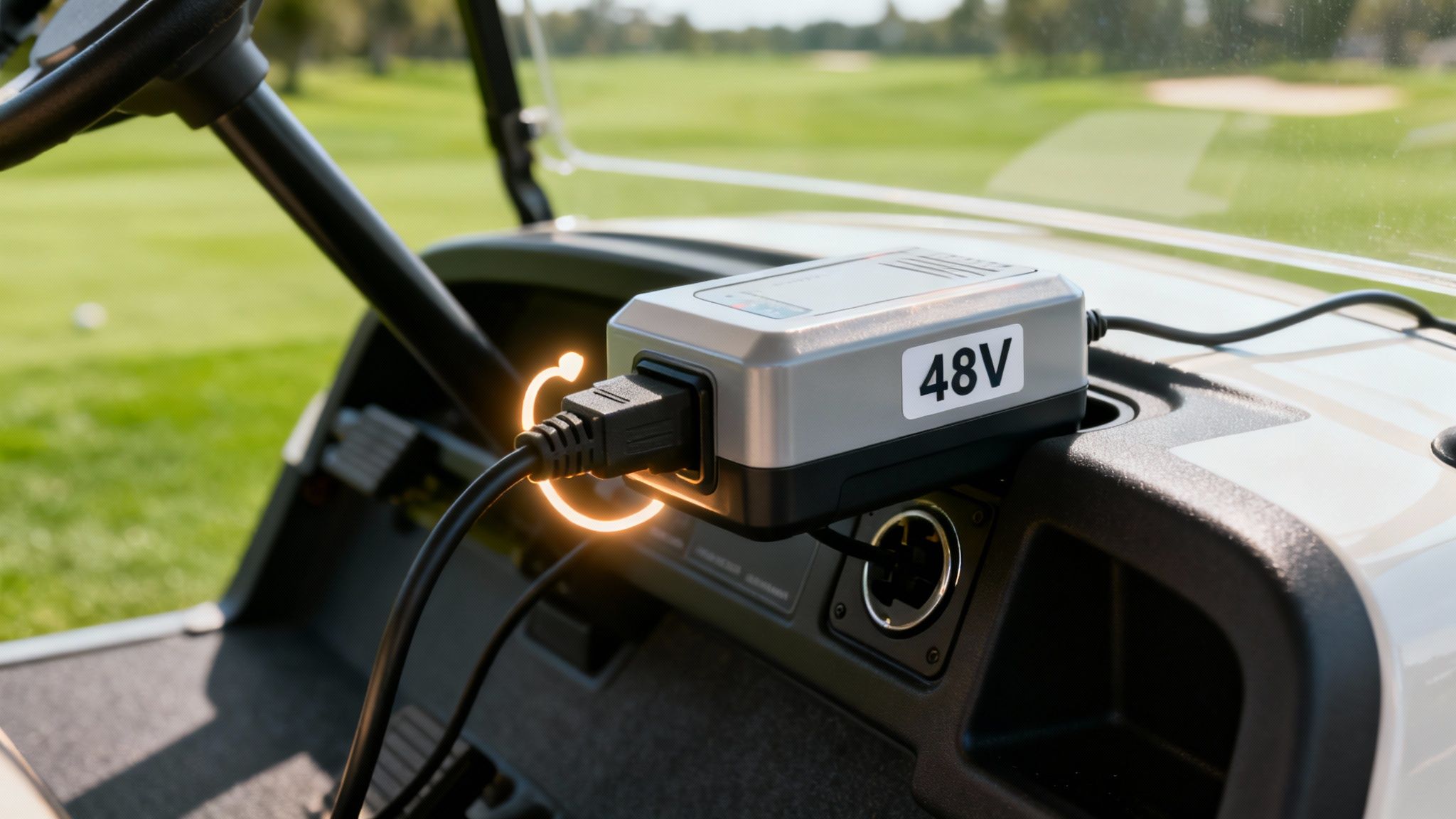
It's tempting to think of a charger as just a plug you stick in the wall. But in reality, it’s the brain behind your vehicle’s power system. Its job is to carefully replenish and maintain your batteries, which are a significant investment. Using a cheap or mismatched charger can actively damage your batteries, slash their lifespan, and leave you with a shorter daily range and a hefty replacement bill down the road.
This guide is here to cut through the confusing tech-speak and give you a straightforward, real-world understanding of how these devices work. We'll show you how the right charger is the key to unlocking consistent performance, whether you're cruising the golf course, managing a large property, or just getting around your neighborhood.
What You Will Learn
My goal here is to give you the practical knowledge to choose, use, and maintain the right charger for your specific cart and batteries. By the time we're done, you'll be able to make decisions with total confidence.
Here’s a look at what we’ll cover:
- Charging Fundamentals: We’ll break down how modern smart chargers use specific algorithms to safely and efficiently power up your batteries.
- Battery Compatibility: You’ll learn the critical differences between chargers designed for old-school lead-acid batteries and the newer lithium-ion setups.
- Key Specifications: We'll decode the important numbers, like amperage (amps), IP ratings for weather resistance, and why safety certifications matter.
- Best Practices: I'll share some simple, actionable tips to protect your investment and get the absolute most life out of your battery pack.
Think of your charger as a personal trainer for your battery. A good one uses a smart, disciplined routine to keep the battery strong and healthy. A bad one just pushes it too hard, leading to burnout and premature failure.
Ultimately, getting a handle on your 48V golf cart charger is about more than just plugging it in. It’s about taking control of your cart’s reliability and making sure it's ready to go whenever you are. Let's dive in and see how these essential devices keep you on the move.
How a Smart Charger Powers Your Golf Cart
Ever wonder what your 48V golf cart charger is really doing for the three to eight hours it's plugged in? It’s not just blindly dumping power into the batteries. Instead, it’s running a precise, multi-stage charging recipe designed to get your batteries full while keeping them healthy for the long haul. It's way more sophisticated than just filling up a gas tank.
Think of your battery pack like a high-tech water reservoir. In this analogy, voltage is the water pressure, and amperage is how fast the water is flowing from the hose. A 48V system has much higher "pressure" than older 36V systems, which is why your cart gets better power and runs more efficiently. It's a big reason the entire industry is moving toward 48V as the standard.
The Smart Charging Algorithm
A modern charger doesn't just hit the battery with a constant stream of energy. It follows a "smart" algorithm, usually broken down into three distinct phases. This intelligent process is what separates a quality charger from a cheap one that can cook your batteries over time.
This multi-stage approach gives you a fast, complete, and safe charge, every single time. Here’s a look at what’s happening behind the scenes.
-
Bulk Stage: This is the "fast charge" part of the process. The charger pushes out its maximum amperage to get the battery up to about 80% full as quickly as possible. It's like turning the hose on full blast to get the reservoir mostly full in a hurry.
-
Absorption Stage: Once the battery hits that 80% mark, the charger throttles back the amperage and holds the voltage steady. This slower, more careful "top-off" phase fills the last 20% without overheating or stressing the battery cells. It’s a crucial step for battery health.
-
Float (or Maintenance) Stage: After the battery is 100% charged, the charger doesn’t just shut off and walk away. It switches into a low-power float mode, delivering just a tiny trickle of energy to combat the battery's natural self-discharge. This keeps your cart topped off and ready to go for your next ride without any risk of overcharging.
Why This Process Matters for Different Batteries
That three-stage recipe is the foundation, but the specifics have to be tuned for the type of battery you have. Traditional lead-acid batteries and modern lithium (LiFePO4) batteries have very different needs when it comes to voltage and charging curves.
Lithium batteries, for instance, have a sophisticated internal brain called a Battery Management System (BMS) that actively balances the cells during charging. You can learn more about how a battery management system works to protect your investment.
A smart charger’s ability to adapt its charging algorithm to your specific battery chemistry is non-negotiable. Using the wrong charging profile is one of the fastest ways to kill a battery pack, a mistake that can easily cost you hundreds or even thousands of dollars.
The entire golf cart battery market, valued at $1.49 billion, is expected to climb to $2.21 billion by 2030. A huge driver of that growth is the shift to more powerful and efficient 48V systems. This industry-wide trend makes having the right 48V golf cart charger more critical than ever before.
Matching the Right Charger to Your Battery Type
Think of it this way: using the wrong 48V golf cart charger for your battery is like putting diesel into a gasoline engine. It's a recipe for an expensive, avoidable mistake. Real compatibility isn't just about matching the voltage; it's about matching the charger's logic to your battery's specific chemistry. Get this right, and you protect your investment, ensure safety, and get the performance you expect.
In the golf cart world, you're primarily dealing with two types of batteries: the old-school lead-acid (which includes Flooded and AGM types) and the modern lithium-ion (specifically LiFePO4). While they both might be 48V, how they need to be charged couldn't be more different.
Why Battery Chemistry Is a Game-Changer
A charger built for lead-acid batteries runs through a multi-stage process that finishes with a low-power, continuous "float" charge. This is essential for a lead-acid battery’s health, but it's downright harmful to a lithium battery. A lithium battery has an internal brain, its Battery Management System (BMS), that expects the charger to shut off completely once it’s full. That constant trickle from a lead-acid charger confuses the BMS, which can lead to overcharging, damaged cells, and a much shorter lifespan.
On the flip side, a dedicated lithium charger has a completely different charging algorithm. It's programmed to deliver power and then stop completely once the battery hits its peak voltage. If you try to use that on a lead-acid battery, it’ll never get the crucial "absorption" and "float" stages it needs to fight off sulfation. The result? A gradual decline in capacity and a battery that dies long before its time.
The infographic below illustrates the standard three-stage process that a smart charger uses. This entire process has to be fine-tuned for the specific battery chemistry you're working with.
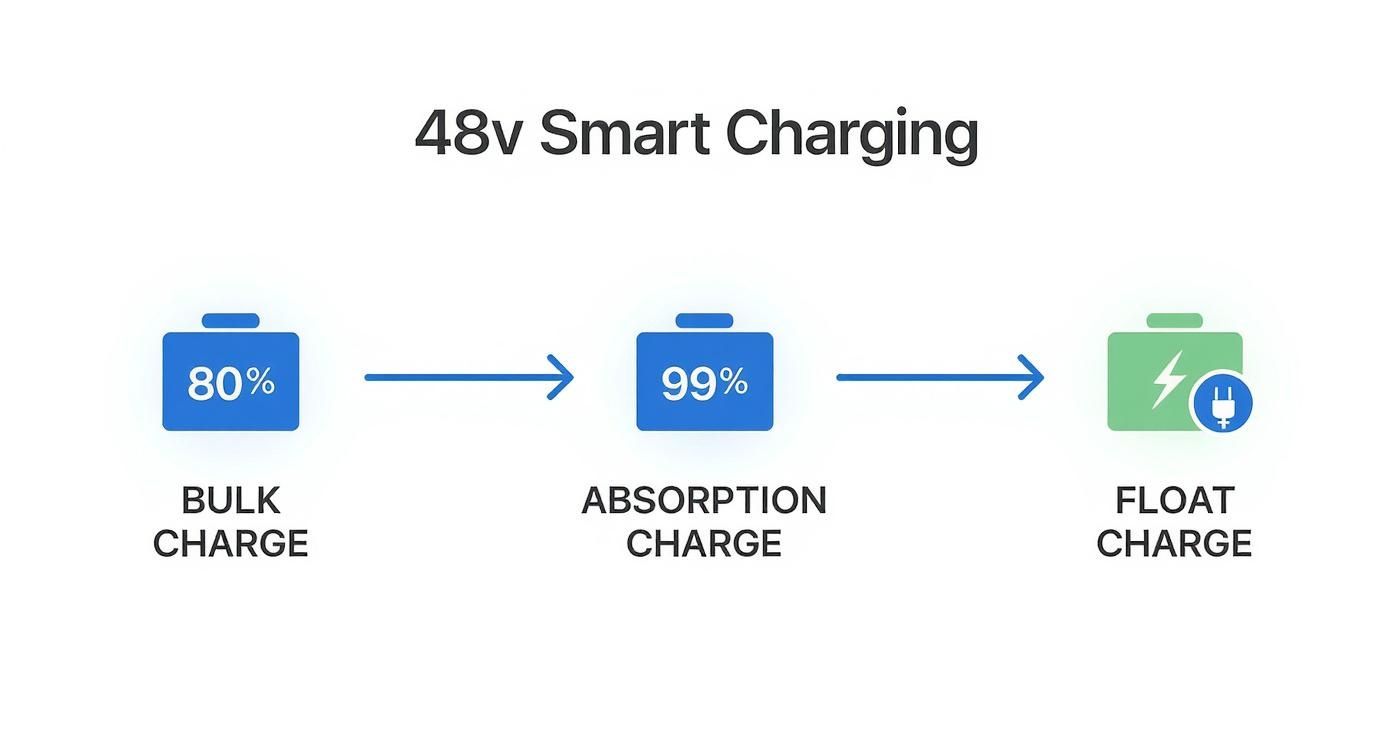
You can see how the charger intelligently tapers the power to safely top off the battery—a critical step that is handled very differently for lead-acid versus lithium.
48V Charger Compatibility Lead-Acid vs Lithium Batteries
To make it crystal clear, let's break down the key differences between chargers designed for these two battery types.
| Feature | Lead-Acid Charger | Lithium (LiFePO4) Charger |
|---|---|---|
| Charging Profile | Multi-stage with bulk, absorption, and float stages. | Constant Current/Constant Voltage (CC/CV) profile. |
| Final Stage | Ends with a continuous low-current "float" or "maintenance" charge. | Shuts off completely once the battery is fully charged. |
| BMS Communication | No communication with the battery. | May communicate with the battery's BMS for optimal charging. |
| Equalization | Often includes an equalization mode to balance cells. | Does not require an equalization mode; balancing is handled by the BMS. |
| Voltage Cut-off | Has specific voltage setpoints for lead-acid chemistry. | Has higher, precise voltage setpoints specific to LiFePO4 cells. |
The takeaway here is simple: these chargers are not interchangeable. Using the wrong one will, at best, underperform and, at worst, permanently damage your expensive batteries.
Don't Forget About Plugs and Connectors
Beyond the internal electronics, you've got to get the physical connection right. Major golf cart brands like Club Car, EZ-GO, and Yamaha have historically used their own unique, proprietary plugs. You simply can't force one plug into a different cart's receptacle.
While adapters exist and can get you out of a jam, nothing beats a charger with the correct, native plug for your cart. A loose or improper connection is a serious risk—it can cause overheating, electrical arcing, and even create a fire hazard.
The industry's big shift toward lithium batteries is pushing charger technology forward. Lithium offers a much longer lifespan and significantly faster charging, which is why it's becoming the new standard. To learn more about this incredible technology, check out our guide on the advantages of a golf cart lithium battery.
Before you buy, always double-check that your new 48V golf cart charger has the right plug for your Solana EV model. It's the final step to ensuring a safe, secure, and efficient charge every single time.
Getting to Grips with Charger Specs
Shopping for a new 48V golf cart charger can feel a bit overwhelming. You're hit with a spec sheet full of numbers and jargon, but here’s the good news: you only need to focus on a few key details that actually affect how your cart performs and how long your batteries last.
Once you know what to look for, that confusing spec sheet becomes a simple guide to picking the right charger. Let's translate that technical talk into what it means for you and your cart.
Amps = Charging Speed
If there's one number to pay attention to, it's the amperage (Amps or A). Think of it like the flow of water through a hose. A higher amp rating means more power is flowing into your batteries at once, which means they'll charge up faster. Simple as that.
Many standard chargers are around 15 amps, and for most people who just plug their cart in overnight, that’s perfectly fine. But if you use your cart heavily or need a quicker turnaround time, stepping up to a 25A model can make a huge difference. Just be sure your battery pack and its internal management system (BMS) are designed to handle that faster charge rate.
The Bottom Line: More amps mean less waiting. A 15A charger is a solid all-rounder, but a 25A model is a worthwhile upgrade for impatient owners or high-use carts.
Smart Features: The Battery's Best Friend
Today's chargers aren't just dumb boxes that pump out power. The best ones are smart devices that actively manage your battery's health, which is a huge deal for protecting your investment. You'll often see this called "multi-stage" or "smart" charging.
Here's what you absolutely want to see:
- Automatic Shut-Off: This is a must-have, no exceptions. Once your batteries are full, the charger needs to stop the main charging cycle. Pushing more power into a full battery is a surefire way to cause permanent damage.
- Float or Maintenance Mode: After the heavy lifting is done, a smart charger shifts into a gentle "float" mode. It provides just a tiny bit of power to keep the batteries topped off, fighting the natural self-discharge process. This means your cart is always 100% ready to roll without being overstressed.
Built to Survive the Garage: IP Ratings
Let's be honest, your charger is probably going to live in a garage or shed where it might get dusty, damp, or splashed. That’s where the IP rating comes into play. "IP" stands for Ingress Protection, and it’s a simple code that tells you how tough the charger's housing is.
A charger with an IP67 rating, for instance, is a real workhorse. The '6' means it’s completely sealed against dust, and the '7' means it can survive being dropped in about three feet of water for up to 30 minutes. An IP rating like this gives you confidence that a little rain or a spilled drink won't kill your charger.
Don't Skip the Safety Sticker: UL Listing
This might be the most important point of all. Always, always look for a safety certification, with the gold standard in North America being the UL (Underwriters Laboratories) listing. Seeing that little logo isn't just for show—it means the charger has been through a battery of independent tests to make sure it’s safe from electrical and fire hazards.
A UL-listed 48V golf cart charger is proven to not overheat, short-circuit, or become a fire risk during normal use. You're dealing with a lot of electricity here, so buying a certified charger is non-negotiable for protecting your cart, your garage, and your peace of mind.
Daily Charging Routines for a Longer Battery Life
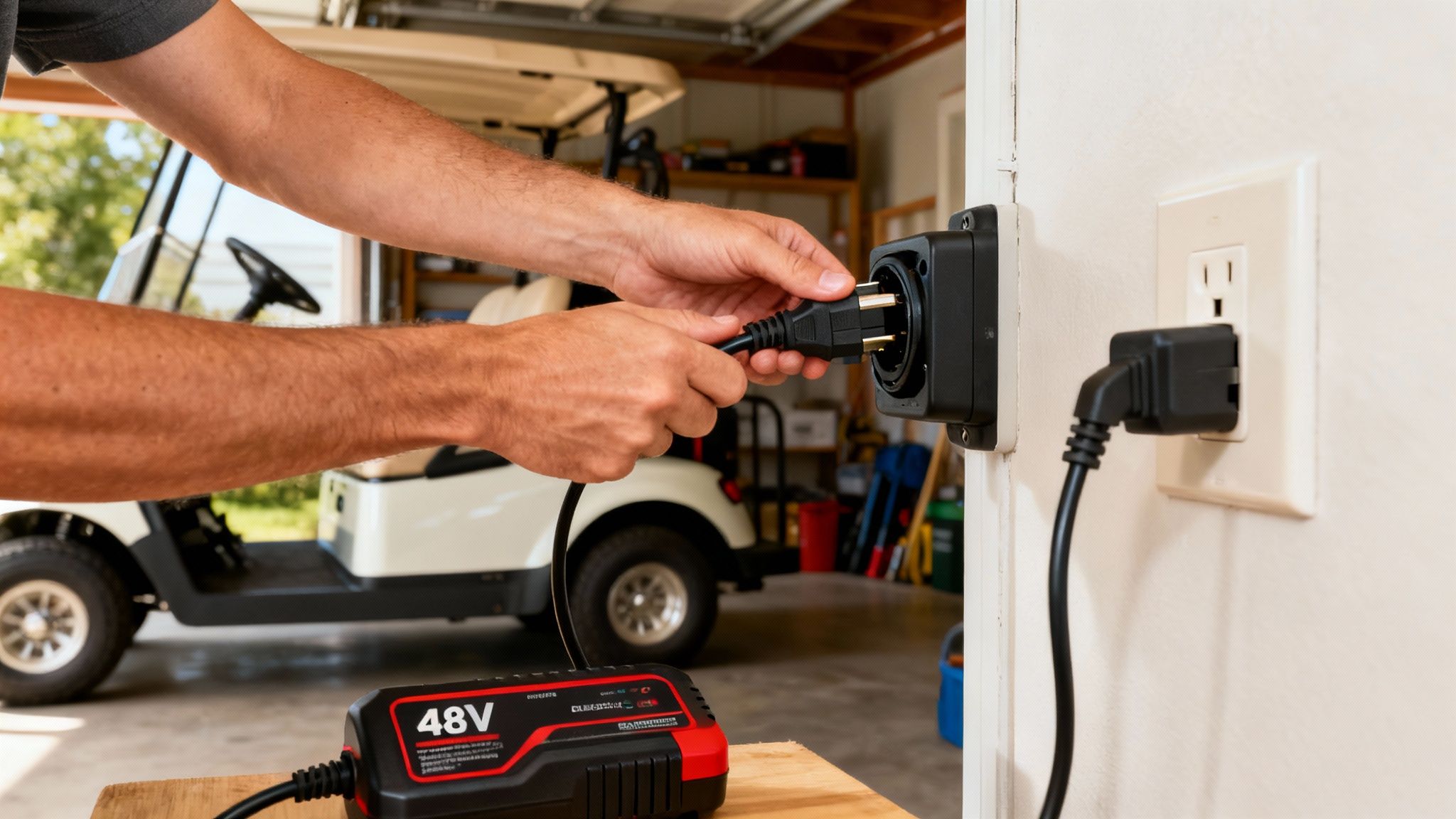
Having the best 48V golf cart charger is a great start, but it's your daily habits that truly make the difference. The real secret to getting the most out of your battery pack—and making sure your cart is always ready to go—is a consistent, correct charging routine. The good news? It’s incredibly easy to establish.
Whether you have an onboard charger bolted right onto the cart or a portable one you store in the garage, the core principles are the same. Good ventilation is non-negotiable. Chargers create heat as a byproduct of their work, and if that heat gets trapped, it can cause the unit to overheat. This not only makes it less efficient but can also shorten its lifespan. Always charge your cart in an open, dry space.
Your Daily Charging Checklist
To keep things simple, here’s a step-by-step process to follow every single time you plug in. Following this exact sequence helps protect your charger's electronics and your cart's port from electrical arcing, which can slowly chew up the connectors over time.
- Park and Prepare: First things first. Park your cart in its usual charging spot. Turn the key to the off position and set the parking brake.
- Connect to Cart First: This is the crucial part. Always plug the charger’s DC cord into the golf cart's receptacle before connecting it to the wall. Make sure it’s a snug, secure fit.
- Connect to Power Second: With the cart connected, now you can plug the charger’s AC power cord into a grounded wall outlet. You should see the charger's indicator lights kick on, signaling that the charging cycle has started.
- Let It Finish: Try to let the charger complete its full cycle whenever possible. Constantly interrupting the charge can throw off the balance of the battery cells, especially with older lead-acid batteries. Any modern smart charger will automatically shut off or switch to a maintenance "float" mode when it's done.
- Unplug Safely: Once the charge is complete, reverse the process. Unplug the AC cord from the wall outlet first, then disconnect the DC cord from your golf cart.
Adopting a consistent charging routine does more than just top off your battery; it actively preserves its health. Small, repeatable actions are the foundation for a longer battery life and a more reliable vehicle.
Simple Maintenance Habits
Beyond your daily plug-in routine, a few quick checks once a month will keep your charging system running perfectly. Take a moment to inspect the charger’s cables for any signs of fraying, cracking, or other wear and tear.
It's also a good idea to check that the plug connectors and the cart’s receptacle are clean and free of dirt, grass, or other debris. A clean connection is a good connection.
These habits have a massive impact on your battery's longevity. For a much deeper dive, our guide covers all the key factors that influence your golf cart battery lifespan. The principles of battery care are surprisingly universal, and it’s interesting to see how they compare to discussions on how long EV batteries typically last in the larger electric car market.
When your 48V golf cart charger suddenly quits, it can put a full stop to your plans. But before you start pricing out a new one or calling for service, take a breath. Most of the time, the fix is surprisingly simple, and you can sort it out yourself with a little detective work.
Let’s walk through the most common hiccups and how to get your cart charging again.
https://www.youtube.com/embed/_Cw42Fssaa8
The Charger Won't Turn On at All
You plug it in, and… nothing. No lights, no fan whirring to life. When your charger seems completely dead, the problem is almost always the power source, not the unit itself. It's a classic case of "is it plugged in?" but with a few extra steps.
- Confirm the Outlet is Live: This is the first and easiest thing to check. Unplug the charger and plug in something you know works, like a shop light or your phone. If that doesn't power up, you've found your culprit.
- Check Your Breaker Box: Head to your garage or utility room and find your main electrical panel. Look for a tripped breaker—the switch will be in the middle position or flipped to "off." Flip it back on and try again.
- Find the Hidden Fuse: Some chargers have their own internal fuse as a failsafe. It might be a small glass tube or a plastic blade-style fuse, usually accessible from the outside of the casing. Check your owner's manual to see if yours has one and, if so, how to inspect or replace it.
The Charger Lights Up, But the Cart Isn't Charging
This is one of the more frustrating problems. The charger’s lights are on, the fan is spinning, and it looks like everything is working—but your cart's battery meter isn't moving an inch. This almost always points to a communication breakdown between the charger and the cart.
First things first, unplug the charger from both the wall and the cart. Safety first.
Now, take a close look at the charging port on your golf cart. Is it packed with dirt, grass, or mud? A poor physical connection is a common reason a charge won't start. Clean out any gunk you see. While you're there, give the wires leading to the receptacle a gentle tug to make sure they're secure. A loose connection here can interrupt the signal the cart needs to initiate charging.
Often, the issue is a safety feature kicking in. Many carts have an onboard computer (OBC) that can lock out the charging process if it detects an error. A simple reset procedure (check your cart's manual for this) can often clear the fault and get the charger and cart talking to each other again.
Your Top 48V Charger Questions, Answered
Even when you feel like you've got a handle on your cart's charging system, questions always pop up. Let's tackle some of the most common ones we hear from owners, giving you quick and clear answers to keep you on the move.
Can I Use a 36V Charger on a 48V Golf Cart?
In a word: no. Think of it like trying to fill a high-pressure tire with a low-pressure pump—it just won't work. A 36V charger doesn’t produce enough voltage to push a charge into a 48V battery pack. It won't even start the charging cycle.
Always match the charger's voltage to your cart's system voltage. It's the only way to charge correctly and, more importantly, safely.
Is It Okay to Leave My Golf Cart Plugged In All The Time?
With a modern smart charger, absolutely. These aren't the "dumb" chargers of the past. Once your batteries hit 100%, a smart charger automatically switches to a "float" or "maintenance" mode.
This mode essentially puts the charger to sleep, only waking up to deliver a tiny trickle of power to keep the batteries topped off. This prevents overcharging, a major killer of expensive batteries, and ensures your cart is always ready to go when you are.
How Do I Know If My Golf Cart Charger Is Bad?
Your charger will usually give you a few warning signs before it completely gives up. Keep an eye (and an ear) out for these telltale clues:
- It’s a Brick: The charger shows no signs of life—no lights, no hum, nothing—even when plugged into a working outlet.
- Weird Noises: You hear a loud grinding from the cooling fan, or maybe the fan isn't spinning at all. A healthy charger should have a consistent, low hum when running.
- Lying Lights: The indicator lights claim the battery is fully charged almost immediately, even when you know it's nearly dead.
- Physical Damage: This is a big one. Look for frayed cables, cracked housing, or melted plastic around the plugs. Any visible damage is a major red flag.
At Solana EV, our goal is to give you the knowledge you need to enjoy every minute with your electric vehicle. To see our full line of premium street-legal carts and the advanced chargers that power them, come visit us at https://solanaev.com.