
Thinking about taking your golf cart off the course and onto neighborhood streets? It's a fantastic way to get around, but it’s not as simple as just driving off the 18th hole. To do it right—and legally—you'll need a golf cart street legal kit.
These kits are essentially a collection of parts that bring your standard cart up to the safety standards required for public roads. We're talking about essentials like headlights, taillights, turn signals, mirrors, a horn, and seat belts. Adding these components is what transforms your cart into a certified Low-Speed Vehicle (LSV).
Taking Your Golf Cart from Fairway to Roadway
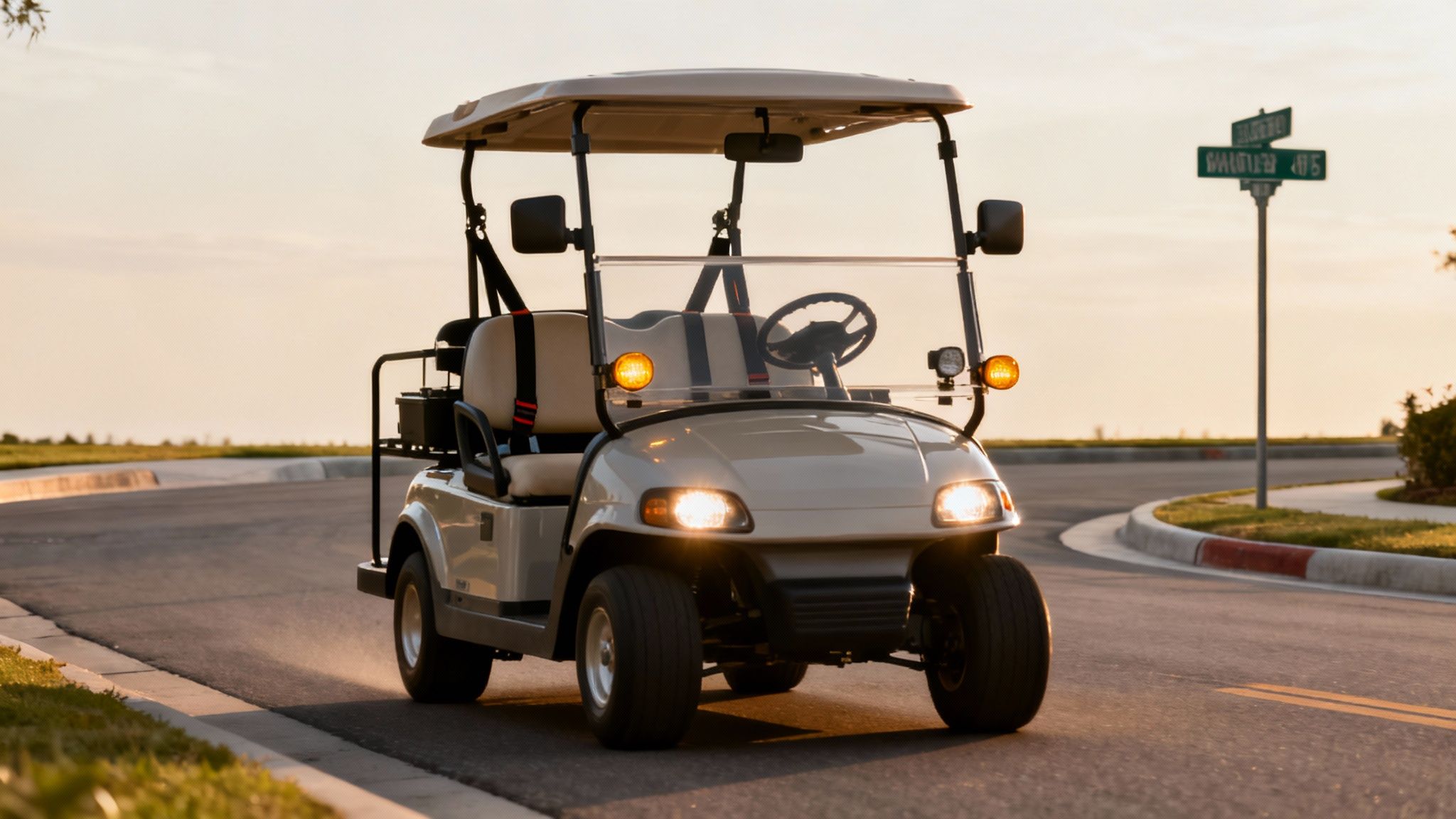
If you're ready to get more use out of your golf cart, you've come to the right place. This guide is your complete walkthrough for turning that cart into a fully compliant Low-Speed Vehicle (LSV) that's ready for local roads. I'll break down everything you need to know, from checking your local laws all the way to passing that final inspection.
This is about more than just bolting on a few lights. It's about understanding the specific safety gear that makes your cart genuinely road-ready. Consider this your personal workshop manual, filled with real-world advice to get you driving safely and with total confidence.
What Is a Low-Speed Vehicle (LSV)?
The whole point of a street legal kit is to meet the federal criteria for an LSV. An LSV is a specific vehicle classification for four-wheeled vehicles that can travel between 20-25 mph and are outfitted with mandatory safety equipment. Your typical golf cart, which tops out around 15 mph, won't qualify without some upgrades.
Every part you add serves a critical purpose. Headlights and taillights make you visible at dusk, while a DOT-approved windshield protects you from road debris. It's all about making your cart—and you—safer among regular traffic.
This trend is exploding. The global market for street-legal golf carts is on track to hit $2.45 billion by 2025, growing at about 6.1% annually. You see them everywhere now, from beach towns and master-planned communities to college campuses, all because they're a convenient and eco-friendly way to get around.
Here's a quick look at the non-negotiable parts you'll find in almost any street legal kit.
Essential Components in a Street Legal Kit
| Component | Function | Why It's Required |
|---|---|---|
| Headlights & Taillights | Provides visibility for you and other drivers, especially at night or in poor weather. | Essential for being seen by cars, trucks, and pedestrians. |
| Turn Signals | Indicates your intention to turn or change lanes, just like in a car. | A fundamental rule of the road to prevent collisions. |
| Brake Lights | Alerts drivers behind you that you are slowing down or stopping. | Prevents rear-end accidents. |
| Horn | An audible warning device to alert others of your presence. | A critical safety feature in unexpected situations. |
| Mirrors | Side and rearview mirrors give you a clear view of your surroundings. | Eliminates blind spots and improves situational awareness. |
| Seat Belts | Secures passengers in the vehicle in case of a sudden stop or impact. | A basic and often legally required safety restraint. |
| DOT-Approved Windshield | Protects occupants from wind, rain, and flying debris like rocks or insects. | Must be shatter-resistant (AS1 or AS5) to meet federal standards. |
These components form the foundation of a safe and compliant LSV conversion.
What to Expect from This Guide
We'll dive into the essential components, the tools you'll need for the job, and the practical steps to get your cart registered and titled. Whether you’re a seasoned DIYer or just weighing your options, this guide will give you the knowledge to make the right moves.
Key Takeaway: Converting your golf cart is a two-part challenge. First, you have to install all the required hardware correctly. Second, you must navigate the specific legal red tape of your state and local government.
Whether you're upgrading an old favorite or starting with a brand-new cart, understanding this process is key. And if you're in the market for a new ride, be sure to check out our deep dive on the best street legal golf carts to start your journey with a vehicle that’s already a step ahead.
Know the Rules of the Road Before You Buy
Before you spend a single dollar on a golf cart street legal kit, the most important thing you can do is get intimately familiar with your local laws. The rules for Low-Speed Vehicles (LSVs) are a real patchwork. They don't just change from state to state—they can be completely different in the next town over.
Seriously, what's totally fine in one zip code could land you a hefty ticket just a few miles down the road.
This research isn't optional. Buying a kit before you know the rules is the fastest way to waste money on parts you don't need, or worse, discover your whole project is a non-starter.
Where to Dig Up the Local Laws
Your first stop should always be your state's Department of Motor Vehicles (DMV) website. That's your source for the big-picture, state-level LSV laws. But don't stop there. City and county rules often pile on extra requirements.
When you're searching their websites, use very specific terms to find what you need:
- "Low-Speed Vehicle requirements"
- "LSV regulations [Your State/City]"
- "Golf cart on public roads"
- "Neighborhood Electric Vehicle (NEV) laws"
These searches should take you right to the official statutes. I recommend printing out a copy of these rules to use as a physical checklist. This document is your new best friend—it’s the blueprint that guarantees the kit you pick meets every single legal demand for your area.
For a general overview of what to look for, our guide on street legal golf cart requirements is a great place to start your research.
What to Look for in the Fine Print
As you dig into the regulations, you'll find they often go beyond just lights and a horn. Some places have unique rules that can really catch you by surprise, so pay close attention to anything that might not be in a standard kit.
For example, it's pretty common in coastal or rainy areas to see a requirement for windshield wipers. Others might demand a specific DOT-approved, shatter-resistant windshield, usually marked with AS1 or AS5. Before you commit to any purchase, it's crucial to thoroughly understand local driving laws and regulations. You can even gain a broader perspective by looking at established standards, like some UK driving laws and safety protocols, to see how seriously safety is taken elsewhere.
Pro Tip: Keep an eye out for road restrictions. Many towns only allow LSVs on streets with a speed limit of 35 mph or less. Some communities even have "golf cart friendly" zones, and driving outside them is a no-go.
Once you have this legal checklist ironed out, you can start shopping for a golf cart street legal kit with total confidence.
Picking the Right Kit for Your Cart and Your Town
With your checklist ready, it’s time to find a kit that ticks all the boxes. Kits usually come in two flavors: universal and model-specific.
-
Universal Kits: These are the one-size-fits-most option. They're often cheaper, but be prepared for some improvisation. You might have to get a little creative with the wiring or mounting to get everything looking clean.
-
Model-Specific Kits: Built for popular carts like the Club Car DS, E-Z-GO TXT, or Yamaha Drive, these kits are the premium choice. They cost a bit more, but you're paying for a seamless, factory-style installation where every wire and bracket is made to fit perfectly.
The decision really boils down to your budget versus how much work you want to do. If you're comfortable with a bit of DIY problem-solving, a universal kit is a great way to save a few bucks. But if you want a straightforward, frustration-free install, a model-specific kit is almost always worth the extra cash.
Getting Your Tools and Cart Ready
Before you even think about touching a wire, let's talk about prep work. I've seen more installations go sideways from a messy workspace or a missing tool than from any complex wiring problem. Taking a little time now to get organized will make the whole project go smoother and save you a ton of frustration later.
Think of it this way: spending 30 minutes on prep can easily save you hours of hunting for the right socket or trying to clean grime off a spot where you need to mount a bracket. This is the difference between a clean, professional-looking upgrade and one that feels thrown together. Let's get everything lined up so this installation is a breeze.
Your Must-Have Tool List
You don't need a full-blown auto shop, but there are a few tools that are absolutely non-negotiable for this job. Most of what you'll be doing involves basic hand tools, so make sure you've got these ready to go.
Here's the essential checklist:
- Socket and Wrench Set: You'll be using this for just about everything—mounting lights, securing mirrors, and attaching brackets. A standard set will do the trick.
- Drill and a Good Set of Bits: This is for drilling clean mounting holes for your lights and horn, and for routing wires neatly through body panels.
- Wire Strippers & Crimpers: Don't skimp here. These are critical for making solid, reliable electrical connections. Bad connections are the #1 reason for electrical gremlins down the road.
- Screwdrivers: A decent set of both Phillips and flathead screwdrivers is a must for accessing panels and securing various components.
- Electrical Tape: Good for wrapping up connections to keep them safe from vibration and moisture.
Now, for my pro tip: get a multimeter. It's your secret weapon for any electrical project. It takes the guesswork out of troubleshooting by letting you see exactly where you have power and where you don't. A light that won’t turn on goes from a major headache to a simple diagnostic check with this one tool.
Prepping the Patient: Your Golf Cart
With your tools laid out, it's time to get the cart itself ready for surgery. A clean cart isn't just about looks; it's about safety and making sure you can see what you're doing.
Safety First: Kill the Power!
This is the most important step. Before you do anything else, disconnect the main battery pack. On an electric cart, flip the tow/run switch to "Tow" and then disconnect the main negative battery terminal. This single action prevents electrical shorts that can fry your new kit or, far worse, cause a nasty shock.
Once the power is off, give the cart a good cleaning. You can't work on what you can't see. Mud and dirt can hide perfect mounting spots or, more importantly, existing wiring problems. Focus on the areas where you'll be working: under the dash, inside the front cowl, and around the rear body panels.
Map Out Your Component Layout
Alright, this is where you put on your strategist hat. Don't just grab the drill and start making holes. Spend a few minutes mapping out where everything will go. Temporarily place each component to see how it looks and feels.
- Mirrors: Hop in the driver's seat. Have a friend hold the side mirrors in a few different spots on the roof supports. Find the position that gives you a clear view behind you without creating a new blind spot.
- Turn Signal Switch: This needs to feel natural. Position it on the steering column where you can flick it on and off without taking your hand too far from the wheel, just like in your car.
- Horn Button: Find a spot on the dash that's easy to reach in a hurry but doesn't get in the way of your key or other controls.
Last but not least, give your cart's existing wiring a quick once-over. Are there any frayed wires or corroded-looking connections? Spotting these potential failure points now will save you from chasing down a mystery electrical issue after you’ve already installed the entire kit. A little bit of planning here ensures every part works perfectly and gives you that clean, factory-installed look.
Getting Your Hands Dirty: Installing the Street Legal Kit
Alright, this is where the fun really starts. You've got your kit and your tools, and your cart is prepped. Now it's time to get down to the business of transforming your golf cart. We'll walk through this one piece at a time, focusing on the little details that make for a clean, professional-looking install and help you sidestep those common, frustrating mistakes.
Everything hinges on the wiring harness. I always think of it as the central nervous system for all your new components. If you get this part right, everything else falls into place much more easily.
Before you touch a single wire, though, a little prep work goes a long way. This quick overview lays out the simple but essential first steps to take.
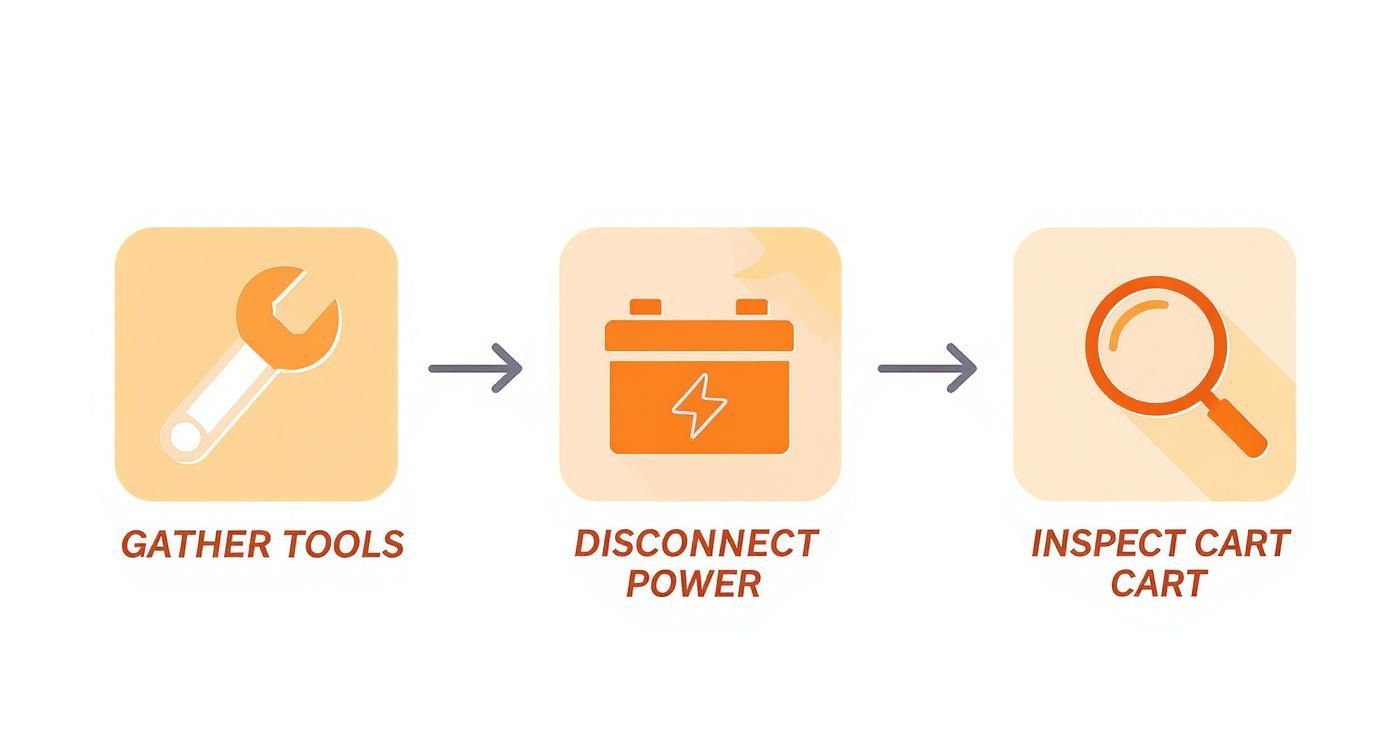
Following this workflow is your best insurance against electrical hiccups and other surprises once you're deep into the project.
Running the Wiring Harness and Voltage Reducer
Your kit's wiring harness is the backbone of this whole operation. The key here is to route it cleanly and keep it protected. I suggest starting at the front of the cart and patiently working your way to the back. Lay the harness out first to get a feel for where each connection goes—headlights, taillights, signals, and horn.
As you run the wires, tuck them neatly along the cart's frame and use zip ties every foot or so to keep everything secure. Make sure to steer clear of any moving parts, especially around the suspension and steering column. You also want to avoid sharp metal edges that could rub through the wire's insulation over time and cause a short.
If you're working on an electric cart, the voltage reducer isn't optional—it's essential. Your battery pack is putting out a hefty 36V or 48V, but all your new lights and accessories are designed for a standard 12V system. Connecting them directly would fry them in an instant.
The reducer's job is to "step down" that power to a safe level. I usually find a dry, secure spot to mount it, like under the front cowl or beneath the driver's seat. Connect the reducer's input side to your main battery pack and its output side to your new harness or fuse block. This ensures every new component gets the clean, stable power it needs to work properly.
Mounting the Hardware for a Factory Finish
With the wiring in place, it’s time to start mounting the actual components. A little bit of patience here really pays off, giving you a final look that seems like it rolled right off the factory line.
Headlights and Taillights
Most kits provide paper templates to help you cut the holes for the lights. My advice? Tape the template securely to the body, then measure it twice (or even three times!) before you cut. A drill with a hole saw or a small rotary tool works best.
Pro Tip: When drilling into a fiberglass or plastic body, start by running your drill in reverse for a few seconds. This scores the surface and stops the drill bit from "walking," which is a great way to prevent ugly cracks or chips in your cart's finish.
Once the holes are cut, you can feed the wiring through and gently mount the light assemblies. Get them snug, but be careful not to overtighten the screws—it's surprisingly easy to crack the plastic housing.
Turn Signal and Horn Assembly
The turn signal switch almost always clamps right onto the steering column. Sit in the driver's seat and find the spot that feels most natural to reach without moving your hand too far from the wheel. The horn is even simpler, usually just a single bolt. Find a solid piece of the frame behind the front cowl to mount it, keeping it shielded from mud and water.
Mirrors and Windshield
Mirrors are a non-negotiable safety item. Mount the side mirrors on the front roof supports and have a friend sit in the cart to help you adjust them to eliminate any blind spots before you drill the final holes. A DOT-approved windshield will typically bolt directly to those same roof supports, giving you a solid, rattle-free fit.
Installing Safety Restraints
Last but not least are the seat belts—an absolute must for any vehicle on the road. The lap belts included in most kits are pretty straightforward. You'll usually need to drill through the floor or seat frame to securely install the anchor points. For a deeper dive, our guide on golf cart seat belt installation covers different belt styles and mounting tips in more detail.
Properly installed seat belts, along with all the other components, are what truly make your cart roadworthy. This is especially relevant as electric carts become more advanced. Globally, electric golf carts represent a dominant market share of about 54.7%, fueled by innovations like lithium-ion batteries and integrated tech. As these carts get faster and more capable, robust safety features become even more important.
Passing Inspection and Handling Paperwork
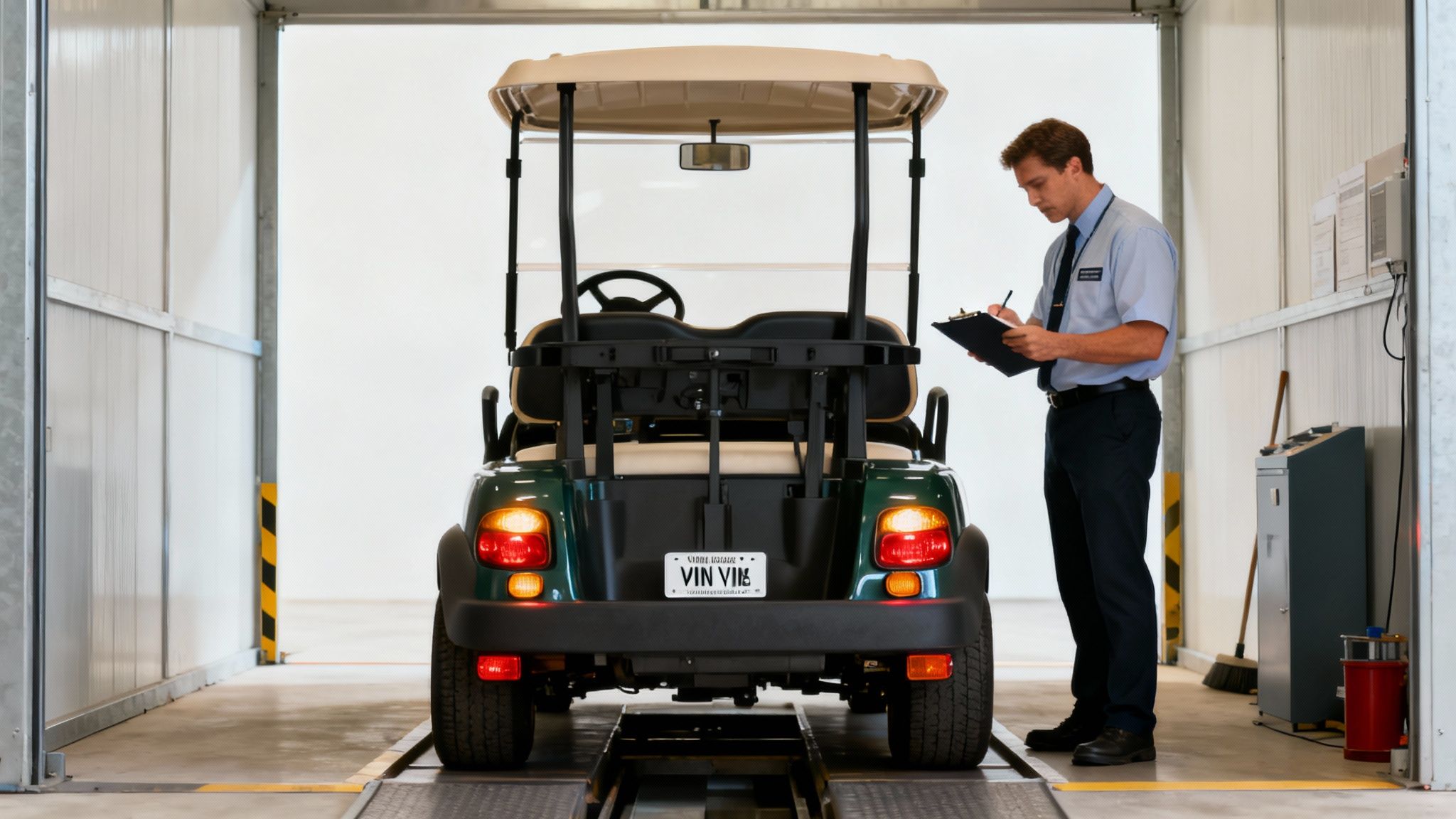
With your golf cart street legal kit installed, you're on the home stretch. The hard part—all that wiring and component mounting—is behind you. But don't pop the champagne just yet. Now comes the bureaucratic finale: transforming your cart from a neighborhood cruiser into a registered Low-Speed Vehicle (LSV).
This last phase is all about inspections and paperwork. It can feel a bit tedious, I know, but getting these final details right is what gets you a license plate, a title, and the peace of mind that you're 100% compliant. This is where your project officially becomes street-legal.
Scheduling and Preparing for Your LSV Inspection
First up, you'll need a state-certified LSV inspection. Your best bet is to call your local DMV or an authorized inspection station to get an appointment on the books. When you call, make sure you specifically mention it's for a newly converted LSV, as their checklist is a little different from a standard car inspection.
Preparation is everything here. Trust me, walking into the DMV with a neat folder of documents shows the inspector you’re serious and have done your homework. It just makes the whole process smoother.
Here's what I recommend having ready to go in a folder:
- Manufacturer's Certificate of Origin (MCO): This is basically your cart's birth certificate. If you can't find it, you'll need to contact the manufacturer for a duplicate.
- Receipts for Your Kit: Keep the receipts for your golf cart street legal kit and any other major parts. This proves you’ve used new, compliant equipment.
- Completed Application Forms: Your local DMV will have specific forms for titling and registering an LSV. Fill these out completely and accurately before you go.
Try to see it from the inspector's perspective. They’re just running down a checklist to make sure your cart is safe for public roads. Don't give them an easy reason to send you home.
The Pre-Inspection Checklist
Before you head to your official appointment, do your own inspection. I can't tell you how many times I've seen a cart fail for a simple, preventable issue. Running through this list can help you catch a loose wire or a burned-out bulb that would otherwise mean a second trip to the DMV.
- Test All Lights: Cycle through everything. Check your headlights (both high and low beams), taillights, brake lights, and all four turn signals. It helps to have a friend stand outside to confirm they all light up as they should.
- Verify the Horn: Is it loud enough to be heard over road noise? A weak, muffled horn is a classic failure point.
- Check Your Mirrors: Make sure the side mirrors and rearview mirror are mounted securely and give you a clear view behind you. No wobbling!
- Confirm Windshield Integrity: If your state requires a DOT-approved windshield, look for the AS1 or AS5 stamp. Give it a once-over for any cracks or large chips.
- Inspect Seat Belts: Buckle and unbuckle every single seat belt. The mechanisms need to work smoothly, and the belts must be anchored solidly to the cart's frame.
A common oversight is the parking brake. Test it on a slight incline to make sure it holds the cart firmly in place. An inspector will almost certainly check this.
Securing a VIN and Insurance
If your golf cart doesn't already have a 17-digit Vehicle Identification Number (VIN), you'll almost certainly need one assigned by the state. This is a non-negotiable step; the VIN is what allows the vehicle to be titled and registered. The DMV will walk you through how to apply for a state-issued VIN plate and where to affix it.
Once your cart has a VIN and passes inspection, the last piece of the puzzle is insurance. A standard auto or homeowner's policy won't cut it—you need a specific LSV policy. It must provide liability coverage that meets your state's minimum requirements for motor vehicles.
This is a critical detail, especially with more and more of these carts on the road. The electric golf cart market in the U.S. was valued at around $529.4 million in 2024 and is only getting bigger. Yet, as you can find in more detail from these U.S. Electric Golf Cart Market growth insights on GlobeNewswire, the state-by-state rules remain a real challenge for owners.
That's why having all your paperwork in order is so important. With your title, registration, and proof of insurance finally in hand, you're ready to hit the road. Legally.
Common Questions We Get About Street Legal Kits
As you get ready to tackle this project, you’re bound to have questions. You're not just bolting on a few parts; you're dealing with electrical systems, mechanical work, and a bit of state law. To help you get ahead of the curve, we’ve rounded up the most common questions people ask when installing a golf cart street legal kit.
Think of this as your project FAQ. Getting these answers sorted out now will save you a ton of hassle down the road and let you move forward with confidence. We'll cover everything from how much this will set you back to the finer points that separate a true LSV from a golf cart with a few extra lights.
How Much Does a Golf Cart Street Legal Kit Cost?
This is usually the first thing people ask, and the honest answer is: it depends. The final price tag is a mix of the kit you choose and whether you're paying for professional installation or doing it yourself.
A basic, universal golf cart street legal kit is the most wallet-friendly route. These kits usually have the bare essentials—lights, a horn, and mirrors—and typically run from $150 to $300. They're a solid choice if you're handy and don't mind a bit of custom fitting.
If you're after a clean, factory-like finish, a model-specific kit for a Club Car, E-Z-GO, or Yamaha is the way to go. They’re designed to fit your cart perfectly and often come with extras like a speedometer, better seat belts, or a DOT-stamped windshield. You can expect to pay anywhere from $400 to $800 for one of these.
A Quick Budget Breakdown:
- Basic Kit: $150 – $300
- Model-Specific Kit: $400 – $800+
- The Must-Have Add-on (Voltage Reducer): $30 – $60
- Professional Labor (Optional): $200 – $500
- DMV & Registration Fees: $50 – $150
All said and done, a full DIY conversion can range from $200 to over $1,000, depending on how high-end you go with your parts.
Can I Install a Street Legal Kit Myself?
For most people, yes! The majority of kits are designed for the DIYer. If you've got some basic experience with tools and wiring, you can definitely make this a weekend project.
Got a drill, a socket set, and a pair of wire strippers? You've got the essentials covered. The instructions that come with most kits are surprisingly good, walking you through where to mount everything and how to run the wires.
The part that gives people the most trouble is usually the wiring—specifically, hooking up the voltage reducer and tapping into the right power source. My advice? Take your time and follow the diagrams to the letter. But if you’re looking at a wiring harness and feeling totally lost, there's no shame in calling a pro. It’s far better to pay an expert a couple hundred bucks than to risk frying your cart's controller, which can be a very expensive mistake.
What’s the Difference Between a “Street Legal” Cart and an LSV?
You'll hear people use these terms interchangeably, but they mean very different things, especially in the eyes of the law. "Low-Speed Vehicle" (LSV) is a specific federal classification, and it comes with a strict rulebook.
Here’s the simplest way to think about it:
- A "Street Legal" Cart is often just a local term. It might mean a cart that has the bare minimum gear—like headlights and a slow-moving vehicle triangle—to be driven within a specific private community or on designated town roads.
- A true LSV is a vehicle that meets all federal and state safety standards. The big one is that it has to be capable of speeds between 20-25 mph. It also needs a 17-digit VIN, just like a car.
To be registered as a legitimate LSV, your cart must be equipped with:
- Headlights, taillights, and brake lights
- Turn signals
- Side and rearview mirrors
- A parking brake
- A DOT-approved windshield (not just any piece of plexiglass)
- Seat belts for every passenger
- A Vehicle Identification Number (VIN)
Just sticking a light kit on your cart doesn't make it an LSV. It has to check every single box on that list to be properly registered and legally driven on public roads where speed limits are 35 mph or less.
Do I Really Need a Voltage Reducer for My Electric Cart?
One hundred percent, yes. For any 36V or 48V electric cart, this is a non-negotiable part. Think of a voltage reducer as cheap insurance for all the new electronics you're adding.
Your cart's battery pack pushes out a lot of voltage—way more than your new lights, horn, or turn signals can handle. Those accessories are all built to run on a standard 12V system, just like in a car.
If you connect a 12V headlight directly to a 48V battery, it won't just flicker—it will instantly fry. A voltage reducer is a small transformer that takes that high voltage from your main battery pack and "steps it down" to a safe, steady 12V. It protects your new gear from getting burned out and ensures everything works reliably. Skipping this is easily the most common and costly mistake people make.
Ready to start your own street-legal journey with a vehicle built for performance and style? Explore the full range of premium LSVs and custom options at Solana EV. Discover the perfect ride for your community today at https://solanaev.com.