
That sinking feeling when you turn the key and get nothing but silence is a common frustration for golf cart owners. Before you assume the worst, remember that the most frequent culprits are often the easiest to fix.
You don't need to be a seasoned mechanic to run through the initial diagnostic steps. This initial check-up is designed to help you quickly identify the low-hanging fruit of golf cart problems.
This simple decision tree illustrates the first three questions you should ask when your golf cart won't start.
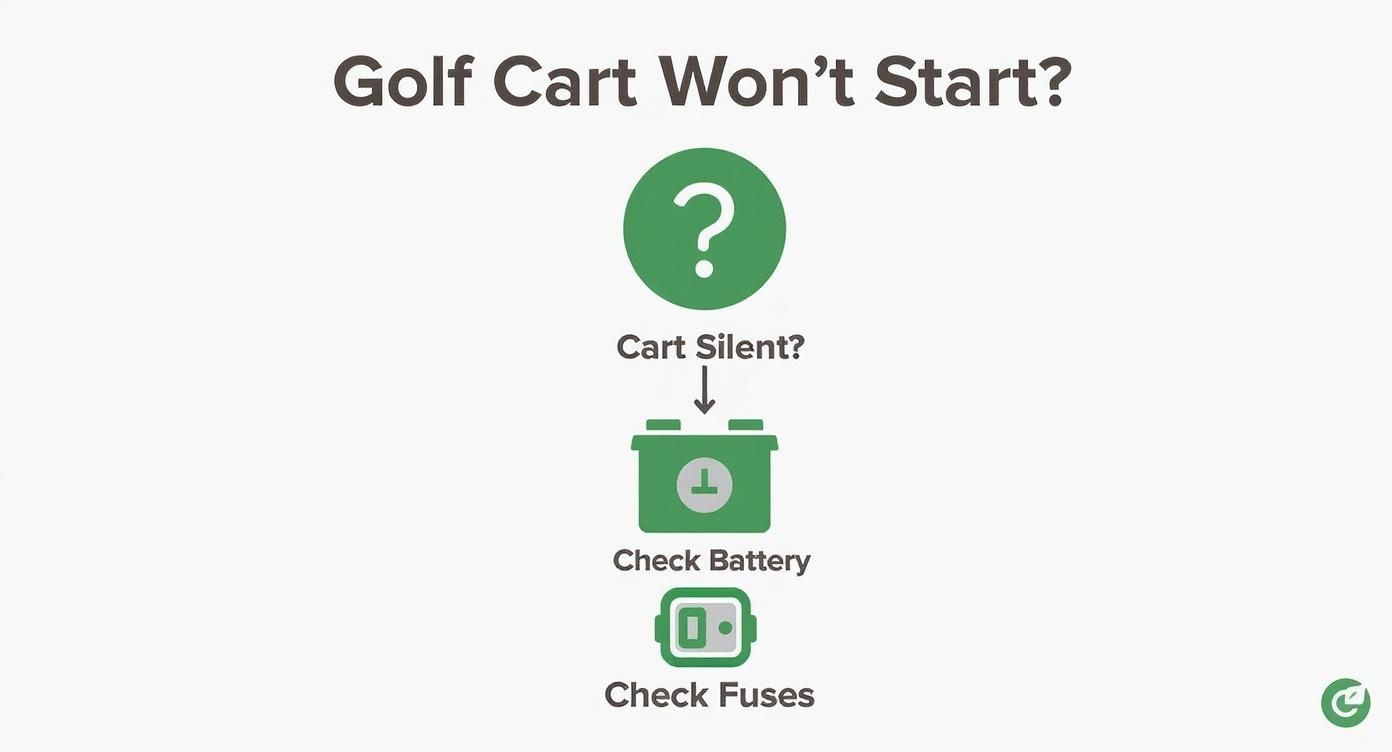
As the chart shows, your diagnostic path begins with the battery, then moves to fuses—both simple but critical components.
Start With The Basics
Your cart’s battery is the heart of its system, so it’s naturally the primary suspect in most starting failures. This is especially true for electric golf carts, which now make up over 70% of the market in places like the United States. In my experience, up to 60% of reported golf cart failures trace back to battery-related issues, from dead cells to something as simple as low water levels.
Before you start pulling out tools, let's run through a quick mental checklist:
- Key and Directional Switch: Is the key turned all the way to "On"? Is the Forward/Reverse switch clicked firmly into place? You'd be surprised how often a switch that's not fully engaged is the entire problem.
- TOW/RUN Switch: Pop the seat and find the TOW/RUN switch. If it's in "TOW," the cart is disabled for maintenance or transport. Flip it back to "RUN."
- Charger Disconnected: Nearly all modern carts have a safety interlock that prevents them from driving while plugged in. Make sure the charger is completely unplugged from the cart.
Pro Tip: Don’t be fooled if your lights or horn work. These accessories require very little power compared to what it takes to get the motor spinning. A battery can easily have enough juice to power the lights but lack the voltage needed to activate the solenoid and get the cart moving.
Check Obvious Mechanical And Safety Interlocks
Beyond the main switches, a few other interlocks can keep a cart from starting. Check that the parking brake is fully disengaged. Some models have a safety feature that won't allow the cart to move if the brake is even partially set. For a more detailed walkthrough, you can review our complete guide on how to start a golf cart properly to ensure no basic step is missed.
Next, give the accelerator pedal a listen. When you press it, you should hear a faint "click." That click is the solenoid engaging, and it’s a good sign that power is flowing from the ignition to that component.
If you hear nothing at all, your problem is likely earlier in the electrical chain—the battery, a fuse, or the ignition switch itself. If you do hear the click but the cart doesn't move, the issue lies elsewhere, possibly with the motor or controller.
To help you narrow things down even further, here's a quick reference table.
Quick Diagnostic Checklist
Use this table to quickly identify symptoms, likely causes, and the first action you should take to diagnose your golf cart's starting issue.
| Symptom | Potential Cause | What to Check First |
|---|---|---|
| Complete silence, no lights | Dead battery or loose main connection | Check battery terminal connections for tightness and corrosion. |
| Lights/horn work, but no movement | Low battery voltage or faulty solenoid | Use a voltmeter to test the battery pack's total voltage. |
| Hears a "click" but no movement | Bad motor, controller, or solenoid | Confirm the click is coming from the solenoid. |
| No "click" and no movement | Faulty microswitch, key switch, or fuse | Check the fuse and listen for the microswitch under the floorboard. |
| Cart jerks or stutters | Intermittent connection or failing controller | Inspect all high-amperage cables for damage or looseness. |
This table should give you a solid starting point for troubleshooting before you have to break out the heavy-duty tools.
Diagnosing Electric Golf Cart Battery Issues
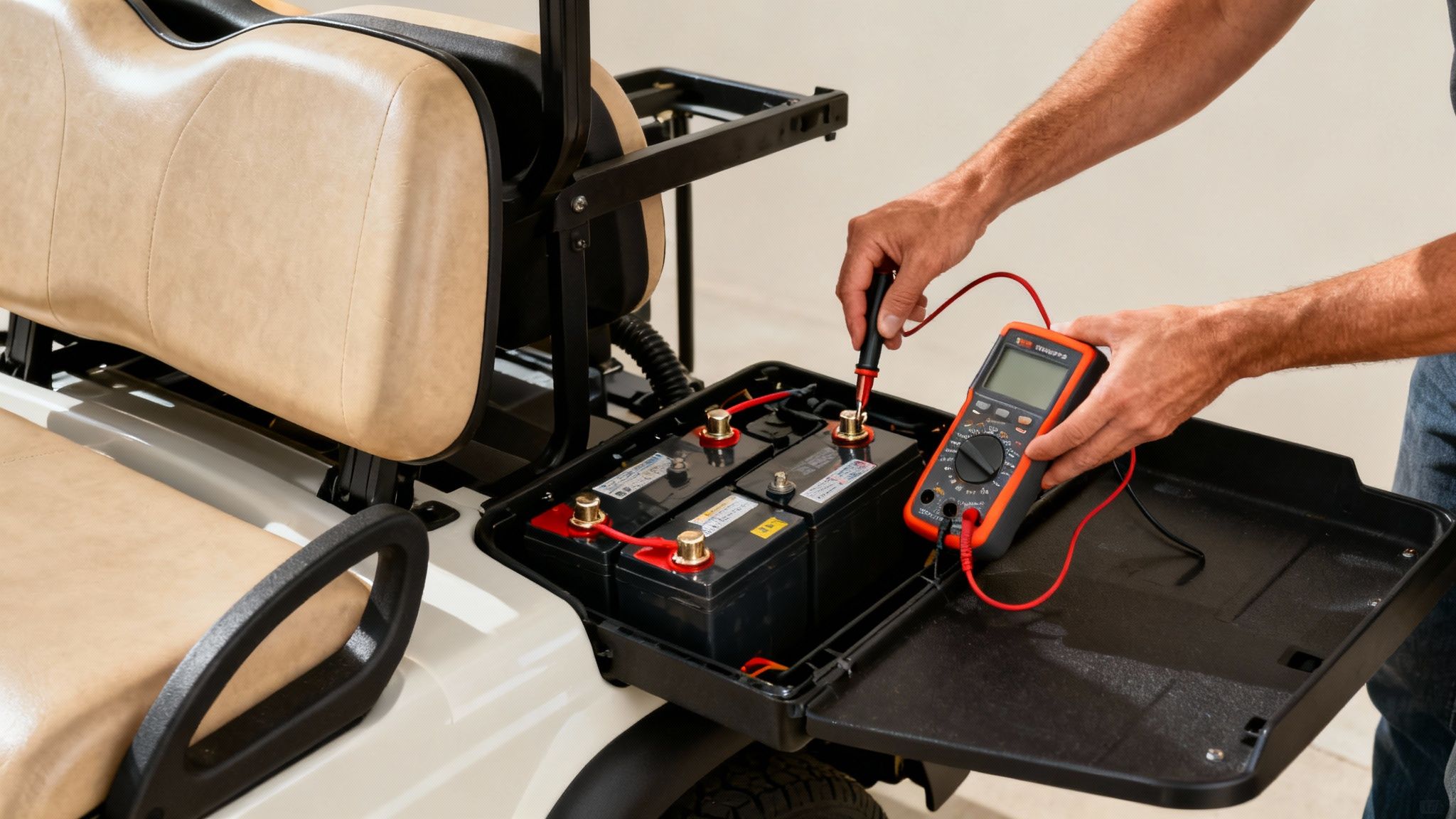
So, your electric golf cart is dead in the water. Nine times out of ten, the problem lies somewhere in the battery pack. It’s the heart of your entire system, and if it's not happy, nothing else is going to work. This is always the first place I tell people to look.
Before you even think about grabbing a wrench or multimeter, just pop the seat and take a good look around. A quick visual scan can often tell you everything you need to know without getting your hands dirty.
The Visual Inspection
Start by just looking at each battery and its connections. You’re hunting for the obvious signs of trouble—the kind of stuff that screams "problem here!" even if you're not a seasoned mechanic.
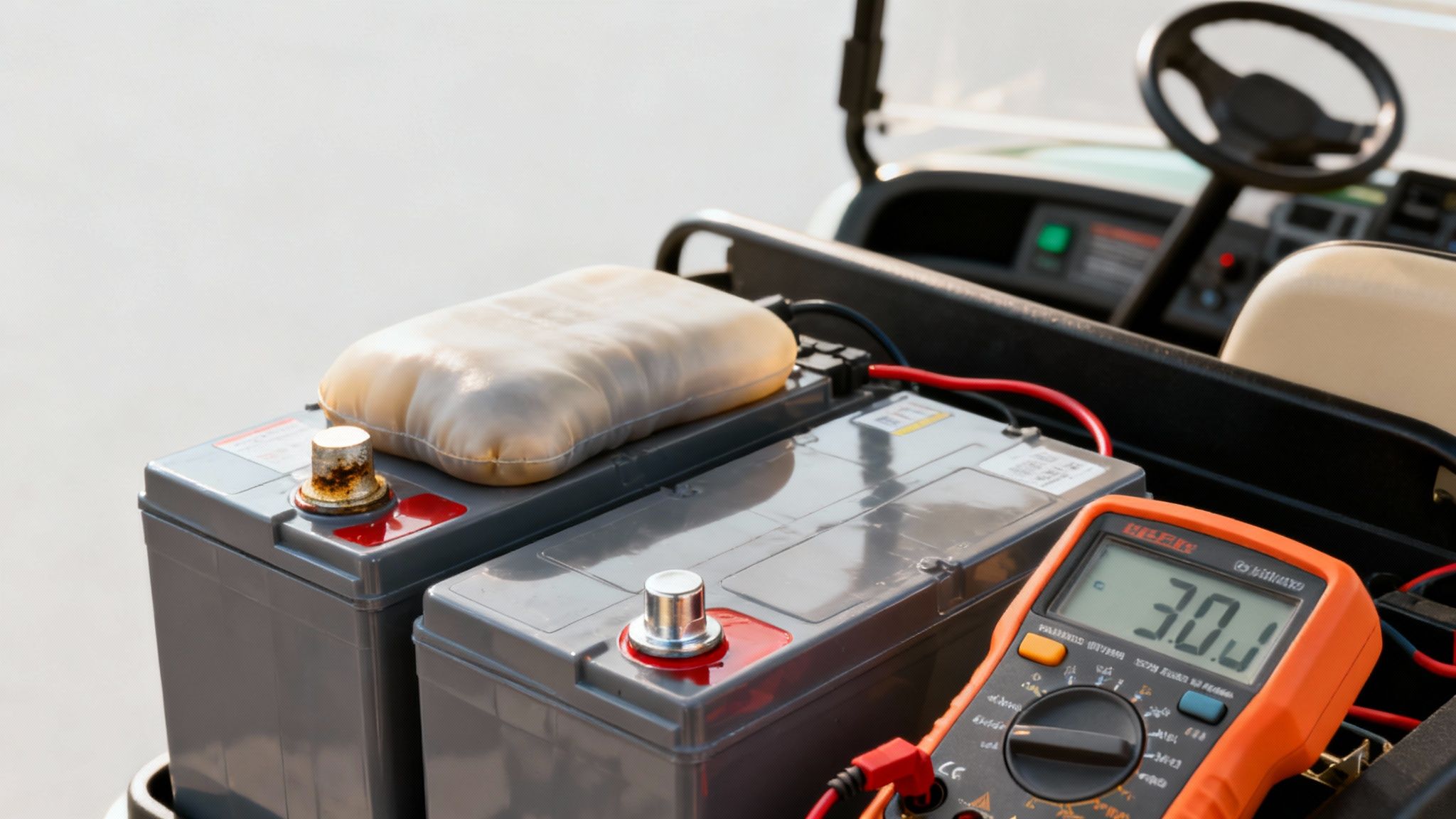
- Corrosion Buildup: Do you see a crusty, white, or greenish-blue powder caked onto the battery terminals? That’s corrosion, and it’s a notorious power-killer. It acts like insulation, stopping the electricity from flowing where it needs to go.
- Swollen or Cracked Cases: Look at the plastic housing of each battery. If the sides are bulging out or you see any cracks, that's a major red flag. It points to internal damage from things like overcharging or just plain old age. A swollen battery is a safety risk and needs to be replaced, no questions asked.
- Loose Connections: Give each cable connected to a terminal a gentle wiggle. If anything feels loose, you may have found your issue. A wobbly connection can cut off power completely, even if the batteries themselves are perfectly charged.
I've seen it a hundred times: someone assumes their cart is good to go just because it was plugged in all night. But a bad charger—or even just one failing battery in the series—can keep the whole pack from charging properly.
Learning the visual signs your battery needs replacement is a game-changer. That link is for car batteries, but the principles are exactly the same. A busted battery looks the same no matter what vehicle it's in.
Testing Voltage with a Multimeter
If a visual once-over doesn't turn up any smoking guns, it's time to dig a little deeper with a multimeter. This is a must-have tool for any cart owner. Switch it over to the "DC Volts" setting to get an accurate reading on your batteries.
First, check the voltage of the entire pack at once. For a typical 48-volt system, a full charge should give you a reading of 50.9 volts or higher. If you’re seeing a number below 48 volts, the pack is too drained to get the cart moving.
Now, let's get granular and test each battery individually. Touch the red probe to the positive (+) terminal and the black probe to the negative (-) terminal of a single battery. A healthy 6-volt battery should read about 6.3 volts when fully charged.
If you test five batteries and they're all reading over 6 volts, but one is sitting at 4.5 volts, you've almost certainly found your weak link. A single bad battery can cripple the performance of the entire pack and stop your cart in its tracks.
Just remember, these tests are only accurate if you start with what you think is a full charge. For more on that, you can check out our guide on properly charging golf carts. It’s crucial to make sure you’re not mistaking a charging problem for a battery failure.
Looking at the Bigger Electrical Picture
So, you've confirmed your battery pack is fully juiced and the connections are spotless, but the cart is still dead in the water. What now? This usually means the problem isn't a lack of power, but a failure to deliver that power to the motor. It’s time to move past the batteries and start playing detective with the rest of the electrical system.
Don't worry, you don't need to be an electrical engineer for this. A little patience and a keen eye will help you track down most common faults. We'll begin with the part that makes that satisfying "click" when you hit the go-pedal.
The Solenoid: Is It Clicking?
Think of the solenoid as a heavy-duty gatekeeper. When you press the accelerator, it gets a small signal to open the gate, letting the full flood of battery power rush to the motor. If that gatekeeper is asleep on the job (or broken), the power goes nowhere, and neither do you.
The easiest way to check it is the classic "click test." Find a quiet spot, turn the key to ON, shift into Forward, and press the accelerator. Listen carefully.
- You hear a solid click: Great! That tells you the signal is making it from the key switch, through the pedal, and to the solenoid. The problem is likely further down the line. It could be that the solenoid's main contacts are shot, or the issue is with the motor controller or the motor itself.
- You hear nothing at all: Silence is a big clue. No click means the solenoid isn't getting the signal to activate in the first place. Your prime suspects are a bad ignition switch, a faulty microswitch under the floorboard, or a simple break in the wiring connecting them.
A dead solenoid is one of the most common reasons a golf cart won’t move. I've seen countless cases where the lights work perfectly but the motor is completely unresponsive, and it almost always points back to a bad solenoid or just enough of a voltage drop to prevent it from engaging. Even if your batteries seem okay, internal corrosion or a broken coil inside the solenoid can stop it cold. If you're dealing with this specific scenario, you can dig deeper into troubleshooting when the lights work but the cart doesn't.
Checking Fuses and the Ignition Switch
Before you dive into replacing bigger parts, always check the simple stuff first. Your cart has at least one main fuse, and often a few smaller ones for lights and accessories. They are the built-in sacrificial lambs of your electrical system, designed to blow and prevent a power surge from frying more expensive components.
Find the main fuse—it's usually in a small plastic holder near the solenoid or the battery pack. Pull it out and hold it up to the light. If that tiny metal filament inside is broken, you've found your culprit. Just make sure you replace it with a fuse of the exact same amperage.
A Quick Word of Warning: If you pop in a new fuse and it blows instantly, stop right there. This is a dead giveaway for a short circuit. Don't just keep feeding it fuses; you need to track down the root cause of the short, or you risk toasting your controller.
The ignition switch itself is another potential point of failure. After thousands of key turns, the internal contacts can get worn or corroded. It might feel like it's working, but it's not actually completing the circuit. If you're comfortable with a multimeter, you can easily test it for continuity to see if it's doing its job.
Hunting for Bad Wires
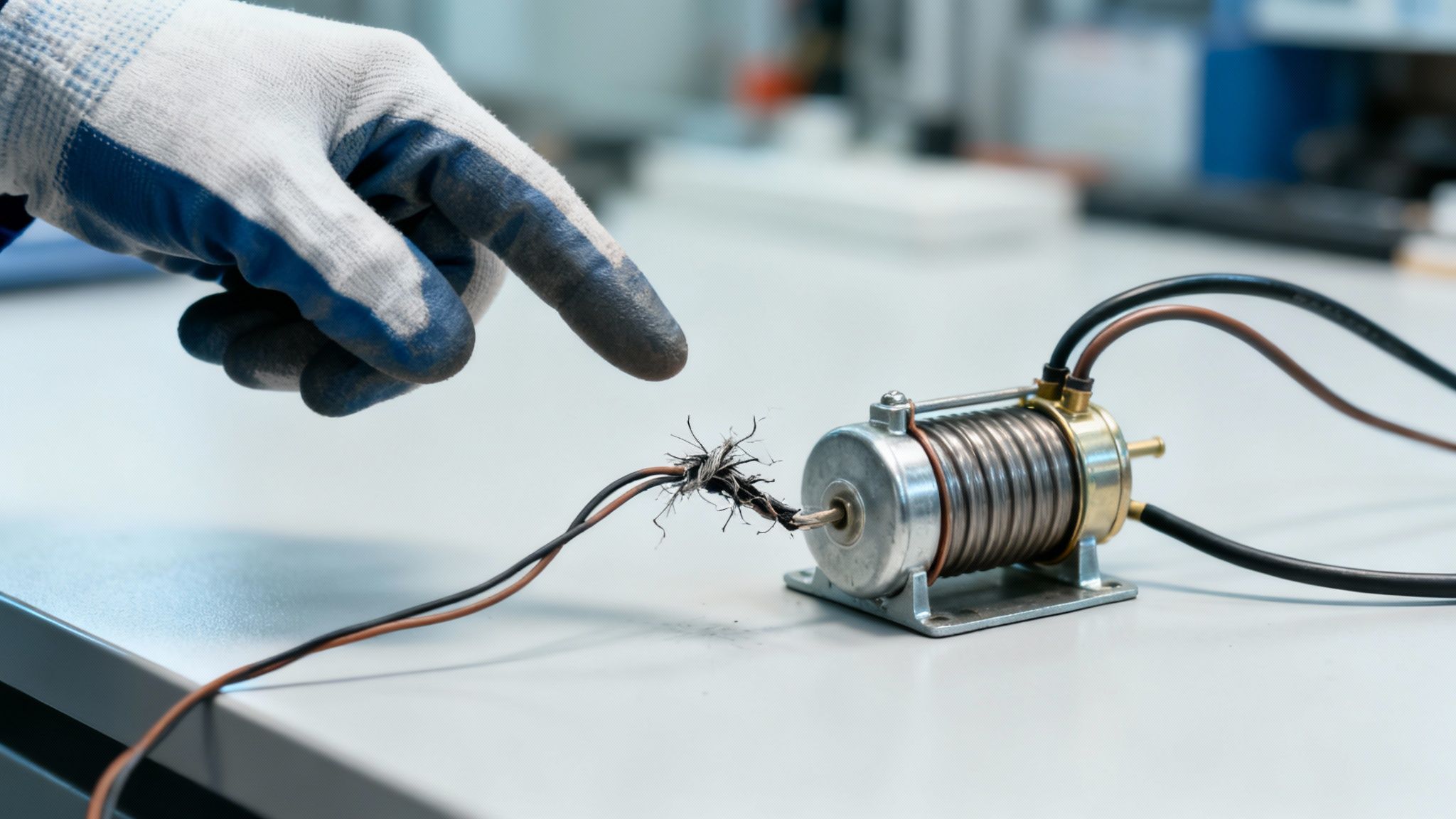
Finally, it's time to get your eyes on the wiring itself. Take a few minutes to trace all the main, thick-gauge electrical cables. You're looking for the obvious signs of trouble: frayed insulation, areas where a wire has been pinched or crushed, or spots that look melted or burnt. Pay close attention to the connection points on the motor, controller, and solenoid.
A wire can look perfectly fine from the outside but be a mess internally. Give each major cable a gentle-but-firm wiggle right at the terminal. If you feel any looseness, that's your problem. A poor connection creates resistance and heat, which is more than enough to stop your cart from starting. Get your tools out and tighten it securely.
Tackling a Gas Golf Cart That Won't Start
When your gas-powered golf cart decides not to start, the game changes. We're no longer thinking about battery packs and solenoids; now it's all about fuel, air, and spark. While the parts are different from an electric cart, the troubleshooting mindset is the same: start simple.
Don't jump straight to thinking about a major engine overhaul. In my experience, the problem is almost always something much easier to fix, usually related to the fuel. That’s the best place to start digging.
First, Look at the Fuel System
Nine times out of ten, a gas engine that won't fire up is having a fuel problem. Stale gas is the biggest offender here. The ethanol-blended fuel we use today can start going bad in as little as 30 days, losing its punch and leaving behind gummy deposits that clog up the entire system.
Pop the cap and check the tank. Does the fuel smell off, almost like varnish? Does it look cloudy or have water in it? Bad gas won't ignite properly. Contaminated fuel is a classic reason for starting issues, so addressing issues like water in the petrol tank can save you a world of trouble down the line.
If the fuel looks and smells fresh, your next stop is the fuel filter. This little part is your engine's last line of defense against debris, and it can get so clogged that it completely chokes off the fuel supply.
Pro Tip: When you swap out a fuel filter, grab a couple of small clamps and pinch the fuel lines on both sides of the old filter. It’ll stop gas from pouring out and make the job much cleaner.
Next, Check for a Spark
Alright, if you're sure the engine is getting good, clean fuel, we need to see if we're getting a spark to ignite it. That's the spark plug's job. If it's dirty, fouled, or just plain dead, you're not going anywhere.
Testing it is pretty straightforward, but you'll need a spark plug wrench.
- First, pull the spark plug wire off. Make sure you grip the rubber boot at the end, not the wire itself, or you could damage it.
- Use your wrench to unscrew the spark plug from the engine.
- Clip the plug back into the wire boot. Now, hold the metal threaded part of the spark plug firmly against a clean metal part of the engine block.
- Get a friend to turn the key and hit the gas. As they do, watch the tip of the spark plug closely.
You're looking for a strong, bright blue spark. If you see a weak, yellowish-orange spark—or no spark at all—it's time for a new plug. If a brand new spark plug doesn't fix it, the problem might be a step up the chain with the ignition coil.
Inspect the Carburetor and Starter Belt
The carburetor is where fuel and air get mixed into the perfect cocktail for combustion. Unfortunately, it hates stale fuel. Those gummy deposits I mentioned earlier can clog the tiny jets inside, starving the engine. Sometimes a quick shot of carburetor cleaner can clear things up, but for a serious clog, you'll probably have to remove it for a proper cleaning.
Finally, give the starter belt a quick look. This is the belt that connects your starter/generator to the engine, physically turning it over. If that belt is loose, frayed, or broken, the starter will just spin uselessly without cranking the engine. Check the tension—you should only be able to push it down about half an inch with firm thumb pressure.
Smart Maintenance to Prevent Future Problems
Fixing a golf cart that won't start is one thing, but making sure you never have to is a whole lot better. A little proactive care can be the difference between a reliable ride and a frustrating walk back to the clubhouse. Think of this as your game plan for keeping your cart ready for action.
The secret to a long-lasting cart isn't complicated—it's consistency. Whether you're running on gas or electric, a simple, repeatable maintenance schedule is your best defense against most common starting issues. It’s the small tasks we forget that often snowball into bigger, more expensive headaches.
For Electric Golf Cart Owners
With an electric cart, your world revolves around the battery pack. It's the heart of your machine, and it needs consistent attention. Honestly, the number one reason I see battery packs fail prematurely is simple neglect, which is completely avoidable.
Make a habit of doing a quick visual inspection at least once a month. Just pop the seat and take a look.
- Clean and Tight Terminals: Keep an eye out for that classic crusty white or blue corrosion building up. If you spot any, a simple paste of baking soda and water will clean it right off.
- Proper Water Levels: For those with traditional lead-acid batteries, the water level is everything. You want to see the water just covering the lead plates in each cell. Always use distilled water to prevent mineral buildup that can kill your batteries over time.
- Smart Charging Habits: Don't let your batteries sit dead for long stretches. Get it on the charger after you use it. Most modern smart chargers are designed to prevent overcharging, so leaving it plugged in is often the best thing you can do for battery health.
A simple checklist can work wonders here. Regular checks turn a little corrosion into a five-minute job instead of a major problem. For a much more detailed breakdown, check out our complete guide on golf cart battery maintenance.
For Gas Golf Cart Owners
Gas carts, naturally, have a different set of needs focused on the engine. Here, we're thinking about fuel, oil, and filters instead of volts and amps. Just like your car, the engine needs some routine love to stay reliable.
Let's start with the fuel. If you know the cart is going to be parked for more than a month—especially over the winter—add a good fuel stabilizer to the tank. This simple step stops the gas from going bad and gumming up your carburetor, which is one of the most common reasons a gas cart won't start.
Beyond that, get into a rhythm with basic engine care. Check the oil level regularly and follow the manufacturer's schedule for changing the oil and filter. Swapping out the fuel filter and spark plug once a year is another one of those cheap, easy wins that ensures a smooth start every time. This is your first line of defense against being stranded.
Seasonal Golf Cart Maintenance Plan
A great way to stay on top of things is to follow a seasonal schedule. It breaks down the work into manageable chunks and ensures nothing gets overlooked.
Follow this seasonal checklist to perform key maintenance tasks and keep your electric or gas golf cart in top condition year-round.
| Task | Electric Cart Action | Gas Cart Action | Frequency |
|---|---|---|---|
| Battery Check | Clean terminals, check water levels (if applicable) | Clean terminals, check for secure connections | Monthly |
| Tire Inspection | Check pressure and inspect for wear or damage | Check pressure and inspect for wear or damage | Monthly |
| Brake Test | Test brake function and check for fluid leaks | Test brake function and check for fluid leaks | Seasonally |
| Full Charge Cycle | Allow batteries to complete a full charge | N/A | Weekly |
| Oil Change | N/A | Change engine oil and filter | Annually (or per manual) |
| Filter Replacement | N/A | Replace air and fuel filters | Annually |
| Spark Plug | N/A | Inspect and replace the spark plug | Annually |
| Suspension & Steering | Check for loose components and lubricate joints | Check for loose components and lubricate joints | Annually |
This checklist isn't exhaustive, but it covers the high-priority items that prevent the vast majority of no-start situations and other common failures. A little time spent here saves a lot of time and money later.
Answering Your Top Golf Cart Questions
We've walked through the major troubleshooting checks, but let's be honest—sometimes the problem you're facing is just plain weird. I get a lot of questions about very specific "what if" scenarios, so let's tackle a couple of the most common ones I hear from cart owners.
Think of this as the go-to guide for those moments that make you scratch your head. One of the most frequent complaints is a cart that stutters or jerks forward but just won't accelerate smoothly. This is almost always a sign of an intermittent power problem.
Why Does My Golf Cart Jerk But Not Go?
When your cart lurches but won’t take off, it’s not usually a simple low battery issue. What’s happening is that power is being sent in short, uncontrolled bursts instead of a smooth stream. My experience points to a few usual suspects here:
- A Failing Solenoid: Over time, the main contacts inside the solenoid get pitted and corroded. This creates a weak, spotty connection that can arc, causing that jerky motion right before it gives up the ghost entirely.
- The Accelerator Pedal Sensor: Modern carts, like a Club Car with its MCOR, use a sensor to tell the controller how much juice to send to the motor. As these sensors wear out, they start sending jumpy, erratic signals. The result? Herky-jerky starts and stops.
- Loose High-Amperage Cables: Never underestimate a loose connection. A cable that’s not cinched down tight on the motor, controller, or one of the batteries can make and break contact as you press the pedal, creating that lurching feeling.
A jerking motion is often the last warning you'll get before a component fails completely. I always tell people to tackle this one early to avoid getting stranded. Start with the easiest fix: check and tighten all your main power cables.
Can You Jump-Start a Golf Cart?
I get this question all the time. The short answer is: it’s risky, and I really don't recommend it.
A car has a single 12-volt battery. Your electric golf cart, on the other hand, runs on a high-voltage system—usually 36V or 48V—made by linking several batteries together in a series. If you try to jump that complex system with a 12V car battery, you risk frying your cart’s sensitive electronics. The controller is particularly vulnerable, and that’s an expensive part to replace.
For a gas cart, you can sometimes jump its 12V starter battery from a car, but you still need to be incredibly careful. For any electric cart, the only safe bet is to use the proper charger designed for its specific voltage. If the battery pack is completely dead, a jump-start won't solve the real problem anyway.
Ready to skip the troubleshooting and get into a reliable, new ride? Explore the premium lineup of street-legal electric vehicles at Solana EV. Find your perfect model today at https://solanaev.com.