
Let's be honest, the core appeal of an electric car boils down to three things: saving a ton of money, making a real difference for the environment, and a driving experience that’s just plain fun. You're cutting out gasoline bills, slashing maintenance costs, and producing zero emissions from the tailpipe.
It's a smart move for your bank account and for the planet.
Why Everyone Is Talking About Electric Cars
It feels like you can't go a block without seeing an electric vehicle (EV) gliding past. This isn't just some passing fad—it's a genuine shift in how we get around. We're going to cut through the noise and give you a straightforward look at what owning an EV actually means.
The numbers don't lie. Global sales of passenger EVs recently hit around 17.8 million cars, which is a massive 25% jump from the year before. And it's not slowing down. Experts predict that number will climb to over 21 million, meaning about one out of every four new cars sold will be electric. If you're curious, you can explore the full EV sales growth data and see what’s fueling this global momentum.
The Real-World Advantages of Going Electric
We’re going to dig into the practical perks that are convincing millions of drivers to ditch the gas pump for good. These aren't just abstract ideas; they're tangible improvements you'll notice every single day. Think of this as your no-nonsense guide to figuring out if an EV is the right call for your next vehicle.
Switching to an EV is about more than just new tech. It’s about finding a smarter, cleaner, and honestly, a more enjoyable way to drive. The benefits change how you think about everything from your daily commute to a long weekend road trip.
We'll break down how an EV fits into your life, where the savings come from, and why the drive itself might become the best part of your day. Here are the main advantages driving this change:
-
Serious Financial Savings: Drastically cut what you spend on "fuel" and upkeep. Over the life of the car, that adds up to a lot of money staying right where it belongs—in your pocket.
-
A Positive Environmental Impact: With zero tailpipe emissions, you’re directly helping to clean up the air in your neighborhood and shrink your carbon footprint.
-
Thrilling Performance: Forget the rumble and lag of a gas engine. EVs deliver instant torque for quick acceleration and a smooth, quiet ride that feels like you're gliding.
-
Unmatched Convenience: Picture this: you start every single morning with a "full tank." Charging at home overnight means you can completely cross "stop for gas" off your weekly to-do list.
How EVs Cut Your Motoring Costs
Let's get right to it: one of the biggest reasons people switch to electric vehicles is to slash their transportation expenses. While the upfront cost of an EV can sometimes look a bit higher than a comparable gas car, that sticker price is only a tiny part of the story. The real magic happens when you look at the total cost of ownership—what you actually spend over years of driving.
When you factor in fuel, maintenance, and government incentives, the financial picture changes dramatically, making an EV one of the smartest buys you can make.
Kissing the Gas Station Goodbye
The most obvious and immediate saving is, of course, fuel. Imagine never having to budget for gasoline again. Instead, you treat your car like your smartphone: plug it in at home overnight, and it’s fully charged and ready to go by morning.
The electricity you use to "fill up" your EV costs a tiny fraction of what you'd pay for a gallon of gas. For most drivers, this translates into saving money on every single mile. Over the course of a year, that easily adds up to hundreds, if not thousands, of dollars back in your pocket.
As more people catch on to these savings, EV adoption is soaring. This isn't just a slow trickle; it's a wave.
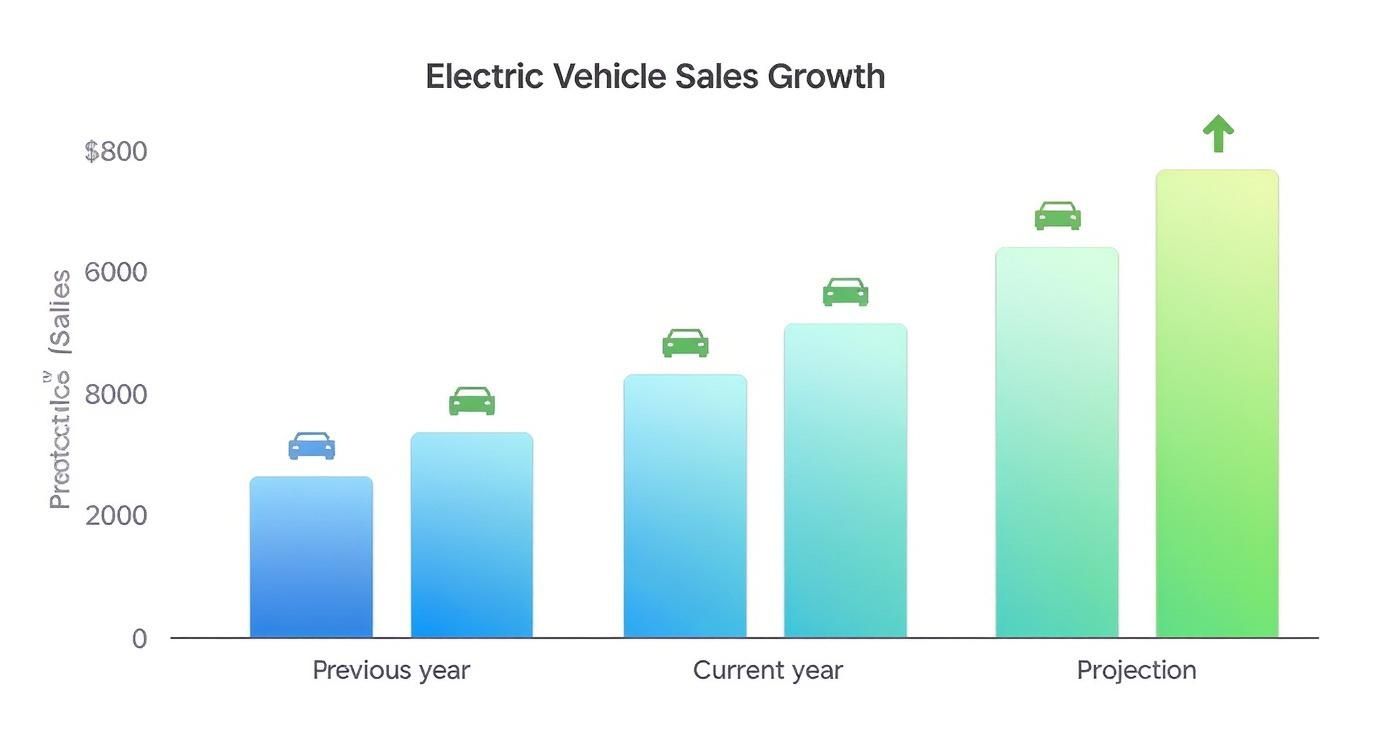
The numbers don't lie. Sales are accelerating as drivers discover the powerful long-term economic advantages that come with plugging in instead of filling up.
Slashing Maintenance Bills
Fuel is just the beginning. The mechanical simplicity of an electric vehicle leads to massive savings on maintenance and repairs. A traditional gas engine is a complex beast, packed with hundreds of moving parts that wear out, break, and need constant service.
An electric motor, on the other hand, is remarkably simple with very few moving parts. This isn't just an engineering detail—it's the key to eliminating a whole list of expensive, recurring maintenance jobs.
Just think of the routine costs that will vanish from your life:
- No More Oil Changes: This is a big one. Electric motors don't need oil, so you can cross that regular expense and appointment off your list for good.
- Forget Spark Plugs and Filters: There are no spark plugs to replace, no fuel filters to clog, and no complicated exhaust systems to repair.
- Longer-Lasting Brakes: EVs feature regenerative braking, a clever system where the motor helps slow the car down and sends a bit of energy back to the battery. A fantastic side effect is that it dramatically reduces wear on your brake pads, making them last far longer than on a gas car.
This elegant simplicity means your annual maintenance budget shrinks significantly. To see exactly how these savings compare over time, check out our in-depth electric vehicle cost comparison.
To put it all into perspective, here's a look at how the costs shake out over a typical five-year ownership period.
Cost of Ownership Gas Car vs Electric Vehicle (5-Year Estimate)
| Cost Category | Gasoline Car (ICE) | Electric Vehicle (EV) | Potential Savings |
|---|---|---|---|
| Fuel / Energy | $9,000 | $2,750 | $6,250 |
| Maintenance | $4,500 | $1,500 | $3,000 |
| Repairs | $2,000 | $1,200 | $800 |
| Total | $15,500 | $5,450 | $10,050 |
As the table shows, the long-term savings are substantial. While this is a general estimate, it clearly illustrates how the lower running costs of an EV can save you over $10,000 in just five years.
Maximizing Government Incentives
To make the switch even more appealing, governments at all levels offer perks to encourage drivers to go electric. The most significant is often the federal tax credit, which can knock up to $7,500 off the price of a qualifying new EV. This isn't a rebate you wait for; it's a direct reduction of your tax bill, making a brand-new vehicle much more attainable.
On top of that, many states, cities, and even local utility companies have their own programs. These can include direct cash rebates on the car, money back for installing a home charger, or even special, lower electricity rates for charging your EV during off-peak hours. It all adds up, lowering the barrier to entry and letting you tap into those long-term savings right from day one.
The Environmental Case for Driving Electric
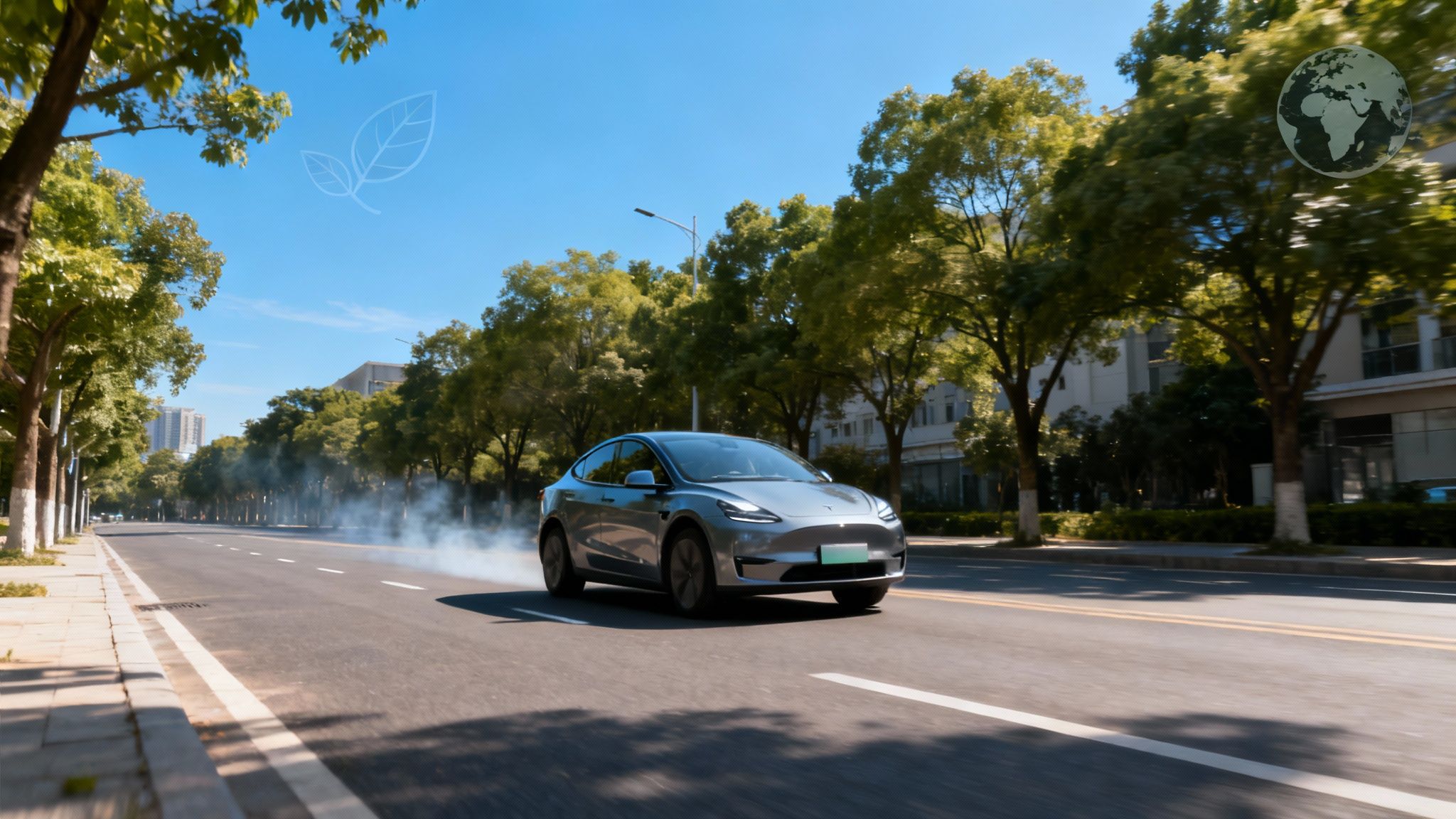
While the savings and performance are fantastic perks, the real heart of the electric vehicle movement is its positive impact on the world around us. Choosing to drive an EV is a direct vote for cleaner air and a healthier planet.
The most obvious win is the total absence of tailpipe emissions. A traditional gas car is, frankly, a mobile pollution factory, pumping harmful gases right into the air we breathe. An EV, on the other hand, produces zero emissions on the road. That translates directly to less smog and cleaner air in our towns and cities.
A Smaller Carbon Footprint Over a Lifetime
I often hear the question, "But what about the battery?" It's a fair point. Manufacturing an EV battery is an energy-intensive process, but that’s only one chapter of the car's life story.
When you zoom out and look at the entire lifecycle—from the factory floor to the daily commute, all the way to recycling—the picture is overwhelmingly clear. An EV’s lifetime carbon footprint is far smaller than a comparable gas car's, even when you factor in battery production. Research from the Union of Concerned Scientists shows that electric cars and trucks produce over 50% less pollution than gas-powered ones over their entire lifespan.
Driving an electric vehicle isn't just a personal choice; it's a direct investment in your community's health. Cleaner air means fewer respiratory problems and quieter, more enjoyable neighborhoods for everyone.
This shift to electric power is a massive piece of the puzzle for hitting climate targets. If governments keep their current promises, we could see 300 million EVs on the road by 2030. That alone could cut our daily oil demand by 5 million barrels, according to analysis on the global electric vehicle market.
Your individual decision, scaled up by millions of other drivers, becomes a powerful force for breaking our dependence on fossil fuels.
More Than Just Emissions: Air and Noise Pollution
The environmental benefits don't stop with CO2. Switching to an EV also slashes other pollutants that directly affect public health.
- Cleaner City Air: Gas engines spew particulate matter and nitrogen oxides, both linked to asthma and other serious respiratory issues. EVs eliminate these toxins at the source.
- Quieter Streets: The whisper-quiet hum of an electric motor is a game-changer for reducing noise pollution, making our communities more peaceful and less stressful.
By getting behind the wheel of a Solana EV, you become an active part of this positive change. Every quiet, emission-free journey helps build a more sustainable future. If you're inspired to do even more, you can learn how to reduce your carbon footprint in other parts of your daily life, too.
Discover the Thrill of EV Performance
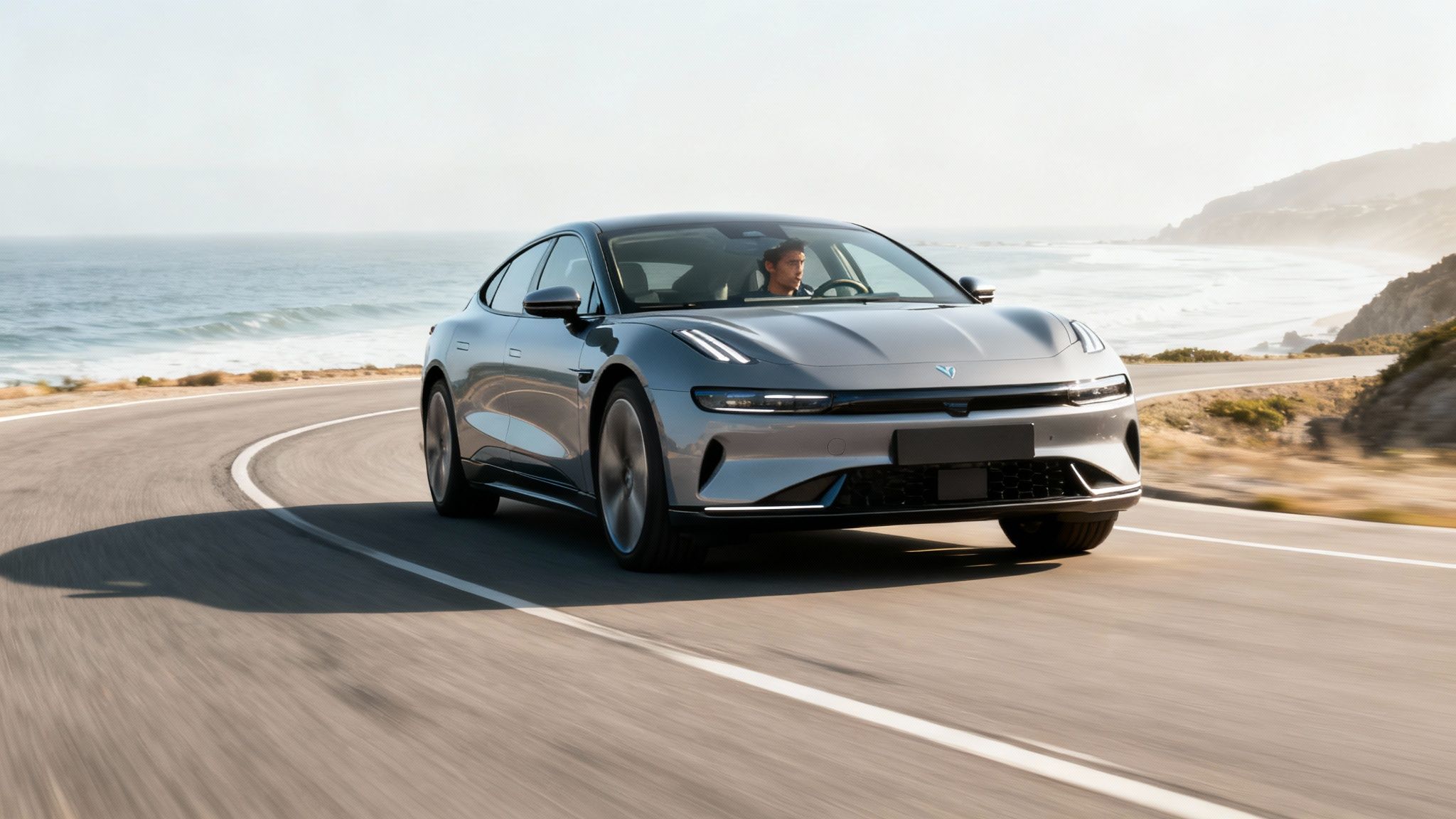
Let's get one thing straight: going electric doesn't mean giving up the fun of driving. It's a common myth that eco-friendly cars are slow and boring, but the reality is quite the opposite. For many drivers, switching to an EV is a massive performance upgrade that makes every trip, from the grocery run to a weekend road trip, genuinely exciting.
The secret sauce is something called instant torque. Think about flipping a light switch—the light comes on instantly, with no delay. That’s exactly how an electric motor delivers power.
A traditional gasoline engine, on the other hand, has to build up revs to hit its peak power, creating a lag between when you hit the gas and when the car truly takes off. In an EV, the moment your foot touches the accelerator, 100% of the motor’s power is right there, ready to go. This is what creates that signature, pin-you-to-your-seat feeling off the line, making merging onto the highway an absolute breeze.
More Than Just a Fast Start
The immediate acceleration is just the beginning. The entire experience behind the wheel feels different, and frankly, better. Without a loud, vibrating engine, the cabin is remarkably quiet and calm, transforming a stressful commute into a far more serene journey. The ride is buttery smooth, free of the jerks and shudders that come with a traditional transmission shifting gears.
This blend of silent power and smoothness is something you have to feel to believe.
Driving an electric vehicle feels less like operating heavy machinery and more like gliding. The silent, smooth, and instantly responsive nature of the powertrain creates a refined experience that gas cars simply cannot replicate.
Another major performance advantage is baked right into the car’s design. The heavy battery pack is usually mounted flat along the floor, which gives the vehicle an incredibly low center of gravity. This might sound like a technical detail, but it completely changes how the car feels on the road.
- Rock-Solid Stability: That low-slung weight anchors the car to the pavement, making it feel exceptionally planted and stable, especially when you need to make a sudden move.
- Confidence in the Corners: This stability directly translates into sharper handling. A Solana EV feels nimble and glued to the road on tight turns, responding precisely to every little input from the steering wheel.
When you add it all up, an EV gives you the best of both worlds. You get the peaceful, quiet ride of a luxury car combined with the exhilarating punch of a sports car. This isn't a compromise; it's a true performance upgrade.
How an EV Simplifies Your Daily Life
Beyond the thrill of instant acceleration and the relief of skipping the gas pump, one of the best parts of owning an electric vehicle is how it just makes life easier. It’s a subtle shift, but it’s a big one. Owning an EV changes your relationship with your car by getting rid of the annoying little errands we've all come to accept as normal.
The most profound change? Charging at home. It’s like having a private, spotless fuel station in your garage. That weekly, out-of-the-way trip to the gas station is just… gone. You get home, you plug in your car like you do your phone, and you forget about it.
Imagine waking up every single morning with a full "tank." You never have to glance at a fuel gauge and wonder if you have enough to get through the day. This one simple habit gives you back precious time and mental energy.
Understanding Your Charging Options
While charging at home will cover the vast majority of your driving—usually over 90% for the average person—it’s good to know what your options are when you’re out and about or on a long trip. The public charging network is growing fast and is pretty easy to get the hang of.
You'll mostly run into two kinds of public chargers:
- Level 2 Chargers: These are the workhorses of the public network. You’ll find them at shopping centers, workplaces, and public garages. They provide a solid, steady charge that’s perfect for adding some range while you’re at your desk or running errands for a couple of hours.
- DC Fast Chargers: Think of these as the pit stops for road trips. Strategically placed along major highways, a DC fast charger can give you a major boost in range in just 20-30 minutes. That's just enough time to grab a coffee and stretch your legs before hitting the road again.
With this network expanding all the time, range anxiety is quickly becoming a thing of the past. Taking a long-distance trip in a Solana EV isn't just possible—it's practical.
Everyday Perks That Make a Difference
The convenience doesn't stop with charging. Many cities offer special perks for EV drivers that make getting around town a breeze. Depending on where you live, you might get access to high-occupancy vehicle (HOV) lanes, even if you’re driving alone. That can be a serious time-saver during rush hour.
Owning an electric vehicle isn't just about what you eliminate—like gas and oil changes. It's about what you gain: more time, less stress, and a quieter, more pleasant start to every journey.
On top of that, you'll start noticing prime parking spots reserved just for electric vehicles, often right by the front door of your destination. Finally, the silent, smooth ride of a Solana EV turns a noisy, stressful commute into a far more relaxing experience. These little things add up, making EV ownership a surprisingly simple and genuinely enjoyable way to travel.
Let's Talk About the Top EV Concerns
Switching to an electric vehicle is a big decision, and it’s totally normal to have a few nagging questions. Even with all the benefits, people often wonder about the practical, day-to-day experience. Let's clear the air and look at the most common worries people have before going electric.
The biggest one is almost always range anxiety—that little voice in your head asking, "What if I run out of juice?" It’s a valid thought, but modern EVs have come a long way. Take the vehicles from Solana EV, for example. They offer ranges that easily cover the average American's daily drive, which is only about 40 miles. You can handle your commute, run all your errands, and still have plenty of charge left in the "tank" when you get home.
What About Charging and Battery Lifespan?
Okay, so what about plugging in? Many people worry about how long it takes to charge. While it's true a public fast charger isn't as quick as a five-minute gas station stop, the reality of EV ownership is different. A staggering 90% of all EV charging is done at home, usually overnight while you sleep.
Think of it like charging your phone. You just plug it in when you get home, and every morning you wake up to a fully charged car, ready for the day. This simple shift in habit means you'll likely only use public chargers on long-distance road trips, not for your daily routine.
Still, old habits die hard. Recent consumer surveys reveal that worries about charging time (56%) and finding a public station (54%) are still top of mind for many people considering the switch. If you're curious about the data, you can dig into these EV adoption rates and consumer views to get a better sense of the landscape.
Then there's the battery itself. It’s the heart of the car and a big part of the investment, so you want to know it's going to last. Good news here.
EV batteries are engineered to last the entire life of the vehicle. Manufacturers are so confident in their durability that they offer robust warranties, typically covering the battery for eight years or 100,000 miles.
This isn't just a promise; it's a guarantee built into the design to protect your investment. Real-world data backs this up, showing that major battery degradation is uncommon. Most batteries hold onto the vast majority of their capacity for many years, making these once-major concerns feel more like manageable details of driving a modern car.
Got Questions About Going Electric? We've Got Answers.
Making the jump to an electric vehicle is a big decision, and it's totally normal to have a few questions. Even with all the exciting benefits, you want to be sure it's the right move. Let's walk through some of the most common things people ask.
"How Long Does an EV Battery Actually Last?"
This is probably the number one question we hear. There's a persistent myth that EV batteries die quickly and cost a fortune to replace. The reality is, they’re built for the long haul.
Modern EV batteries are designed to last the entire lifespan of the car itself. To prove it, manufacturers offer robust warranties, typically guaranteeing the battery for at least eight years or 100,000 miles. That’s a serious commitment that should give you real peace of mind.
"What About Range? Will I Get Stuck?"
Ah, the infamous "range anxiety." It's a valid concern, but one that today's technology has largely solved. The average American drives less than 40 miles a day, and modern EVs, including the lineup from Solana EV, offer ranges that blow that number out of the water.
Your daily commute, school runs, and grocery trips are all easily covered on a single charge. For most drivers, plugging in at home overnight is all you'll ever need, turning public charging stations into a tool for those special long-distance road trips, not a daily necessity.
Think of your EV like your smartphone. You don't wait for it to hit zero; you just plug it in when you get home. It's a simple habit that means you wake up every morning with a full "tank," ready to go.
"Is Charging a Hassle?"
Charging is way more convenient than people imagine. While it's true a DC fast charger isn't as quick as a five-minute gas stop, that's not how most people charge. In fact, over 90% of all EV charging happens at home.
You just pull into your garage and plug in. It’s that simple. To get a better handle on the incredible engineering behind this, check out our deep dive into electric vehicle battery technology.
Ready to feel the difference for yourself? Solana EV offers a perfect blend of performance, cutting-edge style, and true sustainability. Explore our lineup and find the right fit for your lifestyle at https://solanaev.com.