
Yes, golf carts are legal in Florida, but how you can use them isn't a simple free-for-all. The rules change depending on what kind of cart you're driving and where you plan to take it.
Think of it this way: there's a big legal difference between a standard golf cart and a "street-legal" one, officially known as a Low-Speed Vehicle (LSV). Getting this distinction right is the first step to staying safe and on the right side of the law in the Sunshine State.
Navigating Florida Golf Cart Laws
With our beautiful weather and countless planned communities, it's no wonder golf carts are everywhere in Florida. They're a fantastic way to get around the neighborhood. But if you treat one like a car, you could be setting yourself up for fines or worse.
The state draws a hard line between a standard golf cart, the kind you see on the links, and an LSV, which is built and equipped for use on public roads. A standard cart is a bit like a bicycle—it’s meant for designated paths and very specific local streets with low speed limits. An LSV, however, is closer to a moped; it needs a title, registration, and insurance to be driven legally on certain roads.
One key thing to remember is that the rules aren't the same everywhere. Local city and county governments, and even homeowners' associations, can set their own specific ordinances.
This guide will walk you through the essentials:
- The crucial differences between a standard golf cart and an LSV.
- Where you can legally drive each type of vehicle.
- The latest changes to driver age and licensing rules.
- What safety equipment is required to be considered "street-legal."
Standard Golf Cart vs Low-Speed Vehicle (LSV) in Florida
Understanding the key differences between a standard golf cart and a Low-Speed Vehicle (LSV) is the most important part of navigating Florida's laws. The table below breaks down the major distinctions at a glance.
| Feature | Standard Golf Cart | Low-Speed Vehicle (LSV) |
|---|---|---|
| Top Speed | Cannot exceed 20 mph | Can go between 21-25 mph |
| Title & Registration | Not required | Required (just like a car) |
| Insurance | Not required, but recommended | Required (PIP and PDL) |
| VIN Number | Not required | Required (17-digit VIN) |
| Safety Equipment | Basic equipment | DOT-approved headlights, taillights, turn signals, mirrors, seatbelts, windshield |
| Where to Drive | Designated golf cart paths, roads with speed limits of 30 mph or less (local ordinance) | Roads with speed limits of 35 mph or less |
In short, an LSV is a registered motor vehicle held to higher safety and legal standards, while a standard golf cart is considered a recreational vehicle with much more limited use.
Florida law allows standard, unregistered golf carts on certain public roads, but only under specific conditions. These carts, which can't go faster than 20 mph, are typically restricted to streets that have been officially designated for golf cart use, usually with posted speed limits of 30 mph or less.
A significant law change went into effect on October 1, 2023, updating the age and licensing requirements for younger drivers. You can learn more about these recent updates to Florida's golf cart laws on golfcartsearch.com.
For the most complete and authoritative source on all driving regulations in the state, including the specific rules for unique vehicles like LSVs, it's always best to consult the official Florida Driver's Manual.
What Separates a Golf Cart from a Street-Legal LSV?
To really get a handle on the rules for golf carts legal in Florida, you first need to grasp the key distinction between a standard golf cart and a Low-Speed Vehicle, or LSV. It helps to think of it this way: a basic golf cart is designed for private property or a small, self-contained community—like a shuttle for a golf course or a retirement village.
An LSV, on the other hand, is essentially a golf cart that has been upgraded to meet specific federal and state safety standards, transforming it into a vehicle that can legally share the road with cars.
This isn't just a minor difference in semantics. The classification of your vehicle changes everything—where you can drive it, who can operate it, and how it needs to be registered. By Florida law, a "golf cart" is a vehicle that can’t go faster than 20 mph. In contrast, an LSV is a four-wheeled electric vehicle with a top speed greater than 20 mph but not more than 25 mph.
That small bump in speed is the trigger for a whole different set of rules.
The Street-Legal Transformation Checklist
To get your golf cart street-legal status as an LSV, you have to outfit it with specific safety gear required by the Florida Department of Highway Safety and Motor Vehicles (FLHSMV). This isn't just about bolting on a few extras; it's about meeting the same kind of safety standards you'd find on a car.
Here’s what your cart needs to make the leap to an LSV:
- Headlights and Taillights: Essential for being seen, especially if you plan to drive between sunset and sunrise.
- Turn Signals and Brake Lights: So other drivers know what you're doing.
- A DOT-Approved Windshield: This isn't just a piece of plastic; it has to be automotive-grade safety glass to protect you from road debris.
- Seat Belts: One for every seat in the vehicle. No exceptions.
- A Vehicle Identification Number (VIN): This is the 17-digit number that officially registers your LSV as a motor vehicle.
- Rearview and Exterior Mirrors: You need to see what's happening around you in traffic.
Once all that equipment is installed, the vehicle has to be titled, registered, and insured—just like your car. If you want to dive deeper, you can learn more about what a low-speed vehicle is and the nitty-gritty details involved.
This infographic lays out the key differences pretty clearly.
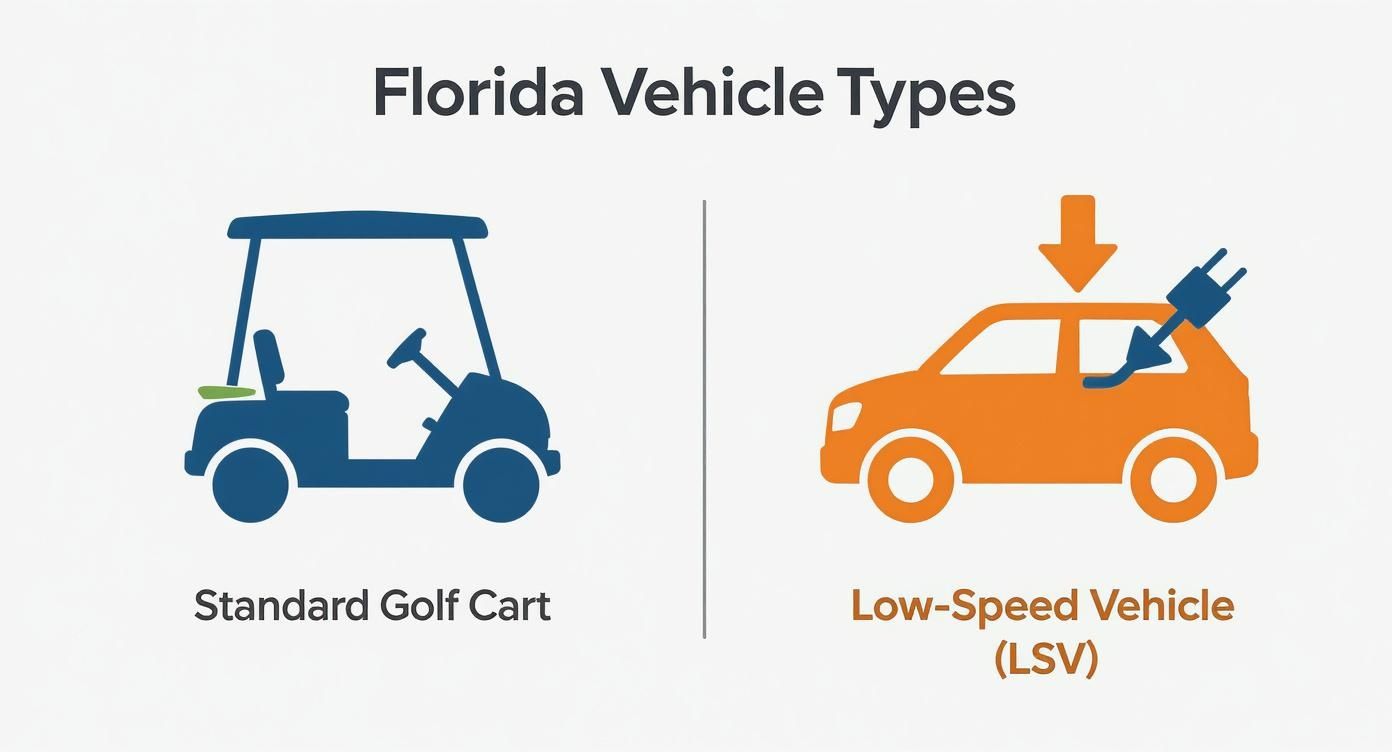
As you can see, becoming an LSV is a serious process that involves meeting car-like standards for both safety equipment and official documentation.
Why This Matters for Florida Drivers
Understanding this distinction isn't just academic; it's crucial for staying safe and avoiding some hefty fines. A standard, unmodified golf cart is legally stuck on golf courses or specific local roads where the speed limit is 30 mph or less, and often only in designated golf cart communities.
The bottom line is this: an LSV isn't just a souped-up golf cart. It's a registered motor vehicle held to a much higher legal standard, which is what gives it the right to be on roads with posted speed limits of up to 35 mph.
Because an LSV meets these more stringent safety and registration requirements, it has much greater freedom to operate on public roads. This one distinction is the bedrock for pretty much every other rule about using a golf cart in Florida.
Where You Can Legally Drive Your Golf Cart
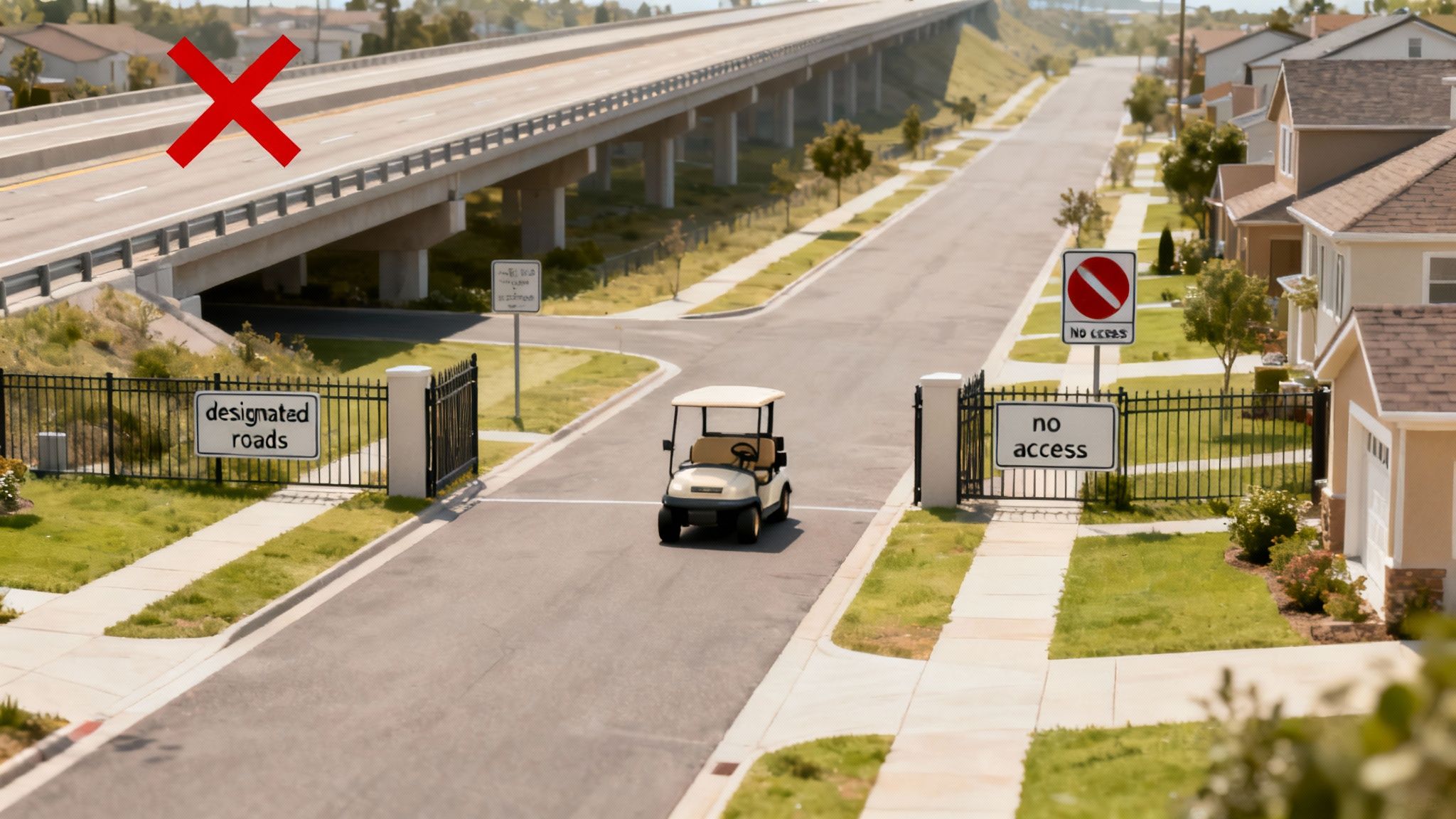
Alright, this is probably the most important part of owning a golf cart in Florida: knowing exactly where you can and can’t drive it. The rules are pretty clear, and they draw a hard line between a standard golf cart and a street-legal Low-Speed Vehicle (LSV). Getting this right keeps everyone safe and keeps you out of trouble.
Think of a standard golf cart as a neighborhood specialist. It's built for short, local trips, not for mixing it up with highway traffic. Its territory is limited.
Driving a Standard Golf Cart
For a regular golf cart—the kind that tops out under 20 mph—your driving map is very specific. Generally, you’re good to go in a few key areas:
- Designated Public Roads: Your local city or county can give the green light for golf carts on certain streets. The rule of thumb is that the road must have a posted speed limit of 30 mph or less. You’ll almost always see signs letting you know it’s a golf-cart-friendly zone.
- Gated and Retirement Communities: This is home turf for most golf carts. Inside these communities, the private roads are often designed with cart travel in mind, making it the preferred way to get around.
- Crossing Certain Streets: Need to get to the other side of a golf course or from one part of your neighborhood to another? Florida law lets you cross a busier street at an intersection, but you can't drive along it.
Florida law also has a special spot for its huge retiree population. It carves out specific allowances for what are called "self-contained retirement communities," letting residents use their carts on private roads throughout the community. You can discover more insights about these specific community rules to see if this applies where you live.
Expanded Access for Low-Speed Vehicles
Now, if you've gone through the process of making your cart a registered LSV, your world gets a lot bigger. Because an LSV has safety gear like seatbelts, headlights, and turn signals, it's allowed on any public road where the posted speed limit is 35 mph or less.
This upgrade opens up a ton of possibilities, letting you use your cart for quick errands, visiting friends across town, or just exploring a bit further from home.
But even LSVs have their boundaries. They are still prohibited from driving along a road with a speed limit over 35 mph, though they can cross one at an intersection.
Absolutely Off-Limits Areas
Whether you’re in a basic cart or a fully kitted-out LSV, some places are strictly off-limits. Knowing these no-go zones is crucial for avoiding a nasty accident or a hefty fine.
Never operate a golf cart on sidewalks, bike lanes, or major highways. These paths are not designed for a vehicle like a golf cart, and driving there puts pedestrians, cyclists, and other drivers in serious danger.
Stick to the approved roads, and you’ll get to enjoy everything that makes golf cart life in Florida so great. Before you turn the key, do a quick check of the local ordinances in your city or county—they have the final say on where golf carts are legal in Florida.
Florida's Mandatory Safety Equipment Requirements
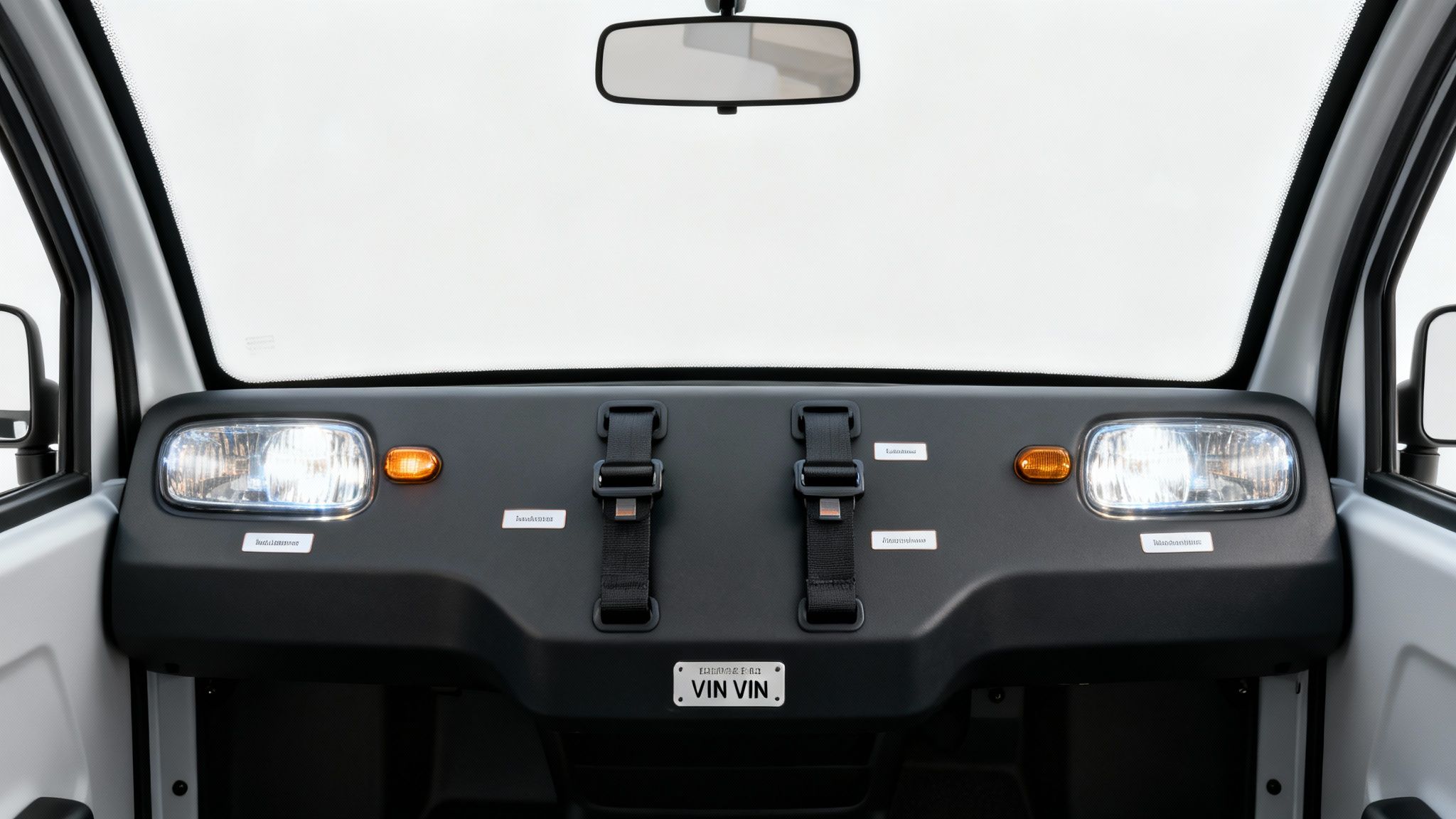
When it comes to driving your cart on public roads in Florida, safety isn't just a good idea—it's the law. The state is serious about equipment, and for good reason. Think of these requirements not as a hassle, but as the essential gear that protects you, your family, and everyone else sharing the road. They’re there to prevent accidents before they happen.
The rules are broken down into two main categories, and it all depends on what you're driving: a standard golf cart or a street-legal Low-Speed Vehicle (LSV). Each has its own specific checklist of required equipment, which directly impacts where—and when—you're legally allowed to drive.
This isn't just bureaucratic red tape. The numbers paint a clear picture. Every year in the U.S., an estimated 13,000 golf cart-related accidents are serious enough to land someone in the emergency room. You can learn more about these important traffic safety findings to see just how critical these rules are.
Essentials for a Standard Golf Cart
If you’re sticking to designated public roads in a standard golf cart, you need to meet the basic safety standards. These are the absolute, non-negotiable fundamentals for daytime driving.
- Efficient Brakes: Your cart must stop reliably every single time.
- Reliable Steering: The steering wheel needs to give you precise control.
- Rearview Mirror: Essential for knowing what's coming up behind you.
- Red Warning Reflectors: You'll need one on the front and one on the rear.
Full Compliance for Low-Speed Vehicles
Ready to upgrade your cart to an LSV? This is where the requirements get much more serious. To be street-legal, your vehicle has to be equipped almost like a car, ready to safely mix with traffic on roads with speed limits up to 35 mph.
An LSV's safety equipment isn't optional—it's the core of its legal identity. Each piece, from headlights to seat belts, is required for titling, registration, and insurance. This is what officially separates it from a standard golf cart.
Here’s the rundown of mandatory equipment for any LSV:
- Headlamps, Tail Lamps, and Brake Lights for crucial visibility, day or night.
- Turn Signals to clearly communicate your intentions to other drivers.
- DOT-Approved Windshield for protection from road debris.
- Seat Belts for every single seat.
- Vehicle Identification Number (VIN), which is necessary for official registration.
- Exterior and Interior Mirrors to give you a complete view of your surroundings.
Getting all this gear installed and verified is the only path to making your cart fully legal for expanded road use in Florida. Our comprehensive guide walks you through the full list of street-legal golf cart requirements you’ll need to master.
Understanding Driver Age and License Rules
The rules for who can legally drive a golf cart in Florida have gotten a major facelift recently, so it's critical to know what's changed. The casual, anything-goes days are over. Now, the law sets clear, non-negotiable standards for drivers, especially younger ones.
Think of it as a new tiered system of responsibility. The younger the driver, the stricter the requirements. This was a direct response to growing safety concerns and a rise in accidents involving inexperienced kids behind the wheel.
A key part of this legal update is that anyone under 18 years old must now have a valid learner's permit or a full driver's license to operate a golf cart on public roads. This change effectively puts an end to unlicensed driving by teenagers.
Age-Specific Requirements for Operators
The rules are pretty straightforward and hinge on two things: the driver's age and the type of vehicle. For a standard golf cart, the law splits operators into two distinct groups.
If you're 18 or older, things are simple. You just need to have a valid, government-issued photo ID on you when you're driving. This could be your driver's license, a state ID card, or another official form of identification.
For anyone under 18, the requirements are much more specific:
- You must be at least 15 years old and hold a learner's permit.
- Or, you must be at least 16 years old with a valid driver's license.
What this really means is that a 14-year-old can no longer legally drive a golf cart on a public street. That’s a huge shift from how things used to be.
The Bottom Line: The new law requires anyone under 18 to have passed the written traffic law exam and earned at least a learner's permit before they can legally drive a golf cart on public roads.
To make this crystal clear, here’s a simple breakdown of who needs what.
Florida Golf Cart Operator Requirements at a Glance
| Vehicle Type | Operator Under 18 | Operator 18 or Older |
|---|---|---|
| Standard Golf Cart | Must be at least 15 with a learner's permit or 16 with a driver's license. | Must carry a valid government-issued photo ID. |
| Low-Speed Vehicle (LSV) | Must have a valid driver's license. (Permits not allowed) | Must have a valid driver's license. |
As you can see, the rules create a clear distinction based on age and whether you're driving a basic golf cart or a street-legal LSV.
Stricter Rules for Low-Speed Vehicles
When you're dealing with a Low-Speed Vehicle (LSV), the rules are even tighter and leave no room for interpretation. Why? Because an LSV is legally a registered motor vehicle, just like a car.
Every single person who drives an LSV on a public road, no matter their age, must have a valid driver's license. A learner's permit just won't cut it here.
This strict requirement makes sense when you consider an LSV can legally travel on roads with speed limits up to 35 mph. Following these driver rules is a fundamental part of keeping your golf carts legal in Florida.
Navigating Registration, Title, and Insurance
Let's break down the paperwork side of owning a golf cart in Florida. It can seem a little intimidating, but it’s really just a fork in the road. The path you take depends entirely on one simple question: is your vehicle a standard golf cart or a street-legal Low-Speed Vehicle (LSV)?
If you have a standard golf cart—one that tops out at 20 mph—your life is pretty simple. These carts don't need a title or registration from the Florida Highway Safety and Motor Vehicles (FLHSMV). No license plate, no annual renewals. Easy.
But just because the state doesn't require insurance doesn't mean you should skip it. Your homeowner's policy might not cover you once you leave your property, so a dedicated golf cart policy is a smart move to protect yourself from liability if an accident happens.
The Street-Legal LSV Process
Now, if your cart is an LSV—meaning it can travel between 21-25 mph—the state treats it just like a car. This is the key to making sure your golf carts are legal in Florida for use on public roads.
Getting your LSV road-ready involves a few non-negotiable steps:
- Vehicle Identification Number (VIN): First things first, your LSV needs an official VIN to be recognized by the state.
- Certificate of Title: With a VIN, you can then apply for a title from the FLHSMV, which officially proves your ownership.
- Registration & Plate: Once it's titled, you can register your LSV and get a real license plate.
- Mandatory Insurance: Florida law requires all LSVs to carry both Personal Injury Protection (PIP) and Property Damage Liability (PDL) insurance, just like any other car on the road.
To successfully navigate these administrative steps, it helps to have a clear roadmap. Our guide to golf cart registration offers a detailed walkthrough of this entire process, from getting a VIN to affixing your new license plate.
Getting these details right from the start is crucial for staying compliant. For a broader look at the state's vehicle laws, resources covering Florida's registration and proof of insurance requirements can offer helpful context. Following these steps ensures your LSV is 100% legal from day one.
Common Questions About Florida Golf Cart Laws
Even when you think you have a handle on the rules, real-world situations can still be confusing. Let's tackle some of the most frequent questions we hear from golf cart owners trying to stay on the right side of the law in Florida.
This is your go-to guide for those "what if" moments. We've pulled together the questions that pop up time and time again so you can drive through your neighborhood with total confidence.
Can I Drive My Golf Cart on the Sidewalk?
The short answer is a hard no. It is illegal to drive a golf cart or an LSV on sidewalks anywhere in Florida. Full stop.
Sidewalks are for people—walkers, joggers, kids playing—and putting a vehicle there is a serious safety risk. This rule is enforced pretty strictly, and the only time you should be on one is for the brief moment it takes to cross it when pulling into or out of a driveway. If you get caught cruising down the sidewalk, expect a ticket.
Do I Need a Special Insurance Policy?
This really boils down to what you're driving. If you have a street-legal Low-Speed Vehicle (LSV), the answer is a definite yes. The law requires you to carry Personal Injury Protection (PIP) and Property Damage Liability (PDL) insurance, just like you would for your car.
For a standard golf cart, the state doesn't force you to have insurance, but skipping it is a huge gamble. Your homeowner's policy probably won't cover an accident that happens off your property, which could leave you on the hook for a lot of money. Getting a separate, inexpensive golf cart policy is one of the smartest moves you can make.
The bottom line is that insurance, even when it's not required, is your financial safety net. Without it, one accident could leave you personally responsible for thousands in medical bills or property damage.
What Happens If I Break a Golf Cart Law?
For the most part, violating a Florida golf cart law is considered a noncriminal traffic infraction. Think of it like a standard moving violation in a regular car—you're probably looking at a fine.
A few common ways to get a ticket include:
- Driving where you shouldn't, like on a road with a speed limit over 30 mph.
- Letting someone who is underage or doesn't have a license drive on a public street.
- Operating an LSV that's missing required safety gear.
- Driving a standard cart after sunset without the proper lights.
Fines can differ from one county to the next, so your best bet is always to just stick to the rules.
Can My Local Community Have Different Rules?
Yes, and this is a big one. State law sets the foundation, but Florida statutes give local governments, cities, and even your HOA the power to create their own, often stricter, regulations.
Your town might have its own designated golf-cart-friendly streets, set a curfew for when you can drive, or demand extra safety features that go beyond the state's minimum requirements. Before you hit the road, always double-check the ordinances for your specific city, county, or HOA to make sure you're covered.
Ready to experience the freedom and style of a fully compliant, street-legal electric vehicle? Solana EV offers a premium lineup of LSVs designed to meet Florida's highest standards. Explore our models and find the perfect ride for your community.
Thank you for your sharing. I am worried that I lack creative ideas. It is your article that makes me full of hope. Thank you. But, I have a question, can you help me?