
If you're just starting to figure out what size golf cart you need, you're in luck. Most standard carts fall into a pretty predictable size range, which makes that initial planning a whole lot easier.
A typical 2-passenger golf cart, for example, is usually about 8 feet long, 4 feet wide, and 6 feet tall. These dimensions are no accident; they're designed to be nimble enough for tight cart paths while still fitting comfortably in a standard garage.
Quick Reference for Standard Golf Cart Dimensions
Before you get bogged down in the specs of specific models, it helps to have a general idea of the average dimensions for different configurations. Knowing these baseline numbers is crucial whether you're clearing space in the garage, picking out a trailer, or even planning a new pathway.
Major manufacturers like Club Car, E-Z-GO, and Yamaha tend to stick close to these industry standards. It's all about finding that sweet spot between easy handling and having enough room for passengers and gear. For a deeper dive into the market trends influencing these designs, check out this report on the golf cart market and its specifications.
Quick Guide to Average Golf Cart Dimensions by Type
To give you a head start, this table breaks down the average dimensions for the most common golf cart sizes. It's a great quick-glance tool for your initial planning.
| Cart Type | Average Length (ft) | Average Width (ft) | Average Height (ft) |
|---|---|---|---|
| 2-Passenger | 8.0' | 4.0' | 5.5' – 6.0' |
| 4-Passenger | 9.0' – 9.5' | 4.0' | 5.5' – 6.0' |
| 6-Passenger | 11.5' – 12.0' | 4.0' | 5.5' – 6.5' |
As you can see, the biggest change is in the length as you add more seats. The width and height stay relatively consistent, though some larger models might stand a bit taller to accommodate a raised suspension or larger roof.
How to Measure Your Golf Cart Accurately
While manufacturer specs are a great starting point, nothing beats pulling out the tape measure yourself. This is especially true if you've made any customizations. Getting your own precise measurements is the only way to avoid that sinking feeling when you discover your cart won't fit through a gate or into its new storage shed.
For the most reliable numbers, you need to measure from the absolute widest, longest, and tallest points. This means accounting for every accessory that sticks out, no matter how small.
- Length: Start your tape at the very front of the forward bumper and pull it all the way to the rearmost point. This could be a rear seat footrest, a grab bar, or a utility box.
- Width: Stretch the tape from the outermost edge of one fender or tire to the other—whichever one is wider. Just measuring the body of the cart won't give you the full picture.
- Height: Measure from the ground straight up to the very highest point of the roof. If you have a lift kit, this measurement is absolutely critical for checking garage door clearance.
This infographic gives you a great visual of where to measure for a cart's true length, width, and height.

As you can see, the measurements have to include the vehicle's outermost extremities to accurately represent its real-world footprint.
Accounting for Modifications
Mods are the number one reason to grab a tape measure. Things like lift kits and beefier tires will completely change your cart's original dimensions. A simple 3-inch lift can easily add 5-6 inches to your total height once you factor in the larger tires that usually go with it.
A stock cart might glide under a standard 7-foot garage door without a problem, but a lifted version often won't make it. The golden rule is to always re-measure after any modification to confirm your clearances.
It's not just height, either. Adding something like a rear seat kit can tack on a foot or more to your overall length. To get ahead of these changes, you'll want to understand your golf cart tire size and how it affects the final numbers. For even deeper customization, it's also helpful to learn how to measure wheel diameter accurately to ensure proper fitment.
Dimensions for 2-Passenger Golf Carts
When you picture a golf cart, the classic 2-seater is probably what comes to mind. It's the standard for a reason—its compact size is its biggest asset, making it nimble on tight paths and a breeze to store. These models are the baseline for what most people consider "standard" golf cart dimensions.
On average, you'll find most 2-passenger carts measure about 8 feet long, 4 feet wide, and somewhere between 5.5 to 6 feet tall. This convenient size means they can easily slip into a single bay of a standard garage with room to spare. Their shorter wheelbase is what gives them that fantastic, tight turning radius—perfect for navigating tricky course layouts or winding neighborhood streets.
Comparing Popular 2-Seater Models
While most 2-seaters are built to a similar scale, you'll find slight variations between the major brands. These small differences can actually matter quite a bit, especially if you're working with limited space. Let's look at the "big three": the Club Car Precedent, E-Z-GO RXV, and Yamaha Drive2.
Here’s how their typical factory dimensions stack up:
- Club Car Precedent: Usually comes in at 91.5 inches (7.6 ft) long.
- E-Z-GO RXV: Tends to be a little longer, around 94.5 inches (7.9 ft).
- Yamaha Drive2: Sits right in the middle at 93.6 inches (7.8 ft).
A few inches might not sound like a lot, but it can be the difference-maker when you're trying to fit your cart onto a specific trailer or into a tight spot in the garage.
For perspective, traditional fleet carts used on the course are often a bit smaller, averaging 8 feet (2.4 meters) long and 4 feet (1.2 meters) wide. Their turning radius is typically a tight 10–12 feet (3–3.7 meters), designed specifically for maneuvering around greens. This market is also booming, with projections showing the global golf cart industry could hit USD 3.5 billion by 2033, expanding at a CAGR of 6.7% from 2024. You can find more details in this analysis of the growing golf cart market and its trends.
Sizing Up 4-Passenger Golf Carts
When you need a bit more room for family or friends, the 4-passenger golf cart is a natural step up. These are incredibly popular for cruising around the neighborhood, not just the course. The big difference, of course, is the addition of that rear-facing bench seat, which directly adds to the cart's overall length.
This isn't just a minor change; it has a real impact. A typical 2-seater is around 8 feet long, but a 4-passenger model usually pushes that out to between 9 and 9.5 feet. That extra foot and a half is something you really have to account for. Many people find out too late that their cart won't fit in a standard utility trailer or a tight spot in the garage. While the length changes, the width and height generally stay the same as their 2-seater cousins.
Comparing Popular 4-Seater Models
It’s not just about storage, either. The added length and weight of a 4-passenger model change how it handles. A longer wheelbase means a wider turning radius, so you'll find it's a bit less nimble in tight corners than a zippy 2-seater. Let's look at a couple of popular models to see how this plays out in the real world.
- Club Car Onward 4-Passenger: This is a very common sight, and it measures in at 108.8 inches (9.06 feet) long. Think of this as a good baseline for the category.
- E-Z-GO Freedom L4: This one's often a little bigger, with a length of about 115 inches (9.58 feet). That extra half-foot can make a difference, so be aware.
The bottom line is that getting those extra seats means you're getting a bigger machine. Before you pull the trigger on a 4-passenger cart, grab a tape measure and check your garage depth and trailer length. A good rule of thumb is to have at least 10.5 to 11 feet of clear space. This gives you enough room to not only park the cart but also to walk around it comfortably. A little planning upfront can save you the major headache of bringing home a cart that’s just a few inches too big.
A Look at 6 and 8-Passenger Limo Cart Dimensions
https://www.youtube.com/embed/bcF4S7QATXU
When you need to move more than a foursome, the 6 and 8-passenger "limo" carts are the way to go. These are the shuttle-style workhorses you see at resorts, sprawling campuses, and event venues. As you'd expect, they have a much larger footprint than your typical golf cart.
Their most obvious feature is their sheer length, which completely changes the game for storage and maneuverability. Forget about squeezing one into a standard garage; these vehicles almost always require their own dedicated parking space. Limo carts come in a few different setups, but you can generally expect a 6 or 8-seater to stretch anywhere from 12 to 16 feet (3.7 to 4.9 meters) long and 4 to 6 feet (1.2 to 1.8 meters) wide.
Interestingly, the Asia Pacific region is seeing the biggest boom in demand for these larger carts, largely due to resort construction and growing urban centers. You can dig into the specifics of this trend in this detailed industry report.
Dealing With the Challenges of a Limo Cart
All that extra length creates a much wider turning radius, which can make navigating tight corners and narrow pathways a real headache. Before you commit to a large-capacity cart, you absolutely have to measure your common routes to make sure it can actually get around safely.
Key Takeaway: The biggest hurdle with a limo cart isn't just finding a place to park it—it's having enough room to operate it. A cart that’s 14 feet long might need 25 to 30 feet of open space to pull off a U-turn. That’s a critical detail to consider when you're planning out pathways.
Getting a handle on the unique requirements of these bigger vehicles is essential. For a deeper dive, check out our guide on 6-seater golf cart considerations. A little planning upfront will ensure your shuttle service runs without a hitch.
Planning Your Storage and Transport Needs
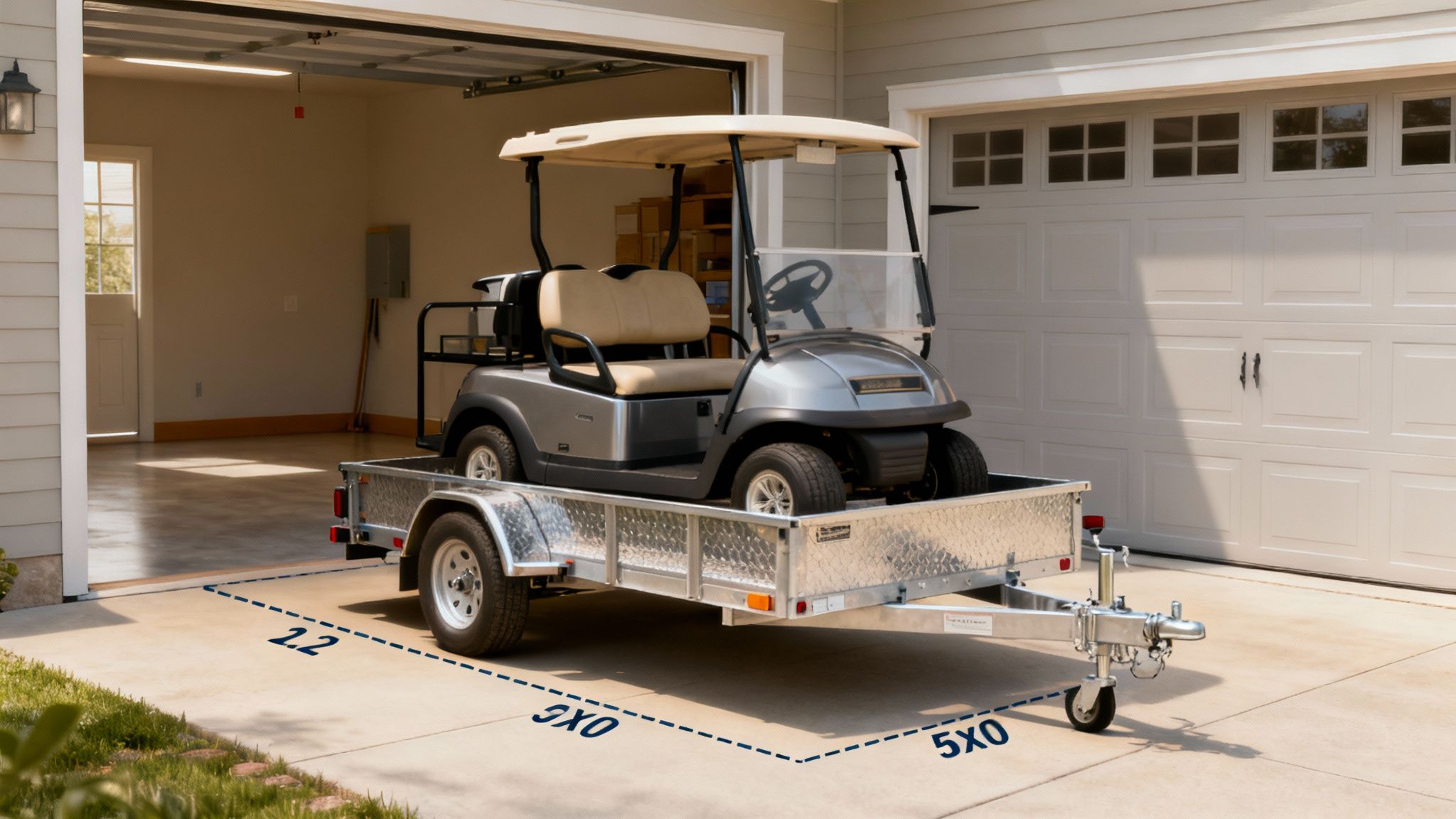
Knowing your golf cart's exact dimensions is the first step, but the real test is making sure it fits where you need it to go. Whether you're clearing out space in the garage or figuring out transport, it’s about more than just the cart's footprint.
The golden rule is to leave a 1 to 2-foot buffer on all sides. This isn't just for looks; it’s practical. You need that extra room to walk around, plug in the charger, and avoid scuffing up your cart or the walls. So, that standard 8-foot-long cart actually needs at least a 10-foot-deep spot to be comfortable. If you're working with a larger area for multiple carts, getting familiar with the typical dimensions of a 3-car garage can save you a lot of headaches down the road.
Finding the Right Trailer for Your Cart
Moving your cart is a similar story. You need a utility trailer that can handle both the size and the weight. A small 5×8 foot trailer might squeeze by for a compact two-seater, but a 5×10 foot trailer is a much safer bet for most standard two and four-passenger models. It gives you that wiggle room you'll be thankful for.
But don't stop at the dimensions. You absolutely have to check the trailer's payload capacity. This number tells you the maximum weight it can safely carry, and it needs to be higher than your cart's total weight, no exceptions.
Crucial Tip: A cart's battery type makes a huge difference in its total weight. Old-school lead-acid batteries are significantly heavier than their modern lithium-ion counterparts. Always confirm the manufacturer's specified weight before you even think about hooking up a trailer.
For those thinking about stowing their cart away for the off-season, proper planning is everything. To make sure your investment is protected from the elements, check out our in-depth guide to golf cart winter storage.
Frequently Asked Questions About Golf Cart Dimensions
When you're trying to figure out golf cart dimensions, a few common questions always pop up. Getting the right answers is key to avoiding those frustrating "uh-oh" moments, like realizing your brand-new cart is two inches too tall for the garage door or an inch too long for the trailer.
Let's tackle these common concerns head-on.
Will a Standard Golf Cart Fit in My Garage?
This is probably the number one question people ask, and for most standard 2-passenger carts, the answer is a resounding yes.
Your typical 2-seater is about 8 feet long, so it will easily fit inside a standard garage that’s at least 20 feet deep. You'll have plenty of room to walk around it. The game changes with extended models, though. Once you get into 4 or 6-passenger carts, which can be anywhere from 9.5 to 12 feet long, you absolutely need to break out the tape measure and check your garage depth first.
How Do Modifications Like Lift Kits Change the Size?
Here's where things can get tricky. People often forget that aftermarket modifications can completely change a cart's original dimensions, and a lift kit is the biggest culprit.
Its main job is to add height, but it affects width, too. Here’s a quick breakdown:
- Height: A simple 3-inch lift kit, paired with bigger, knobbier tires, can easily add a total of 5 to 6 inches to the cart's overall height.
- Garage Doors: This is a huge deal. The standard residential garage door opening is only 7 feet high. A lifted cart can easily sail right past that limit, so always measure your final height after the upgrades.
- Width: The wider stance from a lift kit and offset wheels can also tack on a few inches to the width. This might not seem like much, but it can be the difference between fitting on your trailer or not.
Expert Insight: After any modification, re-measure your cart from its highest, widest, and longest points. The stock dimensions you found online are out the window once you've customized your ride.
What Size Trailer Do I Need to Haul My Golf Cart?
Choosing a trailer isn't just about finding one that's long and wide enough. For most standard 2 and 4-passenger carts, a 5×10 foot utility trailer is a safe bet. If you've got a big 6-passenger "limo" cart, you’ll probably need to step up to a 6×12 foot trailer.
But here's the part people often overlook: payload capacity. A golf cart isn't light—most weigh between 900 and 1,200 lbs. You have to make sure your trailer is rated to handle that weight safely. Don't just assume; check the trailer's specs.
Ready to find an electric vehicle with the perfect dimensions for your needs? At Solana EV, we offer a range of stylish and reliable models designed to fit your lifestyle, from compact two-seaters to spacious campus shuttles. Explore our premium lineup and discover the future of electric mobility today at https://solanaev.com.