
When you're trying to pick between these two giants of the golf cart world, the choice really boils down to a simple question: are you looking for a smoother, more premium ride, or do you need rugged, practical value? Club Car has earned its reputation for exceptional ride quality, largely thanks to its rustproof aluminum frame. On the other side, EZGO is known for its workhorse-like durability and overall value, built on a tough welded steel frame.
Club Car vs EZGO A Quick Comparison
Choosing between Club Car and EZGO isn't just about the logo on the front; it's about matching the cart's DNA to your lifestyle. Both brands build fantastic, reliable vehicles, but they get there using completely different approaches to engineering. Let's start with a high-level look to see which brand might be the right fit for you before we get into the nitty-gritty details.
Club Car consistently markets itself as the more refined, premium choice. The big story here is its aircraft-grade aluminum frame—a huge plus for anyone living in coastal areas or humid climates where rust is a constant battle. This lighter frame, paired with a well-designed suspension, almost always delivers a noticeably smoother and more comfortable ride.
EZGO, in contrast, built its brand on being the dependable, high-value option. Its welded steel frame is incredibly strong and durable, making it a go-to for tough jobs and varied terrain. While you do have to keep an eye out for rust on a steel frame, it’s also much easier and cheaper to weld and repair if it ever gets damaged. EZGO also tends to push the envelope on technology, with its highly efficient AC drive motors and the popular ELiTE lithium battery platform being great examples.
Key Differentiators at a Glance
This quick summary gets right to the heart of what separates these two brands: the frame, the feel, and the price.
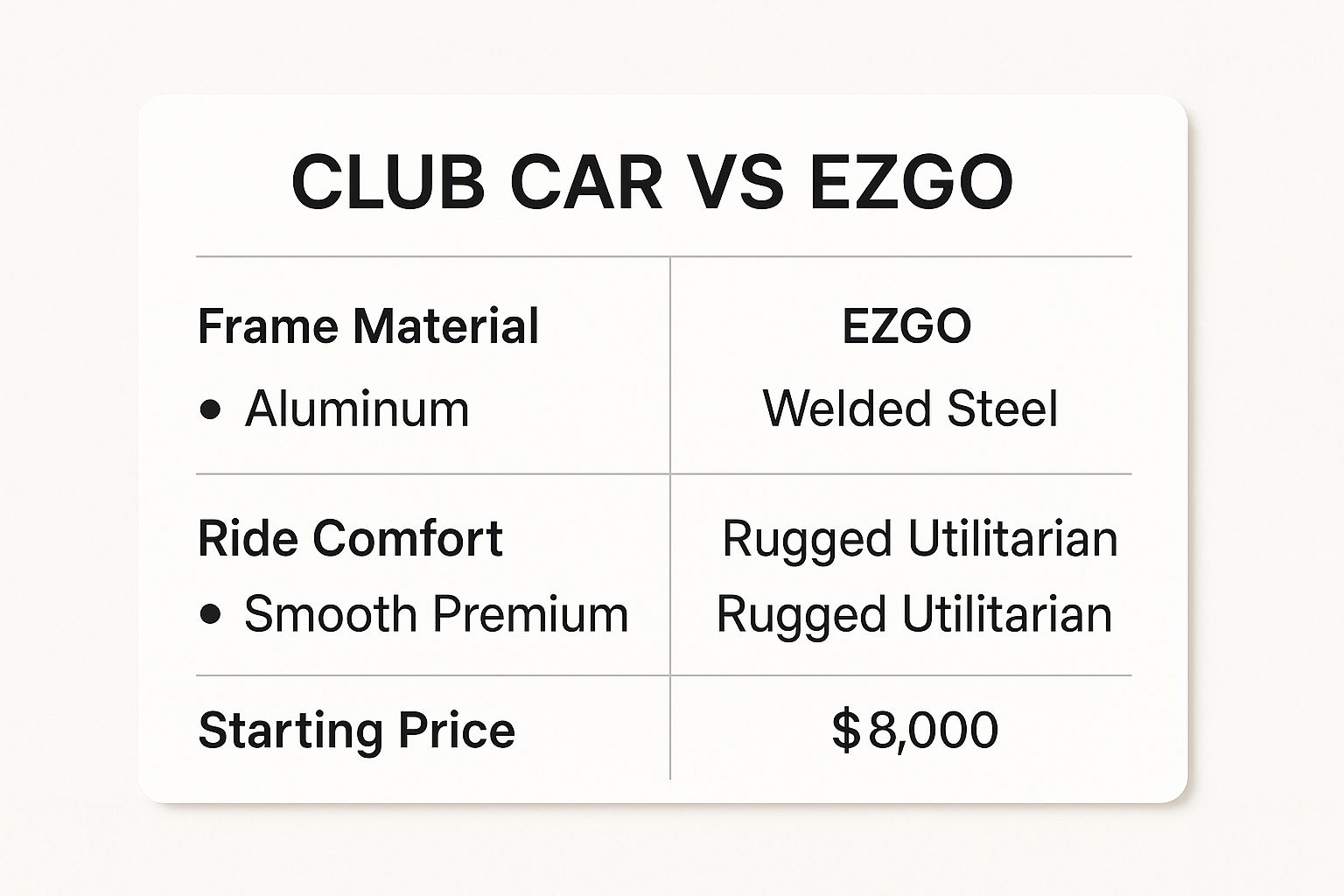
As you can see, the core design philosophy is clear. Club Car invests in a premium aluminum build, while EZGO prioritizes a utilitarian, cost-effective steel construction that’s built to last.
To make things even clearer, this table offers a snapshot of the most important distinctions between Club Car and EZGO golf carts.
Club Car vs EZGO Key Differentiators
| Attribute | Club Car | EZGO |
|---|---|---|
| Frame Material | Aircraft-Grade Aluminum | Welded Steel |
| Primary Strength | Corrosion Resistance & Smooth Ride | Durability & Value |
| Typical Price Point | Generally Higher | Generally Lower |
| Resale Value | Generally Higher | Generally Lower |
| Best For | Coastal areas, comfort seekers | Budget-conscious buyers, utility |
Ultimately, this table helps frame the decision. If you prioritize long-term rust prevention and the most comfortable ride possible, Club Car is likely your answer. If you're focused on upfront cost, sheer toughness, and practical utility, EZGO is probably the way to go.
Getting to Know the Carts and the Companies Behind Them
When you're trying to decide between a Club Car and an E-Z-GO, you're not just picking a vehicle—you're choosing between two industry giants. These aren't new kids on the block; they're titans with decades of history, each with a distinct approach to engineering that defines every cart they build.
Club Car kicked things off back in 1958 and has since carved out a niche for itself as the premium, refined option. Now owned by Platinum Equity, the brand has always been about delivering a superior feel on the road. This comes through in their signature all-aluminum frames and buttery-smooth suspension systems, which are designed to resist rust and provide a more comfortable ride.
A Tale of Two Philosophies
On the other side of the aisle, you have E-Z-GO. Founded in 1954, it's a key part of Textron—a massive global company with deep roots in aviation and defense. That powerful corporate background shines through in E-Z-GO's focus on practical, rugged innovation. They were pioneers in many of the technologies we take for granted today, like the super-efficient AC-drive system.
Their welded steel frames are built for strength and are notoriously easy to repair, making them a go-to choice for commercial fleets and anyone needing a tough, no-nonsense workhorse.
The real difference isn't just aluminum versus steel. It's about who they're building for. Club Car aims for the buyer who wants premium comfort and long-term durability, while E-Z-GO nails it for the user who needs proven, reliable technology that just works.
Together, these two brands are the undisputed kings of the hill. Club Car and E-Z-GO have dominated the global golf cart market for years, commanding over 37% of the industry's market share combined. That's not just a statistic; it's a testament to the trust they've earned over more than 60 years in business. They're the names you see everywhere, from pristine golf courses to sprawling residential communities.
This deep history means your choice goes beyond a simple feature list. To really understand how these different philosophies feel in the real world, check out our in-depth advanced EV golf cart reviews. Knowing their heritage gives you the context for why one cart feels like a luxury cruiser and the other feels like a trusty pickup truck—it's all by design.
Comparing Frame Construction and Ride Quality
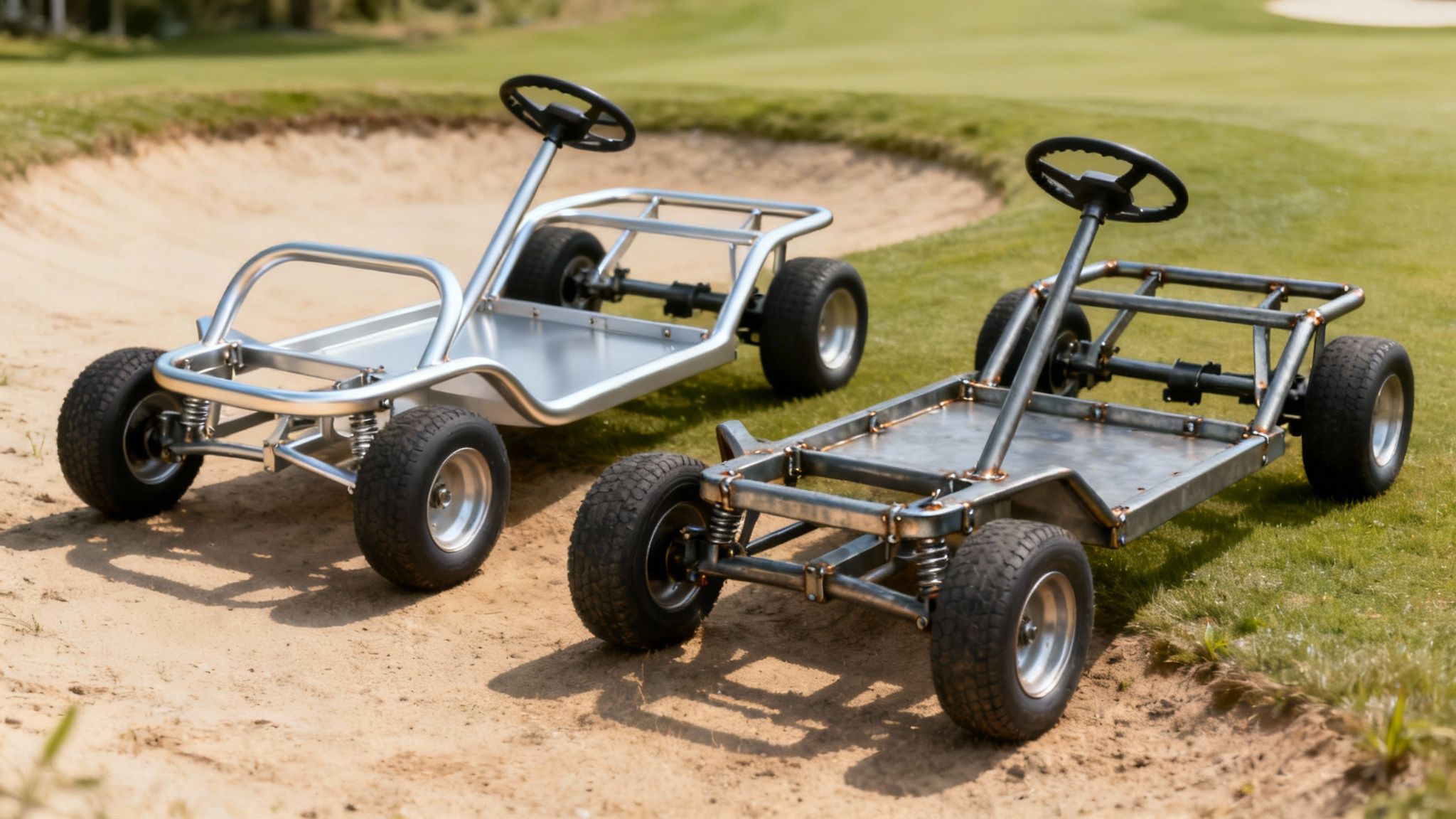
The real character of a golf cart doesn't show up on a spec sheet—it reveals itself the second you take the wheel. While both Club Car and E-Z-GO are dependable workhorses, how they feel on the move is fundamentally different. It all starts with the frame, the very skeleton that dictates everything from how long the cart will last to how it handles a bumpy path.
This single difference is probably the most critical factor in the entire Club Car vs. E-Z-GO debate because it shapes your day-to-day experience more than anything else.
Club Car has built its premium reputation on its signature aircraft-grade, all-aluminum frame. For anyone living in a coastal area or a high-humidity climate, this is a massive advantage. Aluminum just doesn't rust. Period. This design choice single-handedly eliminates the biggest long-term enemy of a cart's structural health. The lighter weight of the frame also helps create a more refined and cushioned ride, soaking up small bumps on the road with noticeable ease.
The Foundation of Feel
E-Z-GO, on the other hand, sticks with a more traditional and rugged approach: a welded steel frame. There's no denying steel is incredibly strong and rigid. It provides a solid, tank-like foundation that’s perfect for tough jobs and rough handling. A big upside to steel is that it's easy to fix. If you do manage to damage it, almost any local welding shop can patch it up affordably.
The trade-off, of course, is steel's vulnerability to rust. E-Z-GO treats its frames with protective coatings, but owners in wet climates need to stay on top of cleaning and maintenance to keep corrosion at bay. This basic material difference leads to two completely distinct driving dynamics.
Your choice between an aluminum and steel frame really boils down to your environment and what you value most. If you’re near the ocean, Club Car’s rustproof aluminum frame gives you incredible peace of mind and often a better resale value. But if you’re in a dry climate or need a cart for heavy-duty work, E-Z-GO’s tough, repairable steel frame offers a ton of practical, rugged value.
How Frames Translate to Real-World Performance
The frame material has a direct impact on how each cart feels on different surfaces. Let’s put it in a real-world context.
Imagine you're driving over the rolling fairways of a hilly golf course. A Club Car's lighter, more forgiving aluminum frame and independent front suspension work together to deliver a smoother ride over those bumps and dips. Your passengers will feel fewer jolts, making for a much more comfortable cruise.
Now, picture yourself hauling bags of mulch across a big property with a mix of grass and gravel paths. An E-Z-GO's rigid steel frame gives you a firm, connected-to-the-ground feel. It might not glide over imperfections as softly as the Club Car, but its stout construction feels incredibly stable and strong, especially with a heavy load in the back. The steering often feels more direct and responsive, adding to its work-ready personality.
Here’s a quick way to think about it:
- Cruising the neighborhood? The Club Car’s smoother suspension and quieter operation deliver a more car-like, comfortable experience for those leisurely drives.
- Tackling demanding terrain? The E-Z-GO’s sturdy steel frame gives you the confidence you need for utility jobs or navigating less-than-perfect paths where pure toughness is what matters.
At the end of the day, Club Car is engineered for a premium, refined feel. E-Z-GO is built for durable, no-nonsense performance. The right choice depends entirely on whether you prioritize cushioned comfort or unyielding strength.
Analyzing Powertrain and Battery Technology
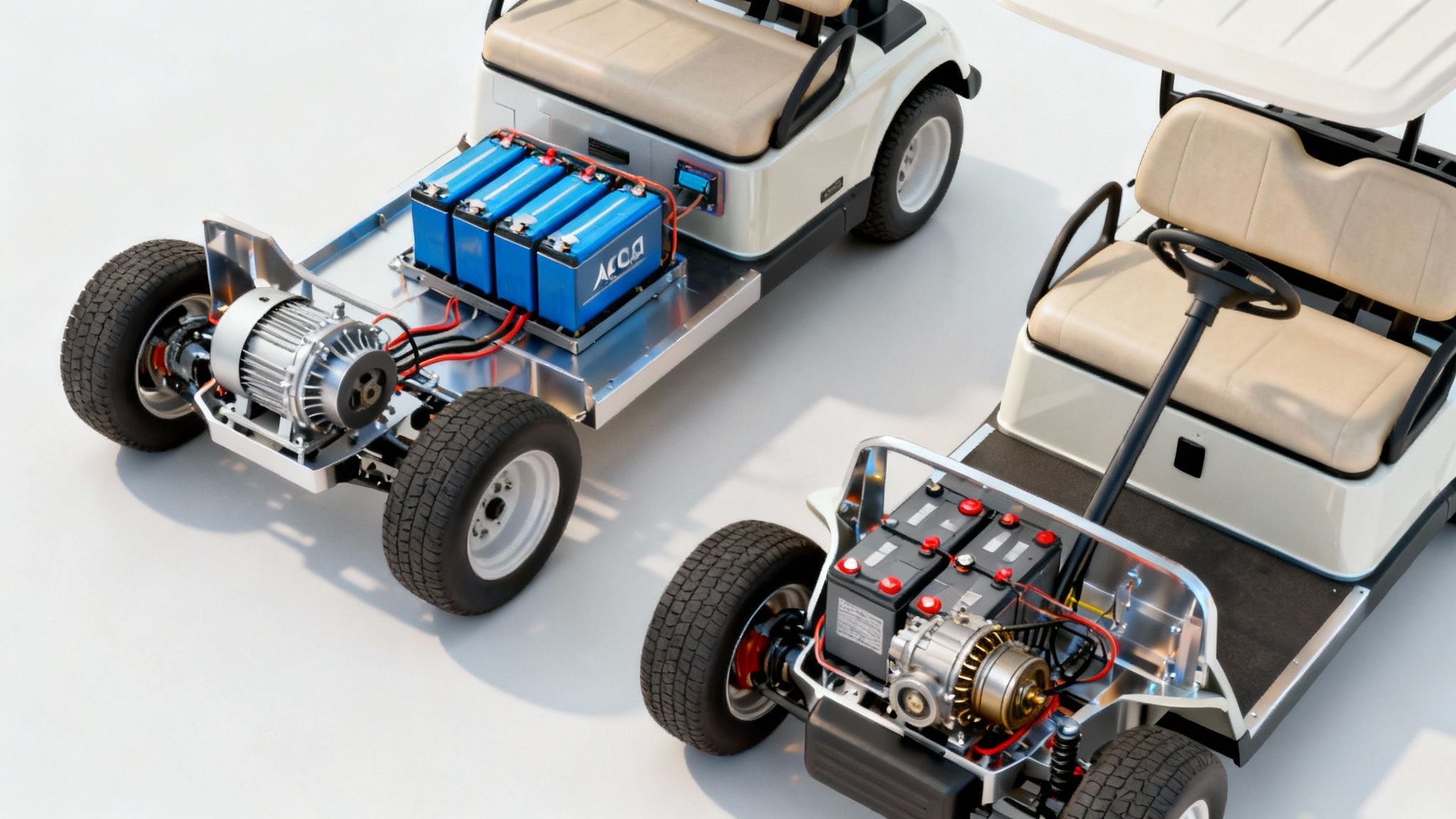
The real difference between modern electric vehicles isn't just the seats or the paint job—it's what's happening under the hood. For both Club Car and E-Z-GO, the powertrain is where the magic happens. Both brands have aggressively moved toward high-tech electric motors and are at the forefront of the shift away from old-school batteries. This evolution directly impacts how your cart performs, how much work it needs, and what it will cost you over time.
This isn't just a small trend. The golf cart world has been completely reshaped by electric power, with these models now making up roughly 52% of the global market. That's a massive leap from less than 30% just ten years ago, showing a clear demand for vehicles that are quiet, clean, and efficient.
Motor Technology And Performance
When you get behind the wheel of a premium Club Car, you can feel the difference their AC drive motor makes. They are engineered to deliver steady, impressive torque, which is a game-changer on hilly terrain. You won't get that dreaded slowdown on inclines; instead, you get smooth acceleration and a real sense of power, even when the cart is fully loaded.
E-Z-GO also uses powerful AC drive technology, especially in their flagship RXV models. But their secret weapon is the IntelliBrake™ system. This isn't just a brake; it's a smart system that combines an automatic parking brake with regenerative braking. As you slow down, it actually recaptures energy to feed back into the battery, extending your range. The driving feel is unique—the cart begins to slow down the moment you ease off the accelerator, giving you incredible control on slopes.
It really boils down to your preferred driving style. Club Car's powertrain feels raw and powerful, perfect for tackling tough landscapes. E-Z-GO’s IntelliBrake™ offers a more refined, one-pedal-style driving experience that many people love for its built-in safety and efficiency.
The Lithium-Ion Revolution
The single biggest leap forward for both Club Car and E-Z-GO has been the adoption of lithium-ion batteries. While you can still find traditional lead-acid models for a lower upfront cost, the lithium options are a window into the future of personal electric vehicles.
The table below breaks down the core differences between the two battery types.
Battery Showdown Lead-Acid vs Lithium-Ion
| Metric | Lead-Acid Batteries | Lithium-Ion Batteries |
|---|---|---|
| Performance | Power fades as the battery drains. Struggles on hills when low. | Delivers consistent, full power until completely discharged. |
| Charging Time | Typically 8-12 hours for a full charge. | Much faster, often charging in just 2-4 hours. |
| Lifespan | 3-5 years on average with proper maintenance. | Can last 8-10 years or more, often double the lifespan. |
| Maintenance | Requires regular watering, terminal cleaning, and equalization. | Zero maintenance. Completely sealed and hassle-free. |
| Weight | Very heavy, which can impact acceleration and turf compaction. | ~75% lighter, improving efficiency and handling. |
As you can see, the benefits of lithium are substantial. E-Z-GO’s ELiTE Lithium line, powered by Samsung SDI battery cells, has really set the standard for efficiency and durability. Not to be outdone, Club Car’s HP Li-Ion batteries deliver outstanding range and performance. To dive deeper into this technology, check out our complete guide to golf cart lithium batteries.
Ultimately, choosing lithium for either brand gets you a lighter, faster-charging, and maintenance-free cart that will perform better for years to come.
Evaluating Customization Options and Overall Value
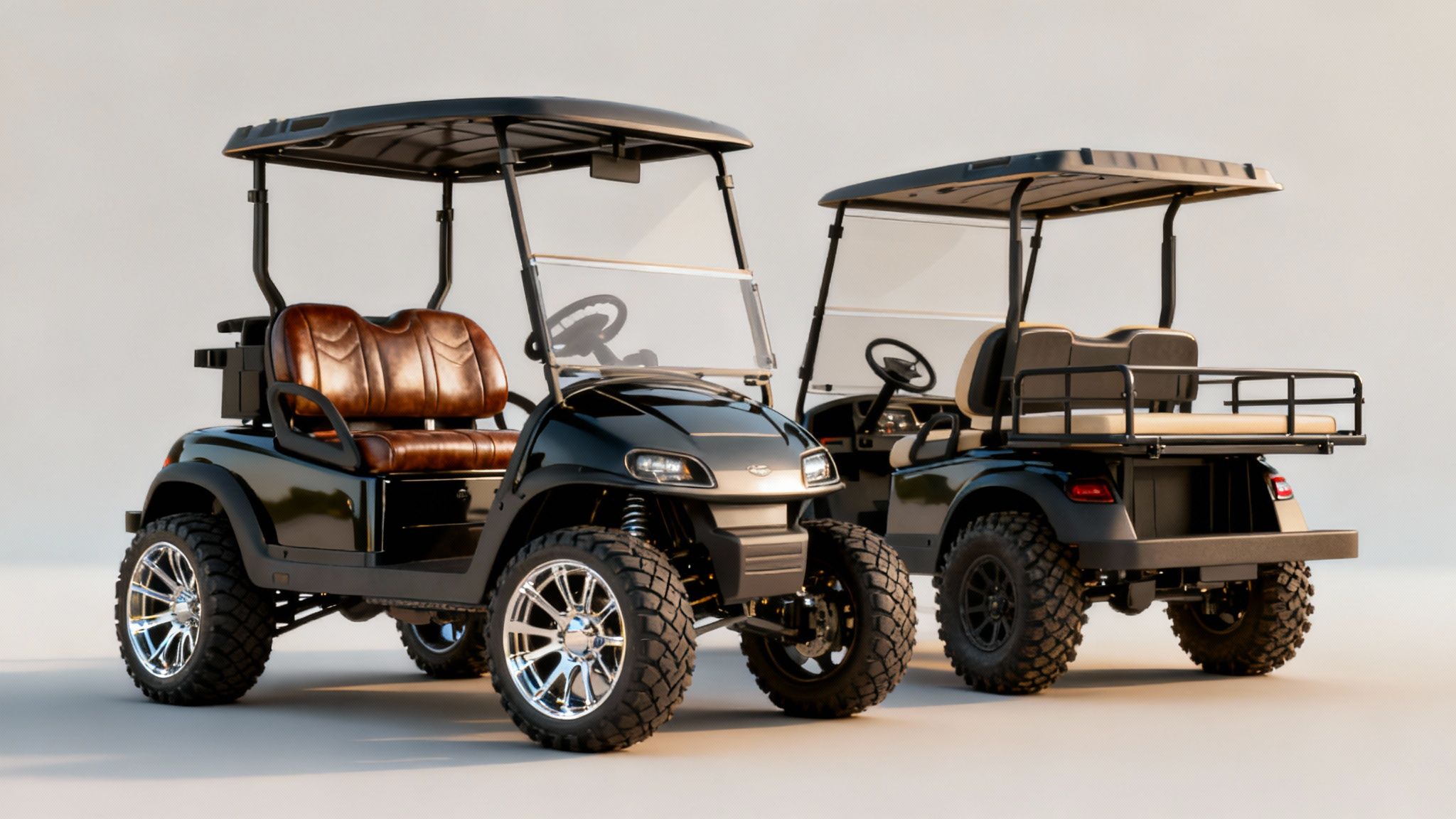
A golf cart is a lot more than just a way to get around the course or the neighborhood; it's a personal statement. So when you're weighing Club Car against E-Z-GO, the sticker price is just the beginning of the story. The real measure of value comes from what you can do with the cart, how much it costs to keep it running, and what it’s worth down the road.
Both Club Car and E-Z-GO give you a ton of options right from the factory, letting you spec out your perfect ride before it even leaves the assembly line. Club Car’s Onward series is a perfect example—it’s built to be configured. You can pick everything from premium stitched seats and integrated sound systems to factory-installed lift kits, all with the peace of mind that it's a high-quality build covered by the manufacturer's warranty.
E-Z-GO is no slouch in this department either, especially with models like the Liberty and Express. Where E-Z-GO really pulls ahead, though, is in the aftermarket world. The sheer popularity and standardized build of carts like the TXT and RXV have created a massive playground of third-party accessories that are often much easier on the wallet.
Aftermarket Flexibility vs. Factory Integration
If you’re the type who loves to tinker and personalize, E-Z-GO is practically a blank canvas. An endless ecosystem of aftermarket suppliers means you can find just about any lift kit, wheel package, or body kit imaginable at very competitive prices. It's a DIYer's dream.
Club Car has a healthy aftermarket scene too, but you’ll often find that parts carry a slightly higher price tag, which fits its more premium positioning. The real payoff with customizing a Club Car comes when it’s time to sell. A well-kept, tastefully upgraded Onward will almost always fetch a higher resale price than a comparable E-Z-GO, largely thanks to its rustproof aluminum frame and solid brand reputation.
It really boils down to your approach. Do you want a premium, integrated customization experience from the factory that holds its value? Go with Club Car. Or do you want a more affordable and flexible platform for your own creative touch? That's where E-Z-GO shines.
Understanding Long-Term Value and Cost of Ownership
Looking past the initial purchase, the longevity of your investment is what really counts. Personal electric vehicles are booming. In the U.S., golf cart sales are expected to grow at a compound annual rate of 4.3% through 2032. And while they're popular everywhere, golf courses still make up nearly 28% of the market. This steady demand ensures parts and service for both brands will be easy to find for years to come.
This is where build materials make a real difference. Club Car's corrosion-resistant frame gives it a huge leg up, especially if you live in a coastal or humid area. That durability is a major reason for its strong resale value. On the other hand, E-Z-GO’s steel frame requires a bit more care to keep rust at bay. If neglected, it can definitely impact its long-term value.
For anyone looking to make their cart one-of-a-kind, be sure to check out our guide on inspiring golf cart customization ideas.
At the end of the day, Club Car often proves to be the better long-term financial bet, while E-Z-GO delivers fantastic upfront value and unmatched flexibility for modifications.
Making the Right Choice for Your Needs
So, how do you choose? When the spec sheets start to blur together, the best way to decide between a Club Car and an E-Z-GO is to think about how and where you'll actually be using it. Your daily environment and priorities are what really matter.
We've already looked at the frames, motors, and price tags. Now, let’s get practical and walk through a few real-world scenarios. This is where you can see which cart truly fits your life.
For the Avid Golfer on a Hilly Course
If you're a serious golfer, you know performance isn't just a number—it's about how the cart handles the course. You need a vehicle that can climb a steep hill without flinching and provide a smooth ride from the first tee to the eighteenth green. In this arena, Club Car often gets the nod.
Its beefy AC motor delivers consistent torque, so you won't lose momentum on inclines, even when you're loaded down with a partner and two sets of clubs. The combination of a premium suspension and a rigid aluminum frame translates into an incredibly smooth ride over bumpy fairways, which makes a big difference by the end of a long round.
While a high-end E-Z-GO RXV is a fantastic and efficient machine, the refined feel and raw power of a Club Car give it a clear edge on more demanding courses.
Our Recommendation: A Club Car Onward or Precedent, especially one equipped with an HP Li-Ion battery, hits the sweet spot of power, comfort, and premium feel that a dedicated golfer will appreciate.
For the Family in a Coastal Community
Living near the coast is beautiful, but the salt air is absolutely brutal on metal. High humidity and salty breezes will go to work on a steel frame immediately, making long-term durability your number one priority. This is one area where there's no contest: Club Car’s all-aluminum frame is the undisputed champion.
You simply don't have to worry about rust. That peace of mind is huge, and it also does wonders for the cart’s resale value down the line. Beyond the frame, popular models like the Onward are designed for family life, offering plenty of factory-installed safety features and fun customization options like premium sound systems and comfortable four-passenger seating.
For the Practical Property Owner
Need a tough-as-nails workhorse to haul tools, bags of feed, or landscaping supplies around your property? Here, your focus shifts to durability and value. For this kind of work, E-Z-GO often emerges as the smarter choice.
Its rugged, welded steel frame is built to take a beating. And if you do manage to damage it, repairs are usually simpler and less expensive than on an aluminum frame.
Better yet, the aftermarket support for models like the E-Z-GO TXT and Express is massive. You can find utility beds, trailer hitches, and countless other accessories for a fraction of what you might pay for factory options. This no-nonsense, practical approach makes E-Z-GO a favorite for people who need rugged utility more than they need a country-club-smooth ride.
Frequently Asked Questions
As we round out this comparison, let's tackle some of the most common questions people have when weighing Club Car against E-Z-GO. These final details should help you make your choice with confidence.
Which Brand Is More Reliable Long-Term?
Both Club Car and E-Z-GO have built their names on reliability, but they take different paths to get there. The big differentiator is the frame. Club Car’s rustproof aluminum frame gives it a serious advantage for longevity, especially if you live in a humid or coastal area where corrosion is a constant battle.
E-Z-GO uses a welded steel frame, which is incredibly tough but needs a bit more care to fend off rust over the years. If you're looking for a cart that will hold up to the elements with less fuss for 15-20 years, Club Car usually gets the nod.
Are Maintenance Costs Higher for Club Car or E-Z-GO?
For routine upkeep, the costs are pretty similar. Things like tires, brakes, and standard batteries are priced competitively across both brands. Where you might see a difference is in the world of aftermarket parts.
E-Z-GO, particularly the wildly popular TXT model, has a massive and affordable third-party parts market. Club Car parts, especially original factory ones, can sometimes carry a higher price tag, which fits its more premium positioning. You'll notice this most when it's time to replace a major component.
Which Brand Holds Its Value Better?
This one's pretty clear-cut: Club Car almost always holds its value better than E-Z-GO. It's a huge factor when you think about the total cost of owning the cart over its lifetime.
The combination of its non-corrosive aluminum frame, premium brand perception, and reputation for durability means that a well-maintained Club Car can retain a significantly higher percentage of its original price. For buyers focused on long-term investment, Club Car is the stronger choice.
What Is the Main Difference Between Their Gas Models?
When you look at the gas-powered carts, the engine is the heart of the matter. Club Car tends to favor powerful Kawasaki engines, which are well-known for running quietly and reliably.
On the other hand, E-Z-GO often uses its EX1 closed-loop EFI gas engine. This engine is praised for being incredibly fuel-efficient and delivering smooth, consistent acceleration.
At Solana EV, we believe in matching you with the perfect electric vehicle for your lifestyle. Explore our full lineup of premium, street-legal carts today. Find your perfect ride.
Absolutely indited content, Really enjoyed examining.
There are some attention-grabbing points in time in this article however I don’t know if I see all of them center to heart. There is some validity but I’ll take maintain opinion till I look into it further. Good article , thanks and we want extra! Added to FeedBurner as properly