
So, how fast can a golf cart really go?
Let's cut right to the chase. Your typical, out-of-the-box golf cart usually tops out somewhere between 12 and 25 mph. It's not built for the racetrack; think of it more like a trusty neighborhood cruiser. This speed range isn't an accident—it's a deliberate balance of getting you where you need to go without sacrificing safety, especially on the course or in a quiet community.
Understanding The Baseline Golf Cart Speed
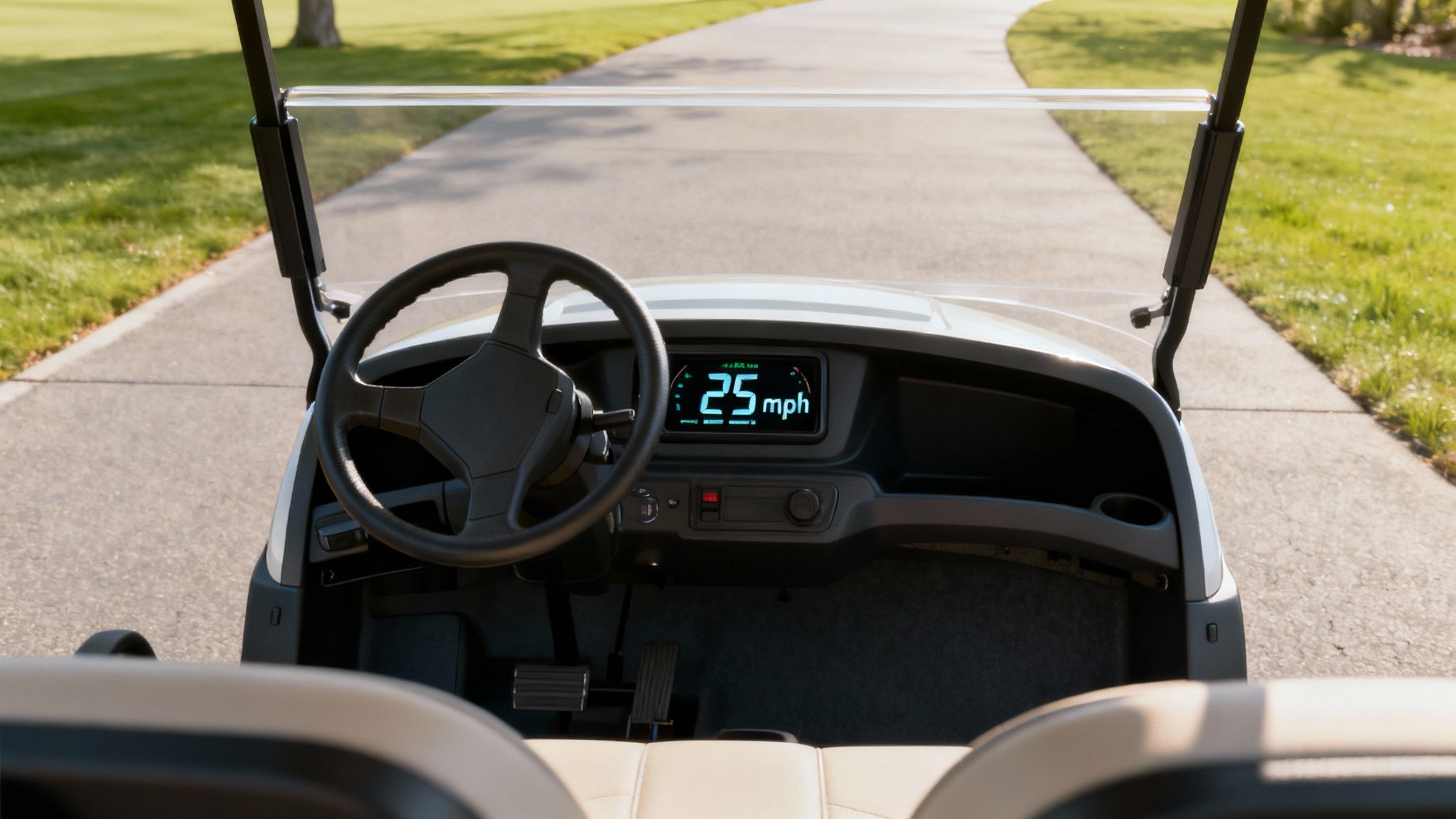
That standard speed isn't just a random number. It's the result of decades of real-world use and safety thinking. The very first golf carts back in the 1930s puttered along at about 12-15 mph, which was perfect for a relaxed trip from one hole to the next. Even with all the technology we have today, that fundamental idea of controlled, safe speed is still at the heart of their design.
For both safety and practical reasons, most carts are engineered to operate between 12 and 25 mph. You'll often find that golf course managers and even local towns set their own limits, with 19 mph being a common cap to keep things moving efficiently while minimizing the risk of accidents.
To give you a quick snapshot, here’s how different types of carts generally stack up.
Typical Golf Cart Speeds at a Glance
This table breaks down the common speed ranges you can expect from standard, modified, and street-legal golf carts. It's a great starting point for understanding what's possible.
| Cart Type | Average Speed (mph) | Typical Top Speed (mph) |
|---|---|---|
| Standard Golf Course Cart | 12-15 | 19 |
| Privately Owned/Modified Cart | 15-20 | 25+ |
| Street-Legal (LSV) Cart | 20-25 | 25 (by law) |
As you can see, the "right" speed really depends on where and how you plan to use your cart.
Key Factors Influencing Speed
Right from the factory, a few core components dictate your cart's get-up-and-go. Getting a handle on these is the first step before you even think about upgrades.
- The Motor: This is the heart of your cart. Whether it’s a traditional DC (Direct Current) motor or a more modern, efficient AC (Alternating Current) one, it sets the ceiling for power.
- The Battery System: Think of the voltage (36V, 48V, or 72V) as the size of the fuel tank. More voltage generally means more potential for both speed and torque.
- Factory Settings: Manufacturers almost always install a speed governor or program the controller to limit the cart’s top end. It's a built-in safety measure.
It's not just about raw speed. What often matters more is usable power—the kind that gets you up a steep hill without slowing to a crawl or provides a smooth, quick acceleration from a standstill.
Why Speed Varies So Much
Ever wonder why your neighbor's cart seems to fly while another just ambles along? It all comes down to its intended job. A cart designed purely for the greens is programmed to be slower and gentler.
On the other hand, a street-legal low-speed vehicle (LSV) is built to hit 25 mph so it can safely keep pace with local traffic. If you're curious what a truly performance-focused machine is capable of, you should check out our guide to the fastest electric golf carts.
Stick with us, because we're about to dive into everything that makes your cart tick—from the motor to the tires and the laws that govern it all.
What Really Powers Your Cart's Speed
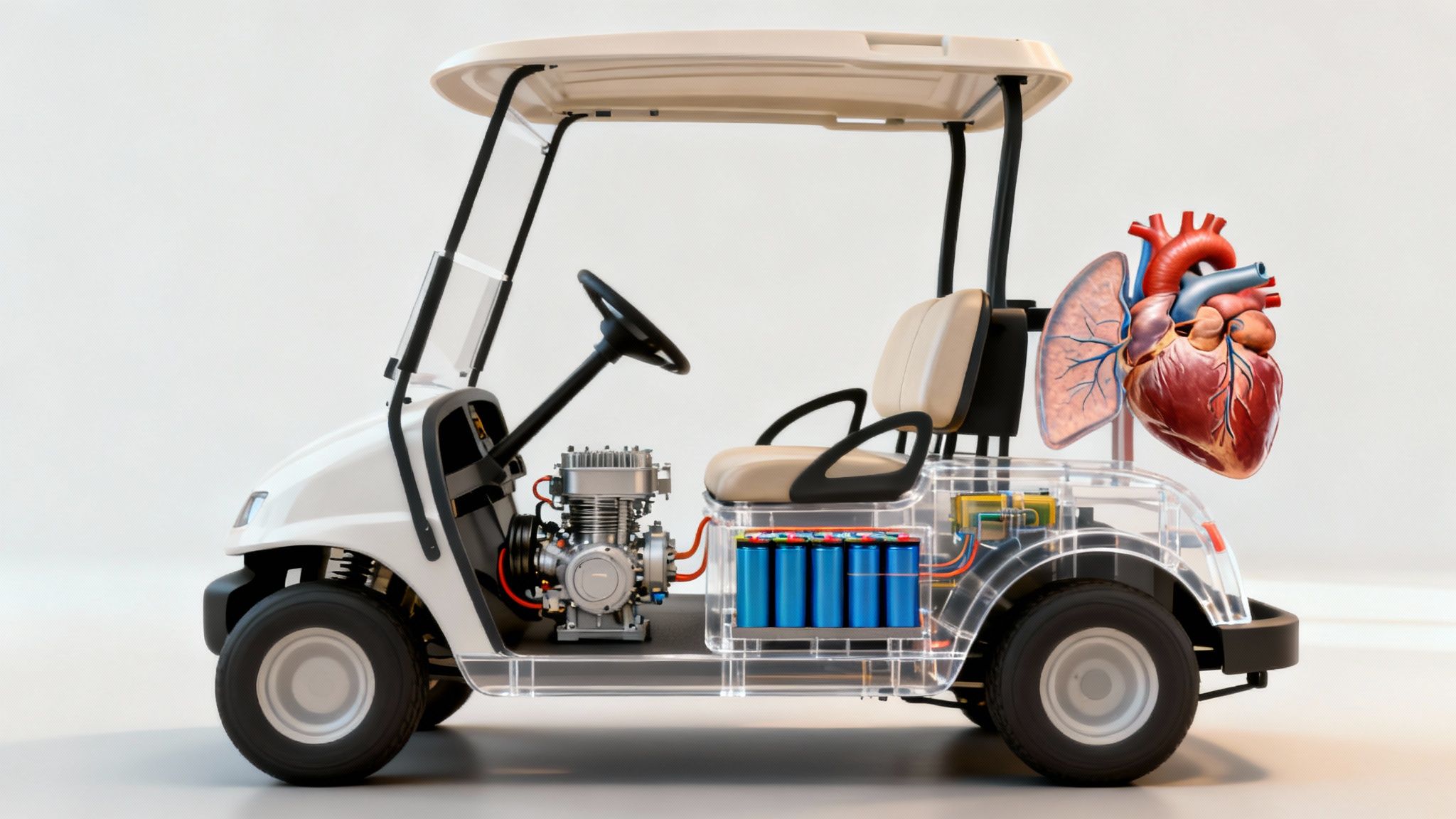
To really get what makes a golf cart fast, you've got to look under the seat. It’s best to think of your cart like an athlete. The motor is the heart, pumping out the raw power, while the battery system acts as the lungs, supplying the energy to keep it all going.
These two parts have to work in perfect harmony. When you push the accelerator, you're not just flipping a switch—you're managing a flow of energy that dictates everything from how quickly you get going to how fast you can ultimately go. Let's dig into the components that make it all happen.
The Heart of the Machine: Your Motor
The motor is where the real work gets done. It takes the electrical energy stored in your batteries and converts it into the mechanical force that spins the wheels. For a long time, the industry standard was the DC (Direct Current) motor—a dependable, no-frills workhorse. But things have changed. Today, AC (Alternating Current) motors are the new standard for high-performance carts, including the entire Solana EV lineup.
So, what's the actual difference between them?
- DC Motors: These are the old guard. They're great for delivering solid torque right from a dead stop. While simple and reliable, they tend to be less efficient, create more heat, and require more upkeep over their lifespan (like replacing the brushes).
- AC Motors: This is the modern technology. AC motors are way more efficient, giving you smoother acceleration and much better hill-climbing power. They also enable regenerative braking, which can actually send a bit of power back into the battery when you slow down. That efficiency boost often means a higher top speed and more miles on a single charge.
A cart powered by a modern AC motor just feels different—it's more responsive and zippy, especially when you're taking off or tackling a steep incline. It's the difference between a steady jogger and a sprinter exploding off the blocks.
The Lungs of Your Cart: The Battery System
If the motor is the heart, then the battery is absolutely the lungs. It’s the energy tank that decides how much power you have on tap and for how long. The most important number to know here is voltage. Golf cart systems are typically rated at 36V, 48V, or 72V.
A good way to think about voltage is to compare it to water pressure. A 36V system is like a regular garden hose—it does the job just fine. A 48V system is more like a firefighter's hose, delivering more power with a lot more force. And a 72V system? That's basically an industrial pressure washer.
More voltage allows the motor to pull power more easily, which has a direct and immediate impact on your golf cart speed and its ability to accelerate. A higher-voltage system doesn't have to strain as much to produce the same result, meaning less wear on the components and more consistent power, even as the battery level drops. If you're really looking for top-tier performance, understanding how a modern power source changes the game is key. You can check out our guide on the benefits of a golf cart lithium battery conversion to see how transformative it can be.
The Brains Behind the Brawn: The Speed Controller
The motor and battery pack provide the potential for speed, but the speed controller is the brain that actually manages it. This little electronic box is the gatekeeper, regulating the flow of electricity from the batteries to the motor. A typical electric cart might have a 3-5 horsepower motor, but the controller is what tells it how hard to work.
By swapping out a factory-standard 250-amp controller for a more robust 400-amp or 500-amp unit, you're essentially opening the floodgates for more electricity to reach the motor. When you pair this upgrade with a powerful motor, you unlock huge gains in both torque and top speed. You're giving the system permission to run at its full, thrilling potential.
How External Factors Impact Your Cart's Performance
The motor and battery might be the heart of your golf cart, but they don't operate in a bubble. The moment your wheels touch the ground, the real world starts to weigh in. Everything from the surface you're driving on to the weight you're carrying can dramatically change your cart's actual golf cart speed.
Think of it this way: an Olympic sprinter sets records on a perfect, modern track. But ask that same athlete to run through thick sand or mud, and you'll see a much different result. Your golf cart is exactly the same. Its environment either helps it glide along efficiently or creates resistance that holds it back.
The Ground Beneath Your Wheels
The terrain you're driving on is one of the biggest and most immediate factors. A smooth, paved road offers almost no resistance, letting your cart hit its top speed without the motor breaking a sweat. It's the perfect scenario for both speed and battery life.
But the second you steer off the pavement, your cart has to start working harder.
- Gravel and Dirt Paths: These create more friction, forcing the motor to use extra energy just to keep you moving forward.
- Grass and Off-Road Trails: Driving across a soft lawn or a bumpy trail means the tires are constantly fighting for grip, which adds a surprising amount of rolling resistance.
- Sand or Mud: These are the ultimate speed killers. The tires sink right in, and the motor has to work overtime just to push through the heavy, shifting ground.
This infographic really puts into perspective how terrain—along with tire pressure and payload—drags down your cart's potential.
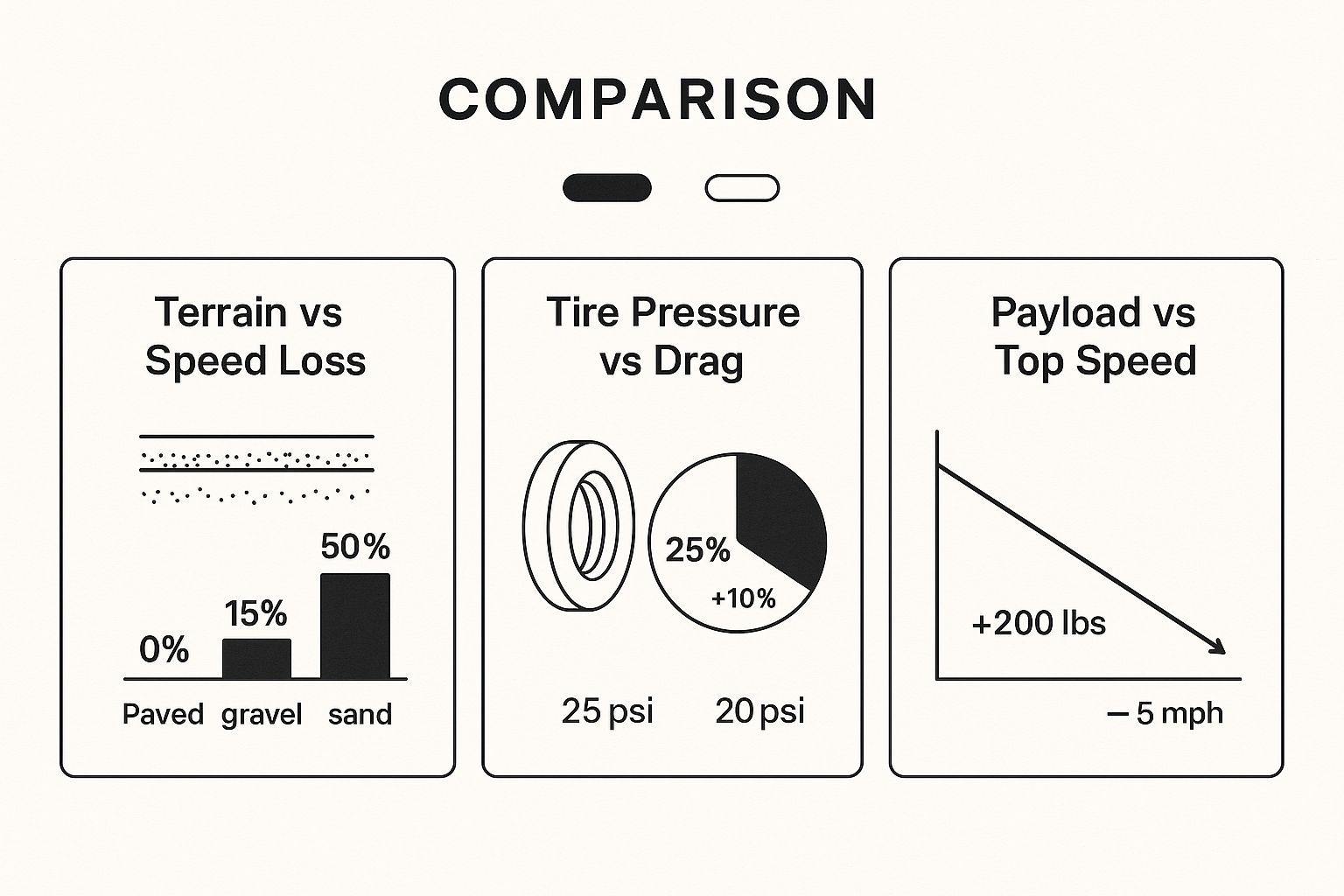
As you can see, just moving from pavement to sand can literally cut your speed in half. That’s a huge difference, and it shows just how much the ground matters.
The Critical Role of Tire Pressure
It's so easy to overlook, but tire pressure has a massive impact on your cart's speed and efficiency. When tires are properly inflated, they have a smaller "contact patch" with the ground, which means less rolling resistance. It's like trying to ride a bike with flat tires—every single pedal stroke feels like a monumental effort because the soft rubber is dragging against the road.
The exact same thing happens with your cart's under-inflated tires. The tire flattens out, increasing its footprint on the ground and creating drag that not only slows you down but also drains your battery much faster. In fact, studies show that under-inflated tires can increase rolling resistance by as much as 15%.
Maintaining the manufacturer's recommended tire pressure is one of the easiest and cheapest ways to ensure you’re getting the best possible speed and range from your cart. It’s a simple check that pays big dividends in performance.
Even being a few PSI below the recommended level is enough to make your cart feel sluggish. The size of your tires also plays a big part in performance, which you can learn all about in our golf cart tire size guide.
How Weight Changes the Equation
Finally, let's talk about weight. The total load your cart is carrying—including you, your passengers, and any gear—has a direct effect on both acceleration and top speed. A standard electric golf cart weighs between 900 and 1,100 pounds all by itself. Every extra pound you add is more work for the motor.
You'll notice this most when accelerating from a standstill or trying to climb a hill. As a rule of thumb, for every 100 pounds of extra payload, you can expect to lose between 0.5 and 1 mph of top speed. That might not sound like a lot, but adding a couple of friends and a cooler could easily shave a few miles per hour off your top end, which you'll definitely feel on an incline. The team at Cutting Edge Golf has some great insights into how weight influences performance.
Navigating Street-Legal Speed Limits
Taking your golf cart off the course and onto public roads is a popular move for a lot of owners. Who wouldn't want the freedom to zip over to a neighbor's house or run a quick errand without firing up the car? But making that happen involves more than just a need for speed—you've got to know the law.
There's a night-and-day difference between a standard golf cart and a vehicle that’s legally allowed to share the road with cars. You can't just take a cart built for the fairway and drive it in traffic. For that, it needs to be officially classified as a Low-Speed Vehicle (LSV).
The Low-Speed Vehicle Distinction
So, what exactly turns a golf cart into an LSV? It’s all about a specific set of federal rules designed to make sure these vehicles meet minimum safety standards for road use. Think of it as the official upgrade that gives your cart a hall pass to operate in a whole new environment.
The LSV designation comes with some very specific speed requirements. The vehicle has to be able to hit at least 20 mph, but its top speed cannot go over 25 mph. That narrow window is completely intentional. It allows the cart to keep up with local traffic without being dangerously fast.
An LSV isn't just a faster golf cart; it's a reclassified vehicle with a unique legal identity. This status is what separates a recreational toy from a legitimate, road-ready mode of transportation.
But speed is only part of the equation. The real transformation into an LSV involves adding a checklist of essential safety equipment. These features are non-negotiable and are what truly make the vehicle safe for public roads.
Standard Golf Cart vs Street-Legal LSV
To really understand the difference, it helps to see the requirements side-by-side. One is designed for a closed course, while the other is equipped for the open road.
| Feature | Standard Golf Cart | Street-Legal LSV |
|---|---|---|
| Top Speed | Typically 12-19 mph | 20-25 mph |
| Headlights/Taillights | Optional | Required |
| Turn Signals | Not Required | Required |
| Seat Belts | Optional | Required |
| Mirrors | Optional | Required (Rear & Side) |
| Windshield | Optional Plastic | Required (Safety Glass) |
| VIN | No | Required (17-digit) |
| Registration/Plate | No | Required |
As you can see, the LSV is held to a much higher standard, bringing it closer to the safety and legal requirements of a traditional car.
Essential Safety Gear for LSVs
To meet federal standards, an LSV must be kitted out with several key safety components, just like your car. These aren't fancy add-ons; they are mandatory for getting your vehicle registered and plated.
- Headlights, Taillights, and Brake Lights: Absolutely essential for visibility, making sure other drivers can see you, especially at dawn, dusk, or in bad weather.
- Turn Signals: You have to be able to communicate your intentions to other drivers on the road.
- Seat Belts: A basic safety feature that's required for every single passenger.
- Windshield: This can't be just any piece of plastic; it has to be an approved type of safety glass to protect you from road debris.
- Mirrors: You'll need both rearview and side-view mirrors to get a complete picture of your surroundings.
- Vehicle Identification Number (VIN): Just like a car, an LSV needs a unique 17-digit VIN for registration and identification purposes.
Once all these upgrades are in place, the vehicle can finally be registered, insured, and plated. That's the process that makes it officially street-legal.
State and Local Rules Matter
While the federal government sets the baseline for what an LSV is, states and even local towns have the final say on where you can drive one. For a golf cart to be street legal, it must be classified as an LSV under Federal Motor Vehicle Safety Standard 500, but local rules often add another layer of regulation.
For example, many places only allow LSVs on roads with a posted speed limit of 35 mph or less. You can dive into the specifics of these laws by exploring resources like California’s vehicle codes.
This is why you see entire communities in places like Charleston, SC, or The Villages, FL, designed around golf cart transportation, with their own paths and cart-friendly roads. On the flip side, other cities might have much tighter rules, limiting LSV use to certain areas or times of day. It’s always on you to check your local ordinances before you hit the road. If you ignore these regulations, you could face fines and legal trouble—especially since a modified cart that goes faster than 25 mph is immediately disqualified from being an LSV.
How to Safely Increase Your Golf Cart Speed
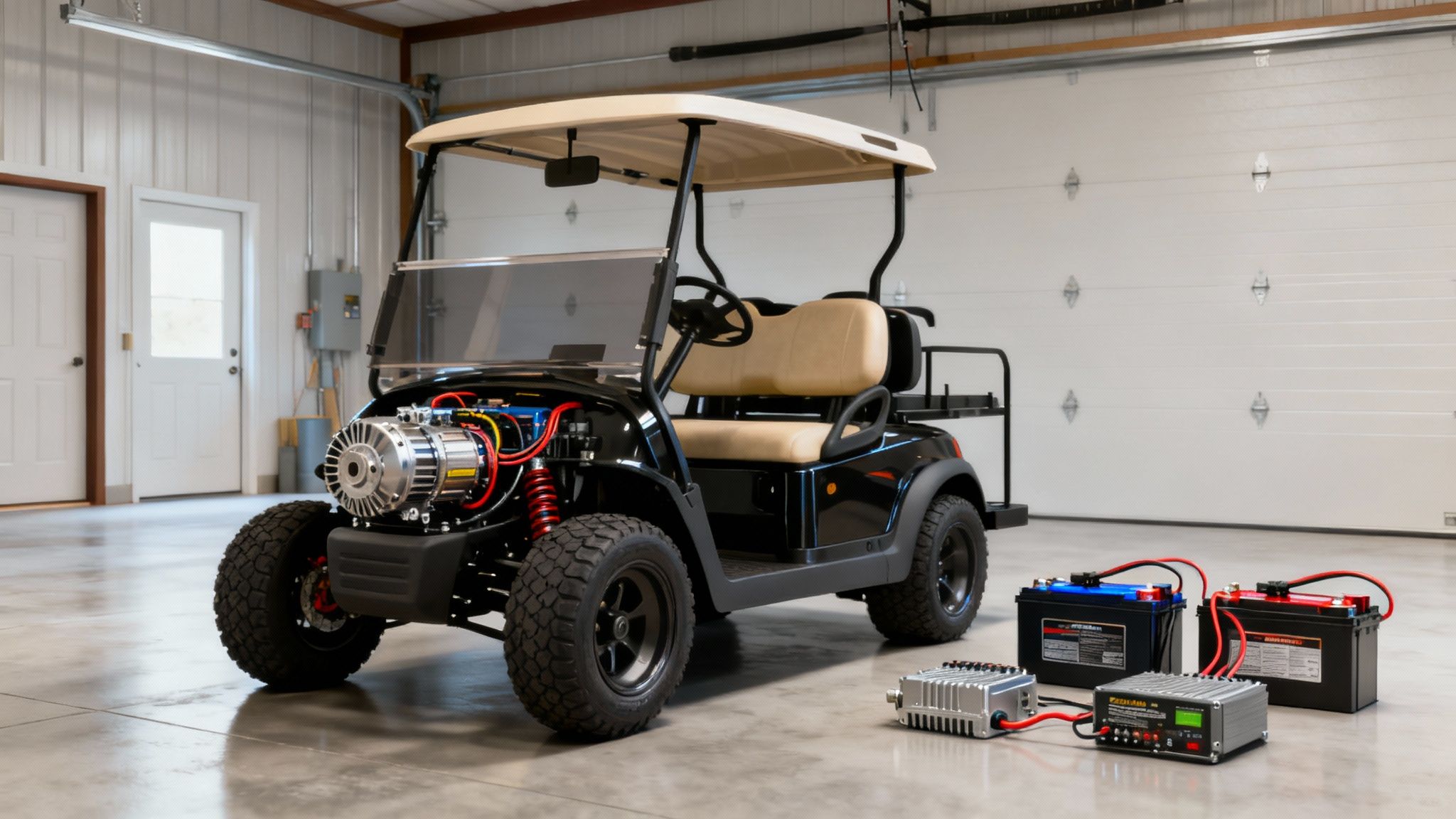
So, you understand what makes a golf cart tick, and now you're wondering how to get a little more zip out of it. It’s a common next step. But making your cart faster isn't just about dropping in a bigger motor; it's about making sure all the parts can work together without causing problems down the road.
Think of it like building a high-performance car. You wouldn't put a massive turbo on a stock engine and expect it to last. The same logic applies here—every upgrade needs to support the others to give you that extra golf cart speed safely and reliably.
Start with the Brains: The Speed Controller
The easiest place to start, and often the most impactful, is the speed controller. This little box is essentially your cart's brain, telling the motor how much power to draw from the batteries. Most stock controllers are programmed to be conservative, keeping speeds low to save battery life on the course.
Upgrading or reprogramming it is like taking the governor off. Suddenly, your cart can access its true potential.
- Reprogramming: A technician can often hook up to your existing controller and simply adjust the settings to allow for a higher top speed. It's like unlocking a feature that was already there.
- Replacement: For a more significant jump, you can swap it out for a higher-amperage controller. Going from a stock 250-amp unit to a 400-amp aftermarket one will give you a much quicker takeoff and a higher top speed.
This upgrade is the foundation. A beefy new motor is completely wasted if the controller is still holding back the power.
Upgrade the Heart for More Power
If the new controller gives you a taste for speed, a motor upgrade is the main course. This is the most direct path to a serious performance boost. Aftermarket motors are built from the ground up to handle higher RPMs and deliver more torque, which translates to more speed and better hill-climbing power.
Now, this is where system balance becomes non-negotiable. A stronger motor is going to demand a lot more electricity. Your stock controller and wiring probably aren't up to the task and could easily overheat or fail. That's why a motor upgrade almost always has to be paired with a new controller and thicker battery cables. For a deeper dive into how these components interact, check out this comprehensive guide to making a golf cart faster.
Increase Voltage for Higher Performance
Another popular route is to increase your cart's system voltage. Jumping from a standard 36-volt system to a 48-volt one makes a huge difference. Think back to our water hose analogy—higher voltage is like cranking up the water pressure. It pushes power to the motor with more force and efficiency.
This isn't a simple battery swap, though. Pushing 48 volts through a system designed for 36 will fry your electronics.
Key Considerations for a Voltage Upgrade:
- Controller Compatibility: You'll need a new controller rated for 48 volts. No exceptions.
- Solenoid: This heavy-duty electrical switch also needs to be upgraded to match the new voltage.
- Charger: Your old 36-volt charger will be useless. You must get a new charger built for a 48-volt battery pack.
- Wiring: It's always a good idea to upgrade the main battery cables to a heavier gauge to safely handle the increased power flow.
When to Call a Professional
While some enthusiasts are comfortable with minor tweaks, big jobs like motor swaps, controller upgrades, and voltage conversions are best left to the pros. A good technician knows how to match all the components so they work in harmony.
They'll also check your brakes and suspension to make sure the rest of your cart can handle the newfound speed. After all, going fast is fun, but stopping is non-negotiable.
Common Myths About Golf Cart Speed
When you start looking into how to boost your golf cart speed, you’ll find a ton of advice floating around. From quick-fix YouTube videos to tips from a well-meaning neighbor, it’s hard to know what actually works and what’s just plain bad advice. Let's bust a couple of the most common myths so you can make smart choices that won't wreck your cart.
A lot of people think fiddling with the governor is a harmless little trick for more speed. While it certainly makes the cart go faster, the serious downsides are almost never mentioned.
Myth 1: Bypassing the Governor Is a Simple Hack
Your golf cart's governor is there for a very good reason. It’s an internal safety mechanism that prevents the engine from revving so high that it tears itself apart. Seeing it as just a simple speed limiter you can easily bypass is a huge oversimplification and a pretty risky one at that.
When you disable it, you're essentially redlining the motor every time you put your foot down. This is a fast track to overheating, throwing a rod, or completely burning out the motor.
“Removing the governor is like taking the safety rails off a roller coaster to make it go faster. The immediate thrill isn't worth the immense risk of something going terribly wrong. It puts excessive strain on every part of your cart's powertrain.”
Instead of trying a dangerous shortcut, a proper speed controller upgrade is a much safer and more reliable path to higher speeds. It's the professional way to unlock performance without pushing your motor into the danger zone.
Myth 2: Bigger Tires Always Mean More Speed
This one is incredibly common, and it’s only half-true. Yes, technically a larger tire covers more ground per rotation, but just slapping on bigger wheels without any other upgrades usually causes more problems than it solves. It's a classic case of seeing one part of the performance puzzle and ignoring the rest.
Bigger tires are heavier and effectively change your cart’s gear ratio, forcing the stock motor and controller to work way harder than they were designed to.
So, what does that feel like from the driver's seat?
- Reduced Torque: Your cart will feel sluggish and have a tough time getting started or climbing even small hills.
- Increased Strain: The motor and controller are constantly under stress, which leads to overheating and can cause them to fail much sooner.
- Slower Acceleration: You might gain a mile or two per hour at the very top end on a long, flat road, but your zippy acceleration will be gone.
To get the real benefit of bigger tires, you have to think of it as a full system upgrade. That means you'll need a more powerful motor, a controller with a higher amperage rating, and heavy-duty solenoids and cables to handle the increased electrical load. Without those supporting mods, you’re just giving up torque and reliability for a tiny speed boost you'll barely even notice.
Common Questions About Golf Cart Speed
We've gone through the nuts and bolts, the rules of the road, and some common myths about golf cart performance. To finish up, let's tackle some of the most frequent questions I hear from owners about how fast these carts can, and should, go.
What's a Normal Speed for a Golf Cart?
Straight from the factory, your typical golf cart is built to cruise between 12 and 19 mph. Manufacturers set this limit for a good reason—it’s the sweet spot for safety and efficiency on the golf course.
But what about carts you see on the street? Newer street-legal LSV models are often designed to hit 25 mph right out of the gate. (For reference, Solana EV models have a top speed of 19 mph.) This makes them perfect for zipping around neighborhoods or planned communities. So, "normal" really comes down to whether the cart is meant for the fairway or the street.
Can I Legally Drive a 35 MPH Golf Cart on the Street?
This is a big one, and the answer is almost always no. The moment a golf cart can go faster than 25 mph, it's no longer considered a Low-Speed Vehicle (LSV) in the eyes of federal law. LSVs have a strict legal speed cap of 25 mph.
You might live in an area, like Porter County, Indiana, that lets LSVs on roads with a 35 mph speed limit, but that doesn't change the rule for the vehicle itself. The cart still can't top 25 mph. Pushing your cart to 35 mph on public roads puts you in a completely different vehicle class, one that comes with serious requirements for licensing, registration, and safety features—not to mention the risk of fines.
The 25 mph speed cap is the golden rule for keeping a golf cart's street-legal LSV status. It doesn't matter if the road's speed limit is higher; if your cart breaks that 25 mph barrier, it's technically no longer compliant.
How Much Does It Cost to Make a Golf Cart Faster?
The price tag for adding more zip to your cart can swing wildly, depending on just how much faster you're looking to go. You could be looking at a simple tweak or a full-blown system replacement.
Here’s a rough idea of what to expect:
- Speed Code Adjustment: The cheapest and easiest route. A technician can reprogram your existing controller, often for $100 to $200, to unlock a few extra miles per hour.
- Controller Upgrade: For a more tangible power boost, a new controller with a higher amperage will usually set you back $300 to over $700.
- High-Performance Motor: This is where you start making a real investment. A quality AC motor can run anywhere from $500 to $1,200 and up.
- Complete System Overhaul: If you're chasing maximum speed, you'll need to think bigger. A new motor, controller, solenoid, and heavy-duty wiring working together can easily run $1,500 to $3,000+.
Just remember, you can't just upgrade one part and expect great results. For any serious speed gains, the whole system needs to be balanced to keep things safe and reliable.
Ready to experience the perfect blend of style, performance, and street-legal speed? The entire lineup at Solana EV is engineered to deliver a superior ride right from the start. Explore our models and find the perfect electric vehicle for your lifestyle at https://solanaev.com.