
When you're looking to save money on your Solana EV, the sticker price is really just the beginning of the story. The real trick to getting the most value is to think about all the costs you'll encounter over the years—from the day you buy it to its daily charging and eventual upkeep. If you get a handle on these expenses from the start, you can find some serious savings and truly enjoy the financial perks of going electric.
Looking Beyond The Purchase Price: Your EV's True Cost
The initial price tag is a big number, but it's only one part of a much bigger financial equation. To really understand what your car will cost you long-term, you need to look at its Total Cost of Ownership, or TCO. This is just a way of adding up every single dollar you'll spend on the car over its life.
Breaking it down this way helps you see exactly where your money is going. More importantly, it shows you where the biggest opportunities are to cut back and save. It's about making smart choices that lower your costs for as long as you own the car.
The Three Core Costs of Owning An EV
Every single expense tied to your Solana EV fits neatly into one of three buckets. Get these under control, and you're well on your way to lowering your total cost of ownership.
- Acquisition Costs: This is the big one upfront—the price you pay to get the keys. It covers the vehicle's retail price, any dealer fees, taxes, and whatever extra features or accessories you decide to add.
- Operational Costs: Think of these as your "running costs." It's everything you spend to actually use the car day-to-day, like electricity for charging, your monthly insurance premium, registration renewals, and even parking fees.
- Maintenance Costs: This is all about keeping your EV in prime condition. It includes routine service checks, new tires, brake fluid changes, and any unexpected repairs that might pop up down the road.
This is a great visual for understanding how those costs stack up over time.
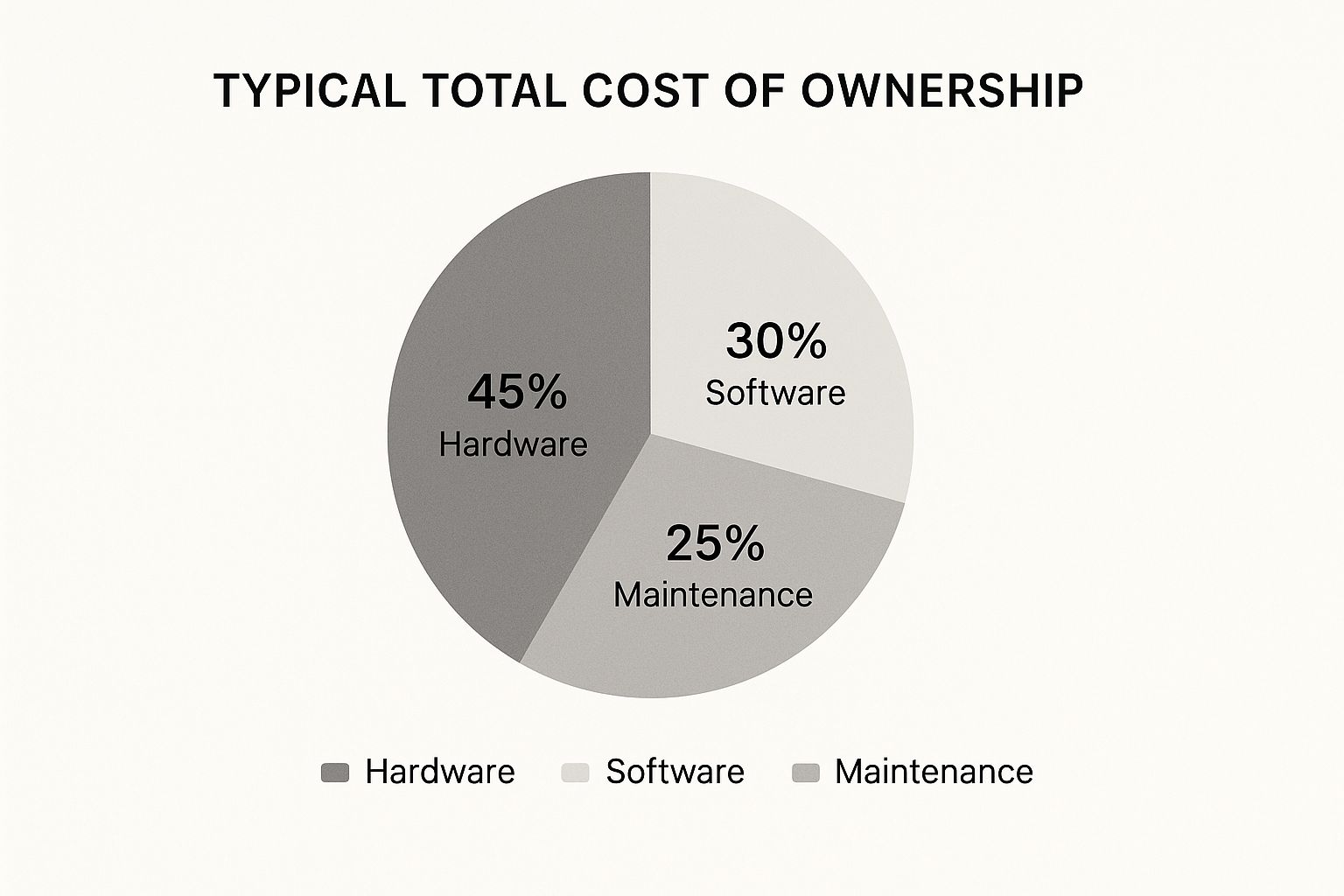
As you can see, the initial purchase is often just the tip of the iceberg. The ongoing costs of actually running and maintaining the vehicle can add up significantly.
Why TCO Is The Number That Really Matters
Zeroing in on just the purchase price is a classic mistake, and it can cost you. A car that seems cheaper at first might come with higher insurance, use more energy, or need more repairs, making it the more expensive option over five years. Our in-depth https://solanaev.com/electric-vehicle-cost-comparison/ breaks this down with real numbers, showing just how different the long-term costs can be.
To put it in perspective, let's look at a typical five-year ownership scenario for a Solana EV versus a similar gas-powered car.
Solana EV TCO Breakdown Vs. Traditional Gasoline Car
| Cost Category | Solana EV (5-Year Est.) | Gasoline Vehicle (5-Year Est.) | Key Savings Area |
|---|---|---|---|
| Purchase Price | $45,000 | $35,000 | Initial cost is higher for EVs. |
| Fuel / Energy | $3,000 | $10,000 | $7,000 savings from charging vs. gas. |
| Maintenance & Repairs | $1,500 | $4,500 | $3,000 savings from fewer moving parts. |
| Insurance | $7,500 | $6,000 | Can be higher due to vehicle value. |
| Taxes & Fees | $3,500 | $2,500 | Varies by state; often higher for EVs. |
| 5-Year Total Cost | $60,500 | $58,000 | The gap closes significantly over time. |
This table shows that while the upfront cost of a Solana EV might be higher, the massive savings on fuel and maintenance can nearly close that gap entirely over just five years.
The most eye-opening stat? An estimated 75% of a vehicle's total cost happens after you buy it, during the operation and maintenance phases. This is precisely why smart daily habits and proactive care are your best tools for long-term savings.
Take insurance, for example. It's a huge part of your operational costs and can fluctuate a lot. To get a better sense of this, it's worth understanding why auto insurance rates keep going up even as your car gets older. By thinking about all three cost pillars before you make a decision, you put yourself in the driver's seat for a smarter, more affordable ownership experience.
Lowering Your Upfront Acquisition Costs
Your biggest chance to slash the total cost of owning your Solana EV comes before you even get the keys. While the day-to-day savings on fuel and maintenance are fantastic, knocking down that initial purchase price gives you an immediate win and lowers the financial bar for everything that follows.
Think of it less like a typical car haggle and more like a strategic financial move. The sticker price you see? That’s just the opening offer. A smart buyer focuses on the "out-the-door" price, which is where thousands can be added in fees, taxes, and other extras. This is ground zero for your savings strategy.
Uncovering and Negotiating Hidden Fees
Dealerships often tack on extra charges that aren't part of the Manufacturer's Suggested Retail Price (MSRP). Some, like the destination fee, are usually set in stone. Many others are not.
You need to carefully review the buyer's order for line items like "dealer prep," "documentation fees," or the dreaded "market adjustment."
A "market adjustment" is just a dealership's attempt to cash in on high demand—and it’s a fee you should always push back on. Documentation fees can also be all over the map. A small administrative fee is normal, but if you see a charge of several hundred dollars, it's time to ask questions. A firm, polite negotiation on these points can save you a surprising amount of cash.
A buyer recently told me about their experience with a new Solana XA. By challenging a $1,500 "market adjustment" and getting a $499 doc fee reduced to $150, they cut $1,849 from the total before even talking about the car's price.
Stacking Incentives for Maximum Savings
This is where the real magic happens. Government incentives are your most powerful tool for cutting the acquisition cost. These programs exist at the federal, state, and even city levels, and the best part is you can often "stack" them on top of each other.
To really move the needle, you have to stay on top of programs like the Major Federal Electric Vehicle Tax Credits. These credits can directly slash your tax bill, acting like a huge post-purchase rebate. But don't stop there.
Many states and cities offer their own unique perks:
- Direct Rebates: Some states will literally mail you a check after you buy an eligible EV.
- Tax Credits: Just like the federal program, these can reduce what you owe in state taxes.
- Utility Rebates: Check with your local electric company. They might offer a rebate for buying an EV or installing a home charger.
It takes a bit of digging to find all of these, but the payoff is well worth it. Someone in California, for example, could potentially stack a federal credit, a state rebate, and a local utility incentive to create a massive trifecta of savings.
Making Smart Financing Choices
How you pay for the car is just as important as the price you negotiate. Your auto loan's terms can dramatically affect your total cost of ownership. Even a half-point difference in the interest rate can mean thousands of dollars over the life of the loan.
Here’s a pro tip: get pre-approved for a loan from your own bank or a credit union before you ever set foot in the dealership. This gives you a solid interest rate to use as a baseline. When the dealer shows you their financing numbers, you can instantly see if they're competitive. If not, use your pre-approval as leverage to get them to offer a better rate.
Pay close attention to the loan term. A longer term, like 72 or 84 months, gives you a lower monthly payment, which can be tempting. But you'll pay way more in interest over time. A shorter term, perhaps 48 or 60 months, means higher payments but saves you a bundle in the long run. By combining a negotiated price, stacked incentives, and smart financing, you can hammer down that acquisition cost and set yourself up for an incredibly affordable ownership experience.
Slashing Your Daily Driving and Charging Expenses
Once your Solana EV is in the driveway, the focus shifts. It's no longer about the one-time purchase price; it's about the day-to-day costs of keeping it on the road. This is where the real potential for long-term savings kicks in, and with a few smart habits, you can dramatically lower what you spend every month.

Managing these ongoing expenses is the key to truly shrinking your total cost of ownership and getting the most financial upside out of driving electric.
This isn't a new concept. In manufacturing, for instance, companies have been laser-focused on Total Cost of Ownership (TCO) for decades. By looking past the sticker price of machinery and analyzing every related cost—from energy use to parts—they've been known to cut total ownership costs by as much as 25%. We can apply that same sharp thinking to our cars.
Master Your Home Charging Schedule
Here’s the single biggest way to cut your daily costs: get smart about when you charge at home. Just plugging in your Solana EV the moment you pull into the garage could be costing you a small fortune over the year.
Most utility companies offer Time-of-Use (TOU) electricity rates, where power is much cheaper during "off-peak" hours. These windows are typically late at night, often from 11 PM to 6 AM, when overall demand on the grid plummets. Charging during this time can slash your electricity cost by 50% or more compared to peak afternoon hours.
It's incredibly easy to set this up. Your Solana EV's dashboard screen or mobile app has a scheduling feature. Just tell it to start charging only when those cheaper rates kick in. It’s a classic "set it and forget it" move that pays off every single month.
"I checked my utility's app and found my off-peak rate was $0.12 per kWh, while the peak rate was $0.28. By programming my car to charge only after midnight, I cut my monthly charging bill from around $70 to less than $35 without changing how much I drive."
Be Strategic with Public Charging
While charging at home is your cheapest bet, public chargers are a necessity for longer journeys. But they are not all created equal. The costs can vary wildly depending on the network and charging speed.
- Level 2 Chargers: These are your slow-and-steady, budget-friendly option. They're perfect when you’ll be parked for a few hours anyway, like at a shopping mall, movie theater, or your workplace.
- DC Fast Chargers: Think of these as the express lane. They're priced for speed and convenience, so you should use them when you're on a road trip and need to get moving again quickly. Avoid making them your go-to for daily top-ups.
Before a long drive, take two minutes to use an app like PlugShare to map out chargers and compare prices along your route. A little planning can help you sidestep an unnecessarily expensive charging stop. For a deeper dive, check out our guide on EV charging efficiency.
Drive Smarter, Not Harder
Your driving style has a direct and immediate impact on your EV's energy use. Stomping on the accelerator and slamming on the brakes is a surefire way to drain your battery faster. Adopting a smoother approach can noticeably extend your range and reduce how often you need to plug in.
Your most powerful tool here is regenerative braking. Whenever you lift your foot off the accelerator in a Solana EV, the motor reverses its function, turning into a generator that converts the car's momentum back into electricity.
To really make the most of it, look ahead. Anticipate stops and slowdowns in traffic. Instead of waiting until the last second to hit the brake pedal, ease off the accelerator early and let the regenerative system do the work. Mastering this technique, often called "one-pedal driving," not only saves energy but also dramatically reduces wear on your physical brake pads, saving you money on maintenance down the line.
Find EV-Friendly Insurance Policies
Insurance is another one of those big, recurring expenses, but many EV owners don't realize that specialized policies can offer significant savings. Some insurance companies give discounts for electric vehicles because of their advanced safety features and lower risk of certain mechanical issues.
When you're shopping for a policy, make sure to ask the providers specifically about:
- EV-Specific Discounts: A direct premium reduction just for owning an EV.
- Charging Equipment Coverage: Protection for your home charging station against damage or theft.
- Battery Coverage: Some premium policies might even offer coverage for the battery pack that goes beyond the manufacturer's warranty.
Don't just automatically renew your old policy. Take the time to get a few new quotes and be sure to mention you're insuring a Solana EV. The right policy could save you hundreds of dollars a year.
Stay Ahead of Maintenance and Repairs
It’s easy to fall into the trap of thinking that because your Solana EV has fewer moving parts, you can just forget about maintenance. But that’s a surefire way to get hit with an unexpected repair bill down the road. Being proactive isn't just about preventing breakdowns; it’s a core strategy for keeping your total cost of ownership low and protecting the long-term value of your investment.
When small issues are ignored, they have a nasty habit of turning into big, expensive problems. A smart maintenance plan keeps your EV running like new, ensures it's safe, and gives you a predictable budget, so you're not caught off guard by a surprise five-figure repair.
Your Preventative Maintenance Checklist
The maintenance needs of a Solana EV are different, but they're just as important as those of a gas-powered car. You can forget about oil changes and spark plugs. Instead, your focus will be on the components unique to electric performance.
Here are the key areas to build your schedule around:
- Keep an Eye on Battery Health: Get in the habit of checking your battery's state of health (SOH) on the vehicle's diagnostic screen. A simple trick to dramatically extend the life of your EV's most valuable component is to keep your daily charge between 20% and 80%.
- Don't Neglect Your Tires: EVs deliver instant torque, which means your tires can wear down faster and in different patterns than you might be used to. Stick to a strict rotation schedule—every 5,000 to 7,500 miles is a good rule of thumb—and check your tread depth regularly. This maximizes tire life and keeps your efficiency high.
- Check Your Brakes: Thanks to regenerative braking, your brake pads will last for a very long time. However, the brake fluid is another story. It still needs to be flushed according to the manufacturer's schedule, usually every two years, to prevent moisture from contaminating the system. You want to be sure it works perfectly when you really need it.
Thinking this way is a powerful financial tool. In the logistics industry, where operational costs make or break a business, this TCO-focused approach has helped companies cut asset downtime by 30% and extend vehicle lifecycles by up to 40%. For a deeper dive into that data, you can explore the full insights on asset management at us.caddi.com.
The difference in maintenance costs over the long haul is pretty stark. Here’s a look at how a Solana EV stacks up against a typical gas car over 100,000 miles.
Maintenance Cost Comparison Over 100,000 Miles
| Maintenance Item | Solana EV Estimated Cost | Gasoline Vehicle Estimated Cost |
|---|---|---|
| Battery Coolant Flush | $250 (every 4-5 years) | $0 |
| Brake Fluid Flush | $200 (every 2 years) | $200 (every 2 years) |
| Brake Pads & Rotors | $400 (once, due to regen) | $800 (twice or more) |
| Tire Rotations | $300 (12 rotations) | $300 (12 rotations) |
| Oil Changes | $0 | $1,200 (20 changes @ $60) |
| Engine Air Filter | $0 | $150 (3-4 replacements) |
| Spark Plugs | $0 | $400 (one replacement) |
| Cabin Air Filter | $100 (every 2 years) | $100 (every 2 years) |
| Total Estimated Cost | $1,250 | $3,150 |
As you can see, the savings are significant. By eliminating entire categories of maintenance like oil changes and spark plugs, the Solana EV costs less than half as much to maintain over its first 100,000 miles.
Dealership Service vs. Independent Mechanics
When it’s time for service, you have a choice: go to an authorized Solana EV dealer or find a trusted independent mechanic. There are pros and cons to each, and the best option often depends on the job at hand.
Dealerships have the specialized training and direct access to factory parts, which is your best bet for complex software updates or any work covered under warranty. Of course, that expertise usually comes at a premium.
A certified independent mechanic who specializes in EVs can be a fantastic, cost-effective alternative for more routine tasks. Their labor rates are often lower, and they can be more flexible. Before you book, just make sure to ask if they have experience with Solana EV models and what specific training their technicians have. Our guide on understanding electric vehicle maintenance costs has more great tips on finding qualified service.
Pro Tip: Next time you need a standard service like a brake fluid flush, call both a dealer and a trusted independent shop for a quote. Ask for an itemized breakdown of parts and labor. The price difference for the exact same job might just surprise you.
Thinking Through an Extended Warranty
The extended warranty—to buy or not to buy? These plans promise peace of mind by covering repairs after the factory warranty ends, but they also add a hefty upfront cost to your TCO.
Before you say yes, take a hard look at your own situation and habits.
- When it might make sense: If you hate the thought of a large, unexpected repair bill and prefer predictable costs, an extended warranty can be a good fit. It’s also worth considering if you plan to keep your Solana EV for many years, well past the standard warranty period.
- When it might not: If you’re comfortable with a bit of financial risk and tend to trade in your cars every few years while they're still under factory coverage, you're probably better off skipping it.
Here’s a smart alternative: "self-insure." Figure out what the warranty would cost—often a few thousand dollars—and put that cash into a dedicated high-yield savings account. This becomes your personal repair fund. If your car proves reliable, that money is still yours, helping you achieve a much lower total cost of ownership in the end.
Maximizing Your EV's Resale Value
The journey of lowering your total cost of ownership doesn't stop after your final maintenance visit. It really ends when you hand over the keys to the next owner. The amount you get back—your car's resale value—is the final, critical piece of the TCO puzzle. Honestly, you should be thinking about this from day one to make sure your ownership experience ends on a financial high.
Protecting your vehicle's value is about more than just avoiding dings and scratches. It's about building a compelling case for the next owner, one that tells a story of a well-cared-for, reliable, and valuable electric vehicle. This proactive approach can easily add thousands of dollars back into your pocket.

The Power of Meticulous Records
I can't stress this enough: a thick folder stuffed with service receipts is your best sales tool. It’s hard, tangible proof that you’ve been a responsible owner. Every single tire rotation, software update, and brake fluid flush should be documented with the date, mileage, and who did the work.
This detailed logbook takes all the guesswork out of the equation for a potential buyer. It shows you’ve followed the recommended maintenance schedule to the letter, which speaks volumes about the car's long-term health. A complete service history is often the one thing that makes a buyer choose your car over another one with a murky past.
This idea of tracking everything isn't unique to cars. Think about global supply chain management, where a detailed TCO analysis is crucial for making smart decisions about hidden costs like shipping and inventory risks. Just like a supply chain manager needs data, a car buyer needs a detailed history to feel confident. You can see how leading companies approach this by exploring how they evaluate total cost of ownership.
The Battery Health Certificate: Your Secret Weapon
For any used EV, the buyer's number one fear is the battery. How healthy is it? How much has it degraded? You can squash this anxiety immediately by providing a battery health certificate.
Many Solana EV service centers or certified independent EV mechanics can run a diagnostic test that generates an official report on the battery's State of Health (SOH). This certificate shows the remaining capacity as a percentage of what it was when it was brand new.
Handing a buyer a certificate showing 94% battery health is infinitely more persuasive than just saying, "the battery is in great shape." It’s hard data that justifies a higher asking price and builds instant trust, making your EV stand out.
Mastering the Used EV Market
When you're ready to sell, timing and presentation are everything. The used EV market has its own rhythm, and if you understand it, you can get much better offers.
Selling in the spring or early summer, for example, often gets you more attention since more people are out looking for a car. It's also smart to think about where you're listing it. General marketplaces are fine, but EV-specific sales sites tend to attract more serious, knowledgeable buyers who are willing to pay a fair price for a vehicle that’s been properly cared for.
To get the best possible return, make sure you nail these final details:
- Cosmetic Condition: A professional detail and a good wax make a huge first impression. Take the time to fix minor scuffs and scratches—it shows you cared.
- Tire Health: Make sure your tires have plenty of tread left. Worn-out tires are an immediate red flag and an easy thing for a buyer to negotiate down on.
- Original Equipment: Don't forget to include all the original items that came with the car, like both key fobs and the factory charging cables. Missing pieces can chip away at the car's value.
By treating your Solana EV as a long-term asset from the very beginning, you do more than just enjoy a great ride. You set yourself up for a profitable and satisfying end to your ownership journey.
Common Questions About Solana EV Ownership Costs
When you're thinking about the real-world costs of owning an electric vehicle, a few key questions always seem to pop up. Getting straight answers is the best way to manage your budget and make sure you're actually saving money in the long run.
Let’s break down some of the most common concerns we hear from Solana EV drivers. These are the practical, day-to-day issues that can really add up over time. Getting a handle on charging habits, warranties, and battery health will give you the power to keep your ownership costs predictable and low.
Does Fast Charging Significantly Increase My TCO?
In a word, yes. Relying too much on DC fast chargers is one of the quickest ways to drive up your total cost of ownership. They’re priced for convenience, not for value, making them significantly more expensive per kilowatt-hour than plugging in at home overnight.
But there's a bigger issue at play here: battery health. Frequent fast charging puts a lot of stress on your battery, which can speed up its natural degradation. Over time, that means less maximum range and a lower resale value when you decide to sell. The best approach is a balanced one—use your affordable home charger for the daily grind and save the fast chargers for those long-haul road trips.
The smartest way to think about it is this: slow, overnight charging preserves your most valuable asset—the battery. Fast charging trades some of that long-term value for short-term convenience.
Are Extended Warranties for Solana EVs a Good Investment?
This really comes down to your personal comfort level with risk. Your Solana EV comes with a solid manufacturer's warranty, but an extended plan can feel like a good safety net, especially with all the complex electronics on board.
Before you sign on the dotted line, though, you have to weigh the high upfront cost of that warranty against the actual likelihood of a major repair that isn't covered. Many third-party plans are riddled with exclusions and fine print that can render them useless when you need them most. A great alternative is to "self-insure"—take the money you would have spent on the warranty and put it into a dedicated savings account just for car repairs.
How Much Does Battery Degradation Really Affect TCO?
Battery degradation is easily one of the biggest hidden costs of EV ownership because it directly hits your car’s resale value. It's a simple market reality: an EV with 95% of its original battery capacity is going to command a much higher price than an identical one with only 80% health left.
It also quietly increases your running costs. As your maximum range shrinks, you might find yourself needing to use expensive public fast chargers more often just to get through your week. The good news is you have a lot of control over this. To minimize degradation, just follow a few simple rules:
- Avoid Regular Charging to 100%: For daily driving, keeping your battery between 20% and 80% is the sweet spot.
- Limit DC Fast Charger Use: Treat them as a tool for long trips, not your go-to charging method.
- Protect from Extreme Temperatures: If you can, park in a garage or a shaded spot to shield the battery from intense heat and bitter cold.
At the end of the day, taking care of your battery is the single best thing you can do to protect your car's long-term value.
Ready to explore an EV that offers style, performance, and a smart ownership experience? Discover the full lineup at Solana EV and find the perfect model for your needs at https://solanaev.com.