
A resort operations manager is staring at a shuttle loop that takes guests across the property all day. At the same time, a wedding coordinator needs to move a six-person bridal party from valet to reception without splitting the group between two vehicles. A two-passenger cart won't solve either problem, and a four-passenger cart leaves no useful room for bags, equipment, or an extra rider.
That's where the 6 passenger gas golf cart still earns serious consideration. It carries a full group, works without waiting for a charging cycle, and fits properties that already maintain small-engine equipment. But gas isn't automatically the practical choice in 2026. For quiet resorts, gated communities, and campuses with dependable charging, a premium electric six-passenger cart can deliver the better operating experience and, in the right duty cycle, the better ownership case.
Table of Contents
- Who Actually Needs a Six-Passenger Cart in 2026
- What a 6 Passenger Gas Golf Cart Really Is
- Gas vs Electric 6 Passenger Carts Side by Side
- Total Cost of Ownership Over Five Years
- Safety, Licensing, and Street Legal Rules
- Best Use Cases for Resorts, Communities, and Fleets
- Why a Premium Electric 6P Like Solana Often Wins
- The Buyer Checklist Before You Sign
Who Actually Needs a Six-Passenger Cart in 2026
A six-passenger cart belongs on a property where one vehicle must move a group through a real daily route. Resort shuttle teams, gated-community staff, campus patrols, event operators, and grounds crews should start with the work, not the fuel type. Ask how many people travel together, how often they stop, what they carry, and whether the cart returns to a reliable charging point.
Passenger turnover changes the specification. Frequent guest transfers call for easy entry, stable handling, and seating that does not make riders climb over one another. Grounds crews may accept tighter passenger access in exchange for a rear seat that converts to a cargo deck. Hospitality teams should give noise serious weight because guests notice engine sound throughout a quiet property.
The market is moving toward larger passenger configurations, although six-seat carts remain a specialized purchase. One industry market estimate values the global golf cart market at USD 2.32 billion in 2025 and projects USD 3.24 billion by 2031. Another projection expects the market to reach USD 3.70 billion by 2034. In North America, six-seat and larger configurations are forecast to grow faster than the overall segment, while two-seat carts still account for the largest seating share.
Match the cart to the property
Specify a six-passenger model when one or more of these conditions apply:
- Passenger turnover: Staff regularly move groups between buildings, parking areas, venues, or accommodations.
- Crew transport: Employees need seats alongside tools, supplies, or landscaping equipment.
- Private-route utility: The cart works mainly on a resort, campus, community, or event property instead of public highways.
- Fleet consistency: Multiple users need the same layout, controls, and service routine.
A six-passenger cart is a poor purchase when it will usually carry one or two people. The added seats increase weight, length, and turning demands without delivering useful capacity.
Procurement rule: Specify the route first, then choose the powertrain. Measure the duty cycle before approving gas or electric.
The buyer's calculation should cover route length, daily use, passenger turnover, terrain, charging access, storage, noise tolerance, and on-site maintenance capability. Gas still fits properties with long shifts, limited charging, or established small-engine service. A premium electric 6P, such as Solana's lineup, can change the decision when quiet operation, predictable charging, and lower routine operating burden matter more than refueling flexibility.
What a 6 Passenger Gas Golf Cart Really Is
A mainstream 6 passenger gas golf cart is a compact utility vehicle built around a small internal-combustion engine, a continuously variable transmission, rear seating, and a chassis designed for low-speed private-property transportation. The common benchmark is a 401 cc electronic fuel-injected, single-cylinder OHV engine rated at about 13.5 horsepower, with a published top speed near 19 mph and a turning radius close to 25.5 feet, based on the E-Z-GO Express L6 gas specifications.
That benchmark matters because dealer quotes often use broad language such as “commercial gas cart” or “street-ready six-seater.” Ask for the actual engine, payload, seating arrangement, speed, and turning specifications. A cart that looks similar in photographs can behave very differently once it carries six adults and equipment.
Start with payload, not the seat count
The practical benchmark payload is 1,200 pounds for the mainstream configuration cited above. Passenger count alone doesn't tell you whether the cart will perform properly. Six adults, bags, coolers, tools, and accessories can push a vehicle toward its payload limit, especially when a rear-facing seat is mounted over the back axle.
A four-forward, two-rear layout is familiar to families and neighborhood users. It gives passengers a clear seating arrangement and can provide a rear cargo conversion when the back seat folds down. A six-forward commercial shuttle layout puts every rider facing the direction of travel, which is usually easier for guest transport and repeated boarding.
| Spec | Typical Range | Notes |
|---|---|---|
| Engine | 401 cc class | EFI, single-cylinder OHV configuration |
| Output | About 13.5 hp | Benchmark for a mainstream major-market gas model |
| Transmission | CVT | Automatic operation with belt-driven power delivery |
| Top speed | Around 19 mph | Standard benchmark, before any LSV-specific configuration |
| Turning radius | Near 25.5 ft | Important on narrow paths and service lanes |
| Payload | Commonly 1,200 lb | Check the manufacturer rating, not the seat count |
| Seating | 4+2 or six-forward | Layout changes access, visibility, and cargo flexibility |
| Chassis | Utility-oriented frame | Confirm axle, suspension, and braking specifications |
| Fuel system | Gasoline with EFI | Useful where rapid refueling matters |
The gas platform is familiar to service departments that already work on small engines. That can simplify troubleshooting and reduce training friction. It also introduces oil, filters, belts, exhaust, fuel, and engine-related service that an electric fleet doesn't need.
Gas vs Electric 6 Passenger Carts Side by Side
A property manager comparing six-passenger carts should start with the daily route, not the showroom floor. The test is six adults, loaded equipment, hills, repeated stops, and the time available between shifts. Gas remains the better choice when the cart operates far from buildings, needs immediate return to service after refueling, or works on a property without practical charging access. Electric is the stronger choice for predictable loops, nearby power, quiet guest areas, and frequent low-speed stops.
Electric carts already hold the larger share of the broader category. The North American market share for electric golf carts was 67.15% in 2025, while one global estimate placed electric share at 75.4% in 2024, according to North American golf cart market research. Gas is still justified when route demands and site conditions support it. A buyer should require that operational case before accepting a gas vehicle's additional mechanical systems.
| Criteria | Gas 6-Passenger | Electric 6-Passenger |
|---|---|---|
| Refueling | Fast refueling with no charging wait | Planned charging and parking access required |
| Route flexibility | Strong for remote or irregular routes | Strong for predictable daily loops |
| Loaded performance | Familiar response during sustained use | Immediate torque and smooth low-speed control |
| Noise | Engine, exhaust, and drivetrain noise | Much quieter operation |
| On-site emissions | Produces exhaust during operation | No tailpipe emissions at the property |
| Routine service | Engine, oil, filters, belts, fuel, and exhaust systems | Battery, charger, motor, tires, brakes, and electrical systems |
| Maintenance environment | Familiar to small-engine technicians | Simpler mechanical drivetrain, more electrical diagnosis |
| Passenger experience | Traditional utility-vehicle feel | Quiet, smooth, and easier around guests |
| Best fit | Remote properties and long uninterrupted shifts | Resorts, communities, campuses, and shuttle loops |
Test power delivery with the cart loaded. Gas offers familiar throttle response and remains practical on sustained grades or extended shifts where refueling is easy. Electric drivetrains provide immediate torque and controlled low-speed movement, useful when a driver moves six passengers through a crowded resort walkway or event area.
Operating cost depends on local fuel and electricity rates, route length, vehicle condition, and charging losses. This gas vs electric cost analysis provides a framework for comparing energy costs, but a fleet manager must replace fryer assumptions with actual cart routes and utility rates.
Review the 6-passenger electric golf cart options alongside the gas quote and compare both vehicles on the same passenger load, hills, stopping pattern, and parking routine. A premium electric 6P such as Solana's lineup can flip the decision when quiet operation, smooth control, and predictable charging fit the property. Gas still wins when rapid refueling and remote-route availability matter more.
Total Cost of Ownership Over Five Years
The sticker price is only the first line on a fleet worksheet. A five-year ownership model should capture energy, scheduled service, wear items, downtime, battery risk, resale value, and the cost of keeping a vehicle available during peak demand.
Gas ownership is straightforward to understand. The fleet pays for fuel, oil, filters, belts, spark-related service, exhaust components, and engine maintenance. A gas chassis may also carry more service complexity once the cart spends its days loaded with passengers on uneven routes.
Electric ownership shifts the expense profile. The fleet pays for electricity, charging equipment, battery inspections, tires, brakes, and eventual battery replacement risk. Regenerative braking can reduce friction-brake workload, but it doesn't eliminate tire wear, suspension service, or electrical diagnosis.
Build the worksheet around real use
Record the following before comparing quotes:
- Daily route: Measure the actual distance and include detours, deadhead travel, and return trips.
- Operating hours: Note how long the cart is moving, not just how long the shift lasts.
- Load: Use the normal passenger and cargo combination, not an empty-cart test.
- Charging access: Confirm where the vehicle parks and whether staff can charge it safely.
- Fuel access: Identify who refuels the cart, how often, and whether the property stores fuel.
- Service support: Price local labor, parts availability, downtime, and emergency response.
- Resale market: Consider whether the next buyer is more likely to want a gas utility cart or an electric community vehicle.
| Cost Line | Gas 6P | Premium Electric 6P |
|---|---|---|
| Energy | Fuel purchases rise with route use and load | Electricity cost depends on charging rate and local utility pricing |
| Scheduled service | Engine, oil, filters, belts, and fuel-system service | Battery checks, charger checks, electrical inspection, and drivetrain service |
| Wear items | Tires, brakes, belts, and engine-related components | Tires, brakes, suspension, and electrical components |
| Battery or engine risk | No traction-battery replacement exposure, but engine repairs remain possible | Battery condition becomes a major long-term valuation factor |
| Downtime | Refueling is quick, but mechanical service can remove the cart from duty | Charging requires planning, while routine mechanical service may be lighter |
| Resale | Appeals to buyers who value refueling and small-engine familiarity | Appeals to resort, HOA, campus, and low-noise property buyers |
| Five-year planning | Easier for properties with established gas maintenance | Stronger where charging and predictable routes are already available |
There is no universal break-even mileage. Electric starts to look stronger as route repetition, fuel consumption, noise restrictions, and maintenance labor accumulate. Gas remains financially defensible when the property has long or irregular shifts, no dependable charging location, and an existing small-engine service operation.
Use the electric vehicle versus gas cost guide to structure the comparison, then insert your own fuel price, electricity rate, labor cost, and expected residual value. Don't approve a fleet purchase from a generic calculator that ignores payload and terrain.
Safety, Licensing, and Street Legal Rules
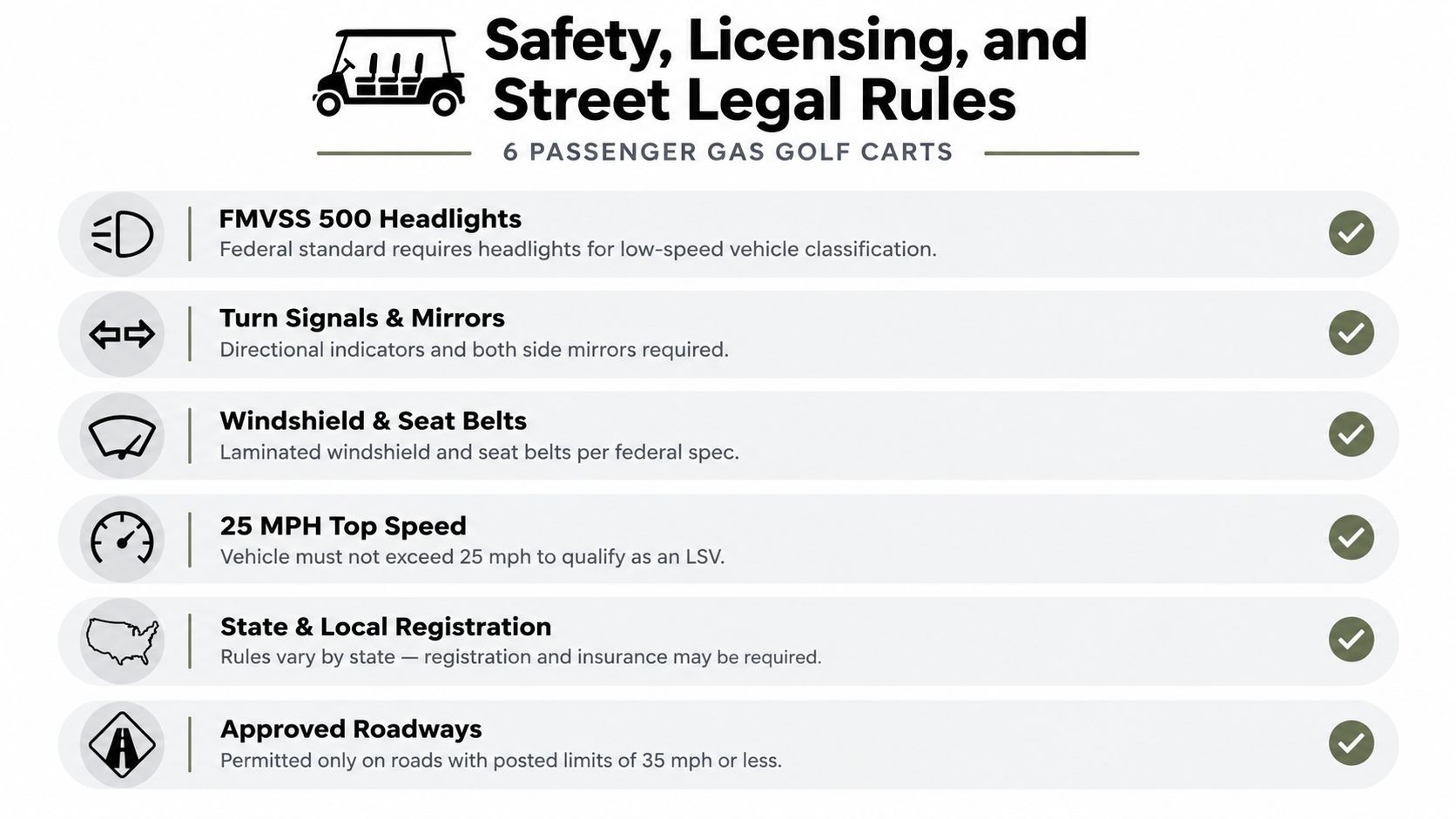
A six-passenger cart isn't automatically road legal because it has lights, a windshield, or a factory-looking dashboard. Public-road use depends on vehicle classification, equipment, speed, roadway rules, registration, insurance, and state or local requirements.
For low-speed-vehicle classification, the federal benchmark is a vehicle capable of 20 to 25 mph on level pavement. Required equipment includes a VIN, windshield glass, seat belts, turn signals, headlamps, brake lights, a horn, mirrors, reflectors, a parking brake, and a rear-view camera, as summarized in this low-speed vehicle equipment reference.
Confirm the jurisdiction before delivery
Start with the exact roads the cart will use. A private resort lane, a marked golf-cart path, a gated community road, and a public street can fall under different rules. Ask the dealer for the vehicle's classification and compliance documentation, then verify the route with the relevant state and local authorities.
Florida illustrates why licensing can't be treated as a product feature. State law requires anyone operating a golf cart, low-speed vehicle, or utility vehicle to possess a valid driver license, as stated in the Florida statute on golf cart operation.
Also inspect the rear seating position. Seat belts must work for every designated passenger, handholds must be accessible, and the canopy, windshield, mirrors, lighting, and braking system must suit the intended route. For indoor or semi-enclosed property use, account for exhaust and noise before placing a gas cart near guest rooms, event spaces, or service corridors.
For a practical compliance reference, review low-speed vehicle requirements before you sign a street-use specification.
Best Use Cases for Resorts, Communities, and Fleets
The right powertrain changes with the workday. A cart that performs well on a predictable guest loop may be a poor choice for an industrial campus where operators spend long periods away from buildings and return with a full load.
Resort shuttle operations
A resort shuttle carries more than passengers. It carries the property's reputation. Guests notice engine noise near pools, villas, restaurants, and wedding venues, and staff need a vehicle that is easy to maneuver around pedestrians.
Electric is usually the better resort specification when the cart follows a repeatable loop and parks near a suitable charging point. Quiet acceleration improves the passenger experience, while no tailpipe emissions make routing near enclosed structures or hospitality spaces simpler. The exception is a spread-out property where the cart can't reliably return to a charging location during the shift.
Gated-community family transport
A gated community often needs a family hauler for errands, school runs, social events, and short trips between homes and amenities. Gas stays competitive here because residents may value quick refueling, familiar service, and dependable use after the cart sits unused for a period.
Electric earns the recommendation when the cart is parked at home or in a garage with suitable power. The smoother drivetrain is more pleasant for family passengers, and quieter operation matters when neighbors share narrow streets and pedestrian paths.
A community cart should be tested with the actual family load. An empty showroom drive tells you almost nothing about braking, steering, or hill performance with six occupants.
Campus and event fleets
Industrial campuses, outdoor venues, and event operators place the hardest demands on a six-passenger cart. The vehicle may carry staff, tools, barriers, supplies, and passengers across routes that change throughout the day.
Gas can outperform electric in this setting when refueling speed and route flexibility matter more than quiet operation. It also makes sense where the maintenance shed already supports gasoline equipment and where charging infrastructure would require new electrical work.
Electric remains attractive for event venues with noise-sensitive guests or indoor-adjacent routes. Fleet managers should compare both carts on the steepest grade, with the heaviest normal load, and after repeated stops. The winner is the cart that finishes the shift predictably, not the one that feels quickest during a short demonstration.
Why a Premium Electric 6P Like Solana Often Wins
A six-adult route changes the buying decision. The fleet manager is not choosing between fuel types in isolation, but between two ways to run the same daily loop, with its stops, hills, guest interactions, parking routine, and service demands. Gas wins when refueling flexibility controls uptime. Electric wins when the cart returns to a known charger and spends its day carrying people on repeat routes.
The Solana EV lineup includes the XA 6P, F, and G configurations for buyers comparing premium electric six-passenger vehicles with conventional gas carts. The XA 6P uses a 72V lithium battery and offers up to 55 miles of range. The F 6P provides six forward-facing seats and a 1,450-pound maximum payload, according to the publisher's product information.
Where electric changes the workday
Electric provides immediate torque, quiet movement, and no tailpipe emissions at the property. Those differences are noticeable when six passengers travel near rooms, restaurants, residences, pools, classrooms, or event spaces. Regenerative braking can also help control speed through repeated stops, reducing the constant engine noise and drivetrain vibration passengers experience in a gas cart.
A premium electric cart makes the stronger operating case when the property has:
- Predictable parking: The cart returns to a known location where staff can manage charging.
- Noise-sensitive routes: Guests, residents, and staff need quiet movement.
- Frequent stops: Smooth torque and controlled braking make repeated shuttle work less tiring.
- Indoor-adjacent operation: The route passes through structures or enclosed service areas.
- Long ownership intent: The fleet can plan battery condition, service, and resale from the start.
| Model | Powertrain | Published comparison point | Key Advantage |
|---|---|---|---|
| Solana XA 6P | 72V lithium electric | Up to 55 miles of range | Six-passenger electric platform with substantial cycle range |
| Solana F 6P | Lithium electric | 1,450-pound maximum payload | Six forward-facing seats and high payload capacity |
| Solana G | Electric | Configuration should be matched to the route and load | Premium six-passenger configuration for operational comparison |
| Typical gas 6P | 401 cc class gasoline engine | Around 19 mph benchmark | Rapid refueling and strong fit for remote operation |
Apply the comparison to the actual shift: load six adults, run the steepest regular section, count the stops, and check where the cart will park afterward. If the cart can recharge during routine parking, the electric drivetrain can reduce noise and simplify daily use. If it remains remote, follows an irregular route, or cannot pause for energy management, gas remains the correct recommendation.
The Buyer Checklist Before You Sign
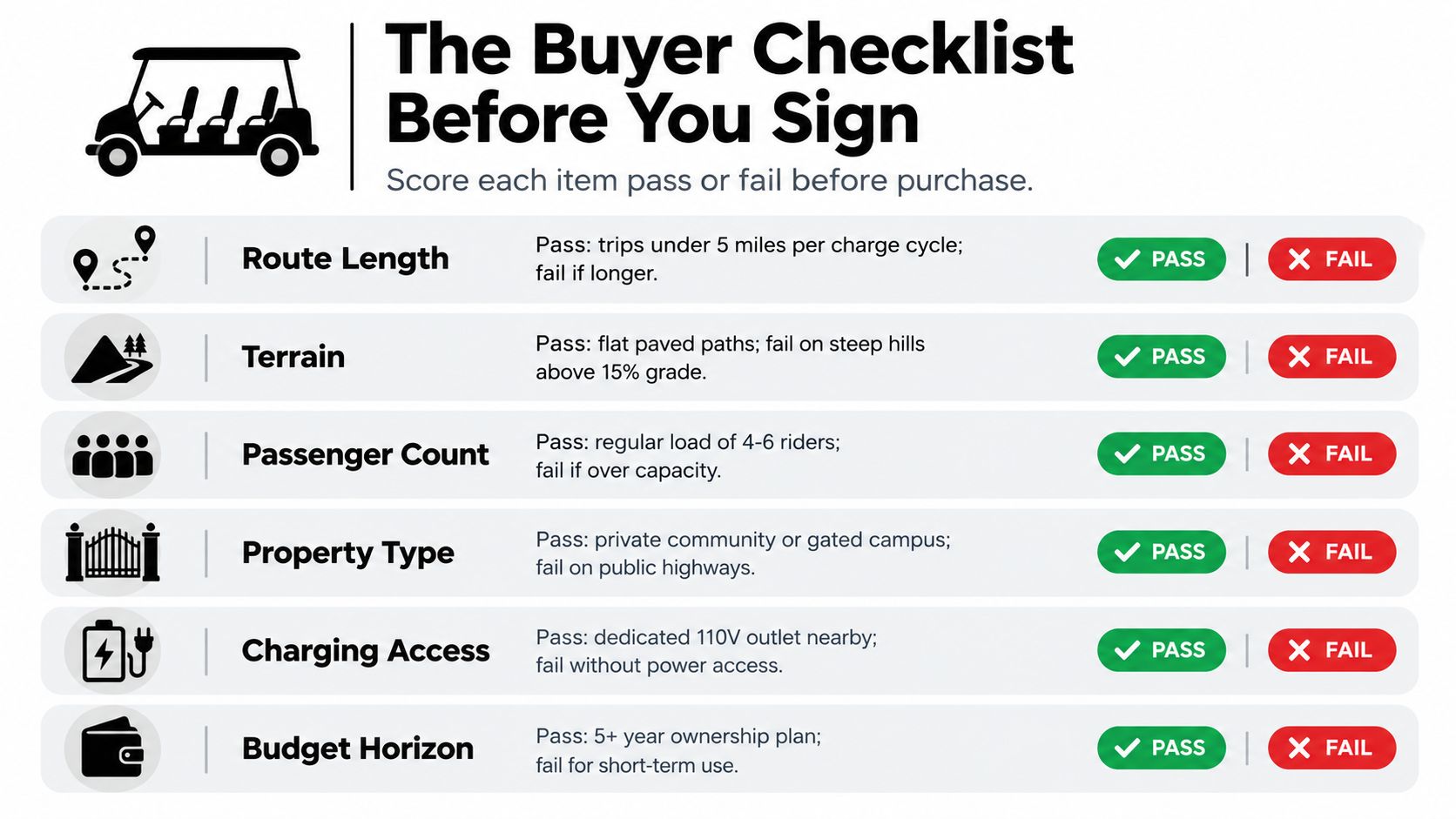
A good specification should survive a loaded test drive, not just a price comparison. Score the cart against the property, the route, and the ownership plan. If the vehicle fails one of the operational essentials, a lower purchase price won't fix the mismatch.
Route and terrain
Measure the actual route, including hills, stops, pedestrian areas, and return travel. A short, repeatable loop favors electric when charging is available. An irregular route with long periods away from the service base favors gas.
Test both vehicles with the normal passenger count. Six adults change acceleration, braking, steering, and suspension behavior. Add the equipment the cart will carry, especially for grounds, event, and campus work.
Capacity and property fit
Check whether the seating layout matches the passengers. Four-forward-two-rear may suit family use, while six-forward seating usually makes more sense for repeated shuttle boarding. Confirm payload, cargo access, handholds, seat belts, mirrors, lighting, and visibility from every seating position.
Then inspect the property:
- Private route: Confirm whether the cart stays on private roads, paths, or restricted-access lanes.
- Public-road use: Verify classification, equipment, licensing, registration, insurance, and local permissions.
- Charging location: Confirm outlet access, weather protection, cable routing, and staff responsibility.
- Fuel location: Confirm storage, refueling procedure, ventilation, and spill controls.
- Service support: Identify who will handle routine maintenance and urgent repairs.
- Ownership horizon: Compare expected energy, service, battery, resale, and downtime costs across the planned term.
Final test: Drive both powertrains on the actual property route, loaded with the people and equipment they must carry.
Don't sign from a brochure. Request a fleet demonstration, record the route conditions, inspect the charging or refueling routine, and have the dealer put the payload and compliance specifications in writing. If the electric candidate handles the route without disruption and returns to a practical charging point, it deserves serious preference. If the property lacks charging or demands uninterrupted remote operation, choose the gas cart for a clear operational reason.
Solana EV offers premium electric six-passenger options for resorts, communities, campuses, and fleet operators comparing quiet operation, lithium power, payload, and daily route demands. Visit Solana EV to review the available lineup, locate a dealer, and arrange a vehicle evaluation on the route your six-passenger fleet runs.