
You're halfway up a wet service road when the rear tires spin, the cart slides sideways, and everyone climbs out to push. A similar problem appears on a hunting property when a loaded cart reaches a muddy ridge with gear, tools, and passengers aboard. The cart may have enough motor power, but power only helps when the tires can transfer it to the ground.
That's the practical reason buyers are searching for 4×4 golf carts electric models. These vehicles still handle golf-course paths, but they're also used around resorts, campuses, gated communities, parks, estates, and rural properties. The important question isn't whether four-wheel drive sounds premium. It's whether your routes demand dependable traction, loaded hill performance, and predictable uptime.
Table of Contents
- Why 4×4 Electric Golf Carts Are Gaining Ground
- What 4×4 Actually Means on an Electric Golf Cart
- 2WD vs 4×4 Electric Golf Carts Compared
- How Electric 4×4 Drivetrains Are Built
- Real-World Range on Dirt, Grass, and Hills
- Where 4×4 Electric Carts Actually Make Sense
- What to Verify Before You Buy a 4×4 Electric Cart
- Choosing the Right 4×4 Electric Cart for Your Needs
Why 4×4 Electric Golf Carts Are Gaining Ground
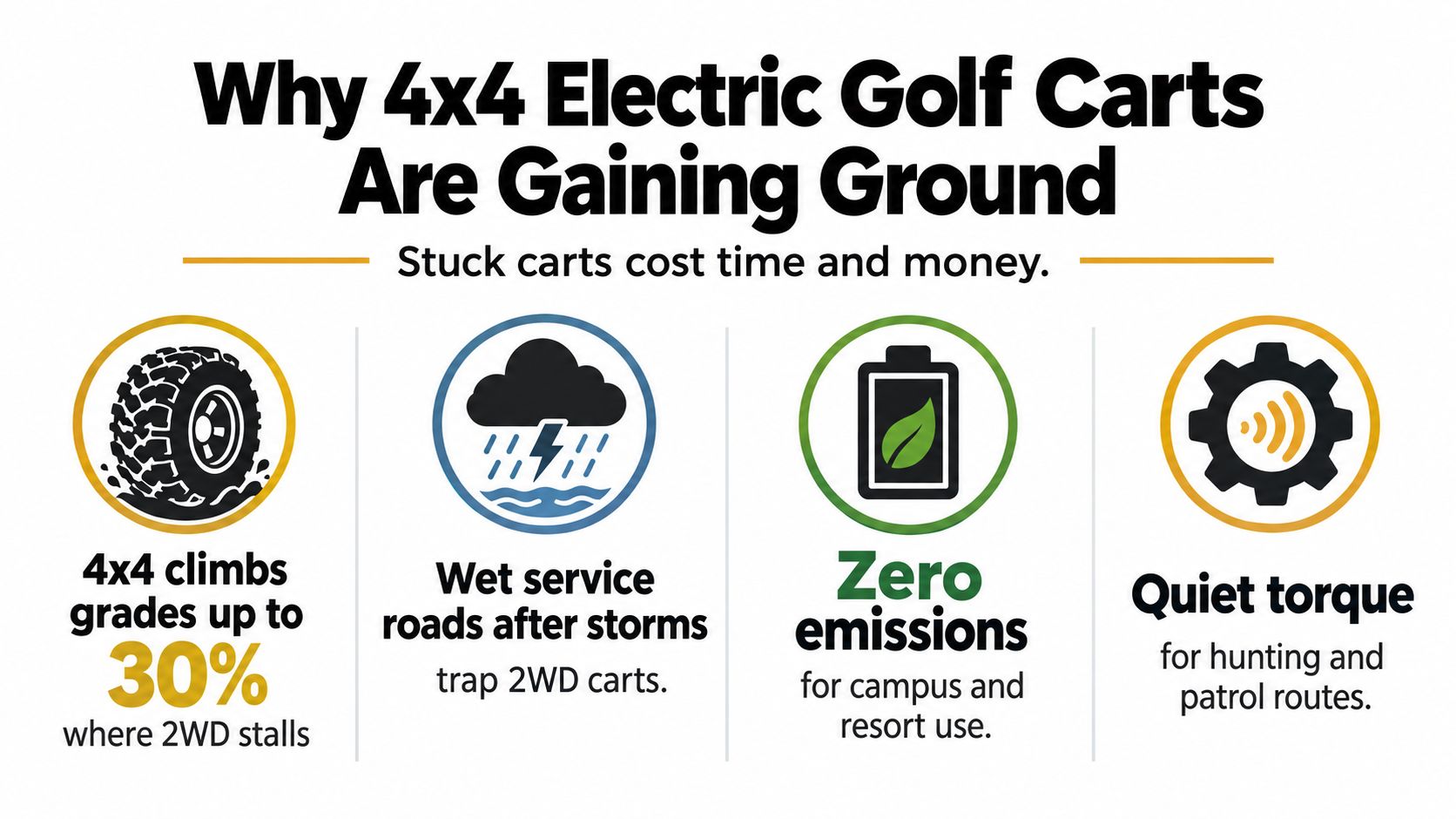
A property manager may be perfectly happy with a 2WD cart during dry weather. After a storm, the same vehicle can become a liability on grass, mud, or a rutted service lane. A hunting outfitter faces a different version of the problem, carrying equipment up a ridge where rear-wheel drive loses grip before the motor runs out of torque.
Battery-electric carts have moved well beyond course-only transport. They now carry guests, maintenance teams, luggage, tools, and supplies across properties where quiet operation and short-route efficiency matter. The broader electric golf cart market was estimated at approximately USD 1.55 billion in 2024 and is projected to reach USD 2.58 billion by 2033, with a 6.1% compound annual growth rate from 2025 through 2033, according to Grand View Research's electric golf cart market analysis.
Battery-electric vehicles represented 68.7% of that market, while the 1-to-4-seat category held the largest seating-capacity share, as reported in the same market analysis. That profile fits many four-wheel, four-passenger carts used for golf, hospitality, neighborhood transport, and property operations.
What four-wheel drive adds
A 4×4 system doesn't make a cart a high-speed off-road vehicle. It gives the vehicle more opportunities to maintain traction when one axle or one pair of tires starts to slip. That can mean fewer recovery situations, more confident climbs, and better movement across wet grass or loose ground.
It can also be overkill. If your vehicle stays on flat pavement or packed paths, the extra hardware may add weight, complexity, and energy use without solving a real problem. The farther your routes leave hard surfaces, the more seriously you should evaluate the drivetrain.
What 4×4 Actually Means on an Electric Golf Cart
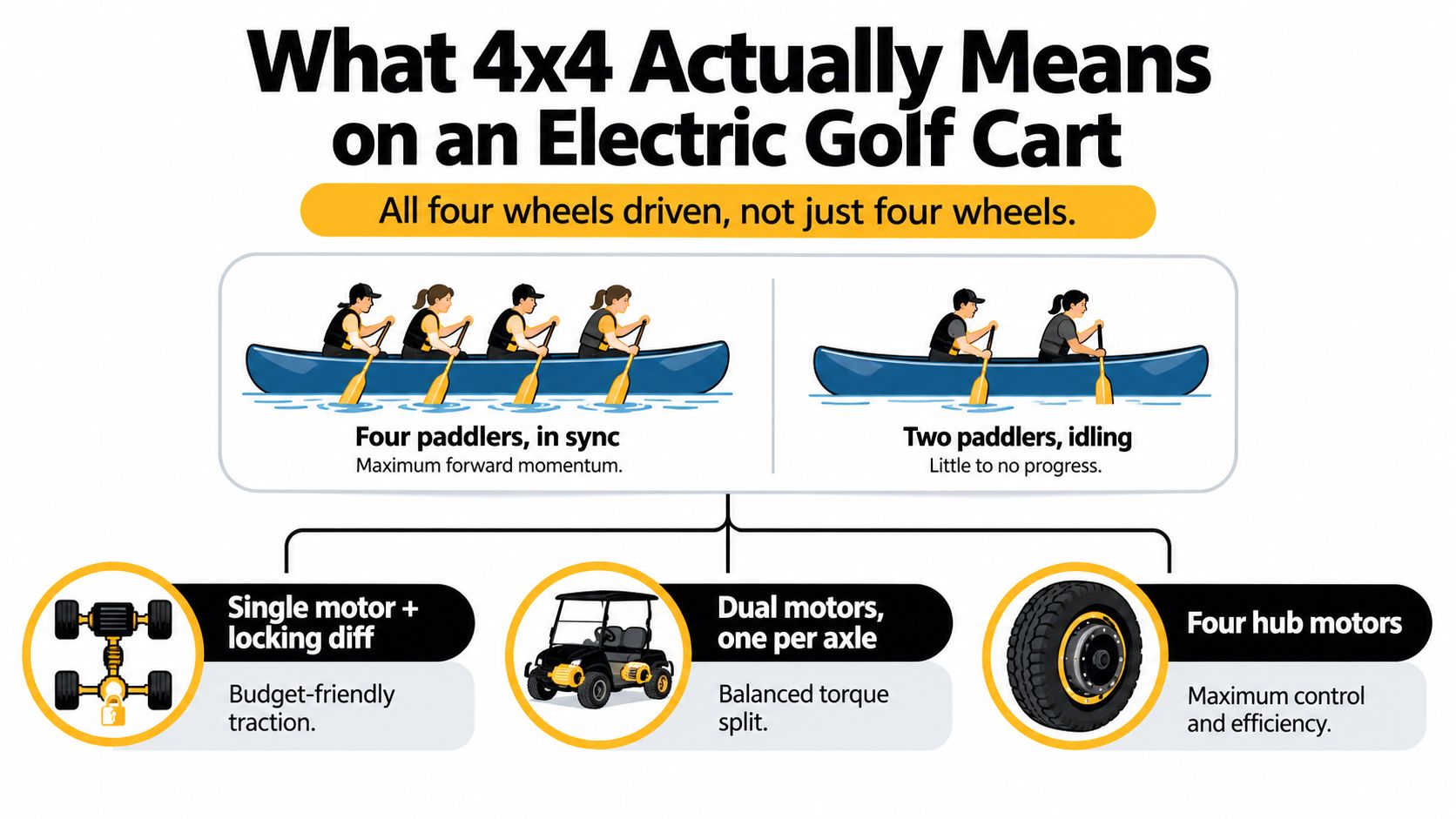
A cart having four wheels doesn't make it a 4×4. Four-wheel drive means all four wheels can receive motor torque, either continuously or when the control system detects a need for additional traction.
Think of a canoe. With one person paddling, the canoe can move, but progress becomes difficult when the water pushes back or the boat turns. With four paddlers working in sync, the group can distribute effort across more contact points. An electric 4×4 cart applies a similar idea to its tires. Instead of asking one axle to push the whole vehicle through resistance, the drivetrain can share the work.
How the system engages
Manufacturers may use several control strategies:
- On-demand drive: The cart normally uses one axle and activates the other when sensors or software detect wheel slip.
- Automatic torque management: The controller continuously adjusts torque distribution as the surface changes.
- Selectable modes: The driver chooses between two-wheel drive, four-wheel drive, or a locked setting for difficult terrain.
Electric platforms suit this arrangement because motors can be placed close to each axle or even near individual wheels. That allows the controller to regulate torque without the same mechanical layout used in a conventional gasoline vehicle.
Traditional automotive 4×4 systems often depend on a transfer case, driveshafts, differentials, and mechanical engagement. An electric cart may use fewer mechanical components, although the exact design varies by model. The simpler appearance doesn't mean every system performs identically. Ask whether the cart provides true torque delivery to all four wheels, how the mode engages, and what happens when one wheel loses grip.
Four-wheel drive also isn't a substitute for clearance, suitable tires, good suspension, or sensible driving. It helps the vehicle use available traction. It can't make a low-speed cart immune to deep ruts, large obstacles, or unsafe slopes.
2WD vs 4×4 Electric Golf Carts Compared
A 2WD cart remains the sensible choice for many buyers. It usually has fewer driven components, lower weight, and lower energy demand on firm ground. If your route is a flat neighborhood loop, a paved campus, or a packed campground path, two-wheel drive may deliver everything you need.
The 4×4 option earns its place when the surface repeatedly changes or when getting stuck disrupts work. Its extra traction can improve progress on mud, loose gravel, wet grass, snow, and grades. The trade-off is additional drivetrain hardware, potential energy losses, and more parts to inspect and service.
| Factor | 2WD Electric Cart | 4×4 Electric Cart |
|---|---|---|
| Loose surfaces | Adequate on firm, packed routes; more likely to spin on mud or soft ground | Better ability to distribute torque across the vehicle |
| Range efficiency | Usually more efficient because the system carries and drives fewer components | May use more energy because of added weight, hardware, and aggressive tires |
| Hill confidence | Works well on moderate, firm grades with a suitable load | Better suited to repeated climbs, wet grades, and changing traction |
| Payload and towing | Appropriate for light passenger and cargo duties within its rating | More capable on difficult surfaces, but added load still increases energy and braking demand |
| Purchase and maintenance | Simpler platform with fewer driven components | More complex system that may cost more to buy and maintain |
The trade buyers often miss
Four-wheel drive can improve mobility while reducing usable range on the same battery. The tires may be heavier or more aggressive, and additional motors, gears, or shafts can consume energy. That doesn't make 4×4 inefficient. It means the buyer should value route completion and uptime, not just energy consumption under ideal conditions.
Practical rule: If your routes stay on hard surfaces, buy the simpler drivetrain. If wet grass, loose ground, or grades regularly interrupt work, traction can be worth more than a small efficiency advantage.
A 2WD cart isn't a lesser vehicle when it matches the duty cycle. A 4×4 cart isn't automatically better when the extra capability never gets used.
How Electric 4×4 Drivetrains Are Built
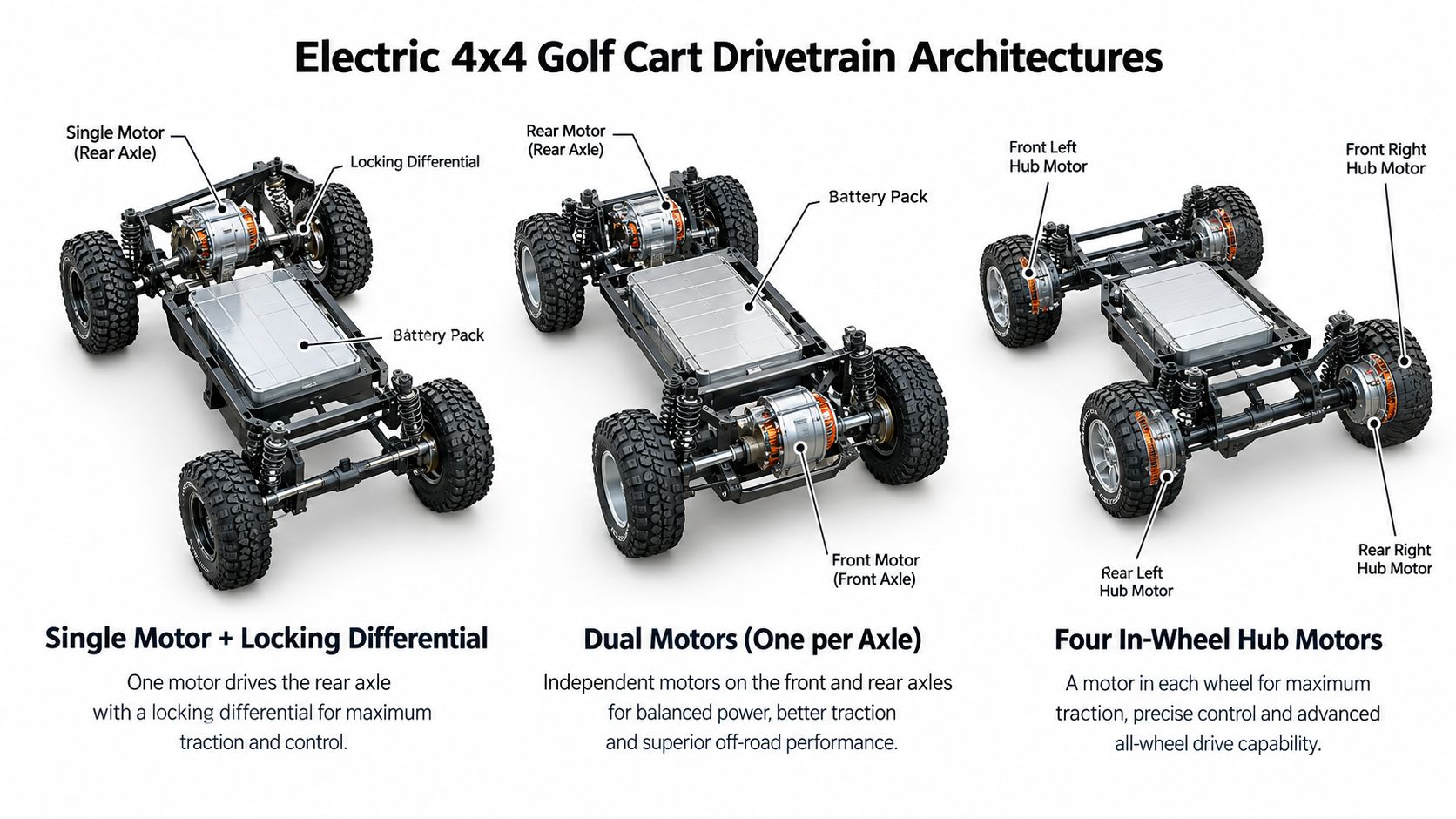
The badge on the body tells you less than the motor and axle layout underneath. Three architectures appear most often in electric 4×4 carts.
A single-motor system with a locking differential uses one motor and mechanical hardware to send power across the axles or wheels. It can be comparatively simple and light. The lock helps prevent one slipping wheel from taking all the available torque, but the design may offer less independent control than a multi-motor platform.
A dual-motor system places one motor at each axle. This arrangement can provide a balanced torque split and genuine on-demand four-wheel drive. The controller can activate the front or rear motor as conditions change, making it a common choice for premium carts intended for mixed terrain.
A four-motor system places a motor near each wheel. It offers the finest potential control because the system can manage each wheel separately. That can be useful on uneven ground, but the added components, control logic, and service requirements can raise cost and complexity.
Look beyond the motor count
Ask how the system behaves when traction changes. Does four-wheel drive engage automatically? Can the driver select it? Does the controller reduce torque to prevent wheelspin? Does the manufacturer provide a clear service procedure for motors, bearings, differentials, and wiring?
Regenerative braking matters on hilly properties. During downhill travel, the motor can act as a generator and return some energy to the battery while helping control speed. It won't remove the need for properly rated mechanical or hydraulic brakes, but it can make repeated descents easier to manage.
You can review how a four-wheel-drive electric golf cart platform approaches the relationship between traction, motor layout, and terrain. The right architecture is the one that matches your surface, slope, load, and service expectations. A four-motor system may be unnecessary for a flat estate, while a basic traction setup may disappoint on muddy service roads.
Real-World Range on Dirt, Grass, and Hills
A cart may leave the charger with a brochure-friendly range, then lose usable distance on the first wet climb. The familiar 25 to 50-plus-mile range describes controlled or favorable conditions, not necessarily a loaded 4×4 cart crossing soft ground.
Industry buying guidance reports that continuous climbing can reduce electric cart range by nearly half, while steep-hill operation alone can produce 20% to 35% reductions, as explained in this electric golf cart range guide. Grade, surface, tire pressure, passenger weight, cargo, temperature, driving style, and repeated stops all affect the result.
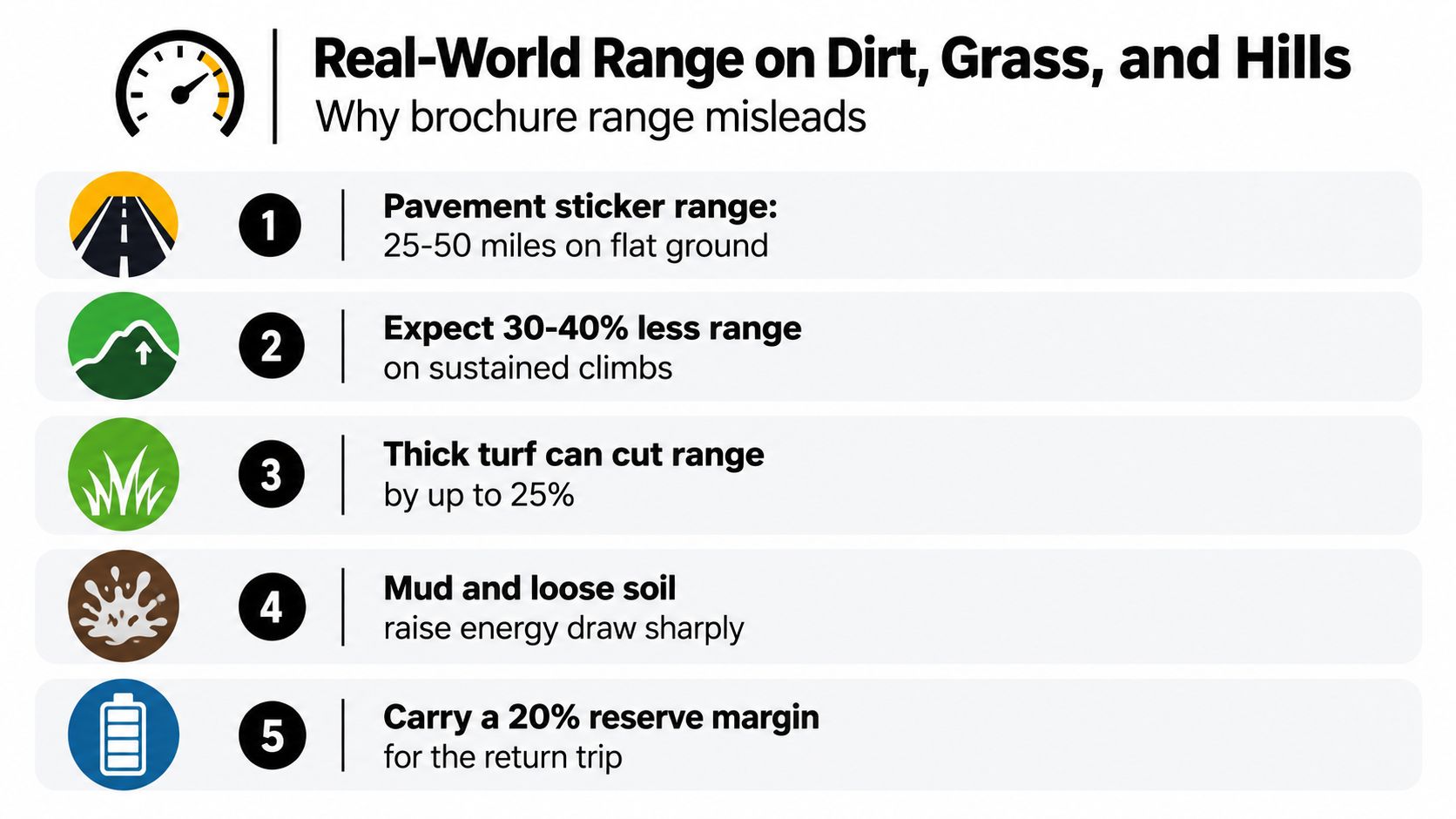
A route with four passengers, luggage, thick grass, and repeated climbs can use far more energy than a flat pavement loop covering the same distance. For that reason, ask “How many fully loaded uphill trips can it complete before charging?” rather than relying only on miles per charge.
Build a route-level estimate
Use the cart's real duty cycle:
- Record the usual passenger count and cargo weight.
- Separate pavement, packed gravel, grass, mud, and loose soil.
- Identify the longest sustained climb and count uphill trips per shift.
- Include weather, especially cold mornings and wet surfaces.
- Keep a reserve for the return route instead of planning to arrive at empty.
This method gives a better operating picture than one range figure. A cart that completes a short route consistently can serve a fleet better than one with a longer idealized range that struggles on the final climb.
Temperature also changes the calculation. NREL reports that lithium-ion resistance rises as temperatures fall, reducing power and usable energy. Cold conditions can reduce charge acceptance, while excessive heat accelerates aging and creates safety concerns. NREL identifies approximately 15 to 35°C, or 59 to 95°F, as a desirable operating range for battery performance and life in its battery thermal management research.
Planning principle: Size the battery for the worst normal route, then preserve enough reserve to return without relying on a perfect-weather estimate.
A battery-management system that monitors cell temperature, limits charging when the pack is cold, and supports preconditioning may matter more than just choosing the largest nominal battery. For further route-planning context, consult this guide to electric golf cart range.
Where 4×4 Electric Carts Actually Make Sense
Consider a hunting lease first. The cart carries people, equipment, tools, and possibly a small trailer across grass, mud, ruts, and uneven access roads. Quiet electric operation suits routes where engine noise is unwelcome, but the decisive factor is traction. A 2WD cart may work during dry conditions, yet a single wet ridge can interrupt the entire trip.
A mountain resort has a different duty cycle. Staff may move supplies between buildings, collect guests, handle valet routes, and work through shoulder-season weather. The route might combine pavement, steep internal roads, wet grass, and occasional snow. Four-wheel drive doesn't make the vehicle invulnerable, but it can make daily movement more predictable when conditions change.
A large estate or ranch often benefits from one cart that handles several surfaces. The driver may leave a paved drive, cross gravel, follow an orchard path, and reach a maintenance area over soft ground. In that setting, a 4×4 platform can reduce the temptation to use a road-focused cart where it doesn't belong.
When 2WD is the better tool
A flat retirement community with paved streets has little reason to carry off-road drivetrain hardware. The same is true for an indoor warehouse, where traction and clearance may matter less than turning radius and simple charging. A flat campground loop with compact paths can also be well served by 2WD.
The broader market supports this variety of applications. Electric models represented 75.4% of the global golf-cart market in 2024, North America accounted for 44.7% of the overall market, and Asia-Pacific was identified as the fastest-growing region in Grand View Research's golf cart market report. Those figures describe the overall category, not 4×4 models specifically, but they show why buyers should define the property and duty cycle before selecting a drivetrain.
4×4 is a duty-cycle decision, not a status symbol. Use it where failed traction costs time, labor, guest service, or access. Choose 2WD when the route is consistently firm and uncomplicated.
What to Verify Before You Buy a 4×4 Electric Cart
Take a written checklist to the dealer. A 4×4 badge doesn't confirm that the chassis, brakes, tires, battery controls, and legal equipment work as one system.
Start underneath the body
Inspect the frame material and corrosion protection. Aluminum can reduce corrosion concerns and weight, while steel may offer a solid platform when properly protected. The right choice depends on construction quality, payload needs, local climate, and how the manufacturer supports repairs.
Then examine the battery system. Ask whether it monitors individual cell temperatures, limits charging when the pack is cold, supports preconditioning, and records fault conditions. A battery-management system should protect the pack during both cold starts and repeated heavy-load operation.
Braking deserves a direct demonstration. Regenerative braking can help control descents, but the cart also needs properly sized service brakes. Four-wheel drive may help the cart climb a slope, yet it doesn't reduce the energy required to stop a heavier loaded vehicle.
Match the tires to the route
Tire tread should reflect the surface you drive. Turf-friendly tires may protect grass, while more aggressive all-terrain patterns can improve loose-surface grip but increase rolling resistance and surface disturbance. Check the load rating, sidewall construction, pressure recommendations, and replacement availability.
Street use creates another layer of responsibility. SAE J2358 applies to four-wheeled low-speed vehicles traveling above 32 km/h, or 20 mph, and no more than 40 km/h, or 25 mph, with a maximum gross vehicle weight of 1,361 kg, or 3,000 pounds, as described in the SAE J2358 standard. U.S. LSVs generally also need equipment such as headlamps, tail lamps, horns, mirrors, and seat belts under FMVSS 49 CFR 571.500.
That means a street-oriented cart requires coordinated validation of steering, braking, tires, restraints, lighting, speed, and weight. Confirm local requirements before modifying a vehicle or taking it onto public roads.
Finally, evaluate the support network. Ask about warranty coverage, parts availability, technician training, diagnostic tools, and response times. A qualified electric golf cart dealer should explain how the 4×4 system is serviced, not just demonstrate its drive mode.
Choosing the Right 4×4 Electric Cart for Your Needs
A cart that handles one steep, loaded climb may struggle after several more. Choose by the number of uphill trips your route demands before charging, not by the showroom range alone.
Start with the route. Pavement and firm, level paths usually favor a quality 2WD cart. Loose soil, mud, wet grass, grades, and changing weather make 4×4 more useful because power can reach the wheels with traction instead of spinning one axle.
Count the work each trip carries. Passengers, cargo, trailers, and repeated climbs all draw from the battery. A short hill with a full load can use more energy than a longer flat route, so estimate how many loaded uphill runs you need, then keep enough charge for the return.
Public-road use requires a complete vehicle check. Four-wheel drive, lights, or a higher speed setting do not establish legality by themselves. Confirm the applicable low-speed-vehicle rules and verify steering, braking, tires, restraints, lighting, speed, and weight together.
Battery temperature also belongs in the comparison. NREL identifies 15 to 35°C, or 59 to 95°F, as a desirable lithium-ion operating range and reports that optimized thermal management can increase battery power by more than 10%, as noted in the NREL battery research cited earlier. Ask how the pack performs on cold mornings and during sustained high-load driving.
Choose by terrain, payload, and duty cycle. Bring a route map to the dealer, mark the steep sections, and describe your expected loaded trips. Solana EV offers electric golf carts for course, neighborhood, resort, and property use, including four-wheel configurations. Review its vehicles and discuss your route requirements with Solana EV before choosing between 2WD and 4×4.