
If someone says "golf cart," you probably picture a manicured fairway and a couple of golfers. But that picture is getting seriously outdated. While they're still perfect for the back nine, the modern 4-seater golf cart has broken free from the course and become a go-to vehicle for families, planned communities, and even businesses.
Why a 4-Seater Golf Cart Is More Than Just a Golf Cart
Let's be clear: the 4-seater golf cart you see cruising through a gated community is a whole different beast. It's not just for recreation anymore; it's a genuine utility player that makes daily life easier, more fun, and way more efficient. This isn't just a trend—it's the result of some incredible engineering from brands like Solana EV, who are building stylish and powerful electric carts that easily handle short-range trips.
These vehicles have carved out their own niche, slotting in perfectly among the most unique commercially available electric vehicles beyond cars. Their silent, zero-emission ride makes them a welcome addition to any neighborhood.
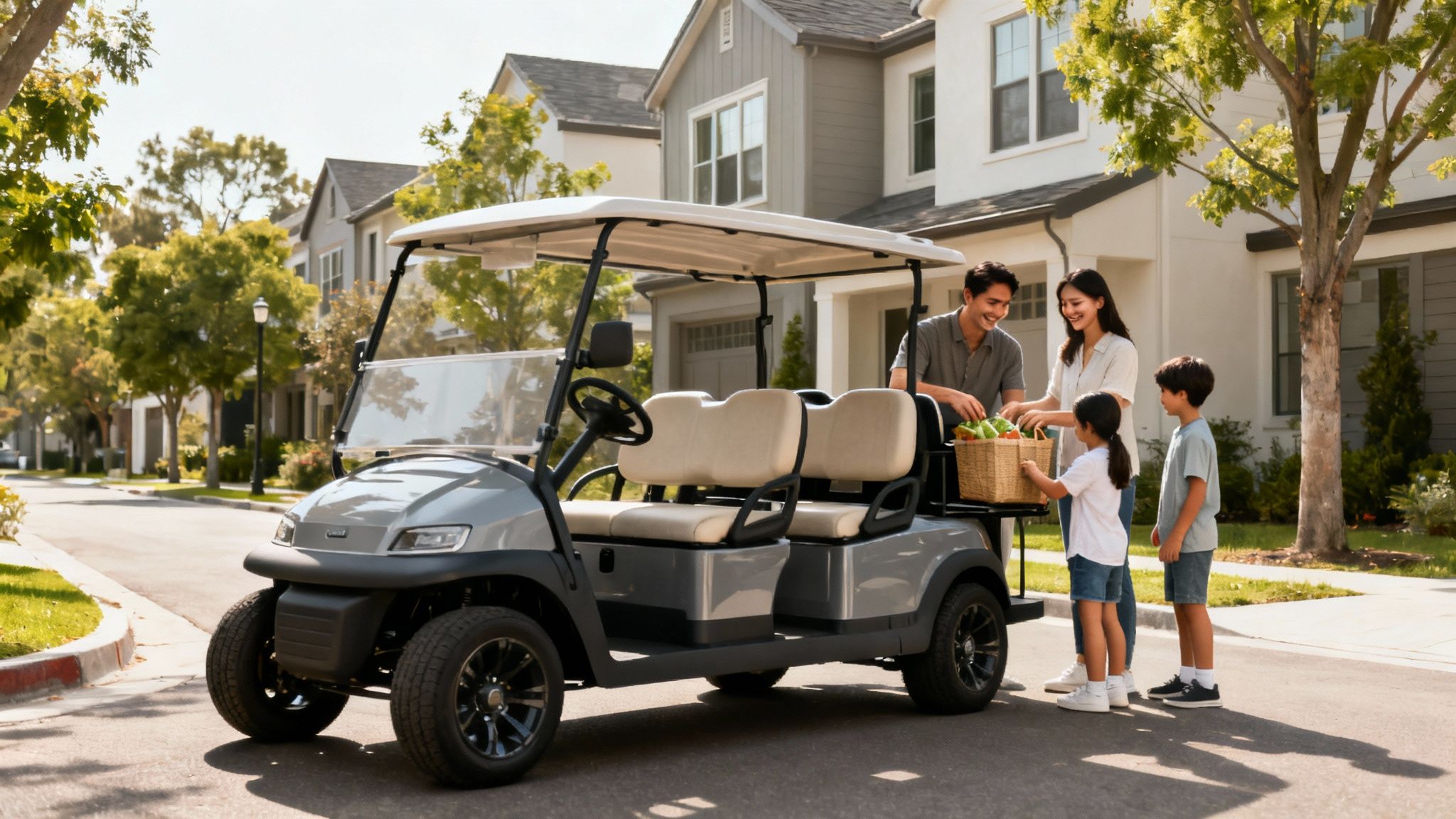
A New Way to Get Around the Neighborhood
The real game-changer here is the rise of the Low-Speed Vehicle (LSV). Think of an LSV as a street-legal golf cart. It's been upgraded with essential safety features that allow it to be legally driven on most public roads with speed limits of 35 MPH or less. Suddenly, your 4-seater cart isn't just a toy—it’s a practical second car for the family.
A 4-seater golf cart gives you the people-moving space of a small car but with the nimble, cost-effective perks of an EV. It’s the perfect fit for how we live today.
Once your cart is road-ready, you’ll be surprised how often you leave your car in the garage. It’s perfect for those quick trips that feel like a hassle in a full-size vehicle.
- Family Fun: Loading up the kids and all their stuff for a trip to the community pool or a friend's BBQ is a breeze. No more buckling into a hot car for a two-minute drive.
- Property & Business Use: Resorts can shuttle guests with ease, maintenance crews can zip across large properties, and security teams can patrol quietly and efficiently.
- Quick Errands: Why fire up the SUV for a run to the corner store or post office? An open-air ride to grab groceries or a coffee is just plain better.
And if you need to haul more than just people, many carts can be adapted. For those who need to move tools, supplies, or equipment, a golf cart with a utility bed offers a whole new level of practicality. This guide will walk you through everything you need to know about these incredibly versatile machines.
Getting to Know the Nuts and Bolts: Core Features and Specs
To really find the right 4-seater golf cart, you need to look under the hood—figuratively, of course. Diving into a spec sheet can feel a bit overwhelming at first, but once you know what to look for, it all clicks into place. These numbers aren't just details; they're the DNA of your cart, defining how it drives, how far it goes, and what it can carry.
It's no surprise these carts are everywhere now. The market has exploded, with 4-seater models grabbing a massive 54.1% market share. They've become the go-to for families and small groups. And the shift to electric is even more pronounced, with battery-powered carts making up 75.4% of sales. People clearly want quiet, clean, and convenient transportation. If you're curious about the data, you can read the full research on the golf cart industry to see the trends for yourself.
This popularity means manufacturers are constantly upping their game, so understanding the specs is more important than ever.
How Much Can It Carry and Where Will It Fit?
First up, let’s talk about payload capacity. Think of it as the total weight your cart can safely handle. This isn't just about people; it’s everything you load up—coolers for the beach, bags of mulch, the kids' sports gear, you name it. A typical 4-seater can manage somewhere between 800 to 1,000 pounds.
Pushing past that limit is a bad idea. It puts a ton of strain on the motor, suspension, and brakes, which hurts performance and can be unsafe. It’s like trying to haul a load of bricks in a family sedan—it just wasn’t built for that.
Size matters, too. Most 4-seaters are about 9 to 10 feet long and 4 feet wide. Before you even think about buying, grab a tape measure and check your garage or storage shed. You want to make sure you have enough room to park it and walk around it comfortably. These dimensions are also what make them so nimble on narrow community paths where a bigger vehicle wouldn't stand a chance.
The Heart of the Cart: Your Battery and Powertrain
For an electric cart, the powertrain is everything. At its core are the motor and the battery, and the battery choice you make will have the single biggest impact on your day-to-day experience.
You’ll generally run into two types:
- Lead-Acid Batteries: These are the old-school, tried-and-true option. They're cheaper upfront, but they demand your attention with regular maintenance like checking water levels. They also have a shorter lifespan, usually around 3-5 years.
- Lithium-Ion (Li-ion) Batteries: This is the modern technology you find in your smartphone or a Tesla. They are completely maintenance-free, charge way faster, and last a whole lot longer—we're talking 8-10 years or more. A huge plus is that they deliver consistent power, so your cart won’t get sluggish as the battery level drops.
While lead-acid batteries will get you from A to B, choosing Lithium-ion is really an investment in convenience and better performance. You're buying freedom from maintenance and a more reliable ride, every single time.
This decision directly impacts the million-dollar question: how far can it go?
Before we dive deeper, here’s a quick-reference table to keep these key numbers straight. It’s a great way to compare different models at a glance and see how they stack up.
Key Specifications for a 4 Seater Golf Cart
| Specification | Typical Range | Notes |
|---|---|---|
| Payload Capacity | 800 – 1,000 lbs | Includes passengers and all cargo. Don't overload it! |
| Length | 9 – 10 feet | Measure your storage space before you buy. |
| Width | ~4 feet | Allows for easy navigation on tight paths. |
| Lead-Acid Range | 20 – 25 miles | Good for short trips within a community. |
| Lithium-Ion Range | 40 – 60+ miles | Ideal for longer drives or heavy use. |
| Standard Speed | 15 – 19 mph | Perfect for off-road or private property use. |
| LSV Speed | Up to 25 mph | Required for street-legal status in most areas. |
This table gives you a solid baseline. As you shop around, you'll see how different brands and models either stick to these standards or push the boundaries with higher-performance options.
Speed and Range: How Far and How Fast?
So, how far can you actually go on a single charge? It really comes down to the battery. A cart with a standard set of lead-acid batteries will probably get you 20-25 miles, which is perfect for cruising around the neighborhood. But if you opt for a high-quality Lithium-ion setup, you can easily double that, hitting 40-60 miles or even more.
Of course, other things affect your range. Hauling four people up a steep hill is going to drain the battery faster than a solo cruise on a flat, paved path. Your driving style matters, too.
Speed is the other big piece of the puzzle, especially if you want to drive on public roads. Most golf carts top out between 15-19 mph. However, to be considered a street-legal Low-Speed Vehicle (LSV), a cart needs to be able to reach 25 mph (but no faster). This is a critical legal distinction that opens up a whole new world of possibilities, letting you use your cart for errands, not just for fun.
Choosing the Right Size Cart for Your Needs
Picking the right golf cart is a lot like buying a car—what works for one person might be totally wrong for another. It all comes down to your lifestyle. While a 4-seater often hits that perfect sweet spot, it's smart to see how it stacks up against its smaller and larger cousins. Getting this right from the start means your new ride will fit seamlessly into your life, whether you're hauling kids, cruising the neighborhood, or managing a business property.
The real magic of a 4-seater is its balance. You get enough room for a small family or a few friends without having to maneuver the longer, heavier footprint of a 6-seater. It’s the perfect middle ground—more practical than a 2-seater but still nimble enough for tight turns and easy parking.
The 2-Seater: Compact and Agile
Think of the classic 2-seater as the zippy sports car of the golf cart world. It’s built for one thing: getting one or two people from point A to point B efficiently.
Its biggest selling points are its small size and agility. A 2-seater can dart down narrow paths, squeeze into the tightest parking spots, and tuck away neatly in a packed garage. If you're a solo golfer heading for the first tee or a couple running to the community pool, you can't beat its simplicity.
Of course, the downside is just as obvious. The second you need to carry more than one passenger, you're stuck. That makes it a tough sell for families or anyone who likes to entertain.
The 4-Seater: The All-Around Champion
The 4-seater is the versatile SUV of the bunch. It's the go-to for families in gated communities, resorts shuttling small groups, and property managers making rounds with an assistant. You get double the seating capacity without a massive jump in the cart's overall length, so you hold onto the easy handling that makes these vehicles so fun to drive.
One of the first decisions you'll make with a 4-seater is what's under the hood—or, in this case, the seat. The choice between traditional lead-acid and modern lithium-ion batteries has a huge impact on performance and maintenance. This little chart breaks it down nicely.
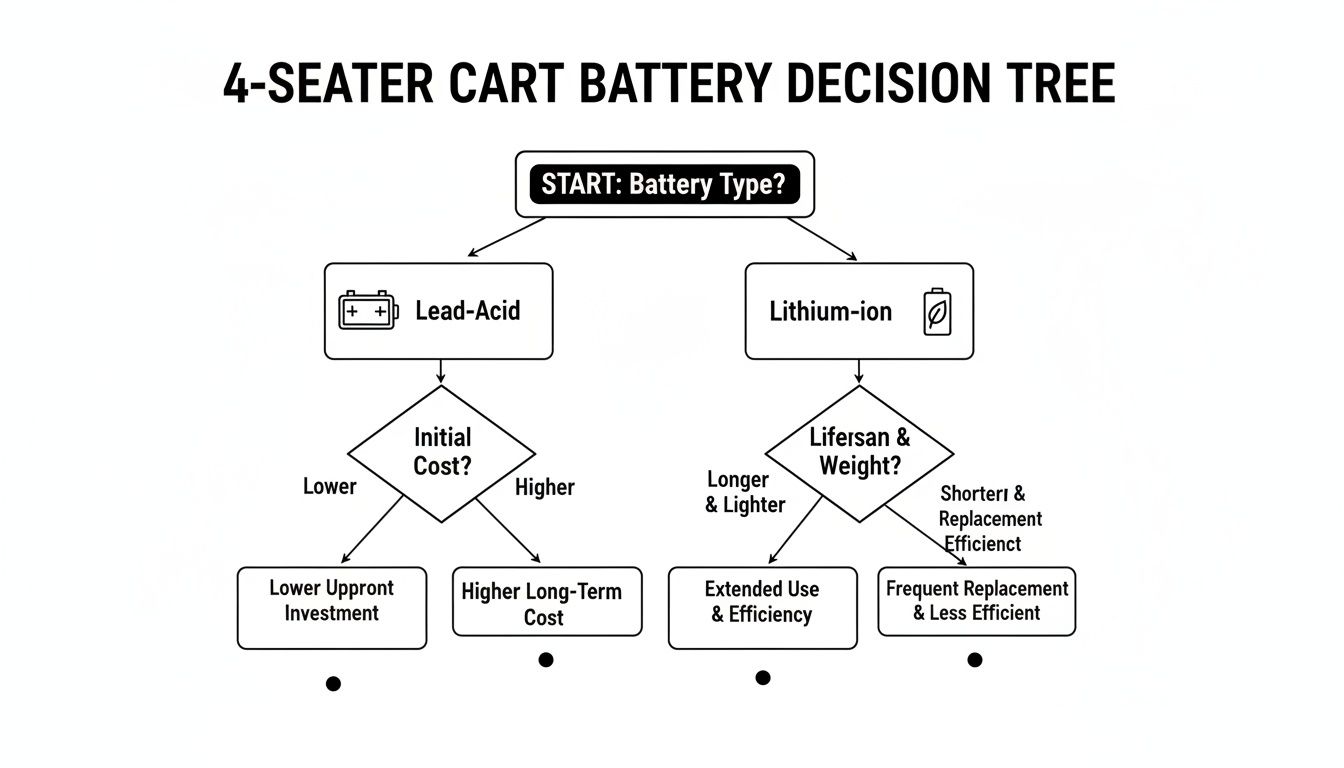
As you can see, lead-acid might save you some money upfront, but lithium-ion batteries are the clear winner for anyone thinking long-term. They last longer and are way more convenient.
This blend of utility and maneuverability is why the 4-seater is so incredibly popular. To get a better sense of its actual size, you can dive into our guide on golf cart dimensions and compare the numbers directly.
The 6-Seater: Maximum Capacity for Big Jobs
When you just need to move as many people as possible, the 6-seater is king. It's the minivan or shuttle bus of the golf cart world. You’ll see these workhorses at large resorts, wedding venues, and sprawling corporate campuses where moving groups is a constant need.
With a 6-seater, you can take the whole family and their friends to the beach in one trip. Or you can ferry an entire work crew and their equipment across a job site without making multiple runs.
But that extra space comes with some trade-offs. A 6-seater is significantly longer and heavier, making tight corners and small parking spots a real challenge. It has a much wider turning radius and demands a lot more storage space. For most people, that extra bulk is more of a hassle than a help, which is why the 4-seater remains the more practical choice for everyday use.
So, You Want to Drive It On the Road? Let's Talk Street Legal.
Taking your 4-seater golf cart from the fairway to the main street is a game-changer. Suddenly, it’s not just for a round of golf; it's your go-to ride for quick errands and neighborhood cruises. But before you hit the pavement, you need to make sure your cart is legally allowed on public roads. This means it needs to meet a specific set of safety standards to qualify as a Low-Speed Vehicle (LSV).
Don't let the regulations intimidate you. Think of it less like navigating a legal maze and more like a simple safety check. The rules are there for a very good reason: to keep you, your passengers, and everyone else on the road safe.
At its core, the difference between a regular golf cart and a street-legal LSV comes down to a handful of essential safety upgrades. It’s like the difference between a bicycle and a moped—one is built for paths, the other is equipped for the road.
The Must-Have LSV Safety Checklist
To get the green light for road use, your 4-seater cart needs some specific gear. These aren't just suggestions; they're required features that allow you to register your vehicle and legally drive it on most roads with a speed limit of 35 MPH or less.
Here’s exactly what you’ll need:
- Headlights, Taillights, and Brake Lights: You have to be seen, especially after dusk. These are non-negotiable for letting other drivers know you're there and when you're stopping.
- Turn Signals: Just like in your car, you need to signal your intentions. Front and rear indicators are a must.
- Mirrors: A rearview mirror and a driver-side mirror are required to help you see what's happening around you and keep an eye on your blind spots.
- DOT-Approved Windshield: This isn't just any piece of plastic. It has to be a legitimate, shatter-resistant windshield that meets Department of Transportation safety standards.
- Seat Belts: Every forward-facing seat needs a seat belt. Safety first, always.
On top of that, every street-legal LSV needs its own Vehicle Identification Number (VIN). This unique 17-digit number is crucial for getting your cart registered, titled, and insured.
Pro Tip: The easiest way to handle all of this is to buy a cart that's already certified as an LSV right from the factory. It shows up with all the safety gear correctly installed and a valid VIN, saving you a massive headache down the line.
The Easiest Path to Being Road-Ready
Sure, you could buy a standard golf cart and try to upgrade it yourself. But honestly, that can be a real pain. You’ll be dealing with sourcing parts, complex installations, and state-specific inspections and paperwork.
The smartest move? Purchase a 4-seater golf cart that’s already been certified as a street-legal LSV by the manufacturer.
This way, you know every component is up to snuff and meets all federal safety standards from day one. If you want to dive deeper into the nitty-gritty, our complete guide on making a golf cart street legal has all the information you could need.
Choosing a pre-certified model takes all the guesswork out of the equation. You get peace of mind and the freedom to hit the road immediately. Just hop in and go—whether you're heading to the farmer's market, taking the kids to the community pool, or just enjoying a quiet, emissions-free ride around the neighborhood. It’s all about focusing on the fun, not the paperwork.
Where Can You Put a 4-Seater Electric Cart to Use?
Thinking a 4-seater golf cart is just for the back nine is selling it short. These things are incredibly versatile, acting as the perfect go-between for a quick walk and firing up the car. It’s when you start seeing them as a genuine transport tool that their real value clicks. Whether you're simplifying life in a planned community or keeping a busy resort running smoothly, these electric carts are up for the job.
What makes the 4-seater the sweet spot? It’s all about that perfect balance of passenger space and a nimble footprint. You can easily fit a small family or a couple of coworkers without dealing with the bulk of a larger vehicle. That means squeezing down narrow paths, navigating through crowds, or tucking it into a tight garage is no sweat.
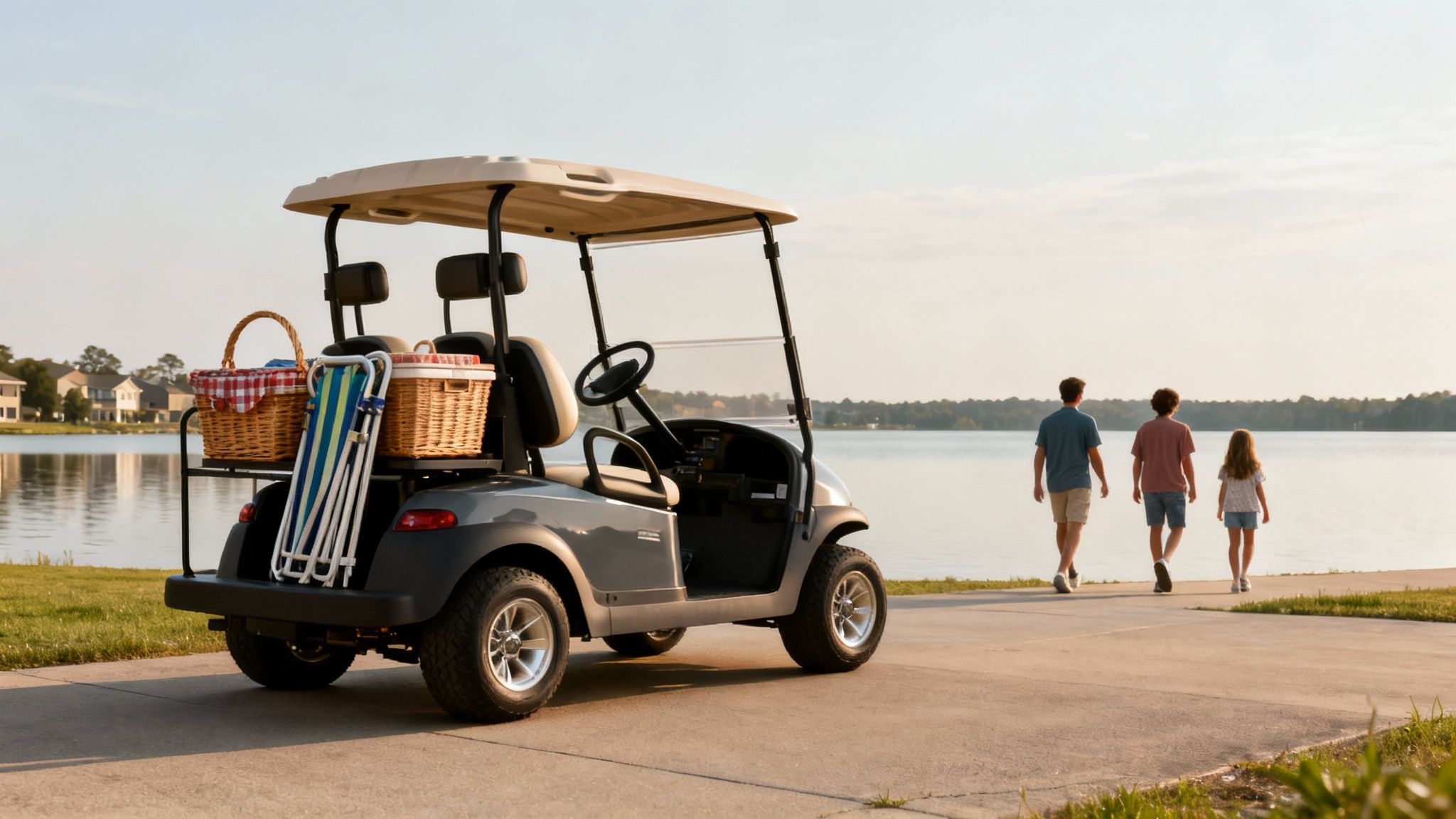
For Families in Gated Communities
In a suburban neighborhood or planned community, a 4-seater cart pretty much becomes part of the family. It turns those short, everyday trips from a hassle into a fun, open-air ride. The convenience is a game-changer, giving you a quiet, zero-emissions way to get things done.
Think about the daily grind:
- Kid-Hauling: Forget starting the SUV just to take the kids to the community pool, a friend's house, or the playground down the street.
- Quick Errands: A quick run to the local farmers market or corner store feels more like a relaxing cruise than a chore.
- Neighborhood Socials: Heading to a block party? You’ve got plenty of room for a cooler and a casserole dish, and you’ll arrive in style.
These carts are also perfect for exploring charming beach towns. When you're trying to find all the things to do in Siesta Key, a cart makes it a breeze to get around and find parking.
For Resorts and Property Management
When you're managing a large property, efficiency is the name of the game. A fleet of 4-seater carts is a smart, cost-effective way to move people and gear around. You cut out fuel costs entirely and deal with far less maintenance compared to gas-powered utility vehicles.
A well-run fleet of electric carts makes a huge difference in how smoothly your property operates and how happy your guests are. They offer quiet, seamless transport that elevates the guest experience while letting your staff cover more ground.
They become absolute workhorses in these settings:
- Guest Shuttles: Ferrying visitors from the parking lot to the lobby or their rooms is a fantastic first impression and a welcome touch.
- Maintenance & Groundskeeping: Crews can zip between jobs with all their tools and supplies, cutting down on wasted time and getting more done.
- Security Patrols: Security teams can cover huge areas quietly and efficiently, maintaining a visible but non-intrusive presence.
For Outdoor Adventurers
Don't assume all carts are stuck on the pavement. You can get seriously rugged, off-road 4-seaters built for hitting the trails. We’re talking lifted suspensions, beefy all-terrain tires, and heavy-duty frames. These carts open up a whole new world of outdoor exploration.
Imagine using your cart for:
- Trail Riding: Quietly cruise down designated trails, getting much closer to wildlife without the roar and fumes of a typical ATV.
- Finding Secluded Spots: Reach those out-of-the-way fishing holes, picnic clearings, or scenic overlooks that are a pain to get to in a full-size truck.
- Hauling Gear: On a large piece of property, it’s the perfect vehicle for moving camping supplies, hunting gear, or landscaping tools.
Whether it’s for family fun, business operations, or exploring the great outdoors, the 4-seater golf cart proves itself over and over as a truly practical and enjoyable ride.
Customizing and Caring for Your 4-Seater Golf Cart
A 4-seater golf cart isn't just a way to get around; it's a part of your lifestyle. Making it your own with the right accessories and keeping it in top shape with simple maintenance are key to getting the most out of your investment. Think of it like a boat or an RV—a little personalization goes a long way, and staying on top of upkeep prevents problems before they start.
The best part? Keeping an electric cart running smoothly is a world away from dealing with a gas engine. Forget about oil changes, messy filters, or finicky spark plugs. A few basic checks are all it takes to keep your cart ready for action.
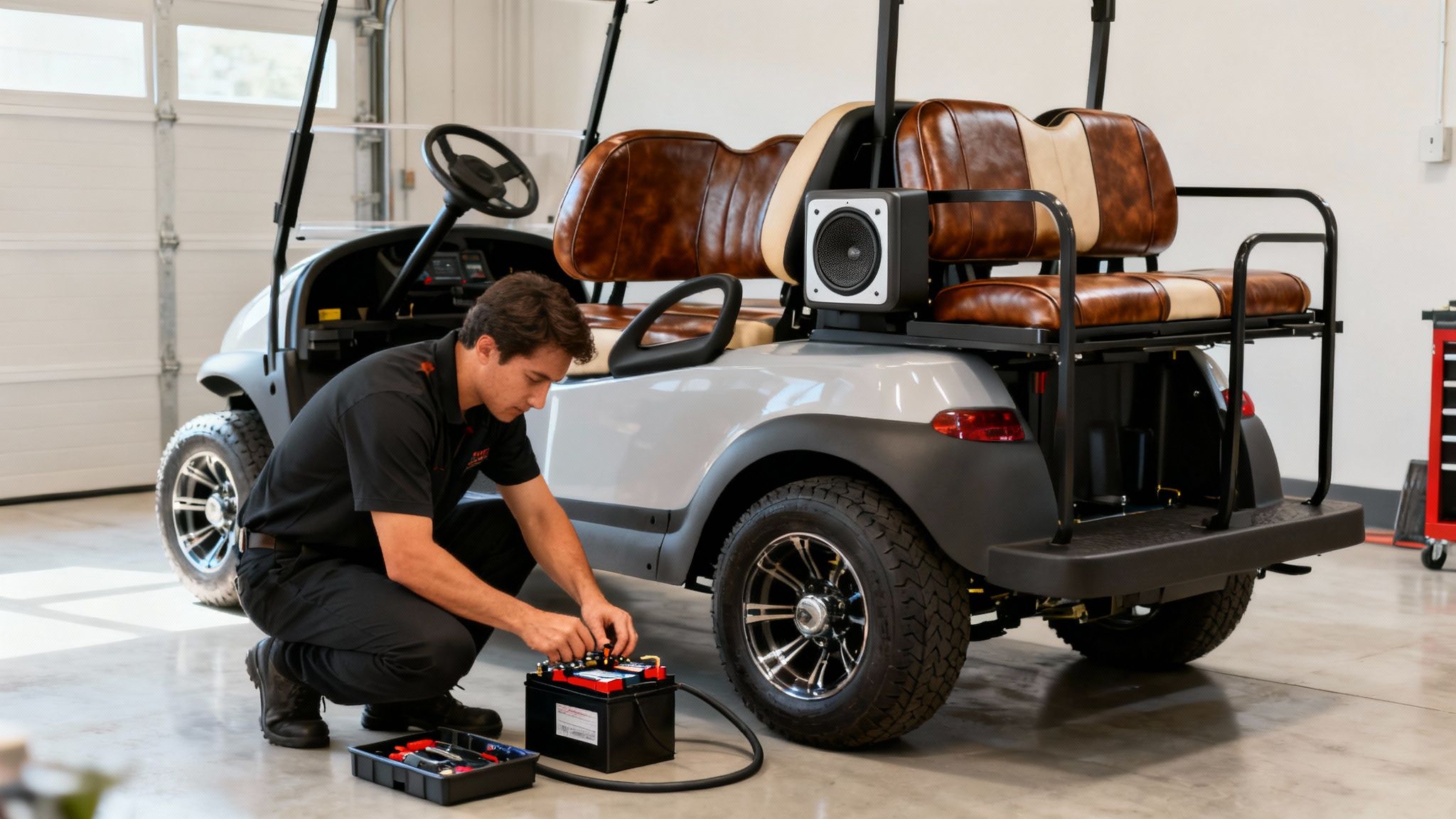
Making It Yours: Popular Accessories and Upgrades
This is where you get to put your personal stamp on your ride. The market for golf cart accessories is massive, letting you add features for everything from comfort and convenience to pure style. You can easily prep your cart to handle a surprise rain shower or a late-night cruise around the neighborhood.
Here are a few of the most popular upgrades we see people add to their 4-seater golf cart:
- All-Weather Enclosures: A clear vinyl enclosure is a game-changer. It keeps the wind and rain out, instantly making your cart usable on those less-than-perfect days. It’s the difference between being stuck inside and still getting where you need to go.
- Premium Sound Systems: Who doesn't love tunes on the go? A Bluetooth soundbar is an easy addition that completely transforms the experience, whether you're heading to the community pool or just enjoying a sunset drive.
- Upgraded Seats: Factory seats are fine, but custom-cushioned seats with contoured backrests and armrests add a touch of luxury. You’ll really appreciate the extra comfort on longer rides.
- Storage Solutions: Let's be honest, you're always carrying something. Overhead racks, under-seat storage trays, and rear cargo boxes let you haul groceries, beach chairs, or sports gear without cramming it all at your feet.
Your Simple Maintenance Checklist
You don't need a mechanic's license to keep your electric cart in peak condition. A few minutes of preventative care each month will dramatically extend its life and save you from unexpected repair bills.
Think of it as a quick health checkup for your cart. Just 15 minutes a month can prevent the vast majority of common issues, ensuring your cart is always reliable when you need it.
Just follow this straightforward checklist:
- Battery Care Is #1: The battery pack is the heart of your cart. If you have traditional lead-acid batteries, pop the caps once a month and top them off with distilled water. Make sure the terminals are clean and tight. If you have Lithium-ion batteries, you can skip this step entirely—they are completely maintenance-free!
- Check Your Tire Pressure: Underinflated tires kill your range and wear out unevenly. Keep a simple pressure gauge handy and check the PSI monthly. The recommended pressure is almost always printed right on the tire’s sidewall.
- Listen to Your Brakes: Your ears are your best tool here. Do you hear any grinding or squeaking? Does the cart pull to one side when you stop? If the pedal feels spongy or you notice anything unusual, it's time for a professional inspection.
- Keep It Clean: A regular wash does more than just make your cart look sharp. Rinsing off dirt, dust, and (especially near the coast) salt helps prevent rust and corrosion on the frame and other metal components.
By adding a few well-chosen accessories and sticking to this simple routine, your 4-seater golf cart will remain a fun, reliable, and indispensable part of your life for years to come.
Your Questions, Answered
Jumping into the world of electric carts can bring up a few questions. We get it. To make sure you feel totally comfortable with your choice, we’ve put together some plain-English answers to the things we’re asked most often about our 4-seater golf carts.
How Far Can a 4 Seater Electric Golf Cart Go on One Charge?
Think of it like the gas tank in your car—how far you can go on a single charge, or its range, really boils down to the battery. That's the biggest factor.
Carts with the old-school lead-acid batteries will generally get you about 20-25 miles. For most folks, that’s more than enough for daily errands around the neighborhood. But if you upgrade to a modern Lithium-ion battery, you’re in a whole different league. Suddenly, you're looking at a range of 40 to 60 miles, sometimes even more. Plus, these newer batteries charge way faster and last for years longer, which is why so many people see them as a worthwhile investment.
What Is the Difference Between a Golf Cart and an LSV?
This is a big one, and it’s super important. A standard golf cart is built for private property—think fairways and large estates—and tops out around 15 mph. A Low-Speed Vehicle (LSV), on the other hand, is a specific class of vehicle that's built from the ground up to meet federal safety standards for driving on public roads.
You can think of an LSV as the street-legal, road-ready cousin of a golf cart. It comes standard with safety gear like headlights, seatbelts, and mirrors. It also has a Vehicle Identification Number (VIN), which means you can register and insure it just like a car. The top speed is capped at 25 mph, making it legal to drive on any road with a speed limit of 35 mph or less.
Is It Expensive to Maintain a 4 Seater Electric Golf Cart?
Not at all—in fact, it's one of their best perks. The simplicity and low cost of maintenance are huge selling points for electric carts. Forget about oil changes, spark plugs, or fussy exhaust systems.
Your regular to-do list is short and sweet. It's mostly just:
- Checking the tire pressure every so often.
- Making sure the brakes feel solid and responsive.
- Keeping the battery terminals clean so they don't get corroded.
If you go with lead-acid batteries, you'll need to top off the water levels once a month. But if you opt for a cart with a Lithium-ion battery, it’s completely maintenance-free. Your yearly running costs drop to practically zero compared to what you’d spend on a gas-powered car or cart.
Ready to see how a 4-seater can fit into your life? The team here at Solana EV can walk you through the options and help you find the perfect blend of style, function, and eco-friendly fun. Check out our lineup of premium electric vehicles and find a better way to get around.