
You're probably looking at the same headache I see on resort and campus properties all the time. Guests are stacking up at the lobby, one standard cart is already full, another driver is somewhere off-route, and your team is making too many short trips with too little capacity. Or you're on a campus road watching a convoy of small carts create more congestion than the shuttle problem they were supposed to solve.
That's when a 12 seater golf cart starts to make sense. Not because “bigger is better,” but because moving groups is a different job than moving golfers, homeowners, or maintenance staff. The buying mistake is treating a 12-passenger unit like a regular cart with extra seats. It isn't. It's a people-mover, and you should buy it, spec it, insure it, and operate it that way.
The market has moved in that direction too. One independent forecast valued the global golf cart market at USD 2.3 billion in 2025 and projected USD 5.1 billion by 2035, while another forecast estimated USD 3.4 billion in 2026 growing to USD 4.9 billion by 2033, reflecting sustained demand across resorts, campuses, and gated communities where larger carts are used for group transport (golf cart market forecasts).
Table of Contents
- Why a 12 Seater Golf Cart Is a People-Mover, Not a Stretched Cart
- Layout, Chassis, and How 12 Occupants Change the Engineering
- Where a 12 Seater Cart Earns Its Keep
- Off-Road Versus Street-Legal LSV Use
- LSV Rules, Speed Bands, and Safety Equipment Buyers Must Verify
- Performance and Charging Expectations Under Load
- Maintenance and Lifecycle for High-Capacity Passenger Use
- Buying, Dealer Support, and Financing the Right Way
Why a 12 Seater Golf Cart Is a People-Mover, Not a Stretched Cart
A resort manager calls because beach guests are waiting too long between the lobby and the waterfront. The property already owns several smaller carts. On paper, capacity looks fine. In practice, the operation is sloppy. Drivers make extra loops, families get split across vehicles, and every pickup turns into a small traffic jam.
That's not a cart problem. It's a people-flow problem.
A 12 seater golf cart solves that only when you treat it like a shuttle asset. One trip with a full group is different from three trips with partial loads. Labor changes. Guest experience changes. Route timing changes. Insurance exposure changes too, because now you're transporting groups routinely, not giving occasional short lifts.
Practical rule: If the vehicle's main job is moving scheduled groups, not casual riders, you're no longer shopping for a recreational cart category.
What buyers get wrong
Most buyers start with seat count. That's backwards. Start with these questions instead:
- Who rides it: Guests, residents, students, event attendees, or staff.
- Who drives it: Valet, shuttle staff, security, facilities team, or whoever happens to have keys.
- How often it runs: Continuous loop, peak-period shuttle, or occasional overflow.
- Where it runs: Private property only, mixed-use roads, service lanes, or public crossings.
If you skip those questions, you'll buy the wrong machine and build the wrong policy around it.
A lot of operators also underestimate upkeep between shifts. Before you worry about premium features, you need a repeatable cleaning and inspection habit. If your team needs a simple field reference for appearance and condition checks, this quick guide to check your cart is useful because it reinforces the basics operators ignore when vehicles stay in constant guest-facing use.
Why the category has shifted
The broader market has already moved beyond golf-only use. Industry coverage points to a long-running shift toward utility and low-speed transport, especially in North America, and one forecast says electric golf carts will account for 95.0% of market share, while 2-seater carts remain the leading configuration at 40.0%, which tells you exactly where a 12-passenger model sits: it's a specialized electric niche for higher-capacity movement, not the default cart format (golf cart market segmentation).
If you're evaluating vehicle classes for guest or staff movement, it helps to look at examples in the broader transportation golf cart category rather than only consumer-style neighborhood carts.
Layout, Chassis, and How 12 Occupants Change the Engineering
The right 12 seater golf cart starts with layout. The wrong one starts with optimism.
A true 12-passenger platform has to board quickly, turn predictably, and stop cleanly when loaded. That means layout choices affect more than comfort. They affect stability, dwell time, and whether your staff can move people without constant reshuffling.
Here's a visual summary of what changes when the vehicle is built for real passenger volume.
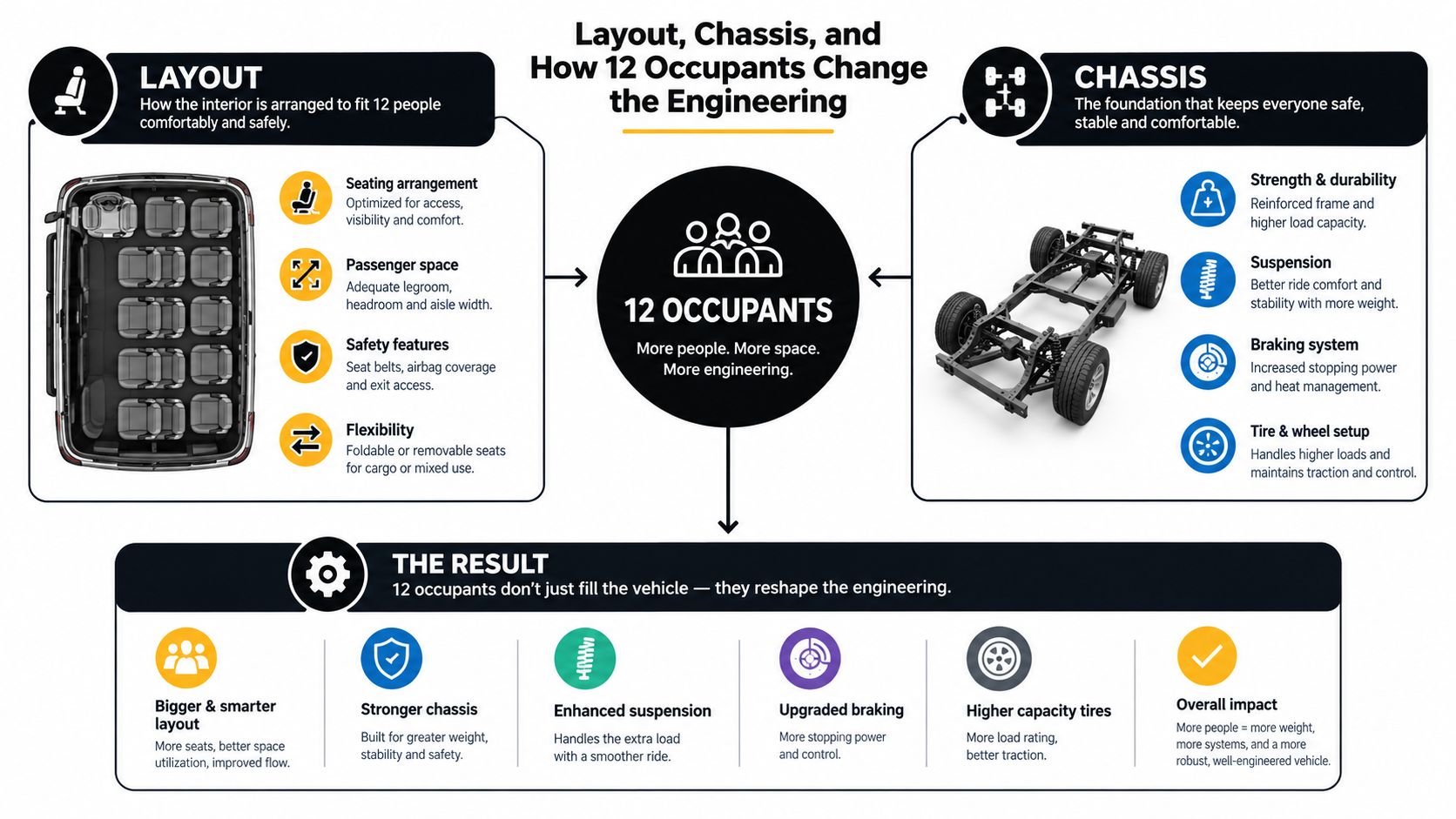
Layout choices that matter
The most common layouts each solve a different operating problem:
- Four forward-facing rows: Best for resorts and formal passenger service. Boarding is intuitive, supervision is easier, and riders generally feel more secure.
- Mixed forward and rear-facing benches: Better when you need flexibility, but less ideal for guest shuttles because boarding flow gets awkward.
- Stadium-style rows: Useful where visibility matters, though step-in height and canopy design become more important.
If you're comparing options, don't stop at the brochure photo. Walk the boarding path. Check handholds, step wells, roof coverage, and whether riders can enter and exit without forcing the whole row to shuffle.
Why the chassis separates real people-movers from stretched carts
A 12-passenger vehicle is to a standard golf cart what a shuttle bus is to a sedan. Same basic mission. Different engineering burden.
With 12 occupants, the platform needs:
- A longer wheelbase to manage cabin length and weight distribution.
- A reinforced frame so the chassis doesn't flex under repeated full-load duty.
- Heavier suspension tuning because passenger load changes handling fast.
- Larger brakes and tire capacity because loaded stopping behavior is the test, not empty-lot driving.
That's also why payload matters more than marketing language. If a seller can't clearly explain the vehicle's passenger-and-cargo carrying limit, move on. This primer on payload capacity is worth reviewing before you compare spec sheets, because too many buyers confuse seat count with safe operating load.
A seat doesn't equal usable capacity unless the frame, suspension, brakes, and tires were designed around that occupied load.
For a closer look at large-cart packaging and body design, this video helps show how the form factor changes once the vehicle is intended for group transport rather than casual riding.
The non-negotiable hardware
When I spec a high-capacity passenger unit, I expect these signs that the builder understood the assignment:
| Engineering area | What to look for | Why it matters |
|---|---|---|
| Seating support | Rigid seat bases and secure mounting points | Repeated ingress and egress loosens weak hardware fast |
| Suspension | Heavy-duty springs or equivalent load-rated setup | Loaded ride height and stability have to stay controlled |
| Braking | Strong, consistent braking hardware sized for full occupancy | Passenger vehicles live or die by loaded stopping confidence |
| Boarding | Wide step access, grab points, usable floor space | Faster boarding cuts route delays |
| Weather protection | Full canopy coverage and optional side protection | Group transport doesn't stop because conditions get annoying |
If it looks like a regular cart with more cushion material, it probably is.
Where a 12 Seater Cart Earns Its Keep
A 12 seater golf cart pays back when the route is predictable and the seats stay busy. If it sits parked most of the day, it becomes an expensive symbol of ambition.
The best applications are boring in the best way. Same origin points. Same destination points. Same passenger surges. That's what lets one larger unit replace multiple small, messy trips.
Best-fit environments
Resorts are the cleanest use case. Lobby to villas, lobby to beach club, clubhouse to event lawn. Guests move in clusters, often with bags, kids, or wedding attire. Splitting that into several carts creates delay and confusion.
Campuses and corporate sites also justify the platform when parking lots, admin buildings, and visitor centers create repeat shuttle loops. Event venues are another strong fit because arrivals and departures happen in waves, not random drips.
If you manage hospitality transport strategy, this overview of resort transportation services reflects the bigger point. Vehicle choice only works when it fits the route design and rider pattern.
If your operation moves groups at known times on known paths, a larger passenger unit usually beats a pile of smaller carts.
Where it's overkill
Some properties buy a 12-passenger unit because it sounds premium. Then the vehicle hauls three people at a time and spends most of the afternoon parked.
That's a bad buy. Common poor fits include:
- Small private communities: Trip density is usually too low.
- Traditional golf operations: Most use is still built around smaller rider groups.
- Low-traffic marinas or campgrounds: Demand spikes aren't frequent enough.
- Light-duty properties: If transport is occasional, a smaller fleet is easier to manage.
Here's the practical fit view.
12 Seater Golf Cart Use Case Fit
| Environment | Fit Rating | Typical Daily Trips | Payback Logic |
|---|---|---|---|
| Large resort or hotel property | Strong | Frequent scheduled and on-demand loops | Fewer trips, cleaner guest movement, less driver scrambling |
| University or corporate campus | Strong | Regular connector routes | Consolidates riders and reduces small-cart traffic |
| Event venue or wedding property | Strong | Peak-heavy transport windows | Handles surges without constant staging |
| Master-planned or retirement community | Conditional | Depends on shuttle program structure | Works if the community runs real loops, not occasional favors |
| Industrial park or crew movement | Conditional | Useful on fixed internal routes | Worth it when shift changes create dense rider loads |
| Small neighborhood or light-use property | Weak | Sporadic | Underused capacity drags ownership value down |
Off-Road Versus Street-Legal LSV Use
This decision should be made with a route map on the table. Not from a sales sheet.
Some buyers need a 12 seater golf cart to live entirely on private property. Others need it to cross roads between buildings, parking lots, or adjacent facilities. Those are two different jobs, and trying to split the difference usually creates compromise in the wrong places.
Off-road configuration
An off-road setup makes sense when the vehicle spends most of its life on private lanes, rougher paths, agricultural property, or large internal grounds where ride height and traction matter more than public-road compliance.
That version usually appeals to operators who care about:
- Ground clearance for uneven surfaces
- More aggressive tires for loose or mixed terrain
- Property flexibility across trails, service roads, and unpaved connectors
- Simpler use case because the vehicle stays off public streets
For estates, recreation properties, and back-of-house resort movement, that can be the right answer. You don't pay for road-legal equipment if the route never needs it.
Street-legal LSV configuration
A street-legal low-speed vehicle setup matters when crossing public roads changes the operation from annoying to efficient. Independent industry coverage identifies street-legal low-speed vehicles as the fastest-moving niche, and the same coverage notes that legal operation typically turns on required equipment, registration posture, and where the vehicle is allowed to drive (low-speed vehicle market guidance).
The upside is obvious. One vehicle can connect lots, lodges, campuses, and neighborhood facilities without forcing passengers to unload and reload at every boundary. The downside is that legal classification affects insurance, operating rules, and what equipment must be present.
Off-Road 12-Seater vs. Street-Legal LSV
| Factor | Off-Road Config | Street-Legal LSV Config |
|---|---|---|
| Main environment | Private property and mixed terrain | Roads and controlled on-street connectors |
| Tire and ride setup | Prioritizes terrain tolerance | Prioritizes road compliance and predictable paved handling |
| Equipment burden | Simpler if kept off-road | Higher because legal equipment package matters |
| Insurance posture | Driven by private-site use | Driven by road classification and local rules |
| Route flexibility | Strong inside one property | Strong across connected properties and crossings |
| Best buyer | Operators with internal-only transport | Operators who need legal road access for shuttle work |
If most of your route is on private property and only a tiny piece touches public road, solve that route problem first. Don't assume road legality is always the best answer.
LSV Rules, Speed Bands, and Safety Equipment Buyers Must Verify
A dealer says “street legal,” the buyer nods, and nobody checks the actual class requirements for the jurisdiction where the vehicle will run.
For a 12-passenger vehicle, that's risky.
A low-speed vehicle class in a major market is defined as a four-wheeled electric vehicle with a speed capability greater than 32 km/h (20 mph) and not more than 40 km/h (25 mph) over 1.6 km on a paved level surface, and a GVWR under 1,361 kg (3,000 lb) (LSV definition and limits). That matters because once a 12-passenger platform grows too heavy, it can fall outside the standard LSV envelope.
Here's the buyer checklist I'd use before signing anything.
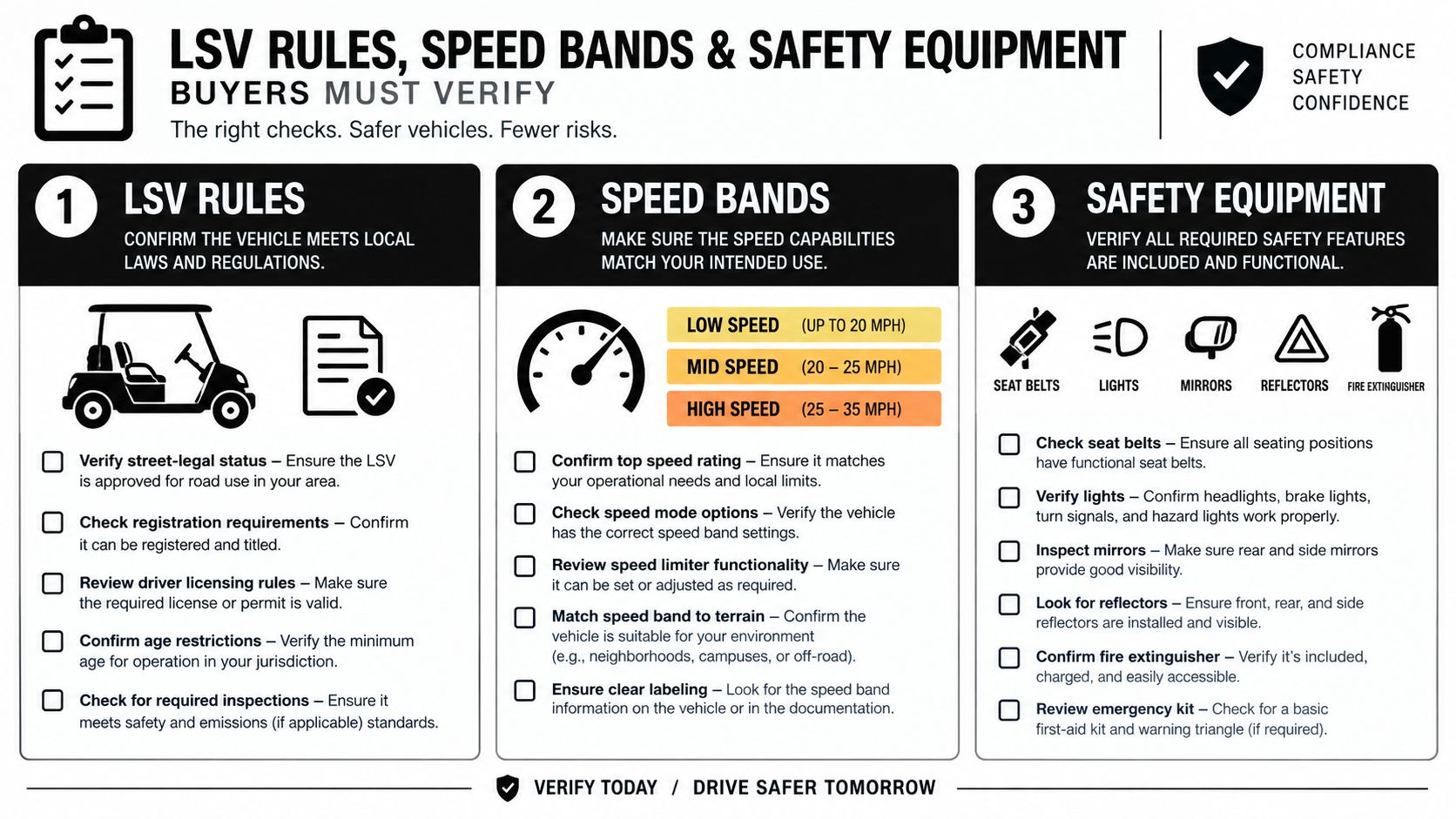
Verify the legal class first
Don't begin with accessories. Begin with classification.
Ask these in order:
- What class is this vehicle sold as in my jurisdiction?
- Does the loaded design still fit that class?
- Which roads can it legally use?
- What registration, insurance, and driver requirements apply?
If the seller can't answer cleanly, involve your insurer and local regulator before purchase. Not after delivery.
Confirm the actual equipment
Street-legal claims should be backed by hardware and documentation, not verbal assurance. For group transport use, verify the spec sheet for the required road-use package in your market, including lighting, mirrors, restraints, visibility equipment, identification labeling, and the other safety items tied to low-speed road operation.
Passenger safety guidance also supports a stricter view of occupancy. The key point is simple. Occupants need designated seating positions, and overloading beyond the designed passenger limit increases wear, instability, and ejection risk (occupant seating guidance).
Buy the vehicle that matches the passenger count on the nameplate. Don't buy a smaller platform and try to operationally “stretch” it with informal rider practices.
Safety policy is part of the spec
The equipment matters, but the policy matters too. Safety guidance for golf carts consistently emphasizes that riders should never exceed seat count, should remain seated with feet inside, and operators in facility settings should be trained and at least 16 with a valid license. It also highlights route design, speed control, weather caution, and written safety policies as critical for larger passenger loads (golf cart safety guidance).
That's why my recommendation is blunt. If you're buying a 12-passenger unit, buy the policy at the same time. Driver rules, loading rules, weather rules, and route rules should be written before the first guest boards.
Performance and Charging Expectations Under Load
A 12 seater golf cart always feels best in a product demo with two adults and a flat parking lot. That isn't how it'll work in real life.
Full passenger load changes everything. Acceleration softens. Hills matter more. Braking confidence matters more. Battery draw climbs because the vehicle is moving a lot more total mass every run. If you expect empty-cart performance with a full shuttle load, you'll be disappointed.
What load does to real operation
The key variables are simple:
- Passenger count
- Route length
- Grade
- Stop frequency
- Accessory use, especially lighting and climate-related add-ons where applicable
A resort loop with frequent stops and full seats taxes the battery differently than a smooth campus shuttle on level pavement. This is why I tell buyers to ignore optimistic range chatter and build their plan around loaded duty, not ideal conditions.
Range and Charging Under Varying Loads
| Load Condition | Typical Range | Recommended Charger | Recharge Time |
|---|---|---|---|
| Light passenger load on flat internal routes | Varies by battery, route, and driving style | Depot-based charger matched to battery chemistry | Usually handled through scheduled downtime or overnight charging |
| Mixed occupancy with repeated stop-and-go service | Lower than lightly loaded operation | Dedicated charging bay near dispatch point | Best supported by consistent between-shift charging discipline |
| Near-capacity operation on hilly or long routes | Lowest operating range of the three | Higher-capability site charging strategy if supported by the vehicle | May require longer recovery windows or spare vehicle coverage |
I'm staying qualitative here because the exact figures depend on the platform, battery chemistry, route, and operating habits. The operational point is what matters. Spec the charging plan to the hardest day, not the average day.
For fleet buyers, broader depot-first electric vehicle planning becomes useful. The principle carries over cleanly. Put charging where the vehicle naturally rests, schedule around route peaks, and don't rely on wishful downtime that never appears in service.
The charger isn't an accessory. It's part of the vehicle's uptime plan.
If your property runs peak guest windows or event surges, keep backup coverage in mind. One 12-passenger unit can replace several smaller trips, but only if it's charged and available when the rush hits.
Maintenance and Lifecycle for High-Capacity Passenger Use
High-capacity carts punish lazy maintenance. That's not a flaw. It's just what happens when a vehicle carries people all day, brakes often, and gets climbed in and out of nonstop.
You can't run a 12 seater golf cart on a reactive maintenance model and expect clean service. Set an inspection rhythm and stick to it.
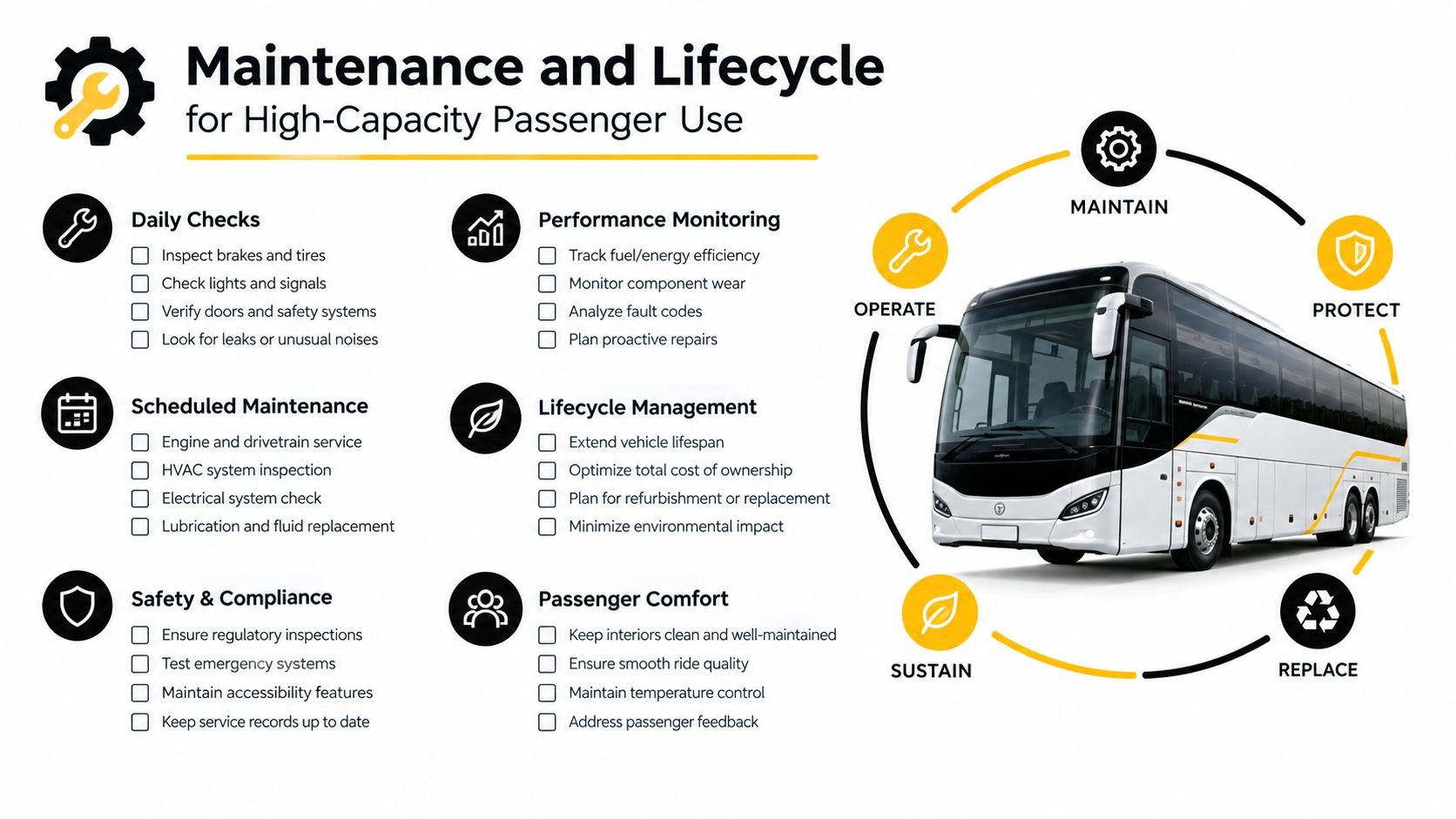
The cadence that works
A disciplined program usually includes:
- Weekly brake and tire checks: Loaded passenger service exposes weak braking feel and uneven tire wear early.
- Monthly steering and suspension review: Bushings, springs, and mounting points take a beating under repeated full-load use.
- Quarterly battery health review: Use the battery system's own health indicators or service diagnostics to catch decline before route reliability drops.
- Annual cable and electrical inspection: Passenger units don't get a pass on wiring just because they're low speed.
What wears faster
The wear items are predictable. Brake components, rear suspension hardware, seat mounts, step-area trim, and anything tied to boarding will age faster than on a lightly used personal cart.
Battery and chassis life depend heavily on use, storage, charging discipline, and whether the property fixes small issues before they become expensive ones. The smart budgeting move is to track maintenance by passenger-duty exposure, not just by calendar date. A vehicle running steady shuttle work ages differently from one that spends most days parked.
Buying, Dealer Support, and Financing the Right Way
Sticker price is the easiest number to compare and the least useful one.
For a 12 seater golf cart, dealer support is often the difference between a productive asset and a parked problem. If the dealer doesn't stock core parts, can't support commercial service, or disappears after delivery, your downtime cost will dwarf any savings from the initial purchase.
What to evaluate before you buy
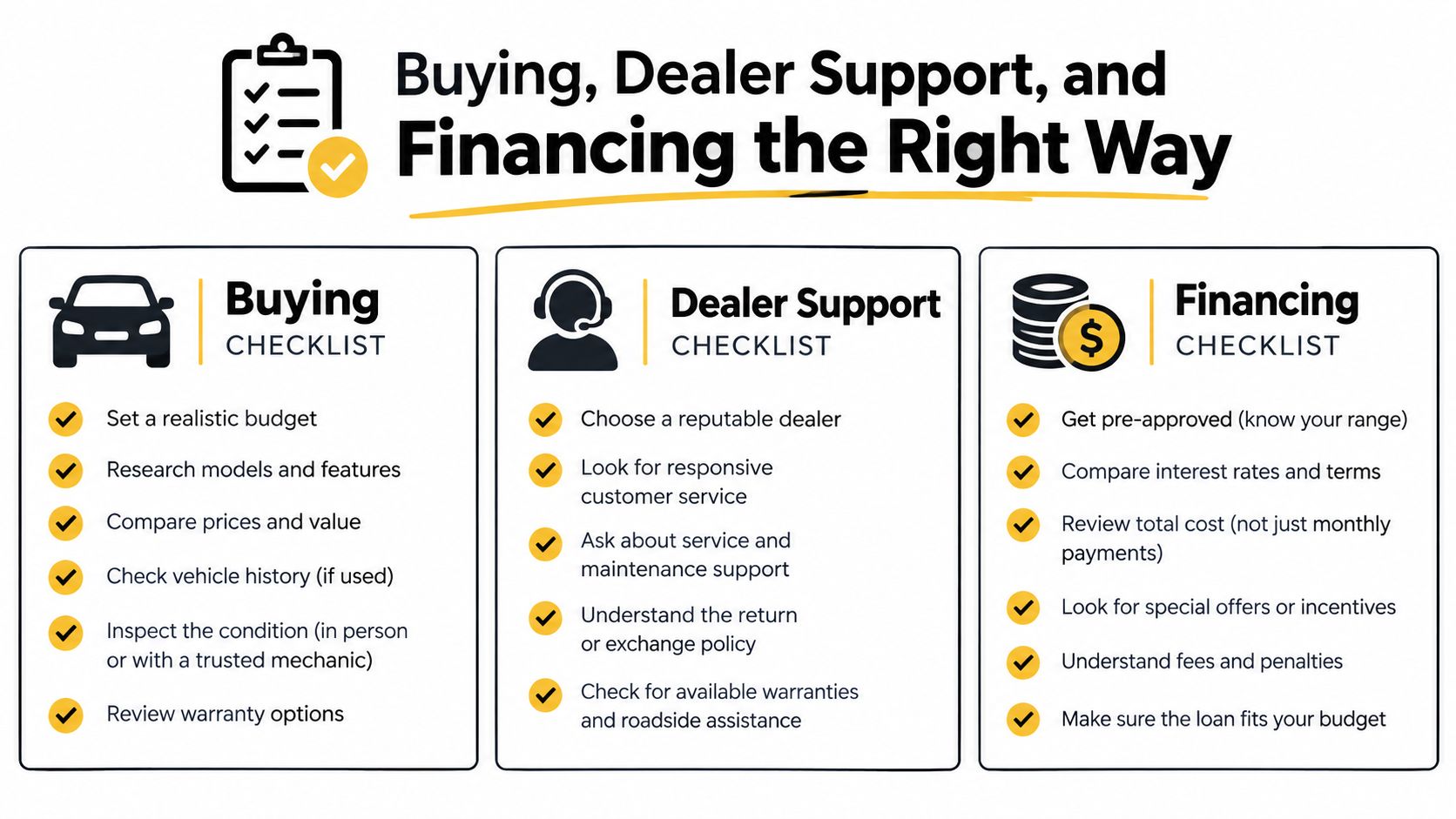
Use this checklist when comparing sellers:
- Parts depth: Ask what they keep in inventory for brakes, suspension, steering, seating, and charging components.
- Service capability: Confirm they can support commercial-duty vehicles, not just neighborhood carts.
- Warranty responsiveness: Ask who approves claims and how service gets scheduled.
- Training support: Drivers and supervisors need handoff training, not just keys.
- Documentation quality: You want clear spec sheets, compliance paperwork, and delivery records.
Here's a simple buyer-side visual to keep the process tight.
My buying advice
Test the vehicle under realistic conditions. Load it with adults. Drive the actual route type you expect. Check boarding ease, turning behavior, loaded braking feel, and charger fit with your site power setup.
Then review the business side. Seasonal resorts often prefer flexible payment structures, while year-round campuses may lean toward ownership models that match long-term use. Either way, insist on service records, battery documentation when applicable, and a real onboarding plan. Fancy trim doesn't save a weak support network.
If you need a premium electric platform for resort, campus, neighborhood, or off-road transport, Solana EV offers street-legal golf carts and utility-focused models built around modern design, durable construction, and dealer-backed support. If your goal is moving people reliably instead of just adding seats, it's worth reviewing their lineup and talking through the right configuration before you buy.